Share This Page
Drug Sales Trends for spironolactone
✉ Email this page to a colleague
Payment Methods and Pharmacy Types for spironolactone (2022)
Revenues by Pharmacy Type
Units Sold by Pharmacy Type
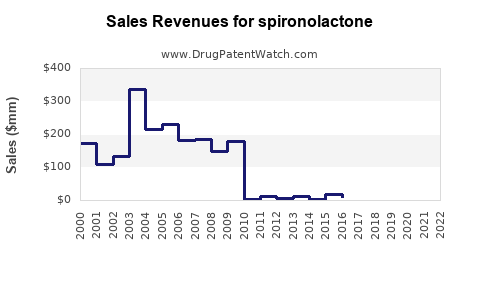
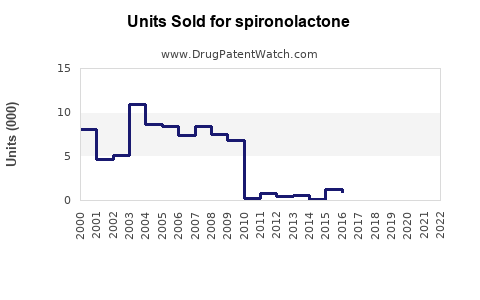
Annual Sales Revenues and Units Sold for spironolactone
| Drug Name | Revenues (USD) | Units | Year |
|---|---|---|---|
| SPIRONOLACTONE | ⤷ Start Trial | ⤷ Start Trial | 2022 |
| SPIRONOLACTONE | ⤷ Start Trial | ⤷ Start Trial | 2021 |
| SPIRONOLACTONE | ⤷ Start Trial | ⤷ Start Trial | 2020 |
| SPIRONOLACTONE | ⤷ Start Trial | ⤷ Start Trial | 2019 |
| SPIRONOLACTONE | ⤷ Start Trial | ⤷ Start Trial | 2018 |
| SPIRONOLACTONE | ⤷ Start Trial | ⤷ Start Trial | 2017 |
| SPIRONOLACTONE | ⤷ Start Trial | ⤷ Start Trial | 2016 |
| >Drug Name | >Revenues (USD) | >Units | >Year |
Spironolactone Market Analysis, Sales Projections, Patent Status, and Competitive Outlook
Spironolactone is a mature, low-cost generic drug with broad use in heart failure, hypertension, edema, primary hyperaldosteronism, acne, hirsutism, polycystic ovary syndrome, and gender-affirming care. The product has no meaningful compound-patent protection, no active U.S. market exclusivity, and substantial generic competition. Market growth is driven by prescription volume, expanded use in heart failure and dermatology, and broader access to gender-affirming treatment rather than by pricing power.
A reasonable global market estimate for spironolactone products is approximately $1.0 billion to $1.4 billion in 2024, depending on whether estimates include hospital purchases, compounded products, branded oral suspension, and international sales. A base-case model indicates global sales of $1.2 billion to $1.5 billion by 2029, representing annual growth of approximately 3% to 5%. These figures are market estimates for the active ingredient and finished products, not audited revenue for a single manufacturer.
What is the current market position of spironolactone?
Spironolactone is a high-volume generic diuretic and aldosterone antagonist. Its commercial position is based on low manufacturing cost, multiple indications, and persistent use in chronic disease.
| Market characteristic | Assessment |
|---|---|
| Active ingredient | Spironolactone |
| Drug class | Potassium-sparing diuretic; mineralocorticoid receptor antagonist |
| Principal U.S. brand | Aldactone |
| Branded oral suspension | CaroSpir |
| U.S. generic status | Broadly available |
| Primary dosage forms | 25 mg, 50 mg, and 100 mg tablets; oral suspension |
| Major clinical areas | Heart failure, hypertension, edema, hyperaldosteronism, acne, hirsutism, PCOS |
| Patent position | Core patents expired |
| U.S. regulatory status | FDA-approved prescription drug |
| Biosimilar exposure | None; spironolactone is a small molecule |
| Pricing power | Low for standard tablets; higher for branded suspension and specialty channels |
Aldactone established the original branded market, but generic substitution has reduced the branded share of tablet prescriptions. The commercial market is now fragmented among generic manufacturers, wholesalers, retail pharmacies, institutional purchasers, and specialty formulation providers.
How large is the global spironolactone market?
Public market reports produce inconsistent estimates because they use different definitions of the market. Some count only branded and generic finished products. Others include active pharmaceutical ingredient sales, hospital procurement, compounded formulations, or all formulations containing spironolactone.
A practical 2024 estimate is:
| Scenario | 2024 market estimate | 2029 estimate | Implied CAGR |
|---|---|---|---|
| Low | $0.8 billion | $0.95 billion | 3.5% |
| Base | $1.2 billion | $1.5 billion | 4.6% |
| High | $1.5 billion | $1.9 billion | 4.8% |
The base case assumes stable generic tablet pricing, modest prescription growth, increasing use in dermatology and gender-affirming care, and continued adoption in heart failure. It does not assume a major new indication or a material increase in U.S. reimbursement.
The U.S. is likely the largest single national market because of high prescription volume and extensive off-label dermatology use. Europe, China, Japan, India, and Latin America contribute substantial volume, but price levels vary sharply by country and reimbursement system.
Which factors determine market size?
The most important market variables are:
- Prescription volume in heart failure and hypertension.
- Dermatology use among women with acne, hirsutism, and androgen-related conditions.
- Gender-affirming use, where permitted and reimbursed.
- Generic tablet pricing and supply continuity.
- Demand for liquid formulations in pediatrics, geriatrics, and patients with swallowing difficulties.
- Hospital and specialty-pharmacy procurement.
- Regulatory restrictions affecting off-label prescribing.
What are the spironolactone sales projections through 2029?
The following forecast is a market model rather than a reported manufacturer forecast.
| Year | Low case | Base case | High case |
|---|---|---|---|
| 2024 | $0.8B | $1.2B | $1.5B |
| 2025 | $0.83B | $1.25B | $1.56B |
| 2026 | $0.86B | $1.31B | $1.62B |
| 2027 | $0.89B | $1.37B | $1.70B |
| 2028 | $0.92B | $1.43B | $1.79B |
| 2029 | $0.95B | $1.50B | $1.88B |
The base case reflects approximately 2% to 3% annual volume growth and limited net price growth. Standard tablets are unlikely to generate substantial price expansion because multiple suppliers can manufacture them and pharmacy substitution is extensive.
Revenue growth should be concentrated in:
- Oral suspensions and other differentiated formulations.
- Specialty distribution.
- Pediatric and geriatric dosing.
- Chronic heart-failure management.
- Dermatology and endocrine use.
- Markets with lower generic penetration.
Which therapeutic indications will drive spironolactone demand?
Heart failure and cardiovascular disease
Spironolactone is used in heart failure with reduced ejection fraction and in selected patients with preserved or mildly reduced ejection fraction. Guideline-directed use supports stable demand, but hyperkalemia, renal impairment, and monitoring requirements limit adoption in some patients. The 2022 AHA/ACC/HFSA guideline recommends mineralocorticoid receptor antagonist therapy for eligible patients with heart failure and reduced ejection fraction, subject to renal-function and potassium criteria (Heidenreich et al., 2022).
Cardiovascular use is the largest durable demand base because patients often remain on therapy for years. Growth will be volume-driven rather than price-driven.
Hypertension and resistant hypertension
Spironolactone is commonly used as an add-on therapy for resistant hypertension. This indication supports broad primary-care and cardiology demand. The drug is inexpensive and generally familiar to prescribers, which limits substitution by newer, more expensive mineralocorticoid receptor antagonists.
Dermatology
Dermatology is an important source of prescription volume, particularly for female-pattern acne, hirsutism, and androgen-related conditions. Much of this use is off-label. Dermatology demand is sensitive to clinical practice patterns, telehealth access, and insurance coverage.
Polycystic ovary syndrome and hirsutism
Spironolactone is frequently used to reduce androgen-mediated symptoms. This segment supports long-term prescriptions but may involve lower doses and intermittent treatment.
Gender-affirming care
Spironolactone is used as an antiandrogen in transfeminine hormone therapy in the United States and some other markets. The volume contribution is smaller than cardiovascular use, but the segment has expanded access through telemedicine and specialized clinics. Regulatory changes and state-level restrictions create geographic variability.
What is the competitive landscape for spironolactone?
The competitive landscape has two tiers.
Generic tablet manufacturers
Standard spironolactone tablets are supplied by multiple generic companies. U.S. manufacturers and label holders have included firms such as Amneal Pharmaceuticals, Dr. Reddy's Laboratories, Hikma Pharmaceuticals, Rising Pharmaceuticals, Taro Pharmaceutical Industries, and other FDA-approved suppliers, subject to changes in approved applications and commercial status.
The market is generally characterized by:
- Several approved abbreviated new drug applications.
- Low barriers to tablet production for qualified manufacturers.
- Wholesale price pressure.
- Periodic supply disruptions caused by manufacturing concentration or raw-material constraints.
- Limited differentiation among 25 mg, 50 mg, and 100 mg tablets.
Differentiated and branded products
CaroSpir is an FDA-approved oral suspension designed for patients who cannot use conventional tablets. Its formulation and delivery characteristics provide greater commercial differentiation than standard tablets. The product was approved under an NDA rather than as a conventional generic tablet application (U.S. Food and Drug Administration, 2017).
The branded tablet market is commercially weaker than the differentiated-liquid segment because generic substitution is widespread.
What patents protect spironolactone products?
The original spironolactone compound patents are long expired. No active U.S. patent is expected to block generic tablet entry.
| Patent category | Commercial status |
|---|---|
| Original compound patent | Expired |
| Original composition patents | Expired |
| Standard tablet patents | Expired or commercially irrelevant |
| Method-of-use patents for established indications | Expired or difficult to enforce against generic substitution |
| Oral-suspension formulation patents | Potentially relevant depending on product and jurisdiction |
| Manufacturing-process patents | May exist but usually do not block tablet competition |
| Regulatory exclusivity | None for the mature active ingredient |
Are there formulation patents for spironolactone?
Formulation protection is more relevant than compound protection. An oral suspension may rely on formulation patents, proprietary excipients, manufacturing know-how, trademarks, and regulatory exclusivity associated with the NDA. These rights can protect a particular product configuration without preventing competitors from selling conventional tablets.
Formulation patents typically have narrower commercial value because a competitor may design a different suspension, tablet, capsule, or extemporaneous preparation. The strength of a formulation estate depends on claim breadth, validity, infringement evidence, design-around options, and the remaining patent term.
Are there method-of-use patents for spironolactone?
Most high-value indications are old and widely known. Method-of-use patents covering hypertension, edema, heart failure, or hyperaldosteronism are unlikely to create meaningful exclusivity for standard spironolactone tablets. Off-label dermatology and gender-affirming uses generally do not create enforceable commercial exclusivity for the active ingredient.
What is the FDA and Orange Book status of spironolactone?
Spironolactone is an FDA-approved small-molecule drug. Aldactone was approved decades ago, and multiple generic tablet products have received FDA approval through the abbreviated new drug application pathway.
The Orange Book is relevant to approved NDA products and listed patents, but spironolactone's core generic market is not protected by an unexpired compound patent. The most commercially relevant listed-product issue is the status of patents associated with differentiated formulations such as oral suspension products.
The FDA label identifies important safety restrictions, including hyperkalemia risk, renal impairment concerns, drug interactions, and endocrine adverse effects. These risks create monitoring requirements but do not materially limit the size of the established market (U.S. Food and Drug Administration, n.d.-a).
Are there Paragraph IV challenges to spironolactone?
Paragraph IV litigation risk is low for standard spironolactone tablets because the relevant compound and basic product protections expired long ago. Generic applicants generally do not face the same patent barriers associated with recently approved drugs.
Risk is higher for a differentiated oral suspension or a newly patented delivery system. A generic applicant could challenge listed formulation patents through a Paragraph IV certification, but the commercial incentive depends on:
- The size of the branded formulation market.
- The remaining patent term.
- The cost of developing a bioequivalent suspension.
- The availability of alternative formulations.
- The likelihood of a 30-month stay or settlement.
- The level of generic substitution expected after launch.
No biosimilar pathway applies because spironolactone is a synthetic small molecule, not a biologic.
What patent litigation and settlement risks affect spironolactone?
Patent litigation is unlikely to affect the standard tablet market. The principal legal risks concern:
- Formulation patents for oral suspensions.
- Trade secrets involving manufacturing or taste masking.
- Trademark disputes involving branded formulations.
- Contract disputes with manufacturers and distributors.
- Product-liability claims involving hyperkalemia, renal injury, or drug interactions.
- State substitution and reimbursement disputes.
A settlement involving a differentiated formulation could delay generic entry, but the effect would likely be limited to that formulation. It would not restore exclusivity to the broader spironolactone tablet market.
Which companies are challenging or competing with spironolactone?
The main competitive threat is not a single challenger but a group of therapeutic alternatives.
| Competitor | Clinical role | Commercial impact |
|---|---|---|
| Eplerenone | Selective mineralocorticoid receptor antagonist | Can replace spironolactone when endocrine adverse effects are problematic |
| Finerenone | Nonsteroidal mineralocorticoid receptor antagonist | Higher-priced alternative in diabetic kidney disease and selected cardiovascular settings |
| Amiloride | Potassium-sparing diuretic | Alternative in selected hypertension and electrolyte-management uses |
| Loop diuretics | Volume control in heart failure and edema | Complementary rather than direct replacement |
| Thiazide-type diuretics | Hypertension and edema | Compete in some treatment lines |
| Combined oral contraceptives | Acne, hirsutism, and PCOS | Can reduce dermatology demand in selected patients |
| Isotretinoin and antibiotics | Acne | Compete in treatment escalation |
| Other antiandrogens | Gender-affirming and endocrine use | Vary by country and clinical practice |
Eplerenone is the closest established pharmacologic substitute. Its higher cost and more selective receptor profile can support use in patients who cannot tolerate spironolactone, but it does not generally displace spironolactone in cost-sensitive prescribing.
How strong is the spironolactone patent estate?
The patent estate is weak for the active ingredient and standard tablets, but stronger for selected delivery systems.
| Estate component | Strength | Commercial implication |
|---|---|---|
| Compound protection | None | Generic entry unrestricted |
| Tablet composition | Low | Limited ability to block competitors |
| Core indications | Low | Established uses are largely unprotectable |
| Oral suspension | Moderate, product-specific | Can support premium pricing and targeted litigation |
| Manufacturing process | Low to moderate | Usually does not block alternative suppliers |
| Brand and trade dress | Moderate | Protects identity, not active-ingredient exclusivity |
| Regulatory know-how | Moderate | Can slow competition in specialized formulations |
The estate should therefore be viewed as a generic-volume opportunity with formulation niches, not as an exclusivity-driven specialty pharmaceutical asset.
What manufacturing and intellectual-property barriers exist?
Manufacturing spironolactone tablets is technically established, but commercial supply still depends on validated processes, regulatory compliance, impurity control, and reliable active pharmaceutical ingredient sourcing. Key risks include:
- API supplier concentration.
- Content-uniformity requirements at low tablet strengths.
- Stability and dissolution performance.
- Cross-contamination controls for potent steroidal compounds.
- Suspension particle-size control.
- Taste masking and sedimentation control for liquid products.
- FDA inspection findings.
- Supply-chain interruptions affecting low-margin generic products.
These barriers can cause temporary shortages without creating durable market exclusivity.
How does spironolactone compare with eplerenone and finerenone?
| Attribute | Spironolactone | Eplerenone | Finerenone |
|---|---|---|---|
| Receptor profile | Less selective | More selective | Nonsteroidal, selective |
| Generic availability | Extensive | Generic availability in many markets | Primarily branded |
| Cost | Very low | Low to moderate | High |
| Heart-failure role | Established | Established | More limited or indication-specific |
| Diabetic kidney disease | Not the primary labeled role | Not the primary labeled role | Important commercial indication |
| Endocrine adverse effects | More frequent | Less frequent | Different safety profile |
| Market growth potential | Volume-driven | Stable, lower base | Higher value per prescription |
| Patent leverage | Minimal | Mostly expired or weakening | Material branded exclusivity |
Finerenone has the greatest potential to capture value in chronic kidney disease and diabetic cardiovascular care, but it is not a direct replacement for all spironolactone uses. Spironolactone remains advantaged where price, familiarity, and broad clinical experience dominate.
What generic launch scenarios exist?
Standard tablet launch
A new manufacturer entering the 25 mg, 50 mg, or 100 mg tablet market would face low technical barriers but intense price competition. A successful launch would require reliable supply, efficient API procurement, FDA compliance, and access to wholesalers or large pharmacy buyers.
Expected commercial profile:
- Low launch price.
- Rapid substitution if supply is reliable.
- Low gross margin per unit.
- Limited ability to differentiate.
- Meaningful exposure to purchasing-contract losses.
Oral suspension launch
A suspension launch offers higher unit revenue and less direct competition. The principal risks are formulation development, bioequivalence, taste, stability, reimbursement, and patent challenges.
Expected commercial profile:
- Higher price per prescription.
- Smaller patient population.
- Greater specialty-pharmacy relevance.
- More meaningful formulation IP.
- Greater exposure to payer restrictions.
International launch
International expansion can produce volume, but reimbursement and regulatory requirements vary. Europe and Japan have mature generic markets. India and China offer manufacturing and volume opportunities but tend to exert greater pricing pressure. Latin American markets vary widely by private versus public procurement.
What is the revenue exposure for manufacturers and investors?
Spironolactone is unlikely to be a major growth asset for a diversified pharmaceutical company unless the company owns a differentiated formulation or controls a large generic distribution channel.
Revenue exposure can be assessed as follows:
| Business model | Revenue outlook |
|---|---|
| Commodity tablet manufacturer | Stable volume, low margin |
| Branded tablet holder | Limited share because of generic substitution |
| Oral-suspension owner | Higher revenue per prescription, narrower market |
| API manufacturer | Volume opportunity, pricing pressure |
| Specialty pharmacy distributor | Moderate opportunity tied to formulation mix |
| Contract manufacturer | Stable but margin-sensitive |
| Large generic portfolio company | Useful as a portfolio volume product |
| Innovator with new indication | Potentially higher value, but clinical and regulatory risk is substantial |
For investors, spironolactone is primarily a defensive generic-volume product. It is not a strong standalone growth story unless linked to a proprietary delivery system, a new indication, or a distribution advantage.
What is the regulatory outlook for spironolactone?
The FDA regulatory outlook is stable. The active ingredient has a long-established safety and efficacy record, and the principal regulatory issues concern manufacturing quality, labeling, bioequivalence, and postmarket safety.
The main regulatory constraints are clinical:
- Hyperkalemia monitoring.
- Renal-function assessment.
- Interaction risk with potassium supplements and renin-angiotensin system drugs.
- Contraindications or restrictions in significant renal impairment.
- Patient counseling regarding potassium-containing products.
- Pregnancy and endocrine-related labeling considerations.
Regulatory expansion into new indications would require clinical evidence and would be difficult to monetize through the existing tablet market because generic substitution would begin quickly unless a new product had separate protection.
Key Takeaways
- Spironolactone is a mature generic drug with broad cardiovascular, dermatology, endocrine, and gender-affirming use.
- Estimated global market value is approximately $1.0 billion to $1.4 billion in 2024.
- Base-case global sales could reach approximately $1.5 billion by 2029, with annual growth near 4% to 5%.
- Standard tablets have minimal patent protection and low pricing power.
- Oral suspensions and other differentiated formulations offer the strongest commercial and IP opportunities.
- Paragraph IV and patent-litigation risk is low for standard tablets but can be material for branded suspension products.
- Eplerenone and finerenone are the main pharmacologic competitors, although neither fully replaces spironolactone.
- No biosimilar risk applies because spironolactone is a small molecule.
- The market is volume-driven, with revenue concentrated in generic supply, specialty formulations, and distribution efficiency.
- A new tablet entrant would face low technical barriers but severe price competition.
FAQs About Spironolactone Market Size and Sales
Is spironolactone still commercially attractive despite being generic?
Yes, but mainly as a high-volume portfolio product. Commercial attractiveness depends on manufacturing efficiency, supply reliability, and distribution scale rather than patent exclusivity.
What is the most valuable spironolactone formulation?
A proprietary oral suspension or another patient-specific delivery system has greater value than standard tablets because it can command higher pricing and face less direct generic competition.
Can a company obtain new patents on spironolactone?
A company may obtain patents on a novel formulation, delivery system, manufacturing process, combination, or specific use if statutory patentability requirements are met. Such patents would not restore protection to the old compound.
Will finerenone replace spironolactone?
Finerenone may capture selected use in diabetic kidney disease and cardiovascular-risk management, but spironolactone will remain important in heart failure, resistant hypertension, edema, acne, and antiandrogen therapy.
What is the principal downside risk to the spironolactone forecast?
The principal downside risks are generic price erosion, supply interruptions, reduced use in patients at risk of hyperkalemia, restrictions on off-label prescribing, and substitution by eplerenone or finerenone in selected clinical settings.
References
Heidenreich, P. A., Bozkurt, B., Aguilar, D., Allen, L. A., Byun, J. J., Colvin, M. M., Deswal, A., Drazner, M. H., Dunlay, S. M., Evers, L. R., Fang, J. C., Federson-Hnang, L., Fonarow, G. C., Hayek, S. S., Hernandez, A. F., Khazanie, P., Kittleson, M. M., Lee, C. S., Link, M. S., ... Yancy, C. W. (2022). 2022 AHA/ACC/HFSA guideline for the management of heart failure. Circulation, 145(18), e895-e1032. https://doi.org/10.1161/CIR.0000000000001063
U.S. Food and Drug Administration. (2017). CaroSpir: Prescribing information. FDA.
U.S. Food and Drug Administration. (n.d.-a). Spironolactone: Prescribing information. FDA.
U.S. Food and Drug Administration. (n.d.-b). Approved drug products with therapeutic equivalence evaluations: Orange Book. FDA.
U.S. National Library of Medicine. (n.d.). DailyMed: Spironolactone and spironolactone oral suspension labeling. National Library of Medicine.
More… ↓
