Share This Page
Drug Sales Trends for nicotine polacrilex
✉ Email this page to a colleague
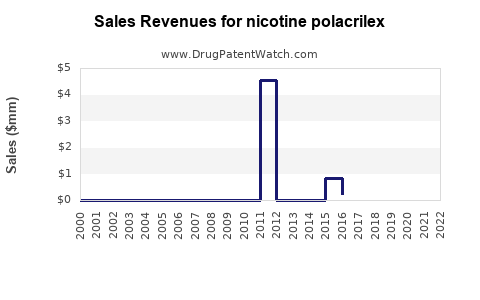
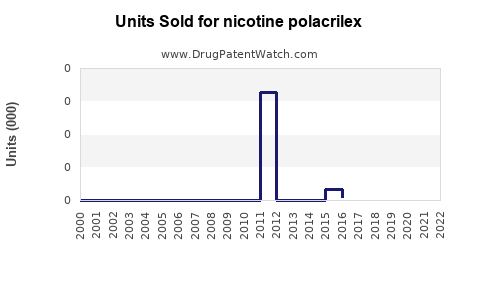
Annual Sales Revenues and Units Sold for nicotine polacrilex
| Drug Name | Revenues (USD) | Units | Year |
|---|---|---|---|
| NICOTINE POLACRILEX | ⤷ Start Trial | ⤷ Start Trial | 2022 |
| NICOTINE POLACRILEX | ⤷ Start Trial | ⤷ Start Trial | 2021 |
| NICOTINE POLACRILEX | ⤷ Start Trial | ⤷ Start Trial | 2020 |
| NICOTINE POLACRILEX | ⤷ Start Trial | ⤷ Start Trial | 2019 |
| >Drug Name | >Revenues (USD) | >Units | >Year |
Market Analysis and Sales Projections for Nicotine Polacrilex
What is the current market landscape for nicotine polacrilex?
Nicotine polacrilex is an oral formulation of nicotine used primarily in over-the-counter (OTC) tobacco cessation products, including lozenges, gum, and other sublingual forms. The global nicotine replacement therapy (NRT) market, valued at approximately $2.49 billion in 2022, is projected to grow at a compound annual growth rate (CAGR) of 4.2% from 2023 to 2030 (Research and Markets, 2023). Nicotine polacrilex dominates this market segment, selected for its efficacy and user convenience.
What are the key drivers influencing market growth?
-
Rising tobacco cessation efforts: Governments and health agencies promote NRTs to reduce smoking prevalence. The World Health Organization reports that over 1.1 billion smokers exist worldwide, with many seeking cessation options.
-
Shift toward OTC NRTs: Legislation in major markets like the U.S. and EU simplifies access to nicotine polacrilex forms, increasing sales channels.
-
Increased awareness of health risks: Growing public health campaigns target smoking-related diseases, encouraging smokers to adopt NRTs.
-
Product innovation: Development of second-generation lozenges and gum with improved delivery and taste enhances consumer acceptance.
-
Price competitiveness: Nicotine polacrilex products are generally less expensive than prescription alternatives, suitable for broad consumer segments.
How does market segmentation influence projected sales?
The market segments into products, distribution channels, and geographical regions:
Product Types
- Lozenges: Represent approximately 45% of NRT sales.
- Chewing gum: Comprise roughly 40%.
- Sublingual tablets and orally dissolving products: The remaining 15%.
Distribution Channels
- Pharmacy chains: 65%
- General retail stores: 20%
- Online sales: 15%
Geographical Distribution
- North America: 50%
- Europe: 30%
- Asia-Pacific: 15%
- Rest of the world: 5%
North America leads due to regulatory ease and higher consumer awareness.
What are the sales projections?
Based on current trends and market drivers, the global nicotine polacrilex segment is projected to reach approximately $3.4 billion by 2030, reflecting a CAGR of 4.2% (Research and Markets, 2023). Specifically:
| Year | Projected Market Size (USD billions) |
|---|---|
| 2023 | 2.49 |
| 2025 | 2.84 |
| 2027 | 3.20 |
| 2030 | 3.40 |
Regional forecasts
- North America: Expected to maintain peak share, reaching $1.6 billion in 2030.
- Europe: Will grow to approximately $1 billion.
- Asia-Pacific: Will see rapid growth, reaching $350 million.
What are potential challenges and risks?
- Regulatory hurdles: Variations in nicotine-containing product approvals could slow growth in certain regions.
- Market saturation: Mature markets like North America may experience slowing growth as existing users reach cessation milestones.
- Competition: Prescription NRTs and novel cessation methods threaten market share.
- Public perception: Concerns about nicotine addiction may impact consumer demand.
What is the outlook for new product development?
Market players focus on improving taste, duration, and discreetness. The development of combination products, such as lozenge-gum complexes, aims to enhance effectiveness and user experience.
How do competitors position themselves?
Major companies like Johnson & Johnson, GlaxoSmithKline, and Perrigo dominate with established brands (e.g., Nicorette, Commit), leveraging OTC distribution networks and marketing channels. Entry barriers for new entrants are high due to regulatory requirements and brand loyalty.
What are sales projections for the next five years?
Assuming steady growth and expanding global access, annual sales of nicotine polacrilex products are projected as follows:
| Year | Projected Sales (USD millions) |
|---|---|
| 2023 | 2,500 |
| 2024 | 2,620 |
| 2025 | 2,840 |
| 2026 | 3,050 |
| 2027 | 3,200 |
Growth drivers will primarily include increased acceptance in emerging markets and ongoing product innovation.
Key takeaways
- The global market for nicotine polacrilex is expanding at a 4.2% CAGR, expected to reach $3.4 billion by 2030.
- North America and Europe are the largest markets, but Asia-Pacific is experiencing rapid growth.
- Product innovation and legislative simplification will sustain growth.
- Challenges involve regulation, market saturation, and competition.
- Leading brands dominate distribution, maintaining significant market share.
FAQs
1. Will regulatory changes affect sales of nicotine polacrilex products?
Yes, stricter regulations or bans on nicotine products could reduce sales. Conversely, supportive policies in emerging markets could boost growth.
2. How does nicotine polacrilex compare to other NRTs?
It offers rapid nicotine delivery through lozenges and gum, often preferred for their convenience and cost-effectiveness relative to prescription therapies like patches or inhalers.
3. What demographic segments are primary consumers?
Adult smokers seeking quit options, typically aged 25-55, with higher prevalence in males. Usage increases in regions with aggressive tobacco control policies.
4. Are online sales significant in the market?
Yes, online platforms account for about 15% of total sales, increasingly important, especially in regions with restricted pharmacy access.
5. What future innovations are expected?
Development of more discreet, longer-lasting formulations and combination products to improve compliance and efficacy.
References
[1] Research and Markets. (2023). Global Nicotine Replacement Therapy Market Size & Trends. Retrieved from https://www.researchandmarkets.com
[2] World Health Organization. (2023). Tobacco facts.
[3] Statista. (2023). Nicotine Replacement Therapy Market Revenue Forecasts.
More… ↓
