You're using a free limited version of DrugPatentWatch: Upgrade for Complete Access

Last Updated: April 2, 2026

Drug Sales Trends for nicotine


✉ Email this page to a colleague
« Back to Dashboard


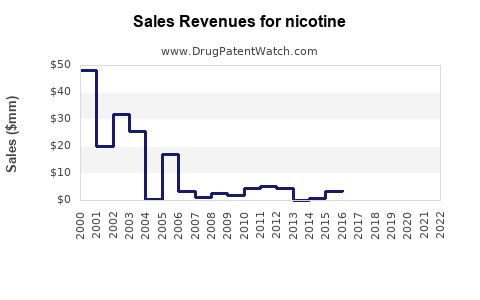
Drug Sales Revenue Trends for nicotine
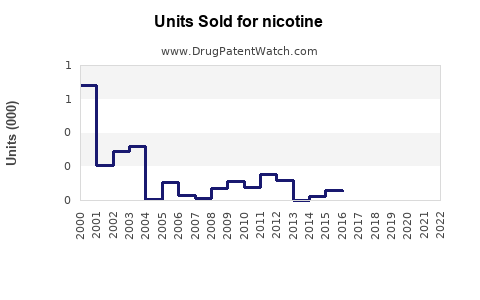
Drug Units Sold Trends for nicotine

Annual Sales Revenues and Units Sold for nicotine

These sales figures are drawn from a US national survey of drug expenditures
Drug Name Revenues (USD) Units Year
NICOTINE ⤷  Start Trial ⤷  Start Trial 2022
NICOTINE ⤷  Start Trial ⤷  Start Trial 2021
NICOTINE ⤷  Start Trial ⤷  Start Trial 2020
NICOTINE ⤷  Start Trial ⤷  Start Trial 2019
NICOTINE ⤷  Start Trial ⤷  Start Trial 2018
NICOTINE ⤷  Start Trial ⤷  Start Trial 2017
>Drug Name >Revenues (USD) >Units >Year

Nicotine Market Analysis and Sales Projections

Last updated: February 19, 2026

This report analyzes the global market for nicotine, encompassing its pharmaceutical applications, consumer product evolution, and projected sales trajectories. The market is segmented by application and region, with a focus on key drivers, regulatory landscapes, and competitive dynamics.

What is the Current Global Market Size for Nicotine?

The global nicotine market is substantial, driven by pharmaceutical nicotine replacement therapies (NRTs) and the expanding market for novel nicotine delivery systems, including e-cigarettes and heated tobacco products. While precise figures vary across market research reports, estimates for the total nicotine market, including all product types, generally range from \$50 billion to \$70 billion annually as of 2023. This figure encompasses both regulated pharmaceutical products and the rapidly growing, though often less precisely tracked, consumer nicotine product segments.

Breakdown of Market Segments

The nicotine market can be broadly categorized into two primary segments:

  • Pharmaceutical Nicotine: This segment primarily comprises Nicotine Replacement Therapies (NRTs) such as nicotine patches, gums, lozenges, and inhalers. These products are regulated as pharmaceuticals and are used to aid smoking cessation.
  • Consumer Nicotine Products: This segment includes a diverse range of products, notably:
    • Traditional Tobacco Products: Cigarettes, cigars, smokeless tobacco.
    • E-cigarettes (Vapes): Devices that heat a liquid containing nicotine, flavorings, and other chemicals to create an aerosol.
    • Heated Tobacco Products (HTPs): Devices that heat real tobacco without burning it, producing an aerosol.
    • Nicotine Pouches: Tobacco-free pouches containing nicotine, flavorings, and fillers.

The consumer nicotine product segment, particularly e-cigarettes and HTPs, has experienced significant growth, altering the overall market dynamics and revenue streams within the broader nicotine landscape.

What are the Key Drivers of Nicotine Market Growth?

Several factors are driving the growth and evolution of the nicotine market:

  • Demand for Smoking Cessation Aids: Increasing public health awareness and government initiatives promoting smoking cessation continue to fuel demand for NRTs. The World Health Organization (WHO) estimates that tobacco kills more than 8 million people each year, prompting governments and healthcare providers to encourage cessation [1].
  • Rise of Reduced-Risk Nicotine Products: The emergence and widespread adoption of e-cigarettes and HTPs represent a major growth driver. These products are often marketed as potentially less harmful alternatives to traditional cigarettes, appealing to smokers seeking to reduce their exposure to combustion byproducts.
  • Technological Innovation in Delivery Systems: Continuous innovation in device technology, battery life, flavor profiles, and nicotine salt formulations in e-cigarettes and other novel products is attracting new users and retaining existing ones.
  • Shifting Consumer Preferences: A demographic shift towards less harmful alternatives and a growing acceptance of vaping culture contribute to market expansion.
  • Emerging Markets: Growing disposable incomes and increasing urbanization in developing economies are leading to higher adoption rates of both traditional and novel nicotine products.

What is the Regulatory Landscape for Nicotine Products?

The regulatory environment for nicotine products is highly fragmented and continuously evolving. Regulations differ significantly by country and product type.

Pharmaceutical Nicotine Regulations

  • Approval Pathways: NRTs are typically regulated as prescription or over-the-counter drugs by national health authorities like the U.S. Food and Drug Administration (FDA) or the European Medicines Agency (EMA).
  • Marketing and Labeling: Strict guidelines govern marketing claims, packaging, and labeling to ensure product safety and efficacy for smoking cessation.

Consumer Nicotine Product Regulations

  • E-cigarettes and HTPs:
    • Age Restrictions: Most jurisdictions enforce minimum age requirements (typically 18 or 21) for purchasing these products.
    • Flavor Bans: Many regions have implemented or are considering flavor bans to reduce youth appeal. Examples include the U.S. federal ban on most flavored e-cigarette pods (excluding tobacco and menthol) and similar restrictions in the European Union.
    • Taxation: Governments are increasingly imposing excise taxes on e-liquids and HTP consumables to generate revenue and potentially discourage use.
    • Marketing and Advertising Restrictions: Limits on advertising channels and promotional activities are common.
    • Product Standards: Regulations are emerging regarding nicotine concentration limits, ingredient disclosure, and device safety. The EU's Tobacco Products Directive (TPD) sets maximum nicotine liquid bottle sizes (10ml) and tank capacities (2ml) for e-cigarettes [2].
    • Health Warnings: Mandated health warnings on packaging are standard.
  • Nicotine Pouches: Regulation for nicotine pouches is less uniform. Some countries categorize them similarly to smokeless tobacco, while others are developing specific regulatory frameworks.
  • Traditional Tobacco: Heavily regulated with comprehensive restrictions on marketing, sales, taxation, and public use.

The regulatory landscape is dynamic, with potential for stricter controls on nicotine content, flavorings, and marketing as governments grapple with public health implications, particularly youth uptake.

What are the Competitive Dynamics and Key Players?

The nicotine market features a mix of established pharmaceutical companies and large multinational tobacco corporations that have diversified into next-generation products.

Key Players by Segment

  • Pharmaceutical Nicotine (NRTs):
    • GSK Consumer Healthcare (now Haleon): Historically a major player with brands like Nicorette.
    • Johnson & Johnson: Offers NRT products under brands like Nicotrol.
    • Pfizer: Markets NRT products.
    • Other Generic Manufacturers: A significant number of smaller companies produce generic NRT formulations.
  • Consumer Nicotine Products:
    • Philip Morris International (PMI): Dominant in HTPs with its IQOS brand.
    • British American Tobacco (BAT): Active in both e-cigarettes (Vuse) and HTPs (glo).
    • Japan Tobacco International (JTI): Offers Ploom HTPs and various traditional tobacco products.
    • Altria Group: Significant presence in the U.S. market with Marlboro cigarettes and investments in e-vapor products.
    • Vaping Companies: Numerous independent and formerly independent companies operate in the e-cigarette space, including Juul Labs (though its market position has shifted due to regulatory challenges), Elf Bar, and many others.

Competitive Landscape Trends

  • Diversification: Traditional tobacco companies are heavily investing in and pivoting towards reduced-risk products to offset declining cigarette volumes.
  • Consolidation and Partnerships: Strategic acquisitions and partnerships are common as companies seek to gain market share or access new technologies.
  • Innovation Race: Intense competition drives continuous product development in terms of device efficiency, user experience, and novel nicotine formulations (e.g., nicotine salts for smoother inhalation).
  • Geographic Expansion: Companies focus on expanding their presence in both developed and emerging markets, navigating diverse regulatory environments.

What are the Sales Projections for Nicotine Products?

Sales projections for nicotine products vary significantly by segment and region, influenced by regulatory changes, consumer adoption rates, and the competitive landscape.

Pharmaceutical Nicotine (NRTs)

The NRT market is expected to experience steady, albeit moderate, growth.

  • Projected Growth Rate: Compound Annual Growth Rate (CAGR) of 3% to 5% through 2030.
  • Key Drivers: Continued emphasis on public health and smoking cessation programs, wider availability of NRTs, and increasing healthcare spending globally.
  • Challenges: Competition from novel nicotine products, potential for user fatigue with traditional NRT formats, and price sensitivity in some markets.

Consumer Nicotine Products

This segment is projected to see more dynamic growth, with significant shifts between product types.

  • E-cigarettes: Expected to continue as a dominant growth category, though the pace may moderate due to increased regulation and market saturation in some developed regions.
    • Projected Growth Rate: CAGR of 7% to 10% globally through 2030.
    • Regional Variations: Strong growth in Asia-Pacific and Latin America, while North America and Europe may see slower growth due to stricter regulations.
  • Heated Tobacco Products (HTPs): Expected to be a significant growth area, particularly in markets where e-cigarettes face stricter regulation or where consumers prefer a more tobacco-like experience.
    • Projected Growth Rate: CAGR of 15% to 20% globally through 2030, driven by PMI's IQOS and BAT's glo.
    • Market Concentration: Growth heavily concentrated in markets where these products have gained regulatory approval and significant consumer traction (e.g., Japan, South Korea, parts of Eastern Europe).
  • Nicotine Pouches: A rapidly emerging category with high growth potential, especially in markets where traditional smokeless tobacco is popular or where e-cigarette regulations are restrictive.
    • Projected Growth Rate: CAGR exceeding 20% through 2030.
    • Geographic Expansion: Significant adoption in North America and Europe, with expansion into other regions anticipated.
  • Traditional Tobacco Products: Projected to continue a secular decline in most developed markets, though it will remain a significant revenue source globally due to its large user base, particularly in developing economies.
    • Projected Decline Rate: CAGR of -2% to -4% in Western markets, with potential for low single-digit growth or stabilization in some emerging markets.

Global Nicotine Market Summary Projections (2023-2030)

Market Segment 2023 Estimated Market Size (USD Billion) Projected 2030 Market Size (USD Billion) Projected CAGR (2023-2030)
Pharmaceutical Nicotine 5 - 7 7 - 9 3% - 5%
E-cigarettes 20 - 30 40 - 55 7% - 10%
Heated Tobacco Products (HTPs) 15 - 20 35 - 50 15% - 20%
Nicotine Pouches 2 - 4 8 - 15 >20%
Traditional Tobacco 25 - 35 20 - 30 -2% to -4% (developed)
Total Nicotine Market 67 - 96 110 - 159 ~6% - 8%

Note: Market size estimates for consumer nicotine products are aggregated and can overlap with broader tobacco market data. Projections are based on current trends and subject to regulatory and technological changes.

What are the Potential Future Trends and Disruptions?

  • Further Regulatory Tightening: Expect increased scrutiny on nicotine content limits, flavor bans, and marketing, potentially impacting product innovation and market access.
  • Harm Reduction Debate: Ongoing scientific research and public health discourse on the relative risks of different nicotine delivery systems will continue to shape regulatory approaches and consumer perceptions.
  • Cannabis and Nicotine Convergence: Potential for hybrid products or co-location of markets as regulatory frameworks for both substances evolve.
  • Bio-engineered Nicotine: Research into more sustainable and potentially safer forms of nicotine production or delivery could emerge.
  • Personalized Nicotine Products: Future advancements may lead to personalized nicotine delivery based on individual user needs and preferences.

Key Takeaways

The global nicotine market is undergoing a significant transformation. While pharmaceutical nicotine for smoking cessation is expected to see steady growth, the consumer nicotine segment, particularly e-cigarettes and heated tobacco products, is the primary engine of expansion. Regulatory pressures, especially concerning youth uptake and public health, will continue to be a major factor shaping market dynamics. Companies that can successfully navigate complex regulatory environments, innovate in product development, and adapt to shifting consumer preferences are positioned for growth. The market is expected to reach over \$100 billion by 2030, driven by the ongoing shift from traditional combustible tobacco to novel nicotine delivery systems.

Frequently Asked Questions

  1. What is the estimated market share of e-cigarettes within the total nicotine market? E-cigarettes constitute a significant portion of the consumer nicotine market, estimated to be between 30% and 45% of the total nicotine market value in 2023. This share is projected to grow as adoption expands, though it faces increasing regulatory headwinds.

  2. How do nicotine pouches compare to traditional tobacco products in terms of market growth? Nicotine pouches are experiencing a much higher growth rate, projected to exceed 20% CAGR, whereas traditional tobacco products are in decline in developed markets at a rate of 2% to 4% CAGR. This indicates a significant consumer migration towards perceived less harmful or more convenient nicotine formats.

  3. What is the primary regulatory challenge for heated tobacco products? The primary regulatory challenge for heated tobacco products (HTPs) is their classification and the perception of their harm reduction potential. While often marketed as less harmful than cigarettes, their long-term health effects are still under scientific investigation, leading to varied regulatory responses regarding marketing, taxation, and product standards across different jurisdictions.

  4. What is the projected impact of flavor bans on the e-cigarette market? Flavor bans, particularly those targeting sweet and fruit-based e-liquids, are projected to slow the growth of the e-cigarette market in affected regions. While menthol and tobacco flavors often remain, the removal of a wide variety of flavors can reduce appeal to new users, potentially leading to market contraction or a shift towards the illicit market in some areas.

  5. Are nicotine replacement therapies (NRTs) expected to be significantly impacted by novel nicotine products? NRTs are expected to maintain a stable, albeit slower, growth trajectory. While novel nicotine products may attract some consumers who would otherwise use NRTs for cessation, NRTs benefit from established regulatory approval as medical devices for smoking cessation, a clear health messaging, and a different consumer demographic often driven by clinical advice rather than consumer trends.

Citations

[1] World Health Organization. (2023). Tobacco. Retrieved from https://www.who.int/news-room/fact-sheets/detail/tobacco

[2] European Parliament. (2014). Directive 2014/40/EU of the European Parliament and of the Council of 3 April 2014 on the approximation of the laws, regulations and administrative provisions of the Member States concerning the manufacture, presentation and sale of tobacco and related products. Official Journal of the European Union, L 127, 1-38.

More… ↓

⤷  Start Trial

Make Better Decisions: Try a trial or see plans & pricing

Drugs may be covered by multiple patents or regulatory protections. All trademarks and applicant names are the property of their respective owners or licensors. Although great care is taken in the proper and correct provision of this service, thinkBiotech LLC does not accept any responsibility for possible consequences of errors or omissions in the provided data. The data presented herein is for information purposes only. There is no warranty that the data contained herein is error free. We do not provide individual investment advice. This service is not registered with any financial regulatory agency. The information we publish is educational only and based on our opinions plus our models. By using DrugPatentWatch you acknowledge that we do not provide personalized recommendations or advice. thinkBiotech performs no independent verification of facts as provided by public sources nor are attempts made to provide legal or investing advice. Any reliance on data provided herein is done solely at the discretion of the user. Users of this service are advised to seek professional advice and independent confirmation before considering acting on any of the provided information. thinkBiotech LLC reserves the right to amend, extend or withdraw any part or all of the offered service without notice.