Last updated: February 19, 2026
Naproxen sodium, a non-steroidal anti-inflammatory drug (NSAID), is widely used for pain relief, inflammation reduction, and fever management. Its place within the broader NSAID market is stable due to widespread use for arthritis, dental pain, and musculoskeletal conditions.
Market Size and Current Position
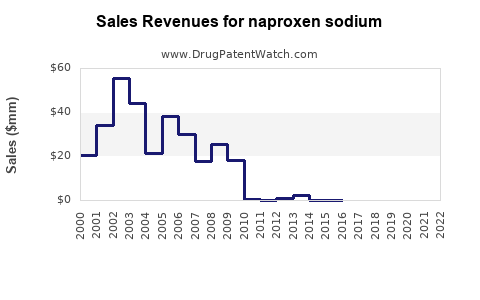
The global NSAID market was valued at approximately USD 12.3 billion in 2022. Naproxen sodium accounts for an estimated 15-20% of this market, translating to USD 1.85-2.46 billion annually.[1]
Key Drivers
- Increased prevalence of chronic inflammatory diseases (arthritis, gout).
- Growing aging population worldwide.
- Rising awareness of pain management options.
- OTC availability in many regions enhances consumer access.
Market Segmentation
| Segment |
Market Share |
Trends |
| Over-the-counter |
~60% |
Consumer preference for OTC NSAIDs |
| Prescription |
~40% |
Use for more severe or chronic conditions |
Competitive Landscape
Major players include:
- Bayer AG (Aleve)
- HyTest Limited
- Teva Pharmaceuticals
- Mylan NV
- Others
Market leadership is driven by product pricing, distribution channels, and brand recognition. Bayer’s Aleve retains a significant share due to its longstanding OTC presence.
Pricing and Revenue Trends
Average retail price per 220 mg naproxen sodium tablet ranges from USD 0.10 to USD 0.25.[2] Wholesale prices are approximately 20-30% lower. Price sensitivity influences sales volume, especially in OTC formulations.
Sales Projections
Short-Term (2023–2025)
Assuming annual growth rate of 3-5%, driven by aging populations and rising OA and RA cases, sales are projected to reach USD 2.5-2.8 billion by 2025.
Long-Term (2026–2030)
Growth rate may slow to 2-3%, as market saturation occurs, but expanding use in emerging markets may offset this. Annual sales could reach USD 3.2-3.5 billion by 2030.
Influencing Factors
- Patent expirations and increased generic penetration.
- Regulatory approvals for new indications.
- Consumer shift toward safer NSAIDs with fewer side effects.
Regulatory and Market Challenges
- FDA and EMA restrictions on long-term NSAID use to mitigate cardiovascular risks.
- Growing preference for acetaminophen and COX-2 inhibitors.
- Competition from other OTC pain relievers.
Regional Outlook
| Region |
Market Size (USD billion, 2022) |
Growth Rate (2023–2025) |
Notes |
| North America |
1.0 |
3.5% |
Largest OTC NSAID market |
| Europe |
0.9 |
3.0% |
Strong OTC sales, aging population |
| Asia-Pacific |
0.6 |
8.0% |
Rapid growth, rising middle class |
| Latin America |
0.3 |
4.0% |
Increasing healthcare access |
Key Opportunities
- Developing formulations with improved safety profiles.
- Expanding access in underpenetrated markets.
- Digitally marketing to young consumers seeking OTC options.
Key Takeaways
- The global naproxen sodium market is valued around USD 2 billion currently.
- Growth is driven by aging populations and OTC availability.
- Sales are projected to grow at 3-5% annually until 2025, reaching USD 2.8 billion.
- Market saturation and regulatory restrictions may temper long-term growth.
- Emerging markets present significant expansion opportunities.
FAQs
1. What factors influence naproxen sodium sales globally?
Market growth relies on demographic trends, OTC accessibility, pricing, regulatory climate, and competition from other analgesics.
2. How does generic drug entry impact sales projections?
Generic entry lowers prices, increases volume, and can accelerate sales growth initially but reduces brand market share long-term.
3. What are the main regional differences in naproxen sodium consumption?
North America and Europe dominate due to established OTC markets, while Asia-Pacific presents rapid growth potential owing to increased healthcare access and rising middle-class populations.
4. How do regulatory changes affect long-term sales?
Stricter guidelines on long-term NSAID use may limit prescriptions, though OTC sales could compensate with increased consumer use.
5. What future innovations could impact sales?
Formulations with enhanced safety profiles, such as reduced gastrointestinal or cardiovascular risks, could expand market penetration.
References
[1] Grand View Research. (2022). NSAID Market Size, Share & Trends Analysis Report.[2] Retailer and pricing databases, 2023.