Share This Page
Drug Sales Trends for metoprolol succinate
✉ Email this page to a colleague
Payment Methods and Pharmacy Types for metoprolol succinate (2022)
Revenues by Pharmacy Type
Units Sold by Pharmacy Type
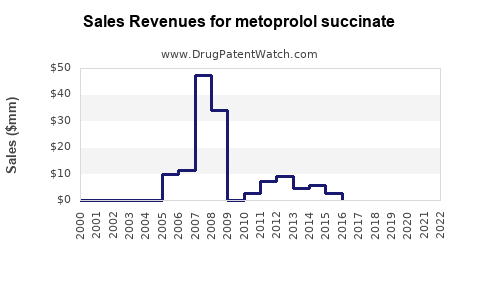
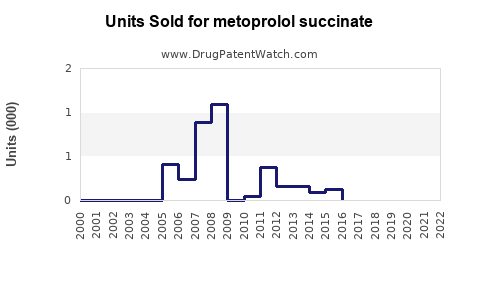
Annual Sales Revenues and Units Sold for metoprolol succinate
| Drug Name | Revenues (USD) | Units | Year |
|---|---|---|---|
| METOPROLOL SUCCINATE | ⤷ Start Trial | ⤷ Start Trial | 2022 |
| METOPROLOL SUCCINATE | ⤷ Start Trial | ⤷ Start Trial | 2021 |
| METOPROLOL SUCCINATE | ⤷ Start Trial | ⤷ Start Trial | 2020 |
| >Drug Name | >Revenues (USD) | >Units | >Year |
Metoprolol Succinate Market Analysis, Sales Projections, Patent Status, and Generic Competition
Metoprolol succinate is a mature, low-cost extended-release beta blocker marketed primarily as generic metoprolol succinate extended-release tablets and historically under the Toprol-XL brand. Its commercial profile is driven by high prescription volume, low unit pricing, broad cardiovascular use, and intense generic competition. The product has limited remaining patent protection and no meaningful biologic or biosimilar risk.
A reasonable base-case forecast places the U.S. metoprolol succinate extended-release market in a low-growth or declining revenue cycle through 2030. Prescription demand should remain relatively stable, while net pricing continues to decline. Under a modeled U.S. market framework, annual sales could range from approximately $200 million to $500 million across branded and generic products, depending on prescription volume, payer mix, formulation share, and manufacturer pricing. These are scenario estimates, not reported market totals.
What is metoprolol succinate and how is it used?
Metoprolol succinate is the extended-release salt form of metoprolol, a selective beta-1 adrenergic receptor blocker. It is administered once daily and is approved in the United States for:
- Hypertension
- Angina pectoris
- Stable, symptomatic heart failure of ischemic, hypertensive, or cardiomyopathic origin
The extended-release product is distinct from metoprolol tartrate, an immediate-release formulation generally administered more than once daily. The two salts are not interchangeable on a milligram-for-milligram basis without appropriate clinical direction.
| Attribute | Metoprolol succinate ER |
|---|---|
| Active ingredient | Metoprolol succinate |
| Drug class | Beta-1 selective adrenergic blocker |
| Primary dosage form | Extended-release tablet |
| Administration | Generally once daily |
| Major indications | Hypertension, angina, heart failure |
| Reference brand | Toprol-XL |
| U.S. regulatory pathway | NDA for reference product; ANDAs for generics |
| Biosimilar exposure | None |
| Commercial stage | Mature generic market |
The heart-failure indication gives metoprolol succinate a differentiated clinical position within the beta-blocker class. The FDA-approved labeling identifies metoprolol succinate extended-release tablets as a therapy for stable, symptomatic heart failure, subject to dose titration and patient selection.[1]
How large is the metoprolol succinate market?
No single public source reports a complete, current global market total for metoprolol succinate alone. Public prescription datasets often combine metoprolol succinate and metoprolol tartrate, while commercial market databases separate products using proprietary methodologies.
The market is best analyzed through three segments:
- U.S. generic metoprolol succinate extended-release tablets.
- Residual brand or authorized-generic sales associated with Toprol-XL.
- International metoprolol extended-release products, which vary by brand, salt, dosage form, and national reimbursement system.
U.S. market structure
The U.S. market is predominantly generic. Large generic manufacturers and contract suppliers compete on 25 mg, 50 mg, 100 mg, and 200 mg strengths. Distribution runs through retail pharmacies, mail-order channels, hospitals, wholesalers, and government programs.
The highest-value segment is not necessarily the highest-volume strength. Patients with heart failure or hypertension may require titration across several strengths, while large health plans often favor the lowest-cost manufacturer regardless of strength.
Historical brand market
Toprol-XL was a major AstraZeneca cardiovascular product before generic competition. AstraZeneca reported Toprol-XL sales of more than $1 billion in the mid-2000s before loss of exclusivity materially changed the market structure.[2] That historical revenue level does not represent the current commercial opportunity. After generic entry, revenue shifted from one branded product to multiple low-price suppliers.
What are the metoprolol succinate sales projections through 2030?
The most defensible forecast is a scenario model rather than a single market number because current product-specific sales are not fully disclosed by manufacturers.
U.S. scenario forecast
The following model assumes a mature market with stable prescription volume, declining average selling prices, and modest continued migration toward generic dispensing.
| Scenario | 2025 estimated U.S. revenue | 2030 estimated U.S. revenue | 2025-2030 trend |
|---|---|---|---|
| Low case | $150 million-$250 million | $110 million-$190 million | Price erosion exceeds volume stability |
| Base case | $250 million-$400 million | $210 million-$350 million | Stable volume with gradual price decline |
| High case | $400 million-$600 million | $360 million-$550 million | Higher prescription volume and stronger channel pricing |
These ranges include generic and residual branded or authorized-generic revenue but exclude metoprolol tartrate. The base case assumes:
- Annual prescription volume remains broadly stable.
- Generic dispensing remains above 95% in the U.S. retail market.
- Average net revenue per prescription declines by approximately 1% to 4% annually.
- Heart-failure prescribing supports demand stability.
- No major safety signal or regulatory withdrawal affects the class.
- No new formulation materially changes the competitive market.
Volume-based forecast logic
A practical way to estimate revenue is:
Annual market revenue = annual prescriptions × average net revenue per prescription
For example, a market with 50 million annual extended-release prescriptions and an average net revenue of $5 to $8 per prescription would produce $250 million to $400 million in annual revenue. The result changes significantly based on whether the estimate uses gross invoice sales, pharmacy reimbursement, manufacturer net sales, or retail spending.
The key commercial point is that metoprolol succinate is a volume business. Revenue expansion would require one or more of the following:
- Increased diagnosis and treatment of hypertension or heart failure.
- Share gains from competing beta blockers.
- Premium pricing for differentiated packaging or adherence programs.
- A new delivery system or combination product.
- Supply disruption affecting competitors.
A conventional generic tablet is unlikely to produce sustained revenue growth through price increases.
When did metoprolol succinate lose exclusivity?
Metoprolol succinate extended-release lost meaningful U.S. market exclusivity in the mid-2000s. Generic competition followed the expiration or invalidation of relevant reference-product protection, including formulation and drug-delivery claims associated with Toprol-XL.
The commercial exclusivity timeline is:
| Period | Event | Commercial effect |
|---|---|---|
| 1990s | Toprol-XL expands in hypertension and cardiovascular care | Branded growth |
| Early 2000s | Generic and formulation disputes develop | Delayed or contested entry |
| Mid-2000s | Generic metoprolol succinate ER products enter the U.S. market | Rapid price erosion |
| 2010s | Multiple manufacturers supply the product | Mature commodity market |
| 2020s | Broad generic availability continues | Limited brand pricing power |
The exact timing of generic entry varied by manufacturer, strength, litigation outcome, and regulatory approval. FDA Orange Book records and individual ANDA histories remain the controlling sources for specific patents, certifications, and approval dates.[3]
What patents protect metoprolol succinate?
The core active ingredient is not a commercially meaningful patent barrier. The remaining intellectual-property value is concentrated in historical extended-release formulation, dosage-form, manufacturing, and method-of-use claims.
Core composition and formulation protection
Metoprolol itself is an old small-molecule active ingredient. Current competition is therefore not blocked by a basic composition-of-matter patent. Historical protection centered on:
- Extended-release delivery.
- Controlled dissolution.
- Tablet composition.
- Dose uniformity.
- Release-rate profiles.
- Manufacturing processes.
- Specific heart-failure or cardiovascular treatment methods.
Most commercially important U.S. protection associated with the original extended-release product has expired or no longer prevents broad generic competition. Generic manufacturers have operated for many years under approved ANDAs, which confirms that no active patent barrier prevents ordinary tablet competition.
Method-of-use patents
Method-of-use claims can remain relevant where a generic label omits a patented indication or includes a carve-out. In the metoprolol succinate market, heart-failure treatment is commercially important, but the practical value of method-of-use exclusivity is limited by the age of the product and the availability of multiple generic suppliers.
A method-of-use patent would have the strongest commercial effect only if it:
- Covered a clinically important indication.
- Remained listed or enforceable.
- Could not be avoided through label carving.
- Supported an indication with meaningful sales.
- Applied to a formulation or dosing regimen difficult to design around.
Those conditions do not describe the ordinary U.S. metoprolol succinate tablet market.
Formulation patents
Formulation patents historically had greater importance than method-of-use patents because the product's commercial differentiation depended on extended release. Modern generic products can compete through approved bioequivalence pathways and do not need to copy every proprietary manufacturing step.
For investors and licensing teams, the relevant question is no longer whether a formulation patent once protected Toprol-XL. The relevant question is whether any current patent can block an approved generic product in a specific jurisdiction. For standard U.S. metoprolol succinate ER tablets, the answer is generally no.
What is the Orange Book status of metoprolol succinate?
Toprol-XL and related reference products have been listed historically in the FDA Orange Book. The Orange Book identifies approved drug products, therapeutic equivalence codes, and patents or exclusivity information associated with listed reference products.[3]
The practical Orange Book position is:
- The reference product is an NDA-approved extended-release metoprolol succinate product.
- Generic versions are approved through ANDAs.
- Therapeutically equivalent generic products can be substituted under applicable state law and payer rules.
- Current commercial protection is not based on an active composition-of-matter patent.
- Patent listings must be reviewed by product, strength, and current Orange Book edition.
Orange Book status can change through patent delisting, expiration, administrative updates, or changes in the reference product's marketing status. A transaction or litigation assessment should rely on the current FDA listing rather than historical patent summaries.
Which companies compete in metoprolol succinate?
The market has historically included major generic pharmaceutical companies and specialized suppliers. The competitive field can change as manufacturers enter, exit, transfer ANDAs, or reduce production because of low margins.
Relevant competitive categories include:
Large generic manufacturers
Companies such as Sandoz, Teva, Mylan or Viatris, Dr. Reddy's Laboratories, Lupin, Zydus, and Sun Pharmaceutical Industries have participated in U.S. cardiovascular generic markets, including beta blockers. Participation can vary by time, strength, and supplier status.
Contract and private-label suppliers
Retail chains, wholesalers, and health systems may source metoprolol succinate through private-label or contract-manufacturing arrangements. These arrangements can obscure the identity of the underlying manufacturer and compress supplier margins.
Brand and authorized-generic channels
Any remaining brand, licensed, or authorized-generic distribution has limited leverage because payers can substitute FDA-rated generic products. Brand economics depend on formulary placement, supply reliability, and the commercial value of legacy prescriber loyalty.
How strong is the metoprolol succinate patent estate?
The patent estate is weak for conventional generic tablets and stronger only for narrowly defined delivery technologies or specialized products.
| Patent category | Current blocking potential | Commercial assessment |
|---|---|---|
| Active ingredient | Very low | Old molecule |
| Standard extended-release tablet | Low | Generic competition established |
| Manufacturing process | Low to moderate | May protect a process, not the market |
| Heart-failure method of use | Low | Mature indication and label strategies |
| New combination product | Moderate to high | Depends on new active ingredients and claims |
| Novel delivery system | Moderate | Potential premium if clinically differentiated |
| Pediatric or adherence formulation | Moderate | Value depends on reimbursement and adoption |
A new intellectual-property opportunity would most likely involve a differentiated product rather than a conventional metoprolol succinate tablet. Examples include abuse-deterrent delivery, liquid extended-release dosing, implantable systems, fixed-dose combinations, or a formulation designed for patients unable to swallow tablets. Each would require independent clinical, regulatory, and patent analysis.
What generic launch risks exist for metoprolol succinate?
Generic launch risk is low for a standard tablet because the product is already widely supplied. The main risks are operational rather than patent-based.
Supply and manufacturing risks
Potential barriers include:
- Active pharmaceutical ingredient supply interruptions.
- Extended-release dissolution failures.
- Batch recalls.
- Manufacturing-site observations.
- Shortages of specific strengths.
- Wholesaler concentration.
- Low-margin exits by smaller suppliers.
Extended-release products require consistent release characteristics. A manufacturer may receive approval yet face commercial difficulty if it cannot maintain dissolution specifications, scale production, or compete on contract pricing.
Regulatory risks
FDA risks include ANDA approval delays, bioequivalence deficiencies, manufacturing observations, labeling errors, and postmarketing quality actions. A generic applicant must demonstrate pharmaceutical equivalence and bioequivalence to the reference product under the applicable FDA pathway.[4]
Market-entry risks
Commercial risks include:
- Established payer contracts.
- Automatic substitution favoring incumbent suppliers.
- High deductions and rebates.
- Limited retail shelf differentiation.
- Price compression after additional entrants.
- Low switching value for pharmacists and health plans.
For a new generic entrant, regulatory approval does not guarantee commercial share. The product must secure wholesaler access, stable supply, and competitive net pricing.
Does metoprolol succinate face biosimilar competition?
No. Metoprolol succinate is a small-molecule drug, not a biologic. It is subject to the generic drug framework rather than the FDA biosimilar pathway.
Competitive risk comes from:
- ANDA-approved generic metoprolol succinate ER products.
- Metoprolol tartrate.
- Carvedilol.
- Bisoprolol.
- Atenolol.
- Nebivolol.
- Other antihypertensive and heart-failure therapies.
Carvedilol is the most important clinical comparator in heart failure because it has a separate evidence base and beta-blocking profile. The choice between carvedilol and metoprolol succinate can depend on blood pressure, heart rate, tolerability, comorbidities, dosing preference, and clinician practice.
How does metoprolol succinate compare with metoprolol tartrate?
| Factor | Metoprolol succinate ER | Metoprolol tartrate |
|---|---|---|
| Release profile | Extended release | Immediate release |
| Typical dosing | Once daily | Often twice daily |
| Heart-failure role | FDA-approved for selected stable heart failure | Not equivalent to succinate for this indication |
| Generic competition | Extensive | Extensive |
| Adherence profile | Potentially simpler | More frequent dosing |
| Patent strength | Mature and largely expired | Mature and largely expired |
| Pricing | Low generic pricing | Low generic pricing |
Succinate has stronger commercial positioning in heart failure because of its approved extended-release indication. Tartrate remains important where clinicians want shorter-acting therapy or more flexible dose adjustment.
What licensing deals and litigation affect metoprolol succinate?
The major commercial litigation period occurred around generic entry and extended-release formulation patents. Historical disputes involved the timing of ANDA approval, patent validity, infringement, and settlement terms.
Current licensing value is limited for ordinary metoprolol succinate tablets. A licensing opportunity would be more credible if it involved:
- A new extended-release technology.
- A fixed-dose combination.
- A pediatric formulation.
- A liquid or sprinkle formulation.
- A clinically differentiated heart-failure product.
- Manufacturing technology that lowers cost or improves supply reliability.
No broad, current patent litigation is required to explain the market's competitive position. The established generic field itself indicates that historic exclusivity barriers have largely ceased to control access.
What is the regulatory status of metoprolol succinate?
The reference product and generic products are FDA-approved prescription medicines. Generic products are approved through ANDAs demonstrating pharmaceutical equivalence and bioequivalence to the reference listed drug.
Regulatory priorities include:
- Accurate extended-release performance.
- Consistent tablet strength.
- Appropriate labeling.
- Controlled dose titration.
- Warnings concerning bradycardia, hypotension, heart failure worsening during initiation, and abrupt discontinuation.
The FDA label warns that abrupt withdrawal of beta-blocker therapy can increase cardiovascular risk in susceptible patients. Commercial promotion must remain consistent with approved labeling.[1]
What is the revenue exposure for manufacturers?
Metoprolol succinate is strategically important for manufacturers with scale, supply-chain efficiency, and cardiovascular portfolio breadth. It is less attractive as a standalone branded asset because:
- Price competition is intense.
- Patent protection is weak.
- Prescriber loyalty is limited.
- Payers can substitute generic products.
- Manufacturing quality is critical.
- Revenue is distributed across many suppliers.
For a generic manufacturer, the product can support portfolio utilization and pharmacy-channel relationships even if gross margins are modest. For a brand company, a conventional metoprolol succinate product is unlikely to justify major promotional spending without a differentiated formulation or combination strategy.
Key Takeaways
- Metoprolol succinate is a mature generic cardiovascular market centered on extended-release tablets.
- The U.S. market is likely to remain volume-stable but revenue-constrained by low pricing.
- A modeled 2025 U.S. market range is approximately $150 million to $600 million, with a base case of $250 million to $400 million.
- Revenue through 2030 is likely to decline modestly unless prescription volume or product differentiation offsets price erosion.
- Toprol-XL's historical billion-dollar sales do not reflect current generic-market economics.
- Standard formulation, composition, and method-of-use patent barriers are largely exhausted.
- There is no biosimilar risk because metoprolol succinate is a small molecule.
- The main risks are supply reliability, manufacturing quality, payer pricing, and generic competition.
- New commercial value would require a differentiated delivery system, combination product, or specialized patient formulation.
FAQs
Is metoprolol succinate still profitable for generic manufacturers?
Yes, but profitability depends on manufacturing scale, supply reliability, and contract access. Unit prices are low, so inefficient production or weak purchasing leverage can eliminate margins.
Can a new company launch metoprolol succinate without licensing Toprol-XL patents?
A company may pursue an ANDA without licensing expired or nonblocking patents. Current Orange Book listings, patent certifications, and product-specific litigation must determine the launch position.
Is metoprolol succinate a good target for a branded reformulation?
Only if the reformulation solves a clinically relevant problem, such as adherence, swallowing difficulty, dose flexibility, pediatric use, or combination therapy. A conventional once-daily tablet has limited branded differentiation.
Which drug is the strongest competitor to metoprolol succinate in heart failure?
Carvedilol is the principal pharmacologic competitor in many heart-failure treatment settings. Clinical selection depends on patient characteristics, tolerance, blood pressure, heart rate, and guideline-directed therapy.
Will metoprolol succinate sales grow with the aging population?
Prescription volume may remain resilient or increase as cardiovascular disease prevalence rises. Revenue growth is less likely because generic price erosion and payer pressure can offset higher unit demand.
References
-
U.S. Food and Drug Administration. (2023). Metoprolol succinate extended-release tablets: Prescribing information. FDA.
-
AstraZeneca. (2006). Annual report and Form 20-F 2005. AstraZeneca PLC.
-
U.S. Food and Drug Administration. (2024). Approved drug products with therapeutic equivalence evaluations: Orange Book. FDA.
-
U.S. Food and Drug Administration. (2024). Generic drug facts and approval standards. FDA.
More… ↓
