Share This Page
Drug Sales Trends for methylprednisolone acetate
✉ Email this page to a colleague
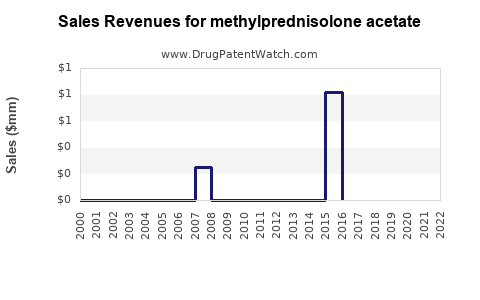
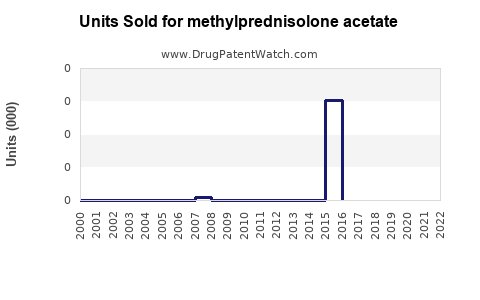
Annual Sales Revenues and Units Sold for methylprednisolone acetate
| Drug Name | Revenues (USD) | Units | Year |
|---|---|---|---|
| METHYLPREDNISOLONE ACETATE | ⤷ Start Trial | ⤷ Start Trial | 2022 |
| METHYLPREDNISOLONE ACETATE | ⤷ Start Trial | ⤷ Start Trial | 2021 |
| METHYLPREDNISOLONE ACETATE | ⤷ Start Trial | ⤷ Start Trial | 2020 |
| METHYLPREDNISOLONE ACETATE | ⤷ Start Trial | ⤷ Start Trial | 2019 |
| >Drug Name | >Revenues (USD) | >Units | >Year |
Executive summary: Methylprednisolone acetate is a mature, genericized injectable corticosteroid market with low patent risk and limited pricing power. Pfizer’s Depo-Medrol remains the reference product, while generic injectable suppliers compete on hospital contracts, wholesaler availability, vial sizes, and manufacturing reliability. The U.S. market is likely to grow at a low single-digit rate through 2029, driven by procedure volumes and chronic inflammatory disease treatment, while unit prices remain flat or decline. A reasonable base-case estimate places U.S. annual manufacturer sales at approximately $150 million to $190 million in 2025, rising to $165 million to $215 million by 2029.
Methylprednisolone Acetate Market Analysis and Sales Projections
Methylprednisolone acetate is a mature injectable corticosteroid with established clinical demand, broad generic substitution, and no material remaining U.S. patent exclusivity. The commercial opportunity is concentrated in hospital and outpatient injection channels rather than branded retail prescriptions.
What is the current market position of methylprednisolone acetate?
Methylprednisolone acetate is a depot corticosteroid suspension administered by intramuscular, intra-articular, intrabursal, and soft-tissue injection. The reference product is Depo-Medrol, marketed by Pfizer. It is used for inflammatory and allergic conditions, rheumatic disease, synovitis, bursitis, dermatologic disorders, and selected respiratory or systemic conditions where a long-acting injectable corticosteroid is clinically appropriate.[1]
The product is not interchangeable with intravenous methylprednisolone sodium succinate. The acetate formulation is a suspension intended for depot administration, while the sodium succinate formulation is water-soluble and used for intravenous or intramuscular treatment in acute settings.
Market characteristics
| Metric | Assessment |
|---|---|
| Therapeutic class | Injectable glucocorticoid |
| Active ingredient | Methylprednisolone acetate |
| Reference brand | Depo-Medrol |
| U.S. regulatory status | Approved prescription drug |
| Primary dosage forms | Injectable suspension |
| Key strengths | Commonly 40 mg/mL and 80 mg/mL; other presentations may be marketed |
| Patent status | Mature, with no meaningful current U.S. composition-of-matter exclusivity |
| Generic substitution | Extensive |
| Biosimilar exposure | None; methylprednisolone acetate is a small molecule |
| Main purchasing channels | Hospitals, ambulatory surgery centers, clinics, wholesalers, specialty distributors |
| Principal commercial risk | Supply disruption and contract price erosion |
How large is the methylprednisolone acetate market?
No authoritative public source reports global sales for methylprednisolone acetate as a standalone molecule. Sales are generally embedded in broader corticosteroid, injectable anti-inflammatory, or hospital-drug categories. The estimates below are scenario-based projections using the product’s mature generic status, clinical volume, channel mix, and historical pricing behavior.
Estimated 2025 market size
| Market | Estimated manufacturer sales, 2025 | Base-case growth through 2029 |
|---|---|---|
| United States | $150 million-$190 million | 2.5%-3.5% CAGR |
| Europe | $70 million-$100 million | 1.0%-2.5% CAGR |
| Japan and developed Asia | $35 million-$55 million | 1.0%-2.0% CAGR |
| Latin America | $25 million-$40 million | 3.0%-5.0% CAGR |
| Middle East and Africa | $15 million-$30 million | 3.0%-5.0% CAGR |
| Global total | $295 million-$415 million | 2.5%-4.0% CAGR |
These ranges represent manufacturer-level sales rather than hospital charges or patient out-of-pocket spending. Gross market value is higher because distributors, hospitals, and clinics add markups.
Market drivers
Demand is supported by:
- Orthopedic injections for osteoarthritis, bursitis, and synovitis.
- Rheumatology and musculoskeletal procedures.
- Outpatient pain-management and sports-medicine practices.
- Dermatologic and soft-tissue injections.
- Continued use in settings where an inexpensive depot steroid is preferred over newer biologic or targeted treatments.
- Expansion of ambulatory surgery centers and office-based procedures.
Volume is constrained by safety concerns associated with repeated corticosteroid injections, evolving clinical practice, and competition from triamcinolone acetonide and other injectable steroids.
What are the sales projections for methylprednisolone acetate?
The base-case forecast assumes stable clinical utilization, modest growth in outpatient procedures, continued generic competition, and low nominal price growth.
U.S. manufacturer-sales projection
| Year | Low case | Base case | High case |
|---|---|---|---|
| 2025 | $150 million | $170 million | $190 million |
| 2026 | $148 million | $175 million | $198 million |
| 2027 | $147 million | $180 million | $207 million |
| 2028 | $147 million | $186 million | $216 million |
| 2029 | $148 million | $192 million | $225 million |
| 2025-2029 CAGR | -0.3% | 3.1% | 4.3% |
The low case reflects additional contract price erosion, substitution by triamcinolone products, and intermittent supply competition. The high case assumes stronger procedural growth, stable availability, and greater use in outpatient orthopedic settings.
Global base-case projection
| Year | Estimated global sales |
|---|---|
| 2025 | $350 million |
| 2026 | $360 million |
| 2027 | $372 million |
| 2028 | $384 million |
| 2029 | $397 million |
Global growth is expected to come mainly from Latin America, Asia-Pacific, and other markets where injectable corticosteroids remain widely used and generic access is less mature. North American and Western European growth is likely to be slower.
Which companies manufacture or market methylprednisolone acetate?
Pfizer is the principal reference-product company through Depo-Medrol. Generic injectable manufacturers and contract manufacturers compete for hospital, group-purchasing-organization, and distributor contracts. The supplier field has included companies such as Hikma Pharmaceuticals, Sagent Pharmaceuticals, and other FDA-approved injectable-drug manufacturers, subject to product availability and current marketing status.
The competitive structure is fragmented at the manufacturer level but concentrated at the customer level. Large hospital systems often negotiate through group purchasing organizations, increasing price pressure and making reliable supply a major differentiator.
Commercial positioning by supplier type
| Supplier type | Competitive advantage | Main limitation |
|---|---|---|
| Pfizer reference product | Brand recognition, established label, institutional familiarity | Premium pricing and limited differentiation |
| Large generic injectable manufacturer | Scale, contracting capacity, broad hospital portfolio | Price competition |
| Smaller generic supplier | Ability to compete selectively on price or supply | Greater vulnerability to shortages and capacity limits |
| Contract manufacturer | Manufacturing flexibility | Limited control over customer relationships |
| Regional supplier | Local distribution and regulatory access | Narrower geographic reach |
What patents protect methylprednisolone acetate?
The core active ingredient is not protected by a current U.S. composition-of-matter patent. Methylprednisolone acetate has been used clinically for decades, and the relevant foundational patent and regulatory exclusivity periods expired long ago.
The commercial estate is primarily regulatory and manufacturing-based rather than patent-based:
- FDA approval for the reference product.
- Generic abbreviated new drug applications.
- Manufacturing process controls.
- Sterile injectable production capacity.
- Container-closure and suspension stability specifications.
- Trademarks associated with Depo-Medrol.
- Potential formulation or device claims in specific jurisdictions, if separately granted.
The Orange Book identifies approved drug products and related patent or exclusivity information. Depo-Medrol is associated with Pfizer’s NDA 011757 in FDA product information and historical approval materials.[2] A current launch analysis should distinguish between active Orange Book listings and expired historical patents.
Are formulation patents a meaningful barrier?
Formulation patents are unlikely to create a material barrier for standard methylprednisolone acetate injectable suspensions. The product is a conventional depot suspension rather than a protected long-acting delivery platform. A supplier could still obtain patents covering a distinct particle-size distribution, excipient system, container, manufacturing method, or delivery device, but those claims would not necessarily block conventional generic products.
The strongest practical barriers are:
- Sterile manufacturing validation.
- Suspension uniformity.
- Particle-size control.
- Dose withdrawal accuracy.
- Endotoxin and particulate control.
- Stability through distribution.
- Inspection history and quality-system compliance.
When does methylprednisolone acetate lose exclusivity?
U.S. market exclusivity for methylprednisolone acetate has already expired. Generic competition is permitted, and the market does not depend on a future patent cliff.
The relevant commercial timeline is:
| Event | Timing |
|---|---|
| Original Depo-Medrol approval | Historical; original approval predates modern generic competition |
| Foundational patent protection | Expired |
| Brand regulatory exclusivity | Expired |
| Generic entry | Established |
| Current exclusivity event | None material to standard injectable products |
| Next major loss-of-exclusivity event | Not applicable |
The absence of a future loss-of-exclusivity event limits upside for the brand and reduces the risk of a sudden post-patent collapse for generic suppliers.
What is the Orange Book status of Depo-Medrol?
Depo-Medrol is an FDA-approved prescription injectable product. The relevant regulatory question is whether the Orange Book currently lists unexpired patents or regulatory exclusivities that would delay ANDA approval. For this mature product, the commercial expectation is that no active patent listing materially prevents generic approval.
Orange Book status should be reviewed by:
- NDA number and strength.
- Dosage form and route.
- Active ingredient and concentration.
- Listed patents and expiration dates.
- Paragraph IV certifications associated with any pending ANDA.
- Therapeutic-equivalence codes for approved generic products.
A generic methylprednisolone acetate product may be approved while remaining commercially constrained by supply, manufacturing, or contracting factors.
Are there Paragraph IV challenges for methylprednisolone acetate?
Paragraph IV litigation is unlikely to be a significant current market issue. Paragraph IV certifications are most commercially relevant when a generic applicant challenges an unexpired listed patent. For a mature methylprednisolone acetate product with expired core protection, generic entry is more likely to proceed through ordinary ANDA pathways.
Potential disputes could still arise over:
- A newly listed formulation patent.
- A manufacturing-process patent.
- Patent ownership or listing validity.
- Product-specific labeling issues.
- Contract, distribution, or antitrust claims.
Those issues would be secondary to the core market economics.
What patent litigation and settlement agreements affect the market?
No major ongoing patent settlement is expected to control standard U.S. methylprednisolone acetate injectable entry. The market is primarily exposed to product-liability, quality, supply, and procurement disputes rather than classic patent-cliff litigation.
A litigation review should focus on:
- FDA warning letters and recalls.
- Sterility failures.
- Particulate contamination.
- Incorrect labeling or concentration.
- Compounding-related adverse events.
- Hospital contracting disputes.
- Antitrust claims involving generic price coordination.
FDA recall and shortage records are commercially relevant because a temporary withdrawal by one supplier can shift meaningful volume to competitors.[3]
How does methylprednisolone acetate compare with competing corticosteroids?
| Product | Typical commercial role | Relative competitive position |
|---|---|---|
| Methylprednisolone acetate | Depot injectable corticosteroid | Established, broad institutional use |
| Triamcinolone acetonide | Intra-articular and soft-tissue injection | Strongest direct substitute in many procedures |
| Dexamethasone sodium phosphate | Injectable systemic and acute-care steroid | Faster-acting, non-depot alternative |
| Betamethasone injectable products | Depot or combination corticosteroid use | Strong in selected markets |
| Hydrocortisone acetate | Local injection and topical-related uses | Narrower clinical role |
| Methylprednisolone sodium succinate | IV or acute systemic therapy | Different formulation and route |
Methylprednisolone acetate competes on familiarity, cost, depot duration, and availability. It loses share when clinicians prefer triamcinolone for joint injections or dexamethasone for systemic treatment.
What generic entry risks exist for methylprednisolone acetate?
Generic entry risk is already realized rather than prospective. The main risks to a supplier are:
- Further unit-price compression.
- Loss of hospital contracts.
- FDA manufacturing observations.
- Reliance on a single sterile facility.
- Raw-material or vial shortages.
- Substitution by triamcinolone.
- Reduced injection frequency due to safety-focused practice.
- State or payer policy changes affecting office-based procedures.
A new entrant would need a low-cost, reliable sterile supply chain and a contracting strategy. Patent ownership is not the primary entry hurdle.
How strong is the patent estate for methylprednisolone acetate?
The patent estate is weak as a basis for exclusivity but the manufacturing position can be defensible.
| Factor | Strength |
|---|---|
| Active ingredient patent | Very low |
| Core formulation patent | Low |
| Method-of-use patent | Low to moderate, generally narrow |
| Orange Book blocking potential | Low |
| Manufacturing complexity | Moderate |
| Regulatory execution barrier | Moderate |
| Brand loyalty | Moderate |
| Pricing power | Low |
| Supply-chain value | High |
Method-of-use patents could cover a particular indication, dosing schedule, or patient population, but such claims would not normally prevent use of the product across the broader injectable corticosteroid market.
What regulatory issues affect future sales?
The FDA label warns of systemic corticosteroid risks, including infection, immunosuppression, endocrine effects, osteoporosis, psychiatric effects, hyperglycemia, and local tissue complications.[1] Repeated intra-articular use is subject to clinical judgment and safety concerns. The product is not approved for every injection route, and improper administration can create severe risk.
Regulatory developments most likely to affect sales are:
- Label changes concerning injection routes.
- Safety communications involving epidural or intrathecal administration.
- Manufacturing inspections.
- Sterility recalls.
- New generic approvals.
- Changes in reimbursement for office-based injections.
- Payer controls on corticosteroid procedure frequency.
What is the revenue exposure for manufacturers?
For Pfizer, Depo-Medrol is unlikely to represent a major corporate revenue driver relative to Pfizer’s broader pharmaceutical portfolio. Its value is more closely tied to hospital formulary presence, portfolio breadth, and reliable supply than to high margins.
For generic manufacturers, methylprednisolone acetate can be commercially attractive when it is bundled with other injectables. Standalone profitability is limited by:
- Low-to-moderate unit prices.
- Contracting discounts.
- Manufacturing overhead.
- Quality-control requirements.
- Customer concentration.
- Price competition after multiple generic approvals.
A supplier with a broader injectable portfolio can use methylprednisolone acetate to support purchasing agreements and distribution relationships.
Key Takeaways
- Methylprednisolone acetate is a mature, genericized injectable corticosteroid market.
- Depo-Medrol is the reference Pfizer product; core U.S. exclusivity has expired.
- No meaningful future patent cliff is expected for standard injectable products.
- Estimated 2025 U.S. manufacturer sales are $150 million to $190 million.
- Base-case U.S. sales are projected to reach approximately $192 million by 2029.
- Global sales are estimated at roughly $295 million to $415 million in 2025.
- The base-case global market could reach about $397 million by 2029.
- Direct competition comes mainly from triamcinolone acetonide and dexamethasone products.
- The strongest entry barriers are sterile manufacturing, quality compliance, and hospital contracting.
- Paragraph IV litigation and biosimilar competition are not material current risks.
- Supply reliability is more commercially important than patent exclusivity.
FAQs About Methylprednisolone Acetate Market Outlook
Is methylprednisolone acetate still profitable for generic manufacturers?
Yes, but profitability depends on manufacturing scale, hospital contracts, and portfolio bundling. Standalone margins are likely to remain limited because multiple suppliers compete on price.
Will biosimilars compete with methylprednisolone acetate?
No. Methylprednisolone acetate is a chemically synthesized small molecule, not a biologic. Competition occurs through generic drug applications rather than biosimilar approvals.
Could a new depot formulation obtain meaningful exclusivity?
A materially differentiated formulation could receive patent protection if it demonstrates novel composition, particle engineering, delivery performance, or clinical benefit. Standard suspension reformulation would face a higher validity and commercial-risk burden.
Which indication contributes the most demand?
Musculoskeletal and intra-articular use is likely the largest commercial demand pool, although product labeling and actual use vary by jurisdiction and clinical setting.
What is the most likely sales scenario through 2029?
A low-single-digit growth scenario is most likely. Procedure-volume growth should offset generic price pressure, producing modest nominal revenue growth rather than a major market expansion.
References
-
U.S. Food and Drug Administration. (2024). Depo-Medrol (methylprednisolone acetate injectable suspension) prescribing information. Pfizer Laboratories.
-
U.S. Food and Drug Administration. (2024). Approved drug products with therapeutic equivalence evaluations: Orange Book. https://www.fda.gov/drugs/drug-approvals-and-databases/orange-book-data-files
-
U.S. Food and Drug Administration. (2024). Drug shortages and drug safety communications. https://www.fda.gov/drugs/drug-safety-and-availability
-
Centers for Medicare & Medicaid Services. (2024). ASP drug pricing files. https://www.cms.gov/medicare/payment/part-b-drugs/average-sales-price
-
U.S. Food and Drug Administration. (2024). Approved drug products database and abbreviated new drug application resources. https://www.fda.gov/drugs/drug-approvals-and-databases
More… ↓
