Share This Page
Drug Sales Trends for hydroxychloroquine sulfate
✉ Email this page to a colleague
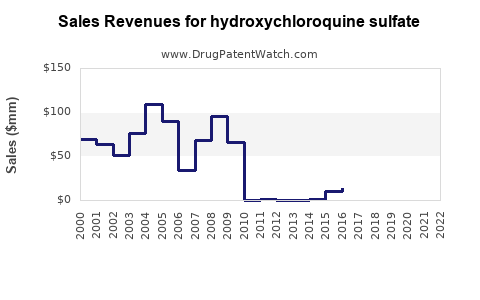
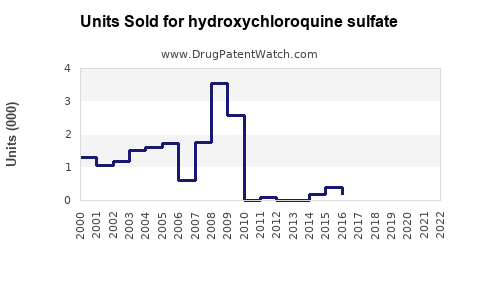
Annual Sales Revenues and Units Sold for hydroxychloroquine sulfate
| Drug Name | Revenues (USD) | Units | Year |
|---|---|---|---|
| HYDROXYCHLOROQUINE SULFATE | ⤷ Start Trial | ⤷ Start Trial | 2022 |
| HYDROXYCHLOROQUINE SULFATE | ⤷ Start Trial | ⤷ Start Trial | 2021 |
| HYDROXYCHLOROQUINE SULFATE | ⤷ Start Trial | ⤷ Start Trial | 2020 |
| >Drug Name | >Revenues (USD) | >Units | >Year |
Hydroxychloroquine Sulfate Market Analysis, Sales Outlook, Patent Status, and Generic Competition
Hydroxychloroquine sulfate is a mature, low-cost generic drug with stable demand in systemic lupus erythematosus, rheumatoid arthritis, and malaria treatment. Its commercial value is concentrated in chronic rheumatology use, while malaria demand is strategically important but lower-margin. COVID-19 created a temporary demand spike in 2020 that did not establish a durable market.
The market has limited patent protection, no meaningful U.S. exclusivity, multiple generic suppliers, and low barriers to tablet manufacturing. Base-case global sales are likely to remain broadly stable in nominal volume through 2030, with growth driven primarily by diagnosed autoimmune disease, population expansion in malaria-endemic regions, and price increases rather than innovation.
What is the current market status of hydroxychloroquine sulfate?
Hydroxychloroquine sulfate is marketed primarily as generic 200 mg tablets. The best-known originator brand is Plaquenil, historically associated with Sanofi. U.S. products are approved for:
- Malaria treatment and suppression
- Systemic lupus erythematosus
- Acute and chronic rheumatoid arthritis
The FDA-approved label requires ophthalmic monitoring because cumulative exposure can cause irreversible retinal toxicity. Cardiac toxicity, hypoglycemia, neuromuscular effects, and drug interactions are additional safety considerations. The drug is prescription-only in the United States.[1]
| Market characteristic | Assessment |
|---|---|
| Active ingredient | Hydroxychloroquine sulfate |
| Primary dosage form | Immediate-release oral tablet |
| Common strength | 200 mg |
| Main chronic-use markets | Lupus and rheumatoid arthritis |
| Main acute-use market | Malaria |
| Originator brand | Plaquenil |
| U.S. patent position | No meaningful active composition exclusivity |
| U.S. generic competition | Established and extensive |
| FDA COVID-19 status | Emergency authorization revoked in 2020 |
| Market structure | Fragmented generic market |
| Commercial maturity | Mature, price-sensitive product |
Hydroxychloroquine is not a biosimilar product. It is a conventional small-molecule drug subject to abbreviated new drug application, or ANDA, competition under the Hatch-Waxman framework.
How large is the hydroxychloroquine sulfate market?
Public manufacturers generally do not report hydroxychloroquine sales as a separate global line item. The product is sold by numerous generic companies, and available market reports use different definitions for geography, dosage, channel, and branded versus generic revenue.
A practical commercial estimate places the global hydroxychloroquine sulfate market in the low hundreds of millions of U.S. dollars annually, with a wide range caused by differences in pricing and inclusion of hospital, retail, tender, and private-market sales. U.S. revenue is substantially lower than the 2020 pandemic peak and is now dominated by generic prescriptions.
Market segmentation by indication
| Segment | Commercial role | Demand profile | Pricing |
|---|---|---|---|
| Systemic lupus erythematosus | Largest chronic-use value segment | Recurring, relatively stable | Low to moderate |
| Rheumatoid arthritis | Established secondary segment | Stable but exposed to biologic substitution | Low |
| Malaria | Public-health and tender segment | Seasonal and geography-dependent | Low, often procurement-driven |
| COVID-19 | Former temporary segment | Demand collapsed after 2020 | Minimal current contribution |
| Other off-label use | Limited commercial reliability | Variable and physician-dependent | Usually generic pricing |
Systemic lupus erythematosus is the most commercially important indication because patients may use hydroxychloroquine for years. Rheumatoid arthritis demand is more exposed to methotrexate, biologic disease-modifying antirheumatic drugs, targeted synthetic drugs, and treatment guidelines.
What are the sales projections for hydroxychloroquine sulfate through 2030?
The most defensible forecast is a scenario range rather than a single point estimate. Mature generic pricing, fragmented reporting, and the absence of a protected product make unit volume more informative than nominal revenue.
Global revenue scenarios
| Year | Bear case | Base case | Bull case |
|---|---|---|---|
| 2024 estimated market | $180 million | $250 million | $350 million |
| 2025 | $175 million | $255 million | $360 million |
| 2026 | $170 million | $260 million | $370 million |
| 2027 | $165 million | $265 million | $380 million |
| 2028 | $160 million | $270 million | $390 million |
| 2029 | $155 million | $275 million | $400 million |
| 2030 | $150 million | $280 million | $410 million |
| 2024-2030 CAGR | -3.0% | 2.0% | 2.7% |
These projections represent market-level revenue, not sales attributable to Sanofi or any individual generic manufacturer.
The base case assumes:
- Stable long-term lupus treatment volumes.
- Low-single-digit growth in diagnosed autoimmune disease.
- Continued malaria procurement in endemic regions.
- No repeat of the 2020 COVID-related demand shock.
- Ongoing generic price pressure offset partly by inflation and supply disruptions.
- No clinically meaningful replacement of hydroxychloroquine in lupus treatment guidelines.
The bear case assumes further price erosion, reduced use in rheumatoid arthritis, and lower malaria tender volumes. The bull case assumes stronger lupus diagnosis and treatment persistence, higher procurement volumes, and periodic supply shortages that support pricing.
U.S. revenue outlook
U.S. revenue is likely to remain a minority of global market value but a major contributor to commercial profitability because chronic rheumatology prescriptions carry higher prices than public-sector malaria tenders.
| U.S. market driver | Direction through 2030 |
|---|---|
| Lupus prevalence and diagnosis | Positive |
| Generic competition | Negative for price |
| Chronic prescription persistence | Positive |
| Rheumatoid arthritis substitution | Negative |
| Retail pharmacy reimbursement | Negative to neutral |
| Supply shortages | Volatile, potentially positive for price |
| COVID demand | No material contribution expected |
The U.S. market should be modeled as low-growth in prescription volume and flat-to-declining in real revenue. Nominal revenue may rise modestly if manufacturing costs, wholesaler pricing, and reimbursement rates increase.
When did hydroxychloroquine sulfate lose patent exclusivity?
Hydroxychloroquine sulfate lost meaningful patent exclusivity decades ago. The original 4-aminoquinoline compound patents are historical and do not provide a current barrier to generic entry.
The commercially relevant exclusivity position is:
| Exclusivity category | Current position |
|---|---|
| Active ingredient patent | Expired |
| Original formulation patent | Expired or commercially irrelevant |
| New chemical entity exclusivity | Expired |
| Orphan exclusivity | None identified for the core product |
| Pediatric exclusivity | None relevant |
| U.S. market exclusivity | None of commercial significance |
| Biosimilar exclusivity | Not applicable |
Generic manufacturers can compete through ANDAs if their products meet FDA requirements for pharmaceutical equivalence, bioequivalence, quality, manufacturing controls, and labeling.
What is the Orange Book status of hydroxychloroquine sulfate?
Hydroxychloroquine sulfate has no commercially important active Orange Book patent barrier associated with the conventional 200 mg tablet market. The core product is an established generic drug, and generic applicants do not face the type of active patent certification risk associated with recently approved small molecules.
Method-of-use patents, if filed for specific new indications, would not ordinarily block approved lupus, rheumatoid arthritis, or malaria indications unless they were listed and enforceable against the relevant labeling. The historical COVID-19 use claims did not create a durable exclusivity position.
The main regulatory risks are therefore manufacturing quality, bioequivalence, supply continuity, and labeling compliance rather than patent litigation.
Are there Paragraph IV challenges to hydroxychloroquine sulfate?
Paragraph IV litigation is not a significant current market issue for the conventional hydroxychloroquine sulfate tablet. The active ingredient and standard use cases are old, and generic competition is already established.
A new formulation, combination product, or novel delivery system could generate Paragraph IV litigation if supported by a later patent. The risk would depend on:
- Whether the patent is listed in the Orange Book
- Whether the generic product infringes the claims
- Whether the claims survive validity challenges
- Whether the ANDA contains a Paragraph IV certification
- Whether the patent holder files suit within 45 days
- Whether a 30-month stay applies
No major current litigation event changes the base-case outlook for ordinary hydroxychloroquine sulfate tablets.
Which companies compete in the hydroxychloroquine sulfate market?
Competition is fragmented across branded, generic, contract-manufactured, and public-procurement suppliers. In the United States, generic availability has included products from large and mid-sized manufacturers such as Teva, Hikma, Amneal, Rising Pharmaceuticals, Prasco, and other FDA-approved suppliers over time. Product availability can change with manufacturing decisions, recalls, shortages, and wholesaler contracts.
Sanofi remains commercially relevant because Plaquenil is the reference brand, but the originator does not control the generic market. In many countries, local manufacturers and tender suppliers have greater commercial influence than the originator.
Competitive factors
The principal competitive variables are:
- Tablet manufacturing cost
- Active pharmaceutical ingredient supply
- FDA and other regulator compliance
- Retail pharmacy contracting
- Public-health tenders
- Product availability during shortages
- Credit terms and distribution reach
- Ability to maintain uninterrupted supply
Brand loyalty is limited in routine generic dispensing. A manufacturer with reliable supply may gain share even without a differentiated formulation.
What formulations are protected by hydroxychloroquine patents?
The standard immediate-release tablet has no meaningful current patent moat. Potentially protectable areas include:
- Modified-release tablets
- Pediatric liquid formulations
- Taste-masked products
- Fixed-dose combinations
- Ophthalmic or implantable delivery systems
- Formulations designed to reduce gastrointestinal effects
- Pharmacokinetic systems intended to improve adherence
- New therapeutic uses supported by clinical evidence
These opportunities face substantial commercial constraints. Hydroxychloroquine is inexpensive, and many patients can use conventional tablets. A new formulation would need to demonstrate meaningful clinical, adherence, safety, or convenience benefits sufficient to justify a premium.
A formulation patent may protect a specific product without protecting the active ingredient. This distinction limits its ability to prevent ordinary generic tablet competition.
What FDA regulatory events affect the market?
The FDA granted an emergency use authorization for hydroxychloroquine and chloroquine products for certain hospitalized COVID-19 patients in March 2020. The FDA revoked that authorization on June 15, 2020, after concluding that the statutory criteria for emergency authorization were no longer met.[2]
The agency cited concerns involving lack of evidence of benefit and risks including serious cardiac adverse events. The revocation removed the principal source of temporary pandemic demand.
The FDA-approved indications for malaria, lupus, and rheumatoid arthritis remain separate from the revoked COVID-19 authorization. The drug continues to be used under approved labeling for those indications.
What generic launch risks exist for hydroxychloroquine sulfate?
Generic launch risk is moderate from a regulatory and supply perspective but low from a patent perspective.
Low patent risk
There is no meaningful current composition patent barrier. A standard generic tablet does not require a license from Sanofi or another originator.
Moderate manufacturing risk
Manufacturers must manage:
- API sourcing
- Impurity controls
- Content uniformity
- Dissolution performance
- Stability
- Data integrity
- FDA inspection exposure
- Packaging and serialization requirements
Hydroxychloroquine has experienced periods of shortage or constrained availability, particularly during the 2020 demand shock. A supplier that depends on a single API source faces higher continuity risk.
High price-competition risk
Multiple suppliers can compress gross margins. Public tenders can produce especially low prices, while retail markets may offer better economics but require pharmacy and wholesaler access.
How does hydroxychloroquine compare with competing lupus treatments?
Hydroxychloroquine remains a foundational therapy for many lupus patients because of its low cost and long clinical history. Its major commercial disadvantage is that it does not replace advanced therapies for severe or refractory disease.
| Therapy | Commercial position versus hydroxychloroquine |
|---|---|
| Hydroxychloroquine | Low-cost foundational therapy |
| Methotrexate | Competes mainly in inflammatory and joint-predominant disease |
| Corticosteroids | Used for rapid control; toxicity limits long-term use |
| Belimumab | Higher-cost biologic for selected lupus patients |
| Anifrolumab | Targeted biologic for moderate-to-severe systemic lupus |
| Mycophenolate | Important in organ-threatening disease |
| Rituximab | Used in selected refractory settings, often off label |
| Voclosporin | Relevant to lupus nephritis, not a direct replacement in all patients |
Hydroxychloroquine has a stronger position in maintenance therapy than in severe disease escalation. Its low price supports broad use, but the need for retinal monitoring can increase total treatment-system costs.
What licensing deals affect hydroxychloroquine sulfate?
No major current licensing transaction is necessary to commercialize conventional hydroxychloroquine sulfate tablets. The active ingredient is generic, and manufacturers generally rely on their own ANDAs, contract-manufacturing arrangements, or supply agreements.
Commercial transactions are more likely to involve:
- API supply contracts
- Government malaria tenders
- Contract manufacturing
- Regional distribution rights
- Private-label retail supply
- Hospital purchasing agreements
A licensing deal would become more relevant if a company developed a patented formulation, combination product, or new indication with regulatory support.
How strong is the hydroxychloroquine sulfate patent estate?
The patent estate is weak for the core product and potentially moderate only for future differentiated formulations.
| Patent category | Strength |
|---|---|
| Core compound | None of commercial value |
| Standard tablet | Weak |
| New indication | Case-specific |
| Modified release | Potentially moderate |
| Pediatric formulation | Potentially moderate |
| Combination product | Potentially moderate |
| Manufacturing process | Usually narrow and design-around risk is high |
| Delivery technology | Dependent on clinical and patent scope |
The commercial moat is based on supply reliability, regulatory compliance, clinical familiarity, and distribution rather than intellectual property.
What is the outlook for hydroxychloroquine sulfate through 2030?
Hydroxychloroquine sulfate should remain a durable generic product with limited revenue growth and low patent risk. The strongest demand will come from chronic lupus therapy and public-health malaria programs. Rheumatoid arthritis demand will remain important but faces substitution from newer therapies.
The principal risks are:
- Further generic price erosion
- Supply interruptions
- API concentration
- Reduced use because of retinal or cardiac safety concerns
- Lower malaria procurement budgets
- Greater use of biologics or targeted therapies in autoimmune disease
- Regulatory action following quality failures
The principal upside factors are:
- Higher lupus diagnosis rates
- Improved treatment access in emerging markets
- Persistent chronic use
- Public-health stockpiling
- Temporary supply tightness
- Commercially successful pediatric or modified-release products
Key Takeaways
- Hydroxychloroquine sulfate is a mature generic drug with no meaningful current composition patent protection.
- The core market is chronic lupus and rheumatoid arthritis treatment, with malaria as a major public-health segment.
- The 2020 COVID-19 demand surge ended after the FDA revoked the emergency authorization on June 15, 2020.
- Standard 200 mg tablets face extensive generic competition and substantial price pressure.
- A reasonable global market base case is approximately $250 million in 2024, rising to about $280 million by 2030.
- Patent risk for ordinary generic entry is low; manufacturing, supply, quality, and reimbursement risks are more significant.
- New formulations or combinations could obtain patent protection, but they would need a clear clinical or adherence advantage to support premium pricing.
- Sanofi's Plaquenil remains the reference brand, but generic suppliers control most routine volume.
FAQs
Is hydroxychloroquine sulfate still profitable for generic manufacturers?
Yes, but profitability depends on manufacturing scale, API cost, supply reliability, and distribution access. Standard tablets have limited pricing power because several suppliers compete.
Can a company launch generic hydroxychloroquine without a license from Sanofi?
Yes. A company can seek FDA approval through an ANDA and does not need a license to the expired originator compound or standard tablet technology.
Does hydroxychloroquine have exclusivity for lupus treatment?
No commercially meaningful exclusivity remains for the conventional lupus indication. Generic manufacturers can market approved products subject to FDA requirements.
Could a new hydroxychloroquine liquid formulation receive patent protection?
Yes. A liquid, pediatric, taste-masked, or modified-release formulation could receive patents if it satisfies novelty, non-obviousness, written-description, and enablement requirements. The patent would protect the formulation, not the underlying active ingredient.
Is hydroxychloroquine demand expected to return to 2020 levels?
No. The 2020 demand was driven by extraordinary COVID-19 use and stockpiling. The long-term market is expected to track autoimmune disease treatment and malaria procurement rather than pandemic demand.
References
- U.S. Food and Drug Administration. (2023). Plaquenil (hydroxychloroquine sulfate) tablets: Prescribing information.
- U.S. Food and Drug Administration. (2020, June 15). Revocation of emergency use authorization for chloroquine phosphate and hydroxychloroquine sulfate.
- U.S. Food and Drug Administration. (2024). Orange Book: Approved drug products with therapeutic equivalence evaluations.
- World Health Organization. (2023). WHO guidelines for malaria.
- Sanofi. (2021). Annual report 2020.
More… ↓
