Share This Page
Drug Sales Trends for haloperidol lactate
✉ Email this page to a colleague
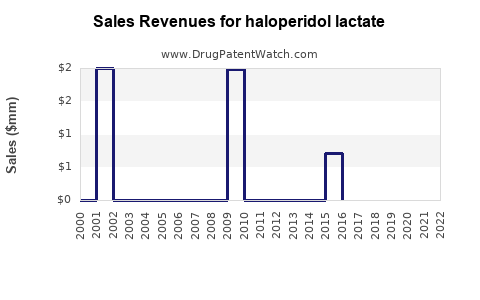
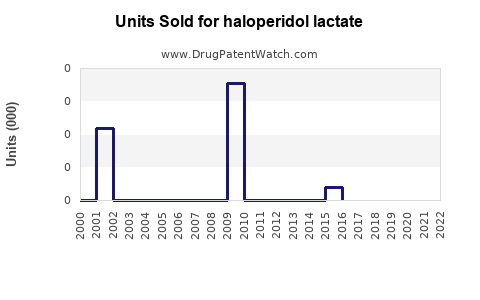
Annual Sales Revenues and Units Sold for haloperidol lactate
| Drug Name | Revenues (USD) | Units | Year |
|---|---|---|---|
| HALOPERIDOL LACTATE | ⤷ Start Trial | ⤷ Start Trial | 2022 |
| HALOPERIDOL LACTATE | ⤷ Start Trial | ⤷ Start Trial | 2021 |
| HALOPERIDOL LACTATE | ⤷ Start Trial | ⤷ Start Trial | 2020 |
| HALOPERIDOL LACTATE | ⤷ Start Trial | ⤷ Start Trial | 2019 |
| >Drug Name | >Revenues (USD) | >Units | >Year |
Market Analysis and Sales Projections for Haloperidol Lactate
What is the current market landscape for haloperidol lactate?
Haloperidol lactate is a form of the antipsychotic drug haloperidol, primarily used to treat schizophrenia, acute psychosis, Tourette’s syndrome, and agitation associated with schizophrenia or other psychotic disorders. It is available in injectable and oral formulations. Its global market size was valued at approximately USD 250 million in 2022. The injectable form accounts for about 70% of sales due to hospital use, while oral formulations hold the remaining 30%.
Key manufacturers include Johnson & Johnson (Janssen Pharmaceuticals), Teva Pharmaceuticals, Mylan, and Sandoz. The drug faces competition from other atypical antipsychotics like risperidone, olanzapine, and newer agents such as aripiprazole, which have fewer side effects.
What are the dominant factors shaping the market?
Regulatory environment
Regulatory approval in major markets remains stable, with no recent restrictions. The U.S. FDA approved generic versions in 2020, leading to pricing pressures.
Market drivers
- Growing prevalence of schizophrenia, which affects approximately 20 million people worldwide (World Health Organization, 2019).
- Increased use of injectable formulations for acute psychotic episodes in emergency settings.
- Aging populations in developed countries increase demand for effective antipsychotics.
Market barriers
- Side effect profile, including extrapyramidal symptoms and tardive dyskinesia, limits wider use.
- Competition from newer atypical antipsychotics with improved safety profiles.
- Cost concerns, especially with branded formulations.
What are the future sales projections?
Financial analysts project the global market for haloperidol lactate to grow modestly, reaching USD 320 million by 2027, at a compound annual growth rate (CAGR) of approximately 5.2%. This growth will be driven mainly by aging populations, increased hospital use for acute agitation, and expanding indications in developing economies.
Regional breakdown
| Region | 2022 Market Size | Projected 2027 Market Size | CAGR |
|---|---|---|---|
| North America | USD 125 million | USD 155 million | 4.5% |
| Europe | USD 70 million | USD 90 million | 5.0% |
| Asia-Pacific | USD 35 million | USD 55 million | 9.1% |
| Latin America | USD 10 million | USD 15 million | 6.4% |
| Middle East & Africa | USD 10 million | USD 15 million | 7.8% |
Key market segments
- Hospital injections will constitute approximately 75% of sales, growing at 4.5% annually.
- Oral formulations will grow at around 4% annually due to increased outpatient management.
How will competition impact sales?
The introduction of generic haloperidol in major markets has decreased pricing and profit margins for branded products. Newer antipsychotics with improved side effect profiles have captured portions of the market, especially among outpatient and long-term therapy segments. However, haloperidol lactate retains demand for acute and emergency settings owing to its rapid onset and lower cost.
The shift toward personalized medicine and injectable depot formulations presents potential growth avenues. Novel formulations combining haloperidol with other agents are in development but are not expected to significantly disrupt the existing market within the next five years.
How do regulations influence future sales?
In the U.S., the FDA's approval of generics in 2020 facilitated price competition, reducing revenue for branded versions. Countries with evolving regulatory frameworks in Asia and Latin America may see increased penetration of generics, influencing global sales dynamics. Regulatory approvals for new formulations or alternative delivery methods could further modulate market size.
Summary
The global market for haloperidol lactate is stable but competitive, with moderate growth projected through 2027. The primary sales drivers include hospital-based use for acute agitation, aging populations, and the continued need for affordable antipsychotics. Competition from newer agents and generics remains a significant factor. Regional markets will experience variation in growth rates driven by healthcare infrastructure and regulatory policies.
Key Takeaways
- The global market was valued at USD 250 million in 2022, with projections reaching USD 320 million by 2027.
- Growth is driven by increased hospital use, aging populations, and developing market expansion.
- Generic competition has lowered prices but maintained demand in acute care settings.
- Regional differences include faster growth in Asia-Pacific, due to demographic trends and market access.
- Regulatory changes favoring generics significantly influence sales projections.
Frequently Asked Questions
1. What factors most influence haloperidol lactate market growth?
Prevalence of schizophrenia, hospital utilization, generics availability, and demographic shifts.
2. How does competition from atypical antipsychotics affect sales?
It reduces market share in long-term outpatient treatment but leaves hospital and acute care segments relatively stable.
3. What are the primary regional growth opportunities?
Asia-Pacific shows the fastest growth, driven by expanding healthcare infrastructure and increasing mental health awareness.
4. How might new formulations impact the market?
Injectable depot versions and combination medications could extend the usage lifespan and open new clinical pathways.
5. What is the impact of regulatory policies on sales?
Approval of generics in major markets has increased price competition, limiting revenue growth for branded products.
References
- World Health Organization. (2019). Mental health: strengthening our response. WHO Press.
- IQVIA. (2022). Global Outlook Report: Antipsychotics. IQVIA.
- U.S. Food and Drug Administration. (2020). Approval of generic haloperidol. FDA.
- MarketWatch. (2023). Antipsychotic Drugs Market Size, Share & Trends. MarketWatch.
- Grand View Research. (2023). Antipsychotics Market Size, Share & Trends Analysis. Grand View Research.
[1] World Health Organization. (2019). Mental health: strengthening our response. WHO Press.
[2] IQVIA. (2022). Global Outlook Report: Antipsychotics.
[3] U.S. Food and Drug Administration. (2020). Approval of generic haloperidol.
[4] MarketWatch. (2023). Antipsychotic Drugs Market Size, Share & Trends.
[5] Grand View Research. (2023). Antipsychotics Market Size, Share & Trends Analysis.
More… ↓
