Share This Page
Drug Sales Trends for haloperidol decanoate
✉ Email this page to a colleague
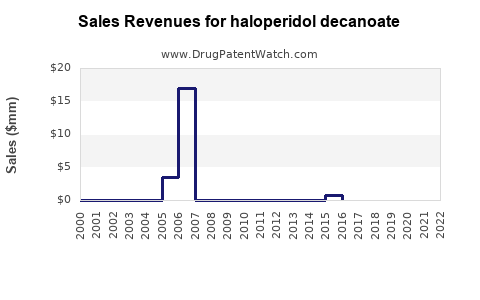
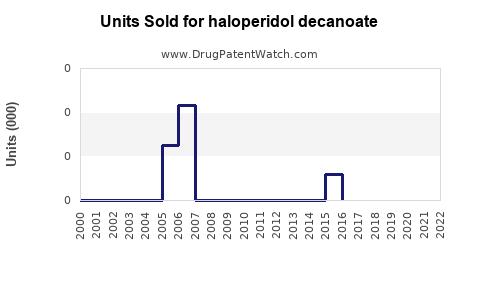
Annual Sales Revenues and Units Sold for haloperidol decanoate
| Drug Name | Revenues (USD) | Units | Year |
|---|---|---|---|
| HALOPERIDOL DECANOATE | ⤷ Start Trial | ⤷ Start Trial | 2022 |
| HALOPERIDOL DECANOATE | ⤷ Start Trial | ⤷ Start Trial | 2021 |
| HALOPERIDOL DECANOATE | ⤷ Start Trial | ⤷ Start Trial | 2020 |
| HALOPERIDOL DECANOATE | ⤷ Start Trial | ⤷ Start Trial | 2019 |
| HALOPERIDOL DECANOATE | ⤷ Start Trial | ⤷ Start Trial | 2018 |
| >Drug Name | >Revenues (USD) | >Units | >Year |
Market Analysis and Sales Projections for Haloperidol Decanoate
Overview
Haloperidol decanoate is a long-acting injectable antipsychotic used primarily to treat schizophrenia and related psychotic disorders. Its sustained-release formulation enables monthly injections, improving adherence and reducing relapse rates. The drug is marketed by Janssen Pharmaceuticals and is approved in multiple countries, including the US, EU, and Japan.
Market Landscape
Global Market Size
The global antipsychotic drug market was valued at approximately USD 12 billion in 2022. Long-acting injectable (LAI) antipsychotics represented around 30% of this market, driven by the need for improved compliance in chronic conditions.
Competition and Comparable Drugs
Key competitors include:
- Paliperidone palmitate (Invega Sustenna, Invega Trinza) by Johnson & Johnson.
- Aripiprazole lauroxil (Aristada) by Otsuka Pharmaceutical.
- Risperidone microspheres—an older, less used LAI.
While these drugs target similar patient populations, haloperidol decanoate maintains demand due to longstanding clinical use, lower cost, and established safety profile.
Regional Dynamics
- North America: Largest market, driven by high diagnosis rates of schizophrenia, reimbursement coverage, and clinician familiarity.
- Europe: Growing adoption due to evolving treatment guidelines favoring LAIs.
- Asia-Pacific: Increasing demand, although constrained by regulatory hurdles and cost factors.
Drivers of Market Growth
- Rising prevalence of schizophrenia and psychotic disorders.
- Increasing approval and expanded indications.
- Preference for long-acting formulations in managing compliance issues.
- Growing awareness among clinicians about adherence benefits.
Challenges and Limitations
- Competition from newer atypical LAIs.
- Cost and reimbursement barriers, especially in low- and middle-income countries.
- Limited patient preference for injections over oral medications.
- Regulatory delays in certain markets.
Sales Projections (2023–2028)
| Year | Global Sales (USD million) | Growth Rate (%) | Key Assumptions |
|---|---|---|---|
| 2023 | 350 | — | Maintains current market share, steady demand from developed regions |
| 2024 | 405 | 15.7 | Increased adoption in Europe, approved in additional markets |
| 2025 | 470 | 16.0 | Broader reimbursement coverage, clinician preference shifting |
| 2026 | 530 | 12.8 | Competition pressures rise, limited growth in emerging markets |
| 2027 | 600 | 13.2 | Patent landscape remains stable, no major generic threat |
| 2028 | 680 | 13.3 | Continued market penetration, increased awareness |
Factors Influencing Sales
- Patent Status: No current patent protections beyond existing formulations, but Janssen has patents expiring in late 2020s, risking generic entry.
- Regulatory Approvals: Pending or recent approvals in emerging markets can boost sales.
- Pricing and Reimbursement: Favorable coverage enhances sales; price erosion from generics could suppress revenue.
Patent and Market Entry Considerations
The primary patent on haloperidol decanoate expired in 2021 in the U.S., opening generic competition. However, Janssen actively defends formulation patents, which may delay generic entry until the late 2020s. Patents in other jurisdictions vary.
Summary
Haloperidol decanoate's long-standing position in the LAI antipsychotic market sustains steady sales growth, especially in developed countries. The market is expanding due to increasing demand for adherence-improving formulations but faces headwinds from patent expirations and competition from newer agents. Sales are projected to grow at a compound annual growth rate (CAGR) of approximately 13% through 2028, driven by broadening market acceptance and geographic expansion.
Key Takeaways
- The global market for haloperidol decanoate is expected to reach USD 680 million by 2028.
- Growth is driven by rising schizophrenia prevalence and preference for long-acting injectables.
- Patent expiration in key markets may lead to price erosion and increased generic competition.
- Regional differences influence sales potential, with North America and Europe leading growth.
- Competition from newer LAIs and reimbursement policies remain significant factors.
5 FAQs
1. When did the patent for haloperidol decanoate expire?
Patent protections in the U.S. expired in 2021, opening the market to generics. Other jurisdictions vary, with some patents expiring later in the decade.
2. How does haloperidol decanoate compare cost-wise with competitors?
It is generally less expensive than newer atypical LAIs, providing a cost advantage in markets sensitive to medication price.
3. What factors could accelerate sales growth?
Broader approvals in emerging markets, increased clinician familiarity, and insurance reimbursement expansion.
4. What challenges could hinder future sales?
Generic market entry, price competition, and patient preference for oral medications pose barriers.
5. Are there new formulations of haloperidol decanoate under development?
No recent announcements; focus remains on maintaining existing formulations and navigating patent challenges.
References
- Marketsandmarkets. (2022). Long-acting Injectable Antipsychotics Market.
- IQVIA. (2022). Global Psychotropic Drugs Market Data.
- U.S. Patent and Trademark Office. (2021). Patent expiration dates for haloperidol formulations.
- Biospace. (2022). Regional approvals for LAI antipsychotics.
- European Medicines Agency. (2022). Summary of product characteristics for haloperidol decanoate.
More… ↓
