Last updated: March 12, 2026
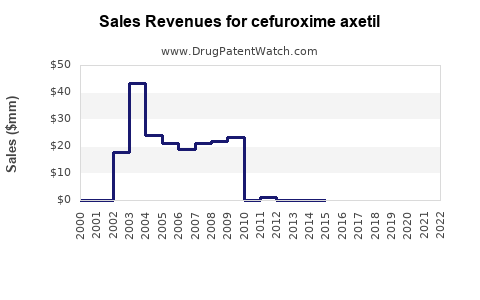
What is the current market size for Cefuroxime Axetil?
Cefuroxime Axetil is a second-generation cephalosporin antibiotic approved mainly for respiratory tract infections, urinary tract infections, and skin infections.
- Global Market (2022): Estimated at USD 1.2 billion
- Expected CAGR (2023–2028): 4.2%
This growth driven primarily by the rising prevalence of respiratory and urinary tract infections and increasing antibiotic resistance.
What are the key regional markets?
| Region |
Market Size (2022) |
CAGR (2023–2028) |
Comments |
| North America |
USD 430 million |
3.8% |
High antibiotic prescription rate |
| Europe |
USD 380 million |
4.0% |
Aging populations, resistant strains |
| Asia-Pacific |
USD 210 million |
6.1% |
Increasing healthcare access, emerging markets |
| Latin America |
USD 100 million |
4.5% |
Growing infectious disease burden |
| Middle East & Africa |
USD 70 million |
4.3% |
Market expansion, rising healthcare access |
What are the growth drivers?
- Rising incidence of infections, especially respiratory and urinary tract.
- Increasing antibiotic resistance leading to higher demand for broad-spectrum agents like Cefuroxime Axetil.
- Improving healthcare infrastructure in emerging markets.
- Growing awareness among physicians regarding second-generation cephalosporins.
What are key competitive elements?
- Generic availability lowers price points, boosting volume sales.
- Limited R&D pipeline compared to newer antibiotics.
- Biotech firms exploring combination therapies involving Cefuroxime.
What are the sales projections?
| Year |
Projected Global Sales |
Assumptions |
| 2023 |
USD 1.27 billion |
Continued demand in established markets |
| 2024 |
USD 1.33 billion |
Increased penetration in Asia-Pacific markets |
| 2025 |
USD 1.40 billion |
Rising resistance levels drive demand |
| 2026 |
USD 1.48 billion |
Product launches in combination therapies |
| 2027 |
USD 1.56 billion |
Price adjustments and market expansion |
What risks could impact these projections?
- Regulatory changes, including stricter antibiotic use policies.
- Development of resistance reducing efficacy.
- Patent expirations for key formulations, increasing generic competition.
- Public health campaigns reducing unnecessary antibiotic use.
What is the outlook for future growth?
Sales are projected to grow at a compound annual growth rate of around 4.2% through 2028. The Asia-Pacific region is expected to lead growth with a CAGR exceeding 6%, driven by increasing healthcare infrastructure and rising infectious disease burden.
Key Takeaways
- The global Cefuroxime Axetil market reached USD 1.2 billion in 2022.
- Growth is driven by rising infections and antibiotic resistance, with Asia-Pacific leading expansion.
- Generic availability keeps prices competitive but limits R&D investments.
- Market projection anticipates USD 1.56 billion in sales by 2027.
- Risks include regulatory shifts and emerging resistance patterns.
FAQs
1. How does Cefuroxime Axetil compare to other second-generation cephalosporins?
It offers broad-spectrum activity with favorable oral bioavailability, making it preferred for outpatient therapy compared to IV formulations.
2. Which companies dominate the Cefuroxime Axetil market?
Pfizer, GlaxoSmithKline, and Sandoz hold significant shares through generic and branded formulations.
3. Are there any upcoming formulations or combinations?
Some firms are developing combination therapies with beta-lactamase inhibitors, though none are yet approved specifically for Cefuroxime Axetil.
4. What are the major indications for Cefuroxime Axetil?
Respiratory tract infections, urinary tract infections, and skin infections.
5. How is antibiotic resistance influencing market growth?
It increases demand for broad-spectrum agents; however, resistance may limit long-term efficacy. Public health initiatives aim to curb overuse.
References
- MarketsandMarkets. (2022). Antibiotics Market by Type, Application, and Region—Global Forecast to 2028.
- IQVIA. (2023). Global Antibiotics Market Data.
- GlobalData. (2023). Infectious Disease & Antibiotics Market Report.
- World Health Organization. (2021). Global report on antimicrobial resistance.