Last updated: February 20, 2026
What is VYFEMLA?
VYFEMLA (lidocaine topical system 1.8%) is a transdermal patch approved by the U.S. Food and Drug Administration (FDA) in November 2021. It is indicated for tattoo anesthesia, providing localized pain relief before tattoo procedures. The product is manufactured by Colgate-Palmolive in collaboration with Sorrento Therapeutics.
Market Overview
Target Market
VYFEMLA addresses the niche market of temporary local anesthesia for tattooing. The primary consumers are professional tattoo studios, cosmetic clinics, and individual consumers planning tattoos. The rise in global tattoo procedures fuels demand.
Market Size and Growth Drivers
- Global tattoo market: Estimated at USD 3.8 billion in 2022, with a Compound Annual Growth Rate (CAGR) of approximately 8%, projected to reach USD 6.2 billion by 2026.[1]
- Tattoo procedures per year: Over 65 million globally in 2022, with demand increasing in North America, Europe, and Asia-Pacific.
- Pain Management Trends: Increasing focus on minimally invasive, topical pain relief options as alternatives to injectable anesthetics.
Regulatory Environment
VYFEMLA has gained regulatory approval predominantly in the U.S. and European markets, with potential for expansion into other regions like Asia-Pacific, contingent on local approvals. No major regulatory hurdles are forecasted in the short term.
Competitive Landscape
VYFEMLA’s main competitors include:
- LATISSE: A topical anesthetic that is used off-label for tattoo anesthesia.
- Lidocaine creams and gels: OTC products with limited efficacy for tattooing, such as EMLA (lidocaine/prilocaine), which require longer application times.
- Other innovations: Non-lidocaine-based patches and devices.
VYFEMLA distinguishes itself with rapid onset (within 30 minutes) and sustained local anesthesia (up to 2 hours), providing an advantage over traditional topical anesthetics.
Market Penetration Strategy
- Distribution channels include tattoo studios, clinics, dermatologists, and retail pharmacies.
- Focus on partnerships with major tattoo chains and cosmetic chains.
- Marketing emphasizes convenience, quick onset, and minimal preparation time.
Sales Projections
Assumptions
- Initial launch in the U.S. market in Q4 2021.
- Target capture of 10% of the tattoo anesthesia market within the first year.
- Penetration growth at 12% annually, driven by brand recognition and increased tattoo procedures.
- Average price per patch at USD 30.
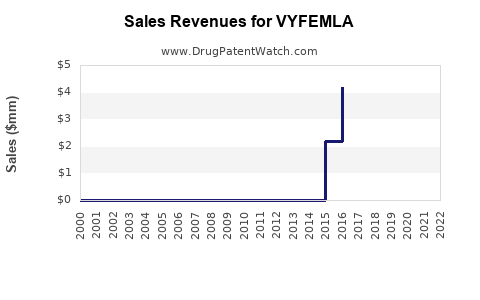
Year 1 (2022)
- Estimated tattoos in the U.S.: 15 million.
- Estimated percentage of tattoos requiring anesthesia: 20% (3 million).
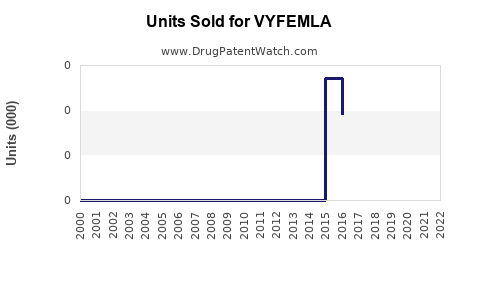
- Market share: 10% (300,000 patches).
- Sales volume: 300,000 patches.
- Revenue: USD 9 million.
Year 3 (2024)
- Estimated tattoos: 25 million.
- Percentage requiring anesthesia: 22% (5.5 million).
- Market share: 15% (825,000 patches).
- Revenue: USD 24.75 million.
Year 5 (2026)
- Estimated tattoos: 30 million.
- Percentage requiring anesthesia: 25% (7.5 million).
- Market share: 20% (1.5 million patches).
- Revenue: USD 45 million.
Risks and Challenges
- Slow adoption due to conservative tattoo industry practices or regulatory delays in international markets.
- Competition from established OTC products.
- Price sensitivity among consumers and tattoo studios.
International Expansion
European markets could emulate the U.S. launch with initial penetration of 10-15%, reaching USD 10-15 million in sales over three years post-launch. Asian markets show high growth potential due to increasing tattoo popularity; however, approval timelines may extend.
Key Takeaways
- The global tattoo market is expanding at approximately 8% CAGR, providing a growing opportunity for topical anesthetic products.
- VYFEMLA's initial sales are conservative but scalable with increased market penetration.
- By year five, sales could reach USD 45 million domestically, with significant international upside subject to regulatory pathways.
- Marketing strategies and partnerships will significantly influence adoption rates and revenue progression.
FAQs
1. How quickly does VYFEMLA onset?
It begins anesthetizing within 30 minutes of application.
2. What is the primary differentiator of VYFEMLA?
Rapid onset, localized anesthesia, and ease of use compared to traditional lidocaine creams.
3. What regulatory hurdles are expected outside the U.S.?
European approval has been granted, with pending or future approvals in Asia-Pacific, contingent on local regulatory processes.
4. Who are the main competitors?
OTC lidocaine creams, off-label use of LATISSE, and emerging device-based solutions.
5. What market segments are targeted for distribution?
Tattoo studios, cosmetic clinics, dermatologists, and retail pharmacies.
References
- Grand View Research. (2022). Tattoo Market Size, Share & Trends Analysis Report.