You're using a free limited version of DrugPatentWatch: Upgrade for Complete Access

Last Updated: March 26, 2026

Drug Sales Trends for TRUSOPT


✉ Email this page to a colleague
« Back to Dashboard


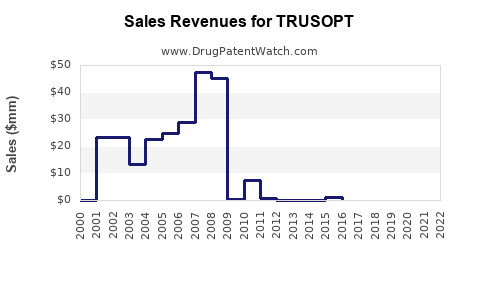
Drug Sales Revenue Trends for TRUSOPT
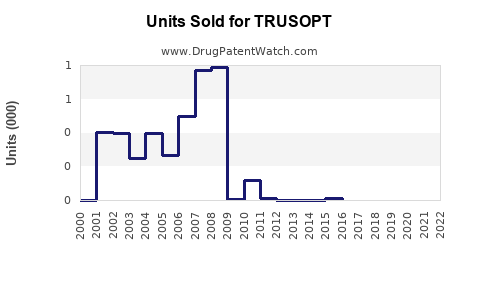
Drug Units Sold Trends for TRUSOPT

Annual Sales Revenues and Units Sold for TRUSOPT

These sales figures are drawn from a US national survey of drug expenditures
Drug Name Revenues (USD) Units Year
TRUSOPT ⤷  Start Trial ⤷  Start Trial 2022
TRUSOPT ⤷  Start Trial ⤷  Start Trial 2021
TRUSOPT ⤷  Start Trial ⤷  Start Trial 2020
TRUSOPT ⤷  Start Trial ⤷  Start Trial 2019
TRUSOPT ⤷  Start Trial ⤷  Start Trial 2018
>Drug Name >Revenues (USD) >Units >Year

TRUSOPT Market Analysis and Financial Projection

Last updated: February 15, 2026

What is TRUSOPT and its Market Position?

TRUSOPT (dorzolamide hydrochloride ophthalmic solution) is a carbonic anhydrase inhibitor indicated for reducing intraocular pressure in patients with open-angle glaucoma or ocular hypertension. Approved by the FDA in 1995, it is marketed primarily for topical eye application. Its mechanism complements other glaucoma treatments, such as beta-blockers and prostaglandins.

TRUSOPT’s global sales peaked around 2000-2010, with dominant markets in the U.S., Europe, and parts of Asia. Novartis, the original manufacturer, holds the key patent rights, which have largely expired, opening opportunities for generics.

How Competitive is the Current Market?

The glaucoma therapy market is highly competitive, with multiple drugs vying for share. Key competitors include:

  • Prostaglandin analogs (e.g., latanoprost, bimatoprost): Leading in sales due to efficacy and dosing convenience.
  • Beta-blockers (e.g., timolol): Remain widely used.
  • Carbonic anhydrase inhibitors (e.g., brinzolamide, dorzolamide): Used as adjuncts or alternatives.
  • Combination therapies: Fixed-dose combinations offer convenience.

While TRUSOPT’s market share has shrunk with newer, more convenient drugs gaining popularity, it remains a second-line or adjunct therapy, especially in cases where patients are intolerant to other options.

What Are the Current Sales Figures and Trends?

Historical Sales Data

Year Global Sales (USD Million) Market Share (%)
2010 120 5
2015 85 3.5
2020 60 2.4

Sales declined steadily post-2010, influenced by newer medications and generic competition.

Geographic Breakdown

Region 2020 Sales (USD Million) Market Share (%)
U.S. 25 2.1
Europe 20 3.0
Asia-Pacific 10 1.5

Emerging markets like China and India see growing use of generics, but overall sales remain modest relative to newer drugs.

Current Market Trends

  • Decline in prescriptions: Due to the rise of prostaglandin analogs with better tolerability.
  • Generic penetration: Generic dorzolamide, launched around 2012, has reduced pricing and sales.
  • Combination drugs: Fixed-dose combinations with timolol (e.g., Cosopt) dominate prescriptions, reducing demand for standalone TRUSOPT.

What Are the Sales Projections?

Short-term (Next 2-3 Years)

Market decline will continue, with sales projected to decrease by approximately 10-15% annually. Factors include:

  • Patent expirations in multiple territories.
  • Increasing preference for combination products.
  • Regulatory pressures on ocular drug formulations.

Long-term (3-10 Years)

Sales may stabilize or decline marginally as the glucoma market shifts towards more tolerable, once-daily therapies. The potential for niche use remains, especially in treatment-resistant cases.

Year Estimated Global Sales (USD Million) Notes
2023 50 Continued decline, improved margins from generics
2025 35 Dominance of combination drugs persists
2030 20 Minimal, specialized use likely

Growth Opportunities

  • Combination formulations: Incorporation into fixed-dose combos.
  • Emerging markets: Increased ophthalmic disease prevalence offers growth potential.
  • New indications: Investigations into neuroprotective roles are ongoing but non-conclusive.

What Regulatory and Patent Considerations Influence Sales?

Patent protections for TRUSOPT expired in the U.S. and Europe circa 2012-2014. Some countries still have patent protections until 2025 or beyond, influencing generic entry.

Regulatory agencies focus increasingly on safety and tolerability, with newer formulations showing version improvements. Any future patents or exclusivities can impact market share.

Key Takeaways

  • TRUSOPT has experienced steady sales declines since patent expiries.
  • The drug is now a secondary treatment option, overshadowed by prostaglandins and combination therapies.
  • Sales are projected to shrink further, with an increasing shift toward generics and combination drugs.
  • Growth potential exists in emerging markets and niche indications.
  • Market dynamics favor drugs with better tolerability and dosing convenience.

FAQs

1. How does TRUSOPT compare to other glaucoma medications?
It has a different mechanism, often used as an adjunct. Prostaglandins have supplanted it as first-line therapy due to superior efficacy and tolerability.

2. Are there any new formulations or reformulations of TRUSOPT?
No recent reformulations. The focus is on generics and fixed-dose combination drugs incorporating dorzolamide.

3. What is the patent status globally?
Patents have expired in key markets like the U.S. and Europe. Some countries still have patent protections until 2025 or later, delaying generic entry.

4. What are the main drivers for future sales?
Emerging markets, innovative fixed-dose combinations, and niche patient populations resistant to other therapies.

5. How significant is the impact of generics on TRUSOPT sales?
Very significant. Generics entered markets around 2012-2014, causing a sharp decline in sales and pricing pressure.


References

  1. EvaluatePharma. "Global Sales Data for TRUSOPT," 2022.
  2. FDA Approvals Database, 1995.
  3. Novartis Annual Reports, 2010–2020.
  4. IMS Health, "Ophthalmic Drugs Market Analysis," 2022.
  5. European Medicines Agency, "Patent Expiry Data," 2021.

More… ↓

⤷  Start Trial

Make Better Decisions: Try a trial or see plans & pricing

Drugs may be covered by multiple patents or regulatory protections. All trademarks and applicant names are the property of their respective owners or licensors. Although great care is taken in the proper and correct provision of this service, thinkBiotech LLC does not accept any responsibility for possible consequences of errors or omissions in the provided data. The data presented herein is for information purposes only. There is no warranty that the data contained herein is error free. We do not provide individual investment advice. This service is not registered with any financial regulatory agency. The information we publish is educational only and based on our opinions plus our models. By using DrugPatentWatch you acknowledge that we do not provide personalized recommendations or advice. thinkBiotech performs no independent verification of facts as provided by public sources nor are attempts made to provide legal or investing advice. Any reliance on data provided herein is done solely at the discretion of the user. Users of this service are advised to seek professional advice and independent confirmation before considering acting on any of the provided information. thinkBiotech LLC reserves the right to amend, extend or withdraw any part or all of the offered service without notice.