Drug Sales Trends for TOPROL XL
Payment Methods and Pharmacy Types for TOPROL XL (2022)
Revenues by Pharmacy Type
Units Sold by Pharmacy Type
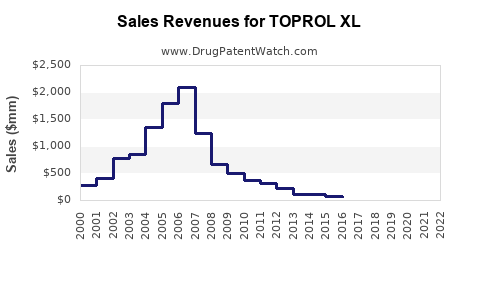
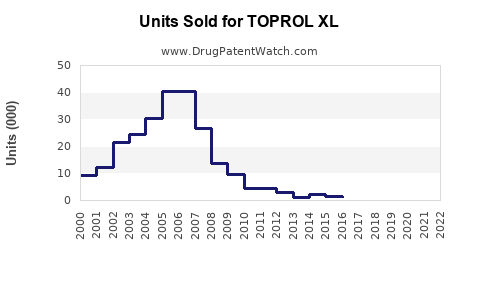
Annual Sales Revenues and Units Sold for TOPROL XL
| Drug Name | Revenues (USD) | Units | Year |
|---|---|---|---|
| TOPROL XL | ⤷ Start Trial | ⤷ Start Trial | 2022 |
| TOPROL XL | ⤷ Start Trial | ⤷ Start Trial | 2021 |
| TOPROL XL | ⤷ Start Trial | ⤷ Start Trial | 2020 |
| TOPROL XL | ⤷ Start Trial | ⤷ Start Trial | 2019 |
| TOPROL XL | ⤷ Start Trial | ⤷ Start Trial | 2018 |
| TOPROL XL | ⤷ Start Trial | ⤷ Start Trial | 2017 |
| >Drug Name | >Revenues (USD) | >Units | >Year |
Toprol XL Market Analysis, Sales Projections, Patent Status, and Generic Competition
Toprol XL, AstraZeneca’s extended-release metoprolol succinate product, is a mature cardiovascular drug with limited branded commercial value and an established generic market. The principal opportunity is generic metoprolol succinate extended release, not branded Toprol XL. Core patent barriers have expired, FDA-approved generics are widely available, and biosimilar risk is irrelevant because metoprolol succinate is a chemically synthesized small molecule.
A reasonable U.S. market outlook is continued prescription stability with declining manufacturer revenue per prescription. Depending on prescription volume and net price assumptions, U.S. sales across metoprolol succinate extended-release products could remain in an estimated $200 million to $500 million annual range through 2029. Branded Toprol XL revenue is likely immaterial relative to the total molecule market.
What is Toprol XL and how large is its market?
Toprol XL is the extended-release formulation of metoprolol succinate, a beta-1 selective adrenergic blocker. The FDA approved Toprol XL for hypertension, angina pectoris and stable, symptomatic heart failure of ischemic, hypertensive or cardiomyopathic origin. The product is administered once daily in strengths of 25 mg, 50 mg, 100 mg and 200 mg.[1]
Metoprolol succinate extended release competes with:
- Generic metoprolol succinate ER.
- Metoprolol tartrate immediate-release products.
- Carvedilol.
- Bisoprolol.
- Atenolol.
- Nebivolol.
- Other antihypertensive and heart-failure therapies, including ACE inhibitors, ARBs, ARNIs and calcium-channel blockers.
The market is prescription-driven and highly genericized. Clinical demand is supported by hypertension prevalence, post-myocardial-infarction treatment, rate control and heart-failure management. Price growth is constrained by generic substitution and multiple FDA-approved suppliers.
Estimated U.S. market profile
| Metric | Current market assessment |
|---|---|
| Active ingredient | Metoprolol succinate |
| Dosage form | Extended-release tablet |
| Primary U.S. brand | Toprol XL |
| Market maturity | Mature, generic-dominated |
| Regulatory status | FDA-approved NDA and ANDA products |
| Biosimilar exposure | None |
| Brand pricing power | Very low |
| Generic competition | High |
| Principal demand driver | Chronic cardiovascular therapy |
| Commercial growth profile | Low-volume growth, declining price per unit |
Public company reporting generally does not isolate Toprol XL revenue from broader cardiovascular portfolios. The historical product market therefore has greater analytical value at the molecule level than at the brand level.
What are the current sales projections for Toprol XL and metoprolol succinate ER?
The brand and molecule require separate forecasts. Toprol XL has lost exclusivity, while generic metoprolol succinate ER captures most U.S. prescriptions.
U.S. revenue forecast
The following scenario is an analyst estimate based on mature chronic-therapy demand, generic pricing, prescription retention and continued substitution. It is not company guidance.
| Year | U.S. metoprolol succinate ER market | Branded Toprol XL opportunity | Generic share assumption |
|---|---|---|---|
| 2025 | $220 million-$480 million | Less than $25 million | 95%-99% |
| 2026 | $215 million-$465 million | Less than $22 million | 96%-99% |
| 2027 | $210 million-$450 million | Less than $20 million | 96%-99% |
| 2028 | $205 million-$440 million | Less than $18 million | 97%-99% |
| 2029 | $200 million-$430 million | Less than $16 million | 97%-99% |
The forecast assumes:
- Prescription volume remains broadly stable, with low-single-digit annual changes.
- Generic net pricing declines by roughly 2% to 5% annually.
- No major supply disruption.
- No material expansion of branded promotion.
- Continued payer preference for low-cost generic ER metoprolol.
- Stable use of metoprolol succinate in hypertension and heart failure.
The wide range reflects uncertainty in gross-to-net discounts, channel mix, wholesaler inventory and the difficulty of isolating metoprolol succinate ER from broader metoprolol sales.
What drives future sales?
The strongest demand supports are chronic treatment duration and physician familiarity. The main constraints are substitution, low generic prices and competition from carvedilol and newer heart-failure therapies.
Metoprolol succinate remains relevant in heart failure because the FDA label includes stable, symptomatic heart failure and because guideline-directed therapy continues to use evidence-based beta blockers. In hypertension, however, the product competes against inexpensive first-line therapies, including thiazide diuretics, ACE inhibitors, ARBs and calcium-channel blockers.[1][2]
When did Toprol XL lose exclusivity?
Toprol XL lost practical market exclusivity after generic metoprolol succinate ER approvals and subsequent commercial launches. The product is no longer protected by a commercially meaningful period of reference-product exclusivity.
FDA-approved generic products entered the U.S. market in the mid-2000s. The entry process included ANDA litigation and settlements involving AstraZeneca and generic applicants. By the time multiple suppliers were active, the market had shifted from a branded monopoly to a price-competitive generic market.
Exclusivity timeline
| Period | Commercial event |
|---|---|
| 1992 | Toprol XL approval period begins with the NDA formulation and labeling framework |
| 2000s | Generic applicants pursue metoprolol succinate ER ANDAs |
| Mid-2000s | FDA generic approvals and commercial generic launches begin |
| Late 2000s onward | Multiple generic suppliers erode branded share |
| 2010s | U.S. commercial value becomes predominantly generic |
| 2025 onward | No meaningful branded exclusivity remains |
FDA Orange Book listings should be reviewed for the live status of any residual patents or exclusivity codes associated with NDA 019962. Those listings do not restore commercial exclusivity where the relevant patent terms have expired or generic approvals are already established.[3]
What patents protect Toprol XL?
The historical Toprol XL patent estate centered on the controlled-release metoprolol formulation and related delivery technology. The primary commercial issue was not a biologic composition patent but the ability to manufacture a once-daily extended-release dosage form.
Historical patent categories
| Patent category | Relevance to Toprol XL | Current commercial effect |
|---|---|---|
| Controlled-release formulation | Controls release of metoprolol over an extended period | Core patents expired or no longer block generic supply |
| Tablet composition | Supports dosage-form performance and stability | Limited present barrier |
| Manufacturing process | Can protect production methods | Potentially relevant only if a live, enforceable claim remains |
| Method of treatment | Covers use in hypertension, angina or heart failure | Generally weak against routine generic substitution |
| Labeling | Defines FDA-approved indications and dosing | Does not create meaningful market exclusivity alone |
The key patent issue for generic applicants was whether their metoprolol succinate ER products infringed the formulation claims and whether the claims were valid. Once the principal formulation patents expired or were overcome through litigation and settlement, generic entry became commercially durable.
What is the Orange Book status of Toprol XL?
Toprol XL is associated with FDA NDA 019962. The Orange Book identifies approved drug products and may list patents submitted by the NDA holder. An Orange Book listing does not itself establish that every claim is enforceable, valid or capable of blocking an ANDA product.[3]
For commercial diligence, the relevant conclusions are:
- Toprol XL is an established FDA-approved reference product.
- Generic metoprolol succinate ER products have long been approved.
- The product does not have a current, effective market monopoly.
- Any residual Orange Book listing must be assessed against expiration, pediatric extensions, litigation outcomes and the scope of the asserted claims.
- Regulatory approval risk for a new generic is substantially lower than the patent risk was during the original litigation period.
Which companies compete with Toprol XL?
Competition exists at both the product and manufacturer levels.
Generic manufacturers
The U.S. metoprolol succinate ER market has included products from large generic manufacturers such as:
- Mylan, now part of Viatris.
- Sandoz.
- Dr. Reddy’s Laboratories.
- Wockhardt.
- Lupin.
- Par Pharmaceutical.
- Zydus.
- Sun Pharmaceutical Industries.
- Other ANDA holders and authorized distributors.
Supplier participation can change because of manufacturing economics, FDA compliance actions, shortages and portfolio rationalization. The market tends to reward manufacturers with reliable supply, low cost of goods and broad wholesaler access.
Therapeutic competitors
| Product | Active ingredient | Competitive position |
|---|---|---|
| Toprol XL | Metoprolol succinate ER | Once-daily beta blocker; mature brand |
| Lopressor | Metoprolol tartrate | Immediate-release metoprolol |
| Coreg | Carvedilol | Heart-failure and hypertension competitor |
| Zebeta | Bisoprolol | Beta-1 selective alternative |
| Tenormin | Atenolol | Older low-cost beta blocker |
| Bystolic | Nebivolol | Branded or generic beta blocker |
| Entresto | Sacubitril/valsartan | Different class; heart-failure competitor |
| ACE inhibitors and ARBs | Multiple | Major hypertension alternatives |
Toprol XL is strongest where prescribers value once-daily dosing, familiarity and established heart-failure use. It is weaker where treatment guidelines favor other drug classes or where the payer emphasizes lowest acquisition cost.
Are there Paragraph IV challenges to Toprol XL?
Historically, generic applicants used Paragraph IV certifications to challenge Toprol XL-related patents. A Paragraph IV certification states that a listed patent is invalid, unenforceable or not infringed. Such certifications can trigger Hatch-Waxman litigation and, in some circumstances, a 30-month stay of FDA approval.[4]
The commercially important Paragraph IV period has passed. Generic competition is already established, so a new Paragraph IV filing would not recreate the historical exclusivity contest. A later entrant would compete against approved generic suppliers rather than against a protected branded monopoly.
What litigation affected Toprol XL?
Toprol XL litigation focused on formulation patents, generic ANDA applications and the timing of market entry. AstraZeneca pursued patent claims against generic applicants, while generic companies challenged the validity and scope of the listed patents.
The practical outcome was market entry by generic metoprolol succinate ER products. Any historical settlement agreements should be interpreted primarily as entry-timing arrangements, not as evidence of continuing brand protection.
Are settlement agreements still relevant to Toprol XL?
Historical settlements can matter for reconstructing when generic manufacturers entered and whether entry was authorized, licensed or delayed. They have limited impact on current valuation because the market is already genericized.
For diligence, settlement documents should be reviewed for:
- Agreed launch dates.
- Authorized-generic rights.
- Restrictions on dosage strengths.
- Supply or distribution arrangements.
- Clauses affecting damages or patent claims.
- Whether the agreement was reviewed under the Federal Trade Commission’s pharmaceutical settlement framework.
Current commercial exposure is determined more by supplier economics and FDA manufacturing status than by the original settlement terms.
What generic entry risks exist for Toprol XL?
The principal risk is not future generic entry. It is further price compression among existing generic suppliers.
Generic risk matrix
| Risk | Probability | Commercial impact |
|---|---|---|
| Additional ANDA entrants | Medium | Moderate price pressure |
| Existing supplier withdrawal | Medium | Temporary supply volatility |
| FDA manufacturing warning | Low to medium | Potential short-term shortage |
| Brand relaunch | Low | Limited effect |
| Patent-based blocking action | Very low | Minimal |
| Therapeutic substitution | Medium | Gradual volume pressure |
| Payer formulary changes | Medium | Share shifts among suppliers |
A new manufacturer could enter if it has efficient extended-release tablet technology, reliable API supply and a competitive distribution network. The opportunity is stronger in contract manufacturing or private-label supply than in branded commercialization.
What manufacturing and intellectual-property barriers remain?
The active ingredient is commercially established, and API supply is available from multiple global manufacturers. The remaining barriers are operational:
- Consistent extended-release dissolution performance.
- Control of tablet coating or matrix-release technology.
- Bioequivalence across strengths.
- Stability and packaging.
- FDA inspection readiness.
- Reliable metoprolol succinate API sourcing.
- Sufficient scale to withstand low generic prices.
Manufacturing know-how can provide a practical advantage even when patent protection is weak. A supplier that produces at lower cost or avoids quality failures can maintain share in a low-margin market.
How strong is the Toprol XL patent estate?
The patent estate is commercially weak for blocking purposes and historically important for understanding generic entry. The core formulation protection no longer supports a branded monopoly. Method-of-use patents are difficult to enforce against ordinary pharmacy substitution when the generic label carries the relevant indication or when physicians prescribe the product without relying on a narrow patented method.
Patent strength should therefore be rated as follows:
| Dimension | Assessment |
|---|---|
| Core composition patent | Low current relevance |
| Extended-release formulation patent | Historical significance; weak current blocking power |
| Method-of-use protection | Low to moderate, depending on claim scope |
| Manufacturing patents | Potentially relevant for individual processes |
| Orange Book leverage | Limited |
| Litigation leverage | Low |
| Overall estate strength | Low for current market exclusion |
What is the outlook for licensing and M&A?
Licensing interest is likely to focus on supply rather than on the Toprol XL brand. Potential transactions could involve:
- Regional commercialization rights.
- Private-label generic supply.
- Authorized-generic distribution.
- API and finished-dose manufacturing.
- Portfolio acquisitions involving multiple cardiovascular generics.
A standalone acquisition of Toprol XL would have limited strategic value unless it includes manufacturing assets, distribution contracts or a broader cardiovascular portfolio. The product could still be useful as a cash-flow or channel product in markets where generic substitution is less complete.
Is there biosimilar risk for Toprol XL?
No. Metoprolol succinate is a small-molecule active ingredient, not a biologic. The relevant competitive pathway is the abbreviated new drug application, not the biosimilar pathway under the Public Health Service Act.
Competitive threats come from ANDA products, therapeutic substitution and pricing, not biosimilar development.
Key Takeaways
- Toprol XL is a mature, generic-dominated cardiovascular product.
- The commercial market is metoprolol succinate extended release, not the branded product.
- U.S. molecule sales are reasonably estimated at $200 million to $500 million annually through 2029, subject to prescription and net-price assumptions.
- Branded Toprol XL revenue is likely below $25 million annually in the current market structure.
- Core formulation patents no longer provide meaningful exclusionary power.
- Historical Paragraph IV litigation and settlements explain generic entry but do not materially constrain current competition.
- Generic manufacturers compete primarily on cost, supply reliability and FDA compliance.
- Biosimilar risk is not applicable.
- The strongest investment opportunity is in efficient manufacturing, private-label supply or portfolio aggregation rather than brand promotion.
FAQs
How long does metoprolol succinate ER stay in the market?
Metoprolol succinate ER should remain a durable product because it is used for chronic cardiovascular treatment, has low manufacturing complexity relative to newer therapies and is supported by established clinical familiarity.
Is Toprol XL still sold under the brand name?
Brand availability can vary by channel and market. FDA-approved generic metoprolol succinate ER products account for most U.S. demand, making branded availability commercially secondary.
Can a generic manufacturer still challenge a Toprol XL patent?
A manufacturer can file a Paragraph IV certification against a listed patent if a relevant patent remains listed. That filing would have limited commercial significance unless the patent were unexpired, enforceable and capable of blocking an already genericized market.
Does Toprol XL have an authorized generic?
Authorized-generic status can vary by distributor and time period. An authorized generic is generally marketed under an ANDA or equivalent generic labeling arrangement and does not restore brand exclusivity.
Which metoprolol product has stronger growth prospects?
Metoprolol succinate ER has the stronger long-term position than the brand because it benefits from generic volume and once-daily dosing. Growth is likely modest, while revenue per prescription remains under pressure.
References
- U.S. Food and Drug Administration. (2022). Toprol-XL (metoprolol succinate) extended-release tablets prescribing information. FDA.
- Heidenreich, P. A., Bozkurt, B., Aguilar, D., et al. (2022). 2022 AHA/ACC/HFSA guideline for the management of heart failure. Circulation, 145(18), e895-e1032.
- U.S. Food and Drug Administration. (2025). Approved drug products with therapeutic equivalence evaluations: Orange Book. FDA.
- U.S. Food and Drug Administration. (2024). ANDA submissions: Amendments and considerations. FDA.
More… ↓
