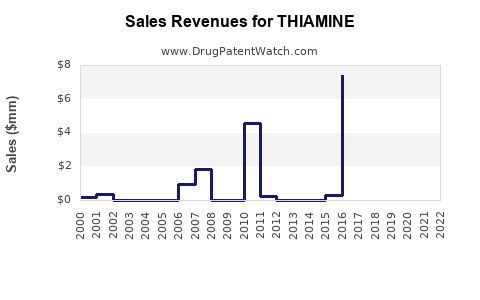
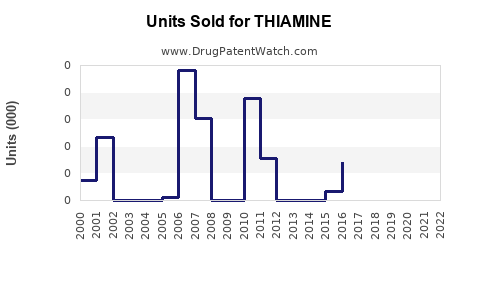
Market Analysis and Sales Projections for Thiamine (Vitamin B1)
Last updated: March 8, 2026
Thiamine (Vitamin B1) is a water-soluble vitamin used primarily to prevent and treat thiamine deficiency, which can lead to conditions such as wet and dry beriberi and Wernicke-Korsakoff syndrome. The global market for thiamine is driven by increasing awareness of nutritional deficiencies, aging populations, and expanding application in medical and dietary supplements.
Market Overview
Market Size (2022-2027)
Year
Market Size (USD billion)
CAGR (Compound Annual Growth Rate)
2022
0.9
N/A
2023
0.96
6.7%
2024
1.03
7.3%
2025
1.09
6.1%
2026
1.16
6.4%
2027
1.23
6.0%
The market is projected to grow at approximately 6-7% annually, reaching approximately $1.23 billion by 2027.
Key Drivers
Rising prevalence of nutritional deficiencies globally.
Growing use in clinical treatments for conditions linked to thiamine deficiency.
Expansion of dietary supplement formulations.
Increased focus on health and wellness among aging populations.
Rising adoption in fortified foods and beverages.
Geographical Breakdown (2022)
Region
Market Share
Key Trends
North America
40%
High supplement consumption; established supply chains
Europe
25%
Aging population; medical applications expanding
Asia-Pacific
25%
Rapid economic growth; increasing health awareness
Rest of World
10%
Growing demand in Africa, Latin America
Competitive Landscape
Major players include:
BASF SE
Shandong Freda Biochem Co., Ltd.
Jiangsu Johnson Pharmaceutical Co., Ltd.
DSM Nutritional Products
Zhejiang Xinruisi Pharmaceutical Co., Ltd.
Market entry requires regulatory approval (e.g., FDA, EMA), quality standards adherence, and supply chain robustness, especially for pharmaceutical-grade ingredients.
Applications and Sales Projections
Primary Application Areas
Pharmaceutical formulations for deficiency treatment (50% of sales)
Fluctuations in demand due to changing health trends.
Competition from synthetic alternatives and cheaper imports.
Limited differentiation among existing products.
Key Takeaways
The global thiamine market is growing at a compound rate of approximately 6-7% through 2027.
Growth is propelled by rising nutritional awareness, aging populations, and expanding clinical use.
North America and Europe dominate sales but growth in Asia-Pacific offers significant upside.
Key applications include pharmaceutical treatments, dietary supplements, and fortified foods.
Market entry demands compliance with rigorous quality standards and regulatory approval processes.
FAQs
What are the main factors influencing thiamine demand?
Increasing awareness of nutritional deficiencies, prevalence of chronic conditions linked to vitamin B1 deficiency, and growth in dietary supplement consumption.
Which regions are expected to see the fastest growth?
Asia-Pacific markets are expected to grow faster due to rising health awareness and improving healthcare infrastructure.
What regulatory considerations apply to manufacturing thiamine?
Compliance with FDA (USA), EMA (Europe), and local regulatory standards is mandatory, including Good Manufacturing Practices (GMP) and safety assessments.
How are new formulations impacting the market?
Innovations in bioavailability, stability, and delivery methods (e.g., injectables, sustained-release capsules) are expanding market applications.
What are the main challenges for new entrants?
High entry barriers include regulatory approval, establishing reliable suppliers, and competing on price in a commodity market.
Drugs may be covered by multiple patents or regulatory protections. All trademarks and applicant names are the property of their respective owners or licensors.
Although great care is taken in the proper and correct provision of this service, thinkBiotech LLC does not accept any responsibility for possible consequences of errors or omissions in the provided data.
The data presented herein is for information purposes only. There is no warranty that the data contained herein is error free.
We do not provide individual investment advice. This service is not registered with any financial regulatory agency. The information we publish is educational only and based on our opinions plus our models.
By using DrugPatentWatch you acknowledge that we do not provide personalized recommendations or advice.
thinkBiotech performs no independent verification of facts as provided by public sources nor are attempts made to provide legal or investing advice. Any reliance on data provided herein is done solely at the discretion of the user.
Users of this service are advised to seek professional advice and independent confirmation before considering acting on any of the provided information. thinkBiotech LLC reserves the right to amend, extend or withdraw any part or all of the offered service without notice.
Alerts Available With Subscription
Alerts are available for users with active subscriptions.