Last updated: February 20, 2026
What is the current market size for SUBOXONE?
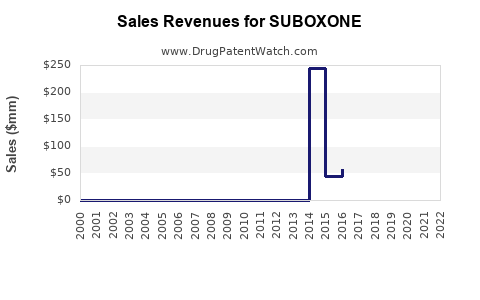
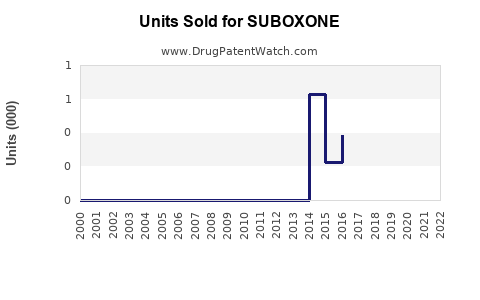
SUBOXONE (buprenorphine/naloxone) is a leading medication used to treat opioid use disorder (OUD). As of 2022, the global market was valued at approximately $1.8 billion, with North America accounting for over 80% of sales due to high prevalence of OUD and supportive regulatory frameworks [1].
How does the competitive landscape look?
Major competitors include:
- Zubsolv (optimized buprenorphine/naloxone)
- Sublocade (monthly injectable form)
- Probuphine (implantable delivery system)
Generic formulations entered the market in 2020 after patent expirations, exerting downward pressure on prices. The market is highly concentrated, with brands from Indivior and Hikma leading.
What are the key market drivers?
- Rising prevalence of opioid dependence: The CDC estimates 2.7 million Americans have OUD [2].
- Increasing approval and adoption of sublingual formulations.
- Expansion of outpatient treatment programs.
- Regulatory policies favoring medication-assisted treatment (MAT).
What are the recent regulatory developments?
- The FDA approved Sublocade in 2017 for monthly injections.
- A DEA rule in 2021 eased prescribing restrictions for buprenorphine for treatment settings with up to 30 patients initially, expanding prescriber access.
- The US government increased funding to expand MAT services through 2025 [3].
How is the sales forecast expected to change?
Projection models anticipate the global SUBOXONE market will grow at a compound annual growth rate (CAGR) of approximately 8% from 2022 to 2027.
| Year |
Projected Market Size (USD billion) |
| 2022 |
1.8 |
| 2023 |
1.94 |
| 2024 |
2.09 |
| 2025 |
2.25 |
| 2026 |
2.43 |
| 2027 |
2.62 |
This growth is driven by increased treatment adoption, new formulations, and expanded access. The impact of generics will moderate growth but not negate it, as brand loyalty and formulary preferences continue.
What are the sales outlooks for key regions?
North America
Expected to maintain dominance with projected sales reaching $2.1 billion by 2027. The US accounts for roughly 85% of global sales due to high OUD prevalence and supportive policies. Growth will remain driven by increased treatment rates and new delivery options such as long-acting injectables.
Europe
Market expansion driven by regulatory approvals. Estimated to reach $400 million by 2027, growing at around 7% CAGR. Variations in healthcare policies and opioid addiction prevalence influence pace.
Rest of the World
Emerging markets show potential but slow adoption due to regulatory and pricing challenges. Foreseeable growth at 5% CAGR, reaching approximately $120 million.
What factors could restrain or accelerate sales?
Restraints
- Price competition from generics.
- Stigma associated with OUD treatment.
- Regulatory hurdles in certain markets.
Accelerators
- Increased government funding.
- Expansion of telemedicine for OUD.
- Development of longer-acting formulations.
Key Takeaways
- The global SUBOXONE market is expected to grow at a CAGR of 8% through 2027.
- North America, led by the US, dominates sales, with projections to reach $2.1 billion.
- Market growth hinges on increased treatment accessibility, formulary coverage, and innovation in delivery methods.
- Competition from generics and pricing pressures could moderate growth.
- Expansion into international markets offers future growth potential.
FAQs
1. What are the main drivers of SUBOXONE sales?
Prevalence of OUD, regulatory support, approval of new formulations, and increased treatment access.
2. How will generics affect the market?
The entry of generic buprenorphine/naloxone will reduce prices, impacting brand revenues but still allow for growth due to continued demand.
3. Are there new formulations in development?
Yes. Extended-release injectables and implantable systems are in late-stage development, potentially boosting sales.
4. What regions offer the most growth opportunity?
North America remains dominant, but emerging markets like Asia and Latin America are expanding rapidly due to increased awareness and regulatory changes.
5. How does regulatory policy influence sales?
Easing prescribing restrictions and expanding treatment access directly increase patient uptake and sales volume.
References
[1] MarketWatch. (2022). Global buprenorphine market size. MarketWatch.
[2] CDC. (2022). Opioid overdose data. Centers for Disease Control and Prevention.
[3] U.S. Department of Health and Human Services. (2021). Funding for opioid treatment expansion. HHS.