Share This Page
Drug Sales Trends for SOLARAZE
✉ Email this page to a colleague
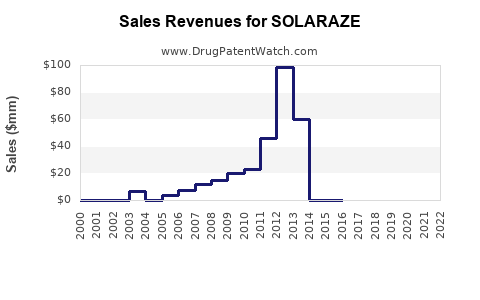
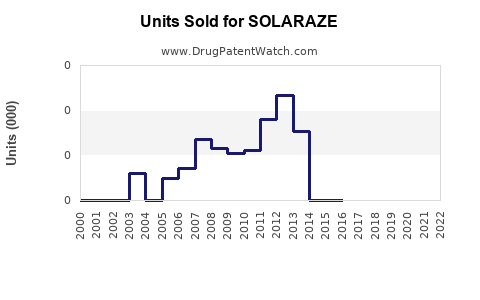
Annual Sales Revenues and Units Sold for SOLARAZE
| Drug Name | Revenues (USD) | Units | Year |
|---|---|---|---|
| SOLARAZE | ⤷ Start Trial | ⤷ Start Trial | 2022 |
| SOLARAZE | ⤷ Start Trial | ⤷ Start Trial | 2021 |
| SOLARAZE | ⤷ Start Trial | ⤷ Start Trial | 2020 |
| >Drug Name | >Revenues (USD) | >Units | >Year |
SOLARAZE Market Analysis, Patent Status, Competitive Landscape, and Sales Projections
SOLARAZE is a topical diclofenac sodium 3% gel approved in the United States for the treatment of actinic keratoses. Its commercial opportunity is constrained by generic competition, low treatment duration, limited differentiation from other actinic-keratosis therapies, and the absence of meaningful remaining exclusivity. The product remains commercially relevant as a prescription topical, but its brand revenue potential is limited.
Public sources do not report reliable standalone SOLARAZE sales. The projections below therefore use market-based scenarios rather than company guidance.
What is SOLARAZE and what is it approved to treat?
SOLARAZE contains diclofenac sodium at a concentration of 3% in a topical gel formulation. The FDA-approved indication is the topical treatment of actinic keratoses in adults. The product is generally applied twice daily for approximately 60 to 90 days, depending on the prescribing information and clinical circumstances (U.S. Food and Drug Administration, 2000).
Actinic keratosis is a precancerous skin lesion caused primarily by cumulative ultraviolet exposure. Treatment demand is driven by:
- An aging population
- Higher skin-cancer screening rates
- Long-term sun exposure
- Dermatology visits and diagnosis rates
- Patient preference for field-directed rather than lesion-directed treatment
SOLARAZE is used as a field therapy. It treats visible lesions and areas of subclinical damage across a broader skin surface than lesion-directed procedures such as cryotherapy.
SOLARAZE product profile
| Attribute | SOLARAZE |
|---|---|
| Active ingredient | Diclofenac sodium |
| Strength | 3% topical gel |
| Dosage form | Prescription topical gel |
| Main indication | Actinic keratosis |
| Route | Topical |
| Typical treatment period | Approximately 60 to 90 days |
| Original U.S. approval | 2000 |
| Regulatory pathway | New Drug Application |
| Current competitive status | Generic diclofenac sodium 3% gel competition |
| Biosimilar relevance | None |
| Primary prescribers | Dermatologists, primary-care physicians, advanced practice clinicians |
What is the FDA regulatory status of SOLARAZE?
SOLARAZE was approved by the FDA through an NDA for actinic keratosis. Generic diclofenac sodium 3% gel products subsequently entered the market through abbreviated new drug applications.
The product is not a biologic and does not face biosimilar competition. Its competitive exposure comes from ANDA-approved generic products that rely on the reference product’s safety and efficacy findings while demonstrating pharmaceutical equivalence and bioequivalence or applicable product-specific requirements.
The FDA regulatory issues that matter commercially are:
- Whether the brand remains marketed by its listed sponsor.
- Whether generic manufacturers maintain active product listings.
- Whether supply interruptions affect pharmacy substitution.
- Whether revised labeling or safety information changes prescribing behavior.
- Whether a manufacturer obtains a meaningful formulation, device, or use patent.
No major regulatory exclusivity remains associated with the original approval based on the public approval timeline.
When does SOLARAZE lose exclusivity?
SOLARAZE has already lost meaningful regulatory and patent exclusivity.
The original approval occurred in 2000. Any five-year new chemical entity exclusivity associated with the original NDA would have expired no later than 2005. If pediatric exclusivity was granted, it could have extended exclusivity by six months, but that period would also have expired long ago.
The original product also had formulation and topical-delivery patent protection associated with diclofenac gel technology. Those rights do not provide a current barrier to ordinary generic entry.
| Exclusivity category | Approximate status |
|---|---|
| Original NDA approval | 2000 |
| Five-year NCE exclusivity | Expired by approximately 2005 |
| Pediatric exclusivity | No current commercial effect |
| Original formulation patents | Expired or no longer commercially blocking |
| Current generic entry barrier | Low |
| Current brand exclusivity | None of material commercial duration |
Patent expiration dates depend on the specific patent, terminal disclaimers, patent-term adjustments, and jurisdiction. The commercial conclusion is unchanged: generic diclofenac sodium 3% gel has been available, and SOLARAZE does not have a durable U.S. exclusivity position.
What patents protect SOLARAZE?
The original intellectual-property position centered on topical diclofenac formulations and their use in dermatologic conditions, including actinic keratosis. Earlier patents associated with diclofenac gel technology included formulation claims directed to the composition, vehicle, and topical delivery of diclofenac.
The original Solaraze-related estate is no longer a significant blocking portfolio. Relevant patent categories include:
| Patent category | Commercial status |
|---|---|
| Diclofenac topical formulation | Legacy protection; generally expired |
| Gel vehicle and penetration technology | Legacy protection; generally expired |
| Actinic-keratosis treatment method | Any original rights no longer provide effective market exclusivity |
| Manufacturing process | Potentially relevant to cost and quality, but not a broad entry barrier |
| Device or packaging | Limited strategic value for a conventional tube product |
| New combination or delivery technology | Potential future protection, but not part of the established SOLARAZE product |
The central patent risk is therefore low for a conventional diclofenac sodium 3% gel. A competitor could still face formulation-specific patents if it develops a materially different vehicle, delivery system, or combination product. Those rights would protect the new product rather than restore exclusivity to the legacy SOLARAZE brand.
What is the Orange Book status of SOLARAZE?
The FDA Orange Book identifies approved drug products and, where applicable, listed patents and exclusivity. SOLARAZE’s original Orange Book position does not create a current commercial barrier comparable to an actively protected branded medicine.
A generic applicant seeking approval for diclofenac sodium 3% gel could rely on an ANDA pathway and address any listed patents through the applicable certification. Because the core product is now mature, the practical market question is not whether a Paragraph IV challenge could be filed, but whether a generic manufacturer can achieve adequate scale and pharmacy distribution.
What is the Paragraph IV challenge risk?
The Paragraph IV risk to SOLARAZE is historical rather than prospective. Generic applicants would have had an incentive to challenge any unexpired listed patent that blocked approval. Once relevant patents expired or ceased to block launch, the commercial dispute shifted from patent litigation to price, supply, and distribution.
For a new patent involving a reformulated diclofenac gel, Paragraph IV risk would depend on:
- The scope of the claims
- Whether the claims cover the generic’s formulation
- The Orange Book listing
- The expected remaining patent term
- The commercial value of the product
- The cost of litigation compared with expected launch profits
How strong is the SOLARAZE patent estate?
The current SOLARAZE patent estate is weak as a source of market exclusivity.
Strength assessment
| Factor | Assessment |
|---|---|
| Core composition protection | Weak or expired |
| Method-of-use protection | Weak for the original indication |
| Formulation differentiation | Limited |
| Manufacturing barriers | Low to moderate |
| Generic substitution resistance | Low |
| Litigation leverage | Low |
| Ability to support premium pricing | Low |
| Potential for lifecycle management | Moderate only with a new formulation or delivery system |
The main remaining defensible assets are brand recognition, prescriber familiarity, manufacturing quality, supply reliability, and any commercial relationships. These are business advantages, not patent exclusivity.
What formulations are protected by SOLARAZE?
The commercial product is a 3% diclofenac sodium gel designed for topical delivery to actinic keratoses. The formulation’s value comes from balancing:
- Diclofenac solubility
- Skin penetration
- Local concentration
- Product stability
- Patient tolerability
- Spreadability and drying time
- Packaging and shelf life
A generic product does not need to duplicate every inactive ingredient. It must meet FDA requirements for pharmaceutical equivalence and therapeutic substitutability under the applicable ANDA framework.
Formulation innovation could create a new commercial opportunity if it produces measurable improvements in:
- Shorter treatment duration
- Better adherence
- Lower irritation
- Improved cosmetic acceptability
- More consistent drug delivery
- Easier application
- Extended shelf life
Without those advantages, a reformulated product would likely compete on price in an already genericized category.
How does SOLARAZE compare with competing actinic-keratosis treatments?
SOLARAZE competes with several prescription and procedural options. The principal alternatives are fluorouracil, imiquimod, tirbanibulin, photodynamic therapy, and cryotherapy.
| Treatment | Main advantage | Main limitation relative to SOLARAZE |
|---|---|---|
| Diclofenac sodium 3% gel | Generally established topical option and relatively gradual treatment course | Long treatment duration and variable adherence |
| 5-fluorouracil | Strong efficacy and broad clinical familiarity | Local inflammation can be substantial |
| Imiquimod | Immune-mediated field treatment | Treatment schedules and local reactions can be burdensome |
| Tirbanibulin | Short five-day regimen | Higher branded price and newer reimbursement dynamics |
| Photodynamic therapy | Office-based field treatment | Requires clinical infrastructure and light activation |
| Cryotherapy | Fast lesion-directed treatment | Does not treat the full field as effectively |
| Ingenol-related products | Historically short treatment duration | Regulatory and commercial availability issues have changed the category |
SOLARAZE’s strategic position is strongest among patients who need field treatment but may not tolerate the inflammatory profile of fluorouracil or imiquimod. Its weakness is the longer application period and low differentiation after generic entry.
What is the market size for topical actinic-keratosis treatment?
The overall actinic-keratosis treatment market is larger than the diclofenac 3% gel segment. It includes prescription medicines, office procedures, over-the-counter skin products, dermatology visits, and recurring treatment courses.
A practical market model divides the opportunity into three levels:
| Market layer | Estimated commercial scope |
|---|---|
| Total diagnosed actinic-keratosis treatment activity | Large, multi-billion-dollar global healthcare market when procedures and visits are included |
| Prescription field therapies | Several hundred million dollars globally, depending on inclusion criteria |
| Diclofenac sodium 3% gel products | Small generic prescription segment, likely low tens of millions of dollars globally |
The diclofenac segment is difficult to measure because sales are split among the SOLARAZE brand, authorized generics, unbranded generics, hospital and pharmacy channels, and international products sold under different names.
What are the SOLARAZE sales projections?
There is no dependable public reporting of standalone SOLARAZE revenue. A reasonable forecast must separate brand sales from total diclofenac sodium 3% gel sales.
U.S. five-year scenario projection
The following scenario assumes continued generic substitution, stable actinic-keratosis diagnosis rates, no major new indication, and no unexpected supply disruption.
| Year | U.S. total diclofenac 3% gel market | SOLARAZE brand share | SOLARAZE brand revenue |
|---|---|---|---|
| Year 1 | $12 million-$20 million | 5%-12% | $0.6 million-$2.4 million |
| Year 2 | $12 million-$21 million | 4%-10% | $0.5 million-$2.1 million |
| Year 3 | $12 million-$22 million | 3%-9% | $0.4 million-$2.0 million |
| Year 4 | $13 million-$23 million | 3%-8% | $0.4 million-$1.8 million |
| Year 5 | $13 million-$24 million | 2%-8% | $0.3 million-$1.9 million |
These figures represent estimated net market value, not gross list-price sales. The base case implies a low-single-digit decline in brand revenue and roughly flat to low-single-digit growth for the total molecule segment.
Bull case
The bull case requires at least one of the following:
- A manufacturer restores consistent brand supply.
- Dermatologists prefer the branded product for quality or reimbursement reasons.
- Generic shortages reduce substitution.
- A distributor secures a premium niche.
- A new formulation improves adherence or tolerability.
Under that scenario, SOLARAZE could generate approximately $2 million to $4 million in annual U.S. revenue, but sustained performance above that range would require meaningful differentiation.
Bear case
The bear case assumes broad generic availability, continued loss of branded formulary preference, and minimal promotional investment. Under that scenario, annual SOLARAZE U.S. sales could fall below $500,000, with the product retained mainly for residual prescribing, legacy accounts, or limited international markets.
What generic entry risks exist for SOLARAZE?
Generic entry risk is high because the product has:
- No meaningful remaining regulatory exclusivity
- An established active ingredient
- A conventional topical dosage form
- A mature indication
- Multiple clinically accepted alternatives
- Low switching friction at the pharmacy level
The principal risk is price erosion rather than complete volume displacement. Generic products can expand total prescriptions while compressing manufacturer revenue.
Generic launch scenarios
| Scenario | Market effect |
|---|---|
| One or two active generic suppliers | Moderate price erosion; brand may retain limited share |
| Several national generic suppliers | Significant price compression and high substitution |
| Low generic supply reliability | Brand or authorized generic may preserve a niche |
| New short-course competitor | Reduced use of long-course diclofenac therapy |
| Reimbursement tightening | Lower branded utilization and greater generic conversion |
Which companies are challenging SOLARAZE commercially?
The most important competitors are generic manufacturers of diclofenac sodium 3% gel and branded manufacturers of alternative actinic-keratosis therapies.
Competitive pressure comes from:
- Generic topical dermatology companies
- Large diversified generic manufacturers
- Specialty dermatology companies
- Manufacturers of fluorouracil, imiquimod, and tirbanibulin
- Dermatology practices that favor in-office cryotherapy or photodynamic therapy
Commercial competition is more important than patent litigation. The strongest competitors are products with shorter regimens, established reimbursement, lower acquisition cost, or stronger dermatology sales forces.
What patent litigation and settlement agreements affect SOLARAZE?
No major ongoing patent litigation is central to the current commercial outlook for SOLARAZE based on the mature status of its core product. The original generic-entry disputes, if any, no longer determine market access in the same way as they would for a recently approved branded drug.
Settlement agreements would matter only if a new patent protected:
- A materially improved topical formulation
- A shorter dosing regimen
- A combination therapy
- A new delivery device
- A high-value method of treatment
For the legacy product, litigation risk is low and unlikely to support a meaningful revenue premium.
What licensing deals support SOLARAZE?
The product has had historical commercial and ownership changes associated with dermatology companies and generic manufacturers. Publicly available information does not establish a current, high-value licensing arrangement that materially changes the product’s forecast.
Any current license would likely have limited economic value because:
- The core product is genericized.
- Royalty-bearing sales are limited.
- Brand promotion requirements are low.
- Manufacturing and distribution economics dominate the category.
A licensing opportunity would be more attractive for a new diclofenac delivery technology than for the conventional SOLARAZE product.
What manufacturing and intellectual-property barriers remain?
Manufacturing barriers are modest but not zero. A supplier must demonstrate:
- Consistent diclofenac content
- Uniformity across the gel
- Appropriate viscosity
- Stability through shelf life
- Microbiological quality
- Tube or container compatibility
- Reliable commercial-scale production
These requirements can create temporary supply advantages, especially if the market has few qualified manufacturers. They do not create durable exclusivity.
The most credible lifecycle strategy would involve a new product with a shorter course, reduced irritation, improved absorption, or a differentiated delivery system. A new patent estate would need claims broad enough to deter simple design-around products but narrow enough to withstand validity challenges.
How does SOLARAZE compare with other topical dermatology products?
SOLARAZE has a lower strategic value than newer branded actinic-keratosis therapies because it lacks current exclusivity and a clear convenience advantage. It remains more defensible than an undifferentiated generic only where prescribers, payers, or distributors value supply consistency.
| Strategic factor | SOLARAZE assessment |
|---|---|
| Clinical familiarity | Moderate to high |
| Brand differentiation | Low |
| Pricing power | Low |
| Patent protection | Low |
| Generic substitution risk | High |
| Treatment adherence | Moderate to weak because of duration |
| Prescriber loyalty | Limited |
| Regulatory complexity | Low |
| Acquisition attractiveness | Low unless bundled with a broader dermatology portfolio |
Key Takeaways
- SOLARAZE is diclofenac sodium 3% gel for actinic keratosis.
- The product was approved in the United States in 2000.
- Original regulatory and patent exclusivity has expired.
- Generic diclofenac sodium 3% gel is the main commercial threat.
- Biosimilar risk is not relevant because SOLARAZE is a small-molecule topical drug.
- The current patent estate is weak as a source of market exclusivity.
- Public sources do not provide reliable standalone SOLARAZE sales.
- Estimated U.S. brand revenue is likely in the sub-$5 million annual range, with a base case closer to $0.5 million-$2.4 million.
- Total diclofenac sodium 3% gel market value could remain in the low tens of millions of dollars annually.
- A new formulation, shorter dosing regimen, or improved delivery system would be required to create meaningful commercial upside.
- The principal investment risk is generic price erosion, not patent litigation.
FAQs About SOLARAZE Market Potential and Exclusivity
Is SOLARAZE still protected by patents?
The original patent protection associated with the conventional diclofenac sodium 3% gel product no longer provides a meaningful commercial barrier to generic entry.
Can a generic manufacturer launch diclofenac sodium 3% gel?
Yes. Generic diclofenac sodium 3% gel products can enter through the FDA ANDA pathway if they satisfy applicable pharmaceutical-equivalence, quality, and bioequivalence requirements.
Is SOLARAZE a biologic subject to biosimilar competition?
No. SOLARAZE is a small-molecule topical drug and faces generic, not biosimilar, competition.
What would increase the value of the SOLARAZE franchise?
The most valuable improvements would be a shorter treatment course, lower skin irritation, stronger adherence, improved delivery, or a new indication supported by enforceable patents and clinical data.
Is SOLARAZE an attractive licensing or acquisition target?
As a standalone legacy brand, SOLARAZE has limited acquisition appeal. Its value would increase only as part of a broader dermatology portfolio, a supply-constrained generic strategy, or a lifecycle product supported by new formulation and delivery patents.
References
-
U.S. Food and Drug Administration. (2000). Solaraze (diclofenac sodium) 3% gel prescribing information. U.S. Department of Health and Human Services.
-
U.S. Food and Drug Administration. (2024). Approved drug products with therapeutic equivalence evaluations: Orange Book. U.S. Department of Health and Human Services.
-
U.S. Food and Drug Administration. (2024). Drugs@FDA: FDA-approved drugs. U.S. Department of Health and Human Services.
-
National Cancer Institute. (2024). Actinic keratosis. National Institutes of Health.
-
American Academy of Dermatology. (2024). Actinic keratosis: Diagnosis and treatment. American Academy of Dermatology Association.
More… ↓
