Share This Page
Drug Sales Trends for SMZ/TMP DS
✉ Email this page to a colleague
Payment Methods and Pharmacy Types for SMZ/TMP DS (2022)
Revenues by Pharmacy Type
Units Sold by Pharmacy Type
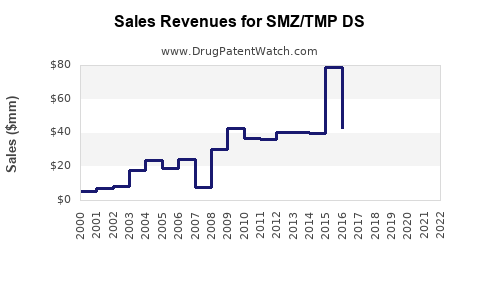
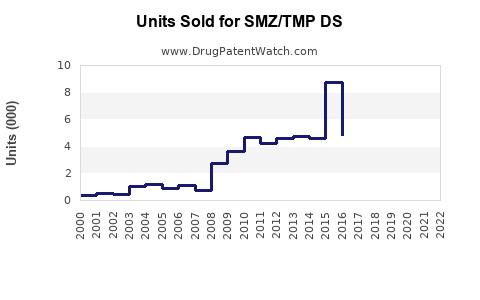
Annual Sales Revenues and Units Sold for SMZ/TMP DS
| Drug Name | Revenues (USD) | Units | Year |
|---|---|---|---|
| SMZ/TMP DS | ⤷ Start Trial | ⤷ Start Trial | 2022 |
| SMZ/TMP DS | ⤷ Start Trial | ⤷ Start Trial | 2021 |
| SMZ/TMP DS | ⤷ Start Trial | ⤷ Start Trial | 2020 |
| SMZ/TMP DS | ⤷ Start Trial | ⤷ Start Trial | 2019 |
| >Drug Name | >Revenues (USD) | >Units | >Year |
SMZ/TMP DS Market Analysis and Sales Projections
SMZ/TMP DS is the generic fixed-dose combination of sulfamethoxazole 800 mg and trimethoprim 160 mg, commonly called trimethoprim-sulfamethoxazole or TMP-SMX. The U.S. market is mature, low-priced, and highly competitive. Growth is driven primarily by prescription volume, supply continuity, and contract access rather than price expansion.
A reasonable base-case estimate is that U.S. manufacturer net sales for standard SMZ/TMP DS tablets are approximately $25 million to $60 million annually, excluding oral suspension, single-strength tablets, intravenous products, institutional contracts not visible in retail data, and international sales. A five-year base-case forecast indicates low-single-digit annual revenue growth, with upside from shortages or supplier exits and downside from additional price competition.
What is the SMZ/TMP DS market?
SMZ/TMP DS contains sulfamethoxazole 800 mg and trimethoprim 160 mg in a fixed-dose tablet. It is used for urinary tract infections, skin and soft-tissue infections, certain respiratory infections, Pneumocystis jirovecii pneumonia treatment and prophylaxis, and selected gastrointestinal infections.
The product is an immediate-release generic tablet. It does not have the commercial profile of a protected branded medicine. Demand is relatively stable because the drug is inexpensive, clinically familiar, and included in standard treatment protocols.
| Market characteristic | Assessment |
|---|---|
| Active ingredients | Sulfamethoxazole 800 mg plus trimethoprim 160 mg |
| Common designation | TMP-SMX DS, co-trimoxazole DS, Bactrim DS equivalent |
| Primary dosage form | Immediate-release tablet |
| Prescription status | Prescription only |
| U.S. regulatory status | Multiple abbreviated new drug applications |
| Patent position | No commercially meaningful blocking composition patent expected for the conventional product |
| Market maturity | Mature generic |
| Demand trend | Stable to modestly declining in routine infections |
| Pricing power | Very low |
| Main buyers | Retail pharmacies, wholesalers, hospitals, clinics, government and managed-care channels |
| Primary commercial risk | Price compression and supply disruption |
The 800 mg/160 mg strength is generally the higher-volume and more commercially relevant strength than the 400 mg/80 mg single-strength tablet.
How large is the SMZ/TMP DS market?
Public sources do not disclose a single authoritative revenue figure for all SMZ/TMP DS products. Manufacturer revenue is fragmented across several generic suppliers, private-label arrangements, institutional contracts, and pharmacy channels. FDA approval records identify products and applicants but do not provide market sales by molecule and strength (U.S. Food and Drug Administration [FDA], n.d.-a).
The commercial market can be divided into four segments:
- Retail generic tablets
- Hospital and institutional purchasing
- Government and public-health contracts
- International products sold as co-trimoxazole or trimethoprim-sulfamethoxazole
Retail tablets likely account for the largest share of U.S. unit volume. Institutional sales have lower list prices but can produce meaningful volume under tenders and group purchasing agreements.
Estimated U.S. market structure
| Segment | Estimated share of U.S. tablet revenue | Commercial profile |
|---|---|---|
| Retail pharmacy | 55%-70% | High prescription count, intense generic substitution |
| Hospitals and clinics | 15%-25% | Contract-based, price-sensitive |
| Government and public health | 5%-15% | Tender-driven and episodic |
| Other channels | 5%-10% | Mail order, specialty distribution and private-label sales |
These percentages are analytical estimates rather than reported market shares.
The largest demand sources are uncomplicated and complicated urinary tract infections, skin infections including community-associated methicillin-resistant Staphylococcus aureus, and Pneumocystis-related use. Antimicrobial stewardship, local resistance patterns, adverse-event concerns, and the availability of alternative antibiotics constrain long-term volume growth.
What are the sales projections for SMZ/TMP DS?
The following forecast estimates U.S. manufacturer net sales for standard SMZ/TMP DS tablets. It excludes international revenue and other dosage forms.
Five-year U.S. revenue forecast
| Year | Downside case | Base case | Upside case |
|---|---|---|---|
| Year 1 | $22 million | $40 million | $60 million |
| Year 2 | $21 million | $40 million | $64 million |
| Year 3 | $20 million | $41 million | $68 million |
| Year 4 | $19 million | $42 million | $72 million |
| Year 5 | $18 million | $43 million | $76 million |
| Five-year CAGR | -4.9% | 1.8% | 6.0% |
The base case assumes stable prescription demand, modest unit growth from population and ongoing clinical use, and continued annual price erosion of approximately 2%-4%. It also assumes no prolonged shortage and no major supplier withdrawal.
The upside case assumes one or more manufacturers reduce supply, allowing remaining suppliers to obtain temporary pricing improvement or share gains. The downside case assumes further generic entrants, lower contract pricing, and substitution toward nitrofurantoin, fluoroquinolones, beta-lactams, doxycycline, or other clinically appropriate alternatives.
Unit and price assumptions
| Variable | Downside | Base case | Upside |
|---|---|---|---|
| Annual U.S. tablet demand | -3% | 0% to 1% | 2% to 3% |
| Average manufacturer net price trend | -5% to -7% | -2% to -4% | 0% to +2% |
| Supplier concentration | Low | Moderate | Higher after exits |
| Shortage exposure | Low | Occasional | Material |
| Five-year revenue trend | Declining | Flat to modest growth | Moderate growth |
The market’s economics are more sensitive to supplier participation and contract terms than to epidemiological growth. A small change in the number of active manufacturers can have a larger effect on revenue than a small change in prescription volume.
Which companies compete in the SMZ/TMP DS market?
The product is supplied by multiple generic companies and private-label distributors. Historical and public FDA records identify applicants and suppliers such as Teva Pharmaceuticals, Sandoz, Amneal Pharmaceuticals, Heritage Pharmaceuticals, Apotex, and other generic manufacturers. Product availability changes by National Drug Code, contract, facility, and wholesaler.
The competitive landscape has three tiers:
Large generic manufacturers
Large suppliers have advantages in regulatory infrastructure, wholesaler access, manufacturing scale, and portfolio contracting. Their disadvantages are lower margins and exposure to broad generic price competition.
Mid-sized generic manufacturers
Mid-sized companies may compete through lower-cost manufacturing, niche channel access, or supply reliability. They can gain share if a large supplier experiences a manufacturing interruption.
Contract and private-label suppliers
Private-label distributors can compete without owning a large commercial infrastructure. Their profitability depends on manufacturing contracts, procurement terms, and reliable FDA-compliant supply.
No single supplier is likely to possess durable pricing power in the ordinary market. The strongest commercial position belongs to a supplier that combines low cost, consistent quality, and reliable fill rates.
What is the FDA regulatory status of SMZ/TMP DS?
SMZ/TMP DS tablets are approved through the FDA’s ANDA pathway. ANDA products demonstrate pharmaceutical equivalence and bioequivalence to a reference listed drug rather than repeating the full clinical development program required for a new chemical entity (FDA, n.d.-b).
The principal regulatory requirements include:
- Compliance with current good manufacturing practices
- Demonstration of bioequivalence
- Validated analytical and dissolution methods
- Stability data supporting the labeled shelf life
- Quality control for both active ingredients
- Appropriate labeling and manufacturing controls
- Ongoing reporting of adverse events and product-quality issues
The product is not a biologic. Biosimilar regulation is therefore not relevant. Competition occurs through generic ANDAs, not through the 351(k) biosimilar pathway.
What patents protect SMZ/TMP DS?
The active ingredients are old, off-patent small molecules. Conventional SMZ/TMP DS tablets do not appear to depend on a current composition-of-matter patent that would block generic entry.
Relevant intellectual-property exposure is more likely to involve:
- Tablet formulation and excipient combinations
- Manufacturing processes
- Taste-masking or modified-release systems
- Packaging and stability methods
- A different dosage form, such as suspension or injectable products
- Method-of-use claims directed to a particular disease or patient population
These rights generally do not prevent ordinary immediate-release SMZ/TMP DS tablets from competing if the generic product does not practice the claimed invention.
Orange Book and method-of-use status
The Orange Book is primarily relevant to approved drug products with listed patents and regulatory exclusivity. Conventional SMZ/TMP DS generic tablets are not expected to have a meaningful active patent barrier comparable to a recently approved branded drug.
A generic applicant could theoretically submit a Paragraph IV certification against a listed patent if an applicable patent were identified. In practice, commercial risk for standard SMZ/TMP DS is more likely to arise from formulation, manufacturing, quality, or supply issues than from Paragraph IV litigation.
There is no major biosimilar litigation pathway for this product, and no known product-specific settlement structure comparable to high-value brand-generic settlements in patented markets.
When does SMZ/TMP DS lose exclusivity?
SMZ/TMP DS lost meaningful market exclusivity decades ago. The commercial market is already genericized.
| Exclusivity category | Status |
|---|---|
| New chemical entity exclusivity | Expired |
| Composition-of-matter patent | Expired or not relevant to current conventional products |
| Pediatric exclusivity | Not commercially relevant to ordinary generic entry |
| Orphan-drug exclusivity | Not applicable to the overall product |
| New formulation exclusivity | Potentially relevant only to a specific formulation |
| Generic competition | Established |
The practical issue is not the date of exclusivity loss. It is whether a supplier can maintain acceptable margins after generic price competition.
What generic launch risks exist for SMZ/TMP DS?
A new generic entrant would face low legal-entry risk but meaningful commercial and operational risk.
Generic launch advantages
- No major expected composition patent barrier
- Established FDA pathway
- Familiar active ingredients and manufacturing processes
- Broad pharmacy and institutional demand
- Low clinical-development cost
- Potential to use existing antibiotic manufacturing infrastructure
Generic launch risks
- Low selling prices
- High buyer leverage
- Limited differentiation
- FDA inspection or warning-letter exposure
- Active-ingredient sourcing constraints
- Product recalls
- Wholesaler inventory limits
- Difficulty obtaining durable formulary or contract share
- Substitution by other antibiotics
A new entrant would need a cost advantage, a dependable API source, an institutional contract, or a supply-reliability proposition. Regulatory approval alone would not ensure commercial success.
How strong is the patent estate for SMZ/TMP DS?
The patent estate for standard SMZ/TMP DS tablets is weak from an exclusivity perspective and moderate only where specific formulation or manufacturing claims are involved.
| Patent factor | Strength |
|---|---|
| Core active ingredients | Very weak |
| Conventional immediate-release tablet | Weak |
| Specialized formulation | Potentially moderate |
| Manufacturing process | Product-specific |
| Method of use | Narrow and indication-dependent |
| Generic blocking power | Low |
| Litigation exposure | Low relative to branded small molecules |
A competitor should conduct a product-specific freedom-to-operate review before launch, particularly for nonstandard formulations, coating systems, controlled release, or combination products. For ordinary DS tablets, market access is mainly a regulatory and commercial execution question.
What is the competitive outlook for SMZ/TMP DS?
The market should remain viable but unattractive for premium pricing. The product has durable clinical demand, yet its mature generic status limits revenue expansion.
Demand drivers
- Continued use in urinary and skin infections
- Persistent clinical familiarity
- Low acquisition cost
- Use in Pneumocystis prophylaxis and treatment
- Periodic shortages of alternative antibiotics
- Growth in outpatient prescribing and older populations
Demand constraints
- Antimicrobial stewardship
- Resistance to sulfamethoxazole-trimethoprim
- Drug interactions and renal dosing concerns
- Sulfonamide hypersensitivity
- Substitution by other first-line therapies
- Reduced prescribing for uncomplicated infections in resistance-heavy regions
Revenue exposure is therefore concentrated in high-volume generic channels rather than a protected franchise. A manufacturer with a 10% share of a $40 million U.S. tablet market would generate approximately $4 million in annual manufacturer revenue before deductions, rebates, chargebacks, and channel costs.
What licensing deals and settlements affect SMZ/TMP DS?
No major current licensing transaction or high-value patent settlement is central to the ordinary U.S. SMZ/TMP DS tablet market. Commercial arrangements are more likely to consist of:
- Contract manufacturing
- API supply agreements
- Private-label distribution
- Wholesaler and group-purchasing contracts
- Hospital tender agreements
The absence of a major patent settlement is consistent with the product’s mature, generic market position. Licensing value would be higher for a differentiated delivery system, pediatric formulation, long-acting product, or combination involving a newer active ingredient.
What launch scenarios should investors and manufacturers model?
Base-case launch
A new supplier enters with FDA approval, captures limited retail and institutional share, and faces annual price erosion. Break-even depends on low manufacturing cost and sufficient volume.
Supply-disruption launch
A competitor experiences a shortage, recall, or manufacturing interruption. The entrant captures temporary share and may obtain better pricing. This scenario can materially improve first-year revenue but may not be durable.
Contract-led launch
The entrant secures a hospital, government, or pharmacy-benefit contract before launch. Revenue is more predictable, but contract pricing is low and renewal risk remains.
Differentiated-product launch
A supplier launches a suspension, specialty formulation, or delivery system with a clinical or operational advantage. This can improve pricing but introduces additional development, regulatory, and market-access costs.
Key Takeaways
- SMZ/TMP DS is a mature, fully generic antibiotic market.
- The relevant U.S. tablet market is likely measured in tens of millions of dollars, not billions.
- A reasonable base-case estimate is approximately $40 million in annual U.S. manufacturer net sales for standard DS tablets.
- Base-case revenue is likely to remain broadly flat, with a projected five-year CAGR of approximately 2%.
- Patent and exclusivity barriers are low for conventional immediate-release tablets.
- Paragraph IV litigation, biosimilar risk, and major patent settlements are not central commercial risks.
- The primary risks are price compression, supplier exits, manufacturing disruptions, API sourcing, and substitution by other antibiotics.
- A new entrant needs cost efficiency, reliable supply, or prearranged institutional access to achieve attractive returns.
- Specialty formulations may offer better margins than standard tablets but carry higher development and regulatory risk.
FAQs
Is SMZ/TMP DS the same as Bactrim DS?
Yes. Bactrim DS is a branded reference product containing sulfamethoxazole 800 mg and trimethoprim 160 mg. SMZ/TMP DS is the generic equivalent designation used for the same active-ingredient strength.
Is SMZ/TMP DS a profitable generic drug?
It can be profitable at scale, but margins are usually limited. Profitability depends on manufacturing cost, contract access, volume, supply reliability, and the number of active competitors.
Does SMZ/TMP DS have biosimilar competition?
No. SMZ/TMP DS is a small-molecule drug, so competition occurs through generic ANDAs rather than biosimilars.
Can a company obtain premium pricing for SMZ/TMP DS?
Premium pricing is difficult for standard tablets. Temporary pricing improvement may occur during shortages, recalls, supplier exits, or contract-specific supply constraints.
What would make SMZ/TMP DS commercially attractive?
The strongest opportunities are low-cost manufacturing, dependable API supply, hospital or government contracts, shortage replacement, and differentiated formulations with regulatory or clinical advantages.
References
-
U.S. Food and Drug Administration. (n.d.-a). Drugs@FDA: FDA-approved drugs. https://www.accessdata.fda.gov/scripts/cder/daf/
-
U.S. Food and Drug Administration. (n.d.-b). Abbreviated new drug application (ANDA). https://www.fda.gov/drugs/types-applications/abbreviated-new-drug-application-anda
-
U.S. Food and Drug Administration. (n.d.-c). Approved drug products with therapeutic equivalence evaluations, commonly known as the Orange Book. https://www.fda.gov/drugs/drug-approvals-and-databases/approved-drug-products-therapeutic-equivalence-evaluations-orange-book
-
National Library of Medicine. (n.d.). DailyMed: Current medication information. https://dailymed.nlm.nih.gov/dailymed/
-
Infectious Diseases Society of America. (2014). Clinical practice guidelines for the diagnosis and management of skin and soft tissue infections. Clinical Infectious Diseases, 59(2), e10-e52. https://doi.org/10.1093/cid/ciu296
More… ↓
