Share This Page
Drug Sales Trends for SILDENAFIL CITRATE
✉ Email this page to a colleague
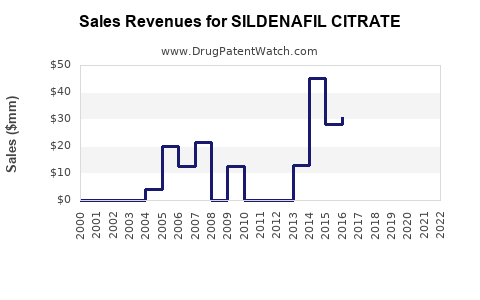
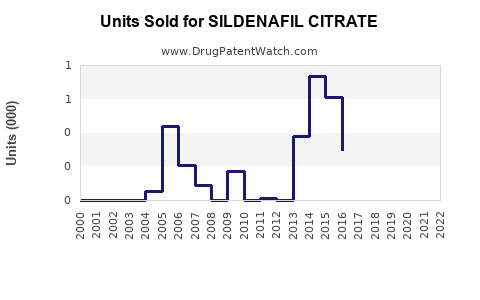
Annual Sales Revenues and Units Sold for SILDENAFIL CITRATE
| Drug Name | Revenues (USD) | Units | Year |
|---|---|---|---|
| SILDENAFIL CITRATE | ⤷ Start Trial | ⤷ Start Trial | 2022 |
| SILDENAFIL CITRATE | ⤷ Start Trial | ⤷ Start Trial | 2021 |
| SILDENAFIL CITRATE | ⤷ Start Trial | ⤷ Start Trial | 2020 |
| SILDENAFIL CITRATE | ⤷ Start Trial | ⤷ Start Trial | 2019 |
| SILDENAFIL CITRATE | ⤷ Start Trial | ⤷ Start Trial | 2018 |
| SILDENAFIL CITRATE | ⤷ Start Trial | ⤷ Start Trial | 2017 |
| SILDENAFIL CITRATE | ⤷ Start Trial | ⤷ Start Trial | 2016 |
| >Drug Name | >Revenues (USD) | >Units | >Year |
Sildenafil Citrate Market Analysis and Sales Projections, Patent Status, and Competitive Outlook
Sildenafil citrate is a mature, off-patent PDE5 inhibitor marketed primarily for erectile dysfunction under Viagra and generic labels and for pulmonary arterial hypertension under Revatio. The commercial market is highly fragmented, price-sensitive, and dominated by generic manufacturers. Global sildenafil sales are best modeled as a low-growth volume market with declining average selling prices, rather than as a branded pharmaceutical growth opportunity.
A reasonable base-case estimate places the global sildenafil citrate market at approximately $1.5 billion to $2.0 billion in 2024, including erectile dysfunction and pulmonary arterial hypertension uses. The market could reach roughly $1.8 billion to $2.4 billion by 2030, reflecting volume growth in emerging markets and online channels offset by generic price erosion in the United States and Western Europe. Published market reports vary widely because some measure only Viagra, some include all sildenafil products, and others include the broader PDE5 inhibitor market.
What is sildenafil citrate used for?
Sildenafil citrate is a selective phosphodiesterase type 5 inhibitor. Its principal approved uses are:
| Use | Brand or product | Commercial characteristics |
|---|---|---|
| Erectile dysfunction | Viagra and generic sildenafil tablets | Largest indication by volume and revenue |
| Pulmonary arterial hypertension | Revatio and generic sildenafil tablets or oral suspension | Smaller market with higher regulatory and specialty-pharmacy complexity |
| Pediatric pulmonary hypertension | Revatio oral suspension and related formulations | Narrower patient population and dosing requirements |
| Unapproved or nonstandard uses | Various compounded or nonprescription products | Regulatory and safety risks vary by jurisdiction |
Viagra was approved by the U.S. Food and Drug Administration in 1998 and became the first widely commercialized oral PDE5 inhibitor for erectile dysfunction. Revatio was approved in 2005 for pulmonary arterial hypertension at a lower dose than the Viagra erectile dysfunction regimen (U.S. Food and Drug Administration, 1998, 2005).
How large is the sildenafil citrate market?
The addressable market has three distinct layers:
- The sildenafil citrate market, including generic sildenafil, Viagra, Revatio, and authorized equivalents.
- The erectile dysfunction PDE5 inhibitor market, including tadalafil, vardenafil, and avanafil.
- The broader erectile dysfunction treatment market, including testosterone products, intracavernosal injections, vacuum devices, penile implants, and behavioral treatment.
Commercial estimates should not combine these categories without adjustment. A forecast for the broader erectile dysfunction drug market will materially overstate the opportunity for sildenafil citrate alone.
Global market estimate
| Metric | 2024 estimate | 2030 base-case estimate | 2024-2030 CAGR |
|---|---|---|---|
| Sildenafil citrate, global | $1.5-$2.0 billion | $1.8-$2.4 billion | 2%-4% |
| Erectile dysfunction PDE5 inhibitors | $3.0-$4.0 billion | $4.0-$5.5 billion | 4%-6% |
| Viagra branded sales | Not separately disclosed consistently | Mature or declining | Negative to flat |
| Generic sildenafil | Largest share of unit volume | Increasing share | Volume growth, price decline |
These figures are analytical estimates based on public company disclosures, prescription trends, generic pricing behavior, disease prevalence, and published market studies. They should not be interpreted as a single audited market total because public sources use inconsistent definitions.
What are the main sildenafil citrate growth drivers?
The strongest growth drivers are demographic and distribution-related rather than patent-driven.
Aging male population
Erectile dysfunction prevalence increases with age and is associated with diabetes, cardiovascular disease, obesity, hypertension, smoking, and certain prostate treatments. Population aging supports long-term demand for PDE5 inhibitors.
The Massachusetts Male Aging Study estimated that erectile dysfunction affected approximately 52% of men aged 40 to 70 to some degree, although diagnosed and treated patients represented a much smaller proportion of the total population (Feldman et al., 1994).
Greater treatment rates
Diagnosis and treatment rates remain below estimated disease prevalence. Greater physician awareness, direct-to-consumer advertising, telehealth, and online prescribing have expanded access. Digital prescribing has been particularly important for sildenafil because the product is oral, familiar, and available in low-cost generic form.
Emerging-market access
Demand is expanding in Latin America, Asia-Pacific, the Middle East, and selected Eastern European markets. Growth is supported by increasing private healthcare spending, urbanization, wider internet access, and increased acceptance of erectile dysfunction treatment.
Pricing remains substantially lower than in the United States. This increases unit demand but limits revenue growth.
Telehealth and direct-to-consumer channels
U.S. digital-health companies have made generic sildenafil available through online consultations and mail delivery. Subscription models can improve adherence and refill frequency, but they also create discounting pressure and increase customer-acquisition costs.
Pulmonary arterial hypertension demand
Sildenafil remains clinically relevant in pulmonary arterial hypertension, particularly in markets where branded specialty products are expensive or unavailable. The PAH segment has lower patient volume but can carry higher net prices than erectile dysfunction products.
What factors are reducing sildenafil sales growth?
Sildenafil is exposed to several structural pressures.
Generic price erosion
The core compound and major U.S. use patents have expired or no longer prevent broad generic competition. Generic sildenafil is available from numerous manufacturers, including large-scale suppliers in the United States, Europe, India, and China.
Retail prices vary significantly by dose, quantity, pharmacy, insurance coverage, and online channel. Cash prices for generic sildenafil can be a small fraction of historical Viagra prices.
Substitution by tadalafil
Tadalafil, marketed as Cialis, has a longer duration of action and is available in daily low-dose regimens. It competes directly with sildenafil in erectile dysfunction. Tadalafil has gained share among patients who value treatment flexibility or spontaneous sexual activity.
Avanafil and vardenafil
Avanafil and vardenafil remain smaller competitors. Their commercial positions depend on speed of onset, tolerability, formulary access, and price. Neither has displaced sildenafil at the generic-volume level.
Safety restrictions and contraindications
Sildenafil cannot be used with nitrates because of the risk of severe hypotension. Caution is required with certain alpha blockers, cardiovascular conditions, and strong CYP3A4 inhibitors. These restrictions limit treatment in some older patients with substantial cardiovascular disease.
Counterfeit and unregulated products
Counterfeit Viagra and adulterated sexual-enhancement products create safety risks and divert demand from authorized channels. FDA testing has identified undeclared sildenafil or related PDE5 inhibitors in some products marketed as dietary supplements (U.S. Food and Drug Administration, n.d.).
How does sildenafil compare with tadalafil?
| Attribute | Sildenafil | Tadalafil |
|---|---|---|
| Primary brands | Viagra, Revatio | Cialis, Adcirca |
| Typical erectile dysfunction use | As needed | As needed or daily |
| Approximate duration | About 4-5 hours | Up to about 36 hours |
| Generic status | Widely generic | Widely generic |
| Food effect | High-fat meals can delay absorption | Less affected by food |
| Pulmonary hypertension brand | Revatio | Adcirca |
| Commercial position | Highest generic familiarity and volume | Stronger premium and daily-use positioning |
| Main disadvantage | Shorter duration and food interaction | Longer exposure may increase adverse-effect duration |
Sildenafil generally has the strongest brand recognition and broadest low-cost availability. Tadalafil has a stronger product proposition for duration and daily dosing. For investors and commercial operators, the relevant competition is no longer primarily Viagra versus Cialis. It is low-cost generic sildenafil versus generic tadalafil, with telehealth distributors influencing channel economics.
What patents protect sildenafil citrate?
The principal sildenafil compound patent estate is expired in the United States and major developed markets.
| Patent or protection | Subject matter | Commercial status |
|---|---|---|
| U.S. Patent No. 5,250,534 | Sildenafil compounds and related use | Expired in 2012 |
| U.S. Patent No. 6,469,012 | Erectile dysfunction method-of-use protection | Expired after the core compound patent and addressed in generic settlements |
| Revatio-related patents | Pulmonary arterial hypertension use and formulations | Principal U.S. barriers have expired or no longer block ordinary generic sildenafil tablets |
| Pediatric exclusivity | Regulatory exclusivity associated with pediatric studies | Expired |
Patent dates can vary by jurisdiction, patent-term adjustment, pediatric exclusivity, and product listing. The commercial conclusion is consistent: sildenafil is a mature generic product with no broad U.S. composition-of-matter barrier.
What is the Orange Book status of Viagra and Revatio?
The FDA Orange Book historically listed Viagra and Revatio patents covering sildenafil products and methods of use. Those listings supported the timing of abbreviated new drug application approvals and Paragraph IV litigation.
Generic sildenafil approvals expanded materially after patent settlements and expiration of the relevant patent protections. FDA approval of generic sildenafil did not create a new period of market exclusivity for the compound.
For commercial diligence, the remaining Orange Book issues are more likely to concern specific dosage forms, labeling, method-of-use carve-outs, or product-specific patents than the basic sildenafil molecule.
When did sildenafil lose exclusivity?
Sildenafil lost practical U.S. compound exclusivity in 2012. Pfizer later faced method-of-use patent constraints, with generic launches shaped by litigation settlements and authorized-generic strategy.
| Milestone | Date |
|---|---|
| Viagra FDA approval | March 27, 1998 |
| Revatio FDA approval | June 2005 |
| Core U.S. sildenafil patent expiration | 2012 |
| First major U.S. generic Viagra launches | December 2017 |
| Broad generic competition | 2018 onward |
| Current market status | Mature generic market |
The 2017 launch timing reflected commercial and legal settlements rather than continued protection of the underlying sildenafil molecule.
Which companies compete in the sildenafil market?
The competitive landscape includes originators, generic pharmaceutical companies, specialty distributors, and telehealth providers.
Originator and branded companies
Pfizer developed Viagra and markets or has marketed sildenafil products. The company’s branded economics have declined as generic competition expanded. Pfizer’s annual reports have historically reported Viagra revenue, but current reporting does not always provide a clean, standalone global sildenafil figure (Pfizer Inc., various years).
Generic manufacturers
The supplier base includes large generic companies such as Teva Pharmaceutical Industries, Mylan/Viatris, Sandoz, Dr. Reddy’s Laboratories, Cipla, Sun Pharmaceutical Industries, and Zydus Lifesciences, subject to country-specific approvals and commercial participation.
In the United States, the market also includes authorized generic and private-label distribution arrangements. The identity of active suppliers can change as contracts, shortages, pharmacy purchasing agreements, and product discontinuations change.
Digital-health distributors
Hims & Hers, Roman, Ro, and similar providers have increased the visibility and accessibility of generic sildenafil. These companies generally do not own the core drug IP. Their defensibility is based on patient acquisition, prescribing workflows, fulfillment, brand trust, and retention.
What are the sildenafil citrate sales projections through 2030?
The following projection models global product sales, including generic and branded sildenafil for erectile dysfunction and pulmonary arterial hypertension.
| Year | Bear case | Base case | Bull case |
|---|---|---|---|
| 2024 | $1.5 billion | $1.8 billion | $2.0 billion |
| 2025 | $1.5 billion | $1.85 billion | $2.1 billion |
| 2026 | $1.55 billion | $1.9 billion | $2.2 billion |
| 2027 | $1.6 billion | $1.96 billion | $2.3 billion |
| 2028 | $1.65 billion | $2.02 billion | $2.4 billion |
| 2029 | $1.7 billion | $2.08 billion | $2.5 billion |
| 2030 | $1.75 billion | $2.15 billion | $2.6 billion |
Bear case
The bear case assumes rapid price erosion, continuing substitution by tadalafil, weak branded demand, and limited growth in pulmonary hypertension. Revenue grows slowly because unit growth is offset by lower net prices.
Base case
The base case assumes 3% annual market growth. Emerging-market volume, telehealth adoption, and patient aging offset generic price declines in mature markets.
Bull case
The bull case assumes faster treatment adoption, stronger growth in online prescribing, expanded access in Asia-Pacific and Latin America, and stable PAH pricing. This scenario requires volume expansion without severe additional reimbursement or pharmacy price compression.
What is the revenue exposure for Pfizer?
Pfizer’s historical Viagra revenue reached approximately $2 billion annually at its peak, but the product’s contribution declined sharply after generic competition. Current Pfizer financial reporting does not consistently isolate Viagra as a major standalone growth asset.
The commercial exposure is therefore more relevant to generic manufacturers and digital-health distributors than to Pfizer. For generic manufacturers, sildenafil provides recurring revenue but limited margin expansion. For telehealth companies, sildenafil can drive customer acquisition and repeat purchases, but revenue quality depends on retention, subscription conversion, fulfillment economics, and regulatory compliance.
How strong is the sildenafil patent estate?
The sildenafil patent estate is weak as a barrier to generic entry and moderate only for narrow formulation or use-specific opportunities.
| Patent-strength category | Assessment |
|---|---|
| Core molecule | Weak; expired |
| Standard immediate-release tablets | Weak; widely generic |
| Erectile dysfunction method of use | Weak to moderate; historical protection expired or bypassed through labeling |
| PAH indication | Moderate in selected jurisdictions and formulations, but broad U.S. barriers have eroded |
| Oral suspension and pediatric formulations | More defensible than ordinary tablets, but limited market size |
| Manufacturing process patents | Potentially relevant to suppliers, but generally do not block finished-dose competition |
| New combinations or delivery systems | Potential opportunity if clinically differentiated and patentable |
What generic launch risks exist?
A new sildenafil entrant faces commercial rather than fundamental patent risk.
Key risks include:
- Low reimbursement and pharmacy acquisition prices.
- Established supplier contracts.
- FDA manufacturing and quality-system requirements.
- API sourcing and supply continuity.
- Product liability exposure.
- Counterfeit competition.
- Limited differentiation among immediate-release tablets.
- Regulatory scrutiny of online prescribing and sexual-health advertising.
- Difficulty gaining market share without pharmacy, payer, or telehealth distribution.
A differentiated formulation, lower-dose product, rapid-dissolution tablet, or combination treatment could improve positioning. The product would still need clinical, regulatory, and commercial evidence to overcome the low price of ordinary generic sildenafil.
What manufacturing and intellectual-property barriers remain?
Manufacturing barriers are more important than compound patents. Sildenafil API production requires process control, impurity management, validated analytical methods, and compliance with current good manufacturing practices.
The most relevant IP opportunities are:
- Improved crystallinity or particle-size control.
- Stable oral suspensions.
- Pediatric or dysphagia-friendly formulations.
- Fast-dissolving or orally disintegrating tablets.
- Combination products.
- Long-acting delivery systems.
- New PAH formulations.
- Manufacturing processes that improve yield or reduce impurities.
These opportunities are commercially limited unless they provide a meaningful benefit over inexpensive tablets.
What regulatory status does sildenafil have?
Sildenafil is FDA-approved for erectile dysfunction as Viagra and for pulmonary arterial hypertension as Revatio. Generic versions have been approved through the ANDA pathway when they demonstrate pharmaceutical equivalence and bioequivalence to the relevant reference product.
FDA approval does not authorize sildenafil for every erectile dysfunction-related or cardiovascular use. Products marketed outside approved labeling can create enforcement, advertising, and liability exposure.
Sildenafil is not a biologic, so biosimilar regulation does not apply. Competition occurs through the generic-drug framework rather than the abbreviated biologics pathway.
What litigation and settlement issues affect sildenafil?
The major U.S. litigation cycle involved Pfizer’s Viagra patents and ANDA applicants seeking approval for generic sildenafil. Settlements allowed certain launches before the latest asserted method-of-use patent dates while protecting Pfizer’s remaining commercial position for a limited period.
The principal litigation risk has now shifted away from basic sildenafil patent disputes. Current disputes are more likely to involve:
- Product-specific formulation patents.
- Manufacturing processes.
- Trade dress and trademark issues.
- Online pharmacy practices.
- Advertising claims.
- Distribution agreements.
- Counterfeit products.
- Regulatory enforcement.
There is no broad current patent dispute that restores exclusivity to standard sildenafil tablets.
Key Takeaways
- Sildenafil citrate is a mature, globally distributed generic drug with estimated 2024 sales of $1.5 billion to $2.0 billion.
- Base-case global sales could reach approximately $2.15 billion by 2030, driven by volume growth rather than pricing.
- The U.S. compound patent expired in 2012, and generic Viagra competition expanded materially from 2017 onward.
- Viagra and Revatio no longer provide Pfizer with the exclusivity economics associated with their early commercial years.
- Generic sildenafil competes primarily with generic tadalafil, not only with branded Viagra.
- Telehealth is expanding access but increasing price and customer-acquisition pressure.
- PAH products and specialty formulations have better pricing potential than standard erectile dysfunction tablets.
- The strongest remaining commercial opportunities involve formulation, delivery, manufacturing, or distribution differentiation rather than the sildenafil molecule itself.
- Sildenafil is not subject to biosimilar competition because it is a small-molecule drug.
- A new entrant’s primary risks are price erosion, supply reliability, regulatory compliance, and distribution access.
FAQs
Is sildenafil citrate still profitable for pharmaceutical companies?
Yes, but profitability depends on manufacturing scale, API costs, supply contracts, and distribution efficiency. Standard tablets have limited pricing power.
Will sildenafil sales grow faster than tadalafil sales?
Sildenafil is likely to grow more slowly in value because its generic prices are lower and its duration of action is shorter. Tadalafil has stronger daily-use and longer-duration positioning.
Does Viagra still have patent protection?
The core sildenafil patent protection has expired. Historical method-of-use patents affected the timing of generic entry but do not prevent broad current competition.
Can a company obtain new patents on sildenafil citrate?
Yes, a company may obtain patents on new formulations, delivery systems, manufacturing processes, combinations, or selected uses if they meet patentability requirements. A new patent would not restore broad exclusivity to ordinary sildenafil tablets.
Is sildenafil citrate a good licensing target?
It can be attractive for licensing when linked to a differentiated formulation, specialty PAH product, digital-health channel, or manufacturing advantage. Licensing ordinary immediate-release sildenafil tablets is less attractive because the market is commoditized.
References
-
Feldman, H. A., Goldstein, I., Hatzichristou, D. G., Krane, R. J., & McKinlay, J. B. (1994). Impotence and its medical and psychosocial correlates: Results of the Massachusetts Male Aging Study. The Journal of Urology, 151(1), 54-61.
-
Pfizer Inc. (Various years). Annual reports and Form 10-K filings. Pfizer.
-
U.S. Food and Drug Administration. (1998). FDA approves Viagra for erectile dysfunction. FDA.
-
U.S. Food and Drug Administration. (2005). FDA approves Revatio for pulmonary arterial hypertension. FDA.
-
U.S. Food and Drug Administration. (n.d.). Tainted sexual enhancement and energy products. FDA.
-
U.S. Food and Drug Administration. (n.d.). Approved drug products with therapeutic equivalence evaluations. FDA Orange Book.
-
U.S. Patent and Trademark Office. (1993). U.S. Patent No. 5,250,534: Pyrazolopyrimidinone antianginal agents. USPTO.
-
U.S. Patent and Trademark Office. (2002). U.S. Patent No. 6,469,012: Use of sildenafil for the treatment of erectile dysfunction. USPTO.
More… ↓
