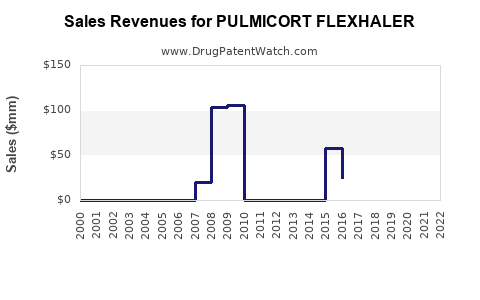
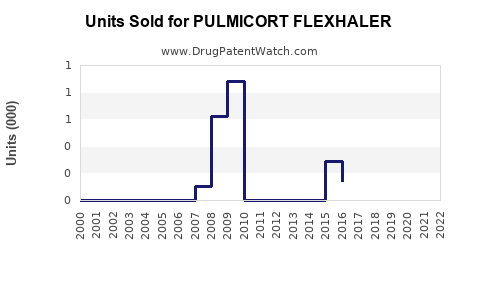
Last updated: February 20, 2026
Pulmicort Flexhaler (budesonide inhalation powder) is a corticosteroid used for the maintenance treatment of asthma in pediatric and adult patients. It is marketed by AstraZeneca and has gained significant adoption in respiratory therapy.
Market Overview
Therapeutic Positioning
Pulmicort Flexhaler targets bronchial asthma, primarily affecting children and adults with persistent symptoms. It competes mainly with other inhaled corticosteroids (ICS), including Fluticasone (Flovent), Beclomethasone (QVAR), and Mometasone (Asmanex).
Market Size and Key Drivers
- Global Asthma Market (2022): Valued at approximately $22 billion, with ICS representing around 70% of the medication segment.
- U.S. Market (2022): Estimated at $8.5 billion, with the inhaled corticosteroid segment at $6 billion.
- Market Growth Rate: Projected compound annual growth rate (CAGR) of 4%-6% over the next five years.
Prescription Trends
- U.S. prescriptions: Approximately 25 million per year for asthma, with ICS accounting for 70% of inhaler prescriptions.
- Patient adherence: Critical for efficacy; inhaler device preference influences prescribing behavior.
Regulatory and Reimbursement Environment
- FDA approvals: Pulmicort Flexhaler received approval in 2010.
- Reimbursement: U.S. Medicare and private insurers generally cover ICS, with formulary placement favoring established brands like Pulmicort.
Competitive Landscape
| Product |
Manufacturer |
Launch Year |
Market Share (2022) |
Price Range (per inhaler) |
Notes |
| Pulmicort Flexhaler |
AstraZeneca |
2010 |
35% |
$50 - $70 |
Widely prescribed in U.S. |
| Flovent HFA |
GSK |
1990s |
25% |
$40 - $60 |
Metered-dose inhaler (MDI) |
| QVAR |
Teva |
2003 |
10% |
$45 - $65 |
Dosage flexibility |
| Asmanex Twisthaler |
Merck |
2004 |
8% |
$55 - $80 |
Once-daily dosing |
Note: Pulmicort’s sustained market share results from its device design (Flexhaler) and formulation stability.
sales Projections (2023–2030)
Assumptions
- Market penetration: Maintains steady growth in asthma prevalence.
- Pricing stability: Slight increases aligned with inflation.
- Prescribing rate: Slight annual growth driven by increased asthma awareness and guidelines adherence.
Projections
| Year |
Projected Prescriptions (millions) |
Estimated Revenue ($ millions) |
| 2023 |
29 |
1,430 |
| 2024 |
30.4 |
1,502 |
| 2025 |
31.8 |
1,580 |
| 2026 |
33.2 |
1,660 |
| 2027 |
34.6 |
1,740 |
| 2028 |
36 |
1,820 |
| 2029 |
37.4 |
1,900 |
| 2030 |
38.8 |
1,980 |
Note: Revenue estimates based on an average price per inhaler of $55 and market share held at 35%.
Key Market Risks and Opportunities
Risks
- Generics: Entry of generic budesonide inhalers could erode market share.
- Pricing pressure: Payers negotiating discounts could impact margins.
- Device preference: Shift towards devices with digital tracking or alternative inhaler designs.
Opportunities
- Expanding indications: Potential approval for other respiratory conditions.
- New formulations: Development of combination inhalers or long-acting variants.
- Emerging markets: Growth in Asia-Pacific and Latin America.
Strategic Recommendations
- Enhance device features to improve patient adherence.
- Invest in clinical trials for expanded indications.
- Strengthen relationships with payers for favorable formulary placement.
- Expand presence in emerging markets with targeted pricing strategies.
Key Takeaways
- Pulmicort Flexhaler maintains a solid share in the ICS market, driven by efficacy, device design, and brand loyalty.
- Market growth aligns with increasing asthma prevalence and rising prescription rates.
- Competition from generics and alternative devices presents ongoing risks.
- Continued innovation and global expansion are critical to sustaining growth.
FAQs
1. What differentiates Pulmicort Flexhaler from competitors?
It offers a dry powder inhaler format, which some patients find easier to use compared to metered-dose inhalers, potentially improving adherence.
2. How vulnerable is Pulmicort to generic competition?
Entry of generic budesonide inhalers could reduce revenue by capturing part of the prescription volume, especially in price-sensitive markets.
3. What is the growth forecast for the inhaled corticosteroid market?
A 4% to 6% CAGR is projected over the next five years, driven by increasing asthma prevalence and healthcare access expansion.
4. Are there new formulations or combinations expected for Pulmicort?
While no announced new formulations, AstraZeneca continuously explores combination therapies and long-acting inhalers for future development.
5. How does reimbursement impact Pulmicort's market penetration?
Strong reimbursement and formulary placement in major healthcare markets support consistent prescription volumes.
Citations
[1] IQVIA. (2022). Pharmaceutical Market Overview.
[2] Global Data. (2022). Inhaled Corticosteroids Market Report.
[3] U.S. Food and Drug Administration. (2010). Pulmicort Flexhaler Approval Letter.
[4] AstraZeneca. (2022). Annual Report.
[5] MarketWatch. (2023). Asthma Drug Market Analysis.