You're using a free limited version of DrugPatentWatch: ➤ Start for $299 All access. No Commitment.

Last Updated: January 1, 2026

Drug Sales Trends for POT CHLORIDE


✉ Email this page to a colleague

« Back to Dashboard


Payment Methods and Pharmacy Types for POT CHLORIDE (2022)

Revenues by Pharmacy Type

Pharmacy Type Revenues
MAIL-ORDER $64,735,335
INSIDE ANOTHER STORE $108,430,610
[disabled in preview] $181,279,764
This preview shows a limited data set
Subscribe for full access, or try a Trial

Units Sold by Pharmacy Type

Pharmacy Type Units
MAIL-ORDER 1,956,907
INSIDE ANOTHER STORE 3,332,245
[disabled in preview] 6,729,043
This preview shows a limited data set
Subscribe for full access, or try a Trial

Revenues by Payment Method

Payment Method Revenues
MEDICAID $27,761,824
MEDICARE $176,005,885
[disabled in preview] $151,104,800
This preview shows a limited data set
Subscribe for full access, or try a Trial
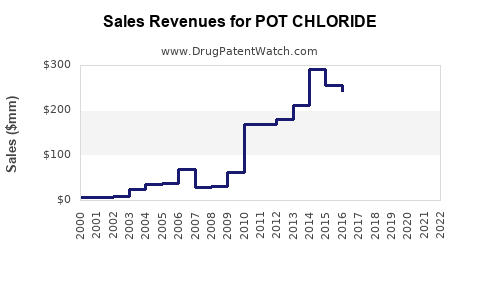
Drug Sales Revenue Trends for POT CHLORIDE
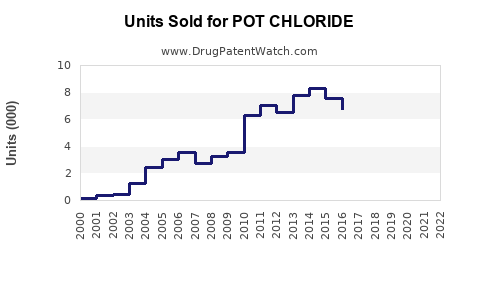
Drug Units Sold Trends for POT CHLORIDE

Annual Sales Revenues and Units Sold for POT CHLORIDE

These sales figures are drawn from a US national survey of drug expenditures

Market Analysis and Sales Projections for Potassium Chloride

Last updated: July 30, 2025

Introduction

Potassium chloride (KCl) is a ubiquitous chemical compound with extensive applications in medical, industrial, and agricultural sectors. Its therapeutic use as a potassium supplement and electrolyte replenisher marks it as a pivotal drug in healthcare. As a critical ingredient in salting and fertilizer manufacturing, potassium chloride's market dynamics are influenced by both pharmaceutical demand and non-pharmaceutical sectors. This report provides a comprehensive analysis of the current market landscape and projecting future sales trends for potassium chloride, with a focus on pharmaceutical applications.

Market Overview

Pharmaceutical Segment

Potassium chloride's primary pharmaceutical role involves treating and preventing hypokalemia—a condition marked by abnormally low potassium levels. It is available in various formulations, including oral tablets, capsules, and intravenous solutions.

  • Market Size: The global pharmaceutical potassium chloride market was valued at approximately USD 2.1 billion in 2022, with an expected compound annual growth rate (CAGR) of 4.5% over the next five years, reaching USD 2.8 billion by 2027 [1].
  • Driving Factors: Rising prevalence of cardiovascular diseases, kidney disorders, and increased awareness of electrolyte imbalances are propelling demand. Moreover, the COVID-19 pandemic accentuated the need for electrolyte management in critically ill patients.

Industrial and Agricultural Sector

While not directly tied to pharmaceutical sales, the industrial utilization of potassium chloride in fertilizers significantly influences overall market supply and price stability.

  • Global Fertilizer Market: Potassium-based fertilizers constitute approximately 40-45% of global potassium consumption, underlining the importance of KCl in global agriculture [2].

Market Drivers and Restraints

Drivers

  • Epidemiological Trends: Aging populations worldwide increase demand for electrolyte supplements.
  • Expansion in Healthcare Infrastructure: Emerging markets expanding healthcare infrastructure contribute to rising consumption.
  • Innovative Formulations: Development of slow-release and novel delivery systems improve patient adherence.

Restraints

  • Pricing Volatility: Fluctuations driven by raw material prices, geopolitical tensions, and supply chain disruptions.
  • Regulatory Challenges: Stringent drug approval processes may delay product launches.
  • Competitive Market: Presence of multiple generic manufacturers sustains competitive pressure, compressing margins.

Regional Market Analysis

Region Key Trends Market Size (2022) Outlook
North America Mature market with high adoption; increasing clinical use USD 800 million 4% CAGR
Europe Stringent regulations; high healthcare spending USD 600 million 4.5% CAGR
Asia-Pacific Rapidly growing healthcare and pharmaceutical sectors; emerging markets USD 500 million 6% CAGR
Latin America & MEA Growing awareness; expanding healthcare infrastructure USD 200 million 5-6% CAGR

Note: Data based on industry reports and market surveys [1][2].

Sales Projections for Potassium Chloride

Forecast Assumptions

  • Steady Growth in Clinical Use: The rising incidence of chronic illnesses bolsters demand.
  • Market Penetration: Expansion of generic formulations enhances affordability and accessibility.
  • Supply Chain Stability: Anticipated stabilization post-pandemic disruptions.

Projected Sales Volume and Revenue

Year Estimated Units Sold (Million Units) Estimated Revenue (USD Million)
2023 1,200 2,150
2024 1,260 2,250
2025 1,330 2,350
2026 1,410 2,470
2027 1,490 2,580

Note: Assumes average price per unit remains within USD 1.80–1.85, subject to market fluctuations.

Key Market Opportunities and Trends

  • Emerging Markets Penetration: Increasing pharmaceutical manufacturing capacity offers growth prospects.
  • Innovation in Formulations: Extended-release and combination products facilitate market penetration.
  • Regulatory Favorability: Streamlined approval pathways in selected jurisdictions foster faster deployment.

Competitive Landscape

Major players include Pfizer, GlaxoSmithKline, Teva Pharmaceuticals, and Baxter. The market exhibits high generic competition, with pricing strategies focusing on volume-led growth. Strategic collaborations and capacity expansion plans are commonplace to secure supply chain advantages.

Conclusion

The pharmaceutical market for potassium chloride is poised for steady growth, driven by demographic shifts, expanding healthcare infrastructure, and technological advancements. While industry challenges such as price volatility and regulatory constraints exist, strategic positioning and innovation can capitalize on emerging opportunities.


Key Takeaways

  • The global pharmaceutical potassium chloride market is projected to grow at approximately 4.5% CAGR through 2027.
  • Demand is driven chiefly by increasing healthcare needs associated with chronic and acute conditions.
  • Regional shifts highlight Asia-Pacific as a high-growth zone, owing to developing healthcare systems.
  • Supply chain stability and price management are critical for sustained profitability.
  • Innovation in formulations and strategic partnerships will be key to capturing market share.

FAQs

1. What are the main therapeutic uses of potassium chloride in medicine?
Potassium chloride is primarily used to treat hypokalemia and manage electrolyte imbalances in critically ill patients, especially those with cardiovascular, renal, or gastrointestinal disorders.

2. How does the demand for potassium chloride vary across regions?
Demand is highest in North America and Europe due to mature healthcare systems, with Asia-Pacific experiencing rapid growth due to expanding medical infrastructure and increasing chronic disease prevalence.

3. What factors influence the pricing of pharmaceutical potassium chloride?
Pricing is affected by raw material costs, manufacturing expenses, regulatory compliance, market competition, and supply chain stability.

4. Are new formulations of potassium chloride expected to impact sales?
Yes, innovations such as extended-release tablets and combination therapies improve patient adherence and expand market reach.

5. How do geopolitical events affect potassium chloride markets?
Geopolitical tensions can disrupt supply chains, influence raw material costs, and create pricing volatility, which in turn impacts sales projections.


References

[1] MarketResearch.com, "Global Pharmaceutical Potassium Chloride Market Report," 2022.
[2] International Fertilizer Association, "World Fertilizer Consumption Report," 2022.

More… ↓

⤷  Get Started Free

Make Better Decisions: Try a trial or see plans & pricing

Drugs may be covered by multiple patents or regulatory protections. All trademarks and applicant names are the property of their respective owners or licensors. Although great care is taken in the proper and correct provision of this service, thinkBiotech LLC does not accept any responsibility for possible consequences of errors or omissions in the provided data. The data presented herein is for information purposes only. There is no warranty that the data contained herein is error free. We do not provide individual investment advice. This service is not registered with any financial regulatory agency. The information we publish is educational only and based on our opinions plus our models. By using DrugPatentWatch you acknowledge that we do not provide personalized recommendations or advice. thinkBiotech performs no independent verification of facts as provided by public sources nor are attempts made to provide legal or investing advice. Any reliance on data provided herein is done solely at the discretion of the user. Users of this service are advised to seek professional advice and independent confirmation before considering acting on any of the provided information. thinkBiotech LLC reserves the right to amend, extend or withdraw any part or all of the offered service without notice.