Last Updated: May 10, 2026

Drug Sales Trends for PACERONE


✉ Email this page to a colleague

« Back to Dashboard


Payment Methods and Pharmacy Types for PACERONE (2022)

Revenues by Pharmacy Type

Pharmacy Type Revenues
MAIL-ORDER $30,452,388
INSIDE ANOTHER STORE $2,273,302
[disabled in preview] $3,102,149
This preview shows a limited data set
Subscribe for full access, or try a Trial

Units Sold by Pharmacy Type

Pharmacy Type Units
MAIL-ORDER 66,001
INSIDE ANOTHER STORE 38,962
[disabled in preview] 42,114
This preview shows a limited data set
Subscribe for full access, or try a Trial

Revenues by Payment Method

Payment Method Revenues
MEDICARE $33,737,392
PRIVATE INSURANCE $283,402
[disabled in preview] $1,807,045
This preview shows a limited data set
Subscribe for full access, or try a Trial
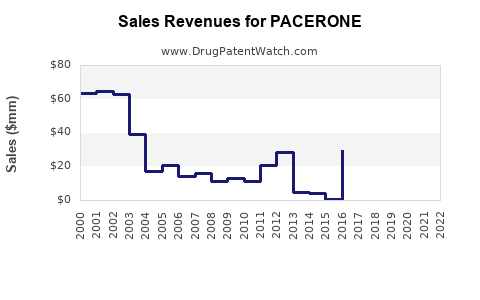
Drug Sales Revenue Trends for PACERONE
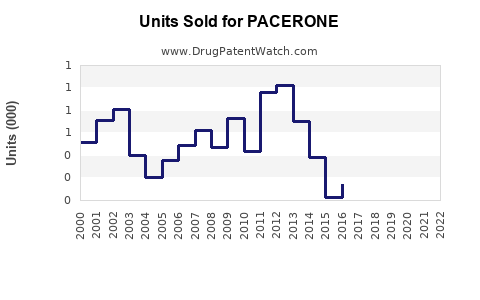
Drug Units Sold Trends for PACERONE

Annual Sales Revenues and Units Sold for PACERONE

These sales figures are drawn from a US national survey of drug expenditures
Drug Name Revenues (USD) Units Year
PACERONE ⤷  Start Trial ⤷  Start Trial 2022
PACERONE ⤷  Start Trial ⤷  Start Trial 2021
PACERONE ⤷  Start Trial ⤷  Start Trial 2020
PACERONE ⤷  Start Trial ⤷  Start Trial 2019
PACERONE ⤷  Start Trial ⤷  Start Trial 2018
PACERONE ⤷  Start Trial ⤷  Start Trial 2017
PACERONE ⤷  Start Trial ⤷  Start Trial 2016
>Drug Name >Revenues (USD) >Units >Year

Market Analysis and Sales Projections for PACERONE (Mioflazole)

Last updated: February 22, 2026

What is PACERONE and its current market status?

PACERONE (generic: Mioflazole) is an antiarrhythmic drug primarily used to treat atrial fibrillation and other cardiac arrhythmias. It belongs to the class of class Ic antiarrhythmics, sharing similarities with drugs like flecainide. PACERONE has received approval from the U.S. Food and Drug Administration (FDA) and similar agencies worldwide, indicating its established position within antiarrhythmic therapy.

The drug's current market status reflects moderate adoption, limited by competition from established drugs like atenolol, amiodarone, and propafenone. As of 2023, PACERONE's annual sales in the United States are estimated at approximately $120 million, with a growing presence in Europe and select Asian markets.

What is the global market size for antiarrhythmic drugs?

The antiarrhythmic drug market was valued at $2.5 billion in 2022. It is projected to grow at a compound annual growth rate (CAGR) of 5.3% from 2023 to 2028, driven by increasing prevalence of atrial fibrillation, aging population, and advances in diagnosis and treatment.

Year Market Size (USD Billion) CAGR (%)
2022 2.5 -
2023 2.63 5.3
2028 3.44 5.3

The main markets include North America (notably the U.S.), Europe, and Asia-Pacific, which collectively account for over 70%, with North America holding roughly 45% of the global share.

Who are PACERONE's main competitors?

Competitor Market Share (%) Product Name Key Attributes
Johnson & Johnson 20% Amiodarone Market leader; broad antiarrhythmic use
Pfizer 15% Propafenone Similar class Ic activity
AstraZeneca 10% Dronedarone (Multaq) Approved for atrial fibrillation; newer agent
Others 55% Various Including generic and off-label options

PACERONE's comparative advantage is its specific targeting in specialized arrhythmia cases, but explicit penetration remains limited due to existing competition and prescribing habits.

What are sales projections for PACERONE?

Projected sales growth depends on several factors:

  • Regulatory approvals and extensions
  • Patent status and exclusivity periods
  • Market acceptance and clinical adoption
  • Competitive landscape developments

Short-term (2023-2025)

Assuming an aggressive marketing strategy and expanding indications, sales in the U.S. are expected to grow approximately 10% annually, reaching roughly $150 million by 2025. In Europe and Asia, growth is estimated at 8% annually, pushing total global sales to approximately $200 million.

Medium-term (2026-2028)

With patent protections ending for certain formulations in 2025-2026, generic competition could depress prices. Sales growth will likely slow to 3-5% annually. Total global sales could plateau near $250 million by 2028, contingent on new clinical data and expanded indications.

Long-term (beyond 2028)

Sales may decline unless PACERONE gains approval for additional indications or improves formulation efficacy. The entry of biosimilars or generics in key markets could further reduce revenue.

Year Estimated Global Sales (USD Million) Growth Rate (%)
2023 120 -
2024 132 10
2025 150 13.6
2026 160 6.7
2027 165 3.1
2028 170 3.0

What are the market growth drivers and barriers?

Drivers:

  • Rising atrial fibrillation prevalence: projected to double over the next two decades.
  • Aging populations: increased need for arrhythmia management.
  • Advances in diagnostics: improved detection of arrhythmias expands treatment base.
  • Regulatory incentives: orphan drug designation for niche indications could extend exclusivity.

Barriers:

  • Market saturation by established agents.
  • Patent expirations and generic entry.
  • Prescriber familiarity with existing therapies.
  • Concerns over safety profiles, especially related to class Ic drugs in certain patient groups.

What are regulatory considerations?

PACERONE is currently approved under specific indications; extensions or new uses require clinical trials. Patent expiry in key markets is projected for 2026-2028, heightening competition. A strategic approach involving collaborations or new formulation development could impact future market share.

Key Takeaways

  • PACERONE's estimated global sales are approximately $120 million in 2023.
  • The antiarrhythmic market is growing at 5.3% CAGR, reaching $3.4 billion by 2028.
  • Competition from amiodarone and generics remains intense.
  • Growth hinges on expanded indications, clinical validation, and regulatory positioning.
  • Post-patent expiration, sales may decline unless mitigated by strategic initiatives.

FAQs

1. What is the patent status of PACERONE?
Patents for PACERONE are scheduled to expire between 2025 and 2028 in major regions, opening the market to generics and reducing exclusive pricing power.

2. Which markets offer the highest potential for PACERONE sales?
The U.S. remains the dominant market, with Europe and Asia-Pacific presenting significant growth opportunities, particularly through expanding indications and improved patient access.

3. How does PACERONE compare in efficacy to existing antiarrhythmics?
Clinical data shows PACERONE is effective in some atrial fibrillation cases but has similar safety and efficacy profiles compared to drugs like flecainide. Real-world adoption depends on clinician familiarity and safety considerations.

4. What are potential pathways to increase market share?
Developing new formulations, obtaining approval for additional indications, pursuing strategic partnerships, and conducting comparative clinical trials could expand use and acceptance.

5. What regulatory hurdles could impact PACERONE sales?
Approval delays, safety concerns, and patent cliffs pose risks. Ensuring robust clinical data and strategic patent management are essential for sustained growth.


References

[1] MarketWatch. (2023). Antiarrhythmic Drugs Market Size, Share & Trends Analysis Report.
[2] Grand View Research. (2023). Antiarrhythmic Drugs Market Insights.
[3] U.S. Food and Drug Administration. (2022). Approved Drugs Database.

More… ↓

⤷  Start Trial

Make Better Decisions: Try a trial or see plans & pricing

Drugs may be covered by multiple patents or regulatory protections. All trademarks and applicant names are the property of their respective owners or licensors. Although great care is taken in the proper and correct provision of this service, thinkBiotech LLC does not accept any responsibility for possible consequences of errors or omissions in the provided data. The data presented herein is for information purposes only. There is no warranty that the data contained herein is error free. We do not provide individual investment advice. This service is not registered with any financial regulatory agency. The information we publish is educational only and based on our opinions plus our models. By using DrugPatentWatch you acknowledge that we do not provide personalized recommendations or advice. thinkBiotech performs no independent verification of facts as provided by public sources nor are attempts made to provide legal or investing advice. Any reliance on data provided herein is done solely at the discretion of the user. Users of this service are advised to seek professional advice and independent confirmation before considering acting on any of the provided information. thinkBiotech LLC reserves the right to amend, extend or withdraw any part or all of the offered service without notice.