Share This Page
Drug Sales Trends for OSELTAMIVIR
✉ Email this page to a colleague
Payment Methods and Pharmacy Types for OSELTAMIVIR (2022)
Revenues by Pharmacy Type
Units Sold by Pharmacy Type
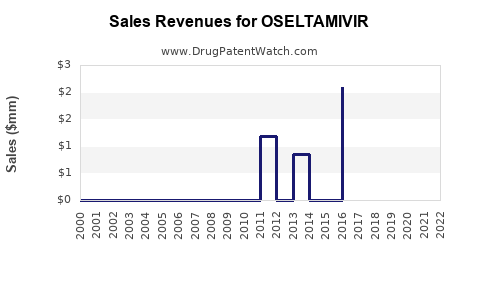
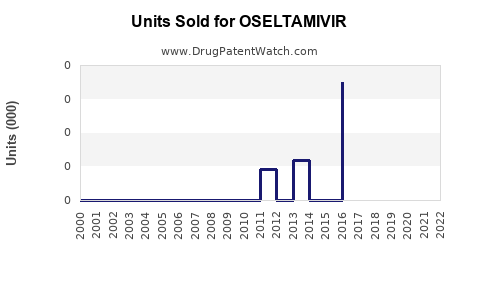
Annual Sales Revenues and Units Sold for OSELTAMIVIR
| Drug Name | Revenues (USD) | Units | Year |
|---|---|---|---|
| OSELTAMIVIR | ⤷ Start Trial | ⤷ Start Trial | 2022 |
| OSELTAMIVIR | ⤷ Start Trial | ⤷ Start Trial | 2021 |
| OSELTAMIVIR | ⤷ Start Trial | ⤷ Start Trial | 2020 |
| OSELTAMIVIR | ⤷ Start Trial | ⤷ Start Trial | 2019 |
| OSELTAMIVIR | ⤷ Start Trial | ⤷ Start Trial | 2018 |
| OSELTAMIVIR | ⤷ Start Trial | ⤷ Start Trial | 2017 |
| >Drug Name | >Revenues (USD) | >Units | >Year |
Oseltamivir Market Analysis, Sales Forecast, Patent Status, and Generic Competition
Oseltamivir is a mature, globally available influenza antiviral marketed primarily as Tamiflu and multiple generic products. Its commercial outlook depends less on patent exclusivity than on seasonal influenza severity, government stockpiling, pandemic preparedness, reimbursement, and generic price competition. Roche's Tamiflu franchise generated approximately CHF 1 billion in annual sales in recent years, while the broader global oseltamivir market is estimated at roughly $1.2 billion to $1.5 billion annually when branded, generic, public-sector, and institutional purchases are included.
The base-case forecast places global oseltamivir product sales at approximately $1.3 billion in 2025, rising to $1.5 billion by 2029. Growth is expected to come from seasonal demand and government inventory replenishment rather than unit-price expansion.
What is the current oseltamivir market size?
Oseltamivir is the leading oral neuraminidase inhibitor for treatment and prevention of influenza A and B. The product is sold as capsules, oral suspension, and, in some markets, powder or compounded formulations.
Because manufacturers do not report global generic oseltamivir sales consistently, market-size estimates depend on scope:
| Market definition | Estimated annual value | Principal products |
|---|---|---|
| Roche Tamiflu franchise | Approximately CHF 1 billion in recent high-demand years | Tamiflu capsules and suspension |
| Global branded and generic oseltamivir | Approximately $1.2 billion-$1.5 billion | Tamiflu plus generic oseltamivir phosphate |
| Influenza antiviral market including other molecules | Approximately $2 billion-$3 billion | Oseltamivir, baloxavir, zanamivir, peramivir and others |
Roche's reported Tamiflu results are the most reliable public commercial benchmark. The company has disclosed that Tamiflu sales can change sharply between years because influenza seasons differ and governments purchase strategic reserves in response to pandemic risk (Roche, 2024).
Oseltamivir remains the volume leader because it is orally administered, available in generic form, recommended for high-risk patients, and used in both treatment and post-exposure prophylaxis. CDC guidance continues to identify oral oseltamivir as a preferred antiviral option for several patient groups, including hospitalized patients and young children (CDC, 2024).
How are oseltamivir sales projected through 2029?
The following base-case forecast covers global product sales for Tamiflu and generic oseltamivir. It excludes diagnostic products, hospital labor, distribution margins, and unrelated influenza antivirals.
| Year | Base-case sales | Low case | High case | Main market driver |
|---|---|---|---|---|
| 2024 | $1.20 billion | $1.05 billion | $1.40 billion | Seasonal demand and public procurement |
| 2025 | $1.28 billion | $1.05 billion | $1.65 billion | Normalized influenza activity |
| 2026 | $1.32 billion | $1.06 billion | $1.75 billion | Stockpile replenishment |
| 2027 | $1.37 billion | $1.07 billion | $1.85 billion | Population aging and institutional use |
| 2028 | $1.43 billion | $1.08 billion | $1.95 billion | Stable volume, lower prices |
| 2029 | $1.50 billion | $1.10 billion | $2.10 billion | Pandemic or severe-season optionality |
The base case assumes annual unit growth of approximately 2% to 4%, offset by low-single-digit price erosion in generic markets. The high case includes one significant influenza season or government replenishment cycle. The low case assumes mild influenza activity, continued generic price erosion, and limited public-sector purchasing.
These figures are market projections, not company guidance. Actual annual revenue can move by several hundred million dollars because government purchases are irregular and influenza epidemiology is volatile.
Which factors drive oseltamivir revenue?
The principal revenue drivers are:
- Seasonal influenza incidence and severity.
- Government stockpile purchases.
- Hospital and long-term-care prescribing.
- Treatment uptake among high-risk patients.
- Generic tender pricing.
- Availability of pediatric formulations.
- Public-health response to novel influenza strains.
- Competition from baloxavir and other antivirals.
Prescription volume is concentrated during influenza seasons, while government and institutional demand can occur outside the normal season. A severe season can raise demand rapidly, but manufacturers may have difficulty converting all demand into revenue if supply constraints or delayed treatment reduce access.
What are Roche's Tamiflu sales and revenue exposures?
Roche is the principal commercial company associated with oseltamivir through Tamiflu. The product originated through research involving Gilead Sciences, with Roche obtaining commercial rights in the late 1990s. Roche has marketed Tamiflu globally for treatment and prevention of influenza.
| Commercial item | Assessment |
|---|---|
| Originator brand | Tamiflu |
| Active ingredient | Oseltamivir phosphate |
| Originator company | Roche |
| Earlier commercial rights holder | Gilead Sciences |
| Principal dosage forms | Capsules and oral suspension |
| Main customers | Retail pharmacies, hospitals, governments, public-health agencies |
| Revenue profile | Highly seasonal and procurement-sensitive |
| Patent position | Core composition protection expired; no meaningful U.S. originator exclusivity barrier remains |
Roche's exposure is commercially important but strategically different from the period before generic entry. Tamiflu now competes on manufacturing reliability, regulatory approvals, institutional relationships, brand recognition, and government procurement capability rather than on core patent exclusivity.
Roche may preserve premium pricing in some markets, but public tenders and pharmacy substitution pressure generally favor lower-priced generic products. Government stockpiles can be more brand-sensitive where procurement specifications require validated suppliers, long shelf life, or continuity of supply.
When did oseltamivir lose patent exclusivity?
The core U.S. oseltamivir composition patent was U.S. Patent No. 5,763,483, assigned to Gilead Sciences. The patent was filed in 1995 and issued in 1998. Its effective U.S. expiration occurred in 2016 after statutory patent-term adjustment and pediatric exclusivity considerations were applied.
| Patent or exclusivity item | Date or status |
|---|---|
| U.S. Patent No. 5,763,483 | Expired in 2016 |
| Tamiflu U.S. approval | October 27, 1999 |
| U.S. pediatric exclusivity | Extended applicable exclusivity by six months |
| Core U.S. generic entry | Began after expiration of core protection |
| Current core composition protection | Expired |
| Current U.S. market structure | Branded and generic competition |
The main patent cliff occurred years ago. Secondary patents may have covered particular processes, formulations, or uses in individual jurisdictions, but these do not recreate broad composition-of-matter exclusivity.
What is the FDA and Orange Book status of oseltamivir?
FDA approved Tamiflu under NDA 21-087 on October 27, 1999. The approved indications include treatment of acute uncomplicated influenza and prevention of influenza in specified age groups and clinical circumstances.
The FDA Orange Book historically listed patents associated with Tamiflu. The commercial significance of those listings has declined because the primary composition patent expired and generic oseltamivir products have obtained approval.
FDA regulatory milestones
| Milestone | Date |
|---|---|
| Original U.S. approval | October 27, 1999 |
| Generic pathway | Abbreviated New Drug Application |
| Active ingredient | Oseltamivir phosphate |
| Common strengths | 30 mg, 45 mg, 75 mg capsules |
| Pediatric product | Oral suspension |
| Current regulatory category | Established small-molecule antiviral |
| Biosimilar pathway | Not applicable |
Oseltamivir is a small molecule, not a biologic. Biosimilar risk is therefore irrelevant. Competitive risk comes from ANDA-approved generics, authorized generics, branded alternatives, and other influenza antivirals.
Which companies are challenging Tamiflu and competing with oseltamivir?
Generic competition includes manufacturers that obtain FDA, European, and other national approvals for oseltamivir phosphate. Supplier participation varies by country and procurement cycle. Publicly visible competitors have included major generic and contract-manufacturing companies such as Teva, Mylan/Viatris, Cipla, Hetero, Sun Pharmaceutical, and other regional suppliers, although product availability and current marketing status differ by jurisdiction.
The principal branded competitors are:
| Product | Active ingredient | Company | Competitive position |
|---|---|---|---|
| Tamiflu | Oseltamivir | Roche | Established originator brand |
| Xofluza | Baloxavir marboxil | Shionogi/Roche in selected markets | Single-dose oral alternative |
| Relenza | Zanamivir | GSK-originated product | Inhaled neuraminidase inhibitor |
| Rapivab | Peramivir | BioCryst in the U.S. | Intravenous hospital option |
Baloxavir is the most important branded competitive threat because it offers single-dose oral administration and a different mechanism. Oseltamivir retains advantages in guideline familiarity, pediatric use, hospitalization settings, global availability, and government stockpile history.
What formulations are protected or commercially differentiated?
The main commercial formulations are hard capsules and oral suspension. Formulation differentiation is more important in pediatric and institutional markets than in adult retail markets.
Capsules
The 30 mg, 45 mg, and 75 mg capsule strengths serve treatment and prophylaxis dosing. Capsules are inexpensive to manufacture and are the most exposed to generic substitution.
Oral suspension
The suspension is strategically important for young children and patients unable to swallow capsules. It can support higher margins because manufacturing, stability, flavoring, dosing devices, and supply-chain requirements are more complex.
During demand surges, suspension availability can become a commercial constraint. Pharmacies and hospitals may compound suspension from capsules when approved commercial suspension is unavailable, subject to applicable regulatory requirements.
Pediatric and institutional supply
Pediatric access is a differentiator for government contracts and hospital formularies. Suppliers with validated suspension manufacturing, stable inventory, and reliable pediatric dosing devices may win tenders even without patent protection.
What patent litigation and Paragraph IV risk affect oseltamivir?
The major Paragraph IV litigation cycle occurred before and around generic entry following expiration of the core U.S. patent. Current U.S. litigation risk is limited because the principal composition patent has expired.
| Risk category | Current assessment |
|---|---|
| Core composition patent challenge | Largely historical |
| Formulation patent challenge | Limited commercial impact |
| Method-of-use patent challenge | Limited commercial impact |
| Manufacturing-process patent | Potentially relevant to API suppliers |
| ANDA litigation | Low relative to patented products |
| Injunction risk | Low for core oseltamivir supply |
| Regulatory exclusivity | No broad current barrier |
Method-of-use claims can remain relevant in particular markets, especially where treatment and prophylaxis labeling differs. Those claims generally do not provide the same market control as a composition patent and may be subject to skinny-label strategies where permitted.
Manufacturing patents could matter to suppliers that use particular synthetic routes, crystalline forms, impurities controls, or process conditions. These rights create supplier-specific risk rather than broad market exclusivity.
How strong is the oseltamivir patent estate?
The oseltamivir patent estate is weak as a source of current market exclusivity but relevant as a historical and manufacturing-rights portfolio.
| Patent-estate dimension | Strength |
|---|---|
| Core molecule protection | Expired |
| Broad U.S. exclusivity | None of commercial significance |
| Formulation protection | Narrow and jurisdiction-dependent |
| Method-of-use protection | Narrow and label-dependent |
| Process protection | Potentially relevant for selected suppliers |
| Generic substitution barrier | Low |
| Government procurement barrier | Moderate |
| Regulatory and quality barrier | Moderate |
| Supply-chain barrier | Moderate to high during demand spikes |
The remaining barriers are operational rather than exclusionary. A supplier must maintain validated production, API access, regulatory compliance, adequate shelf life, and surge capacity. Those requirements can produce commercial concentration even when patents cannot prevent market entry.
What generic launch scenarios exist for oseltamivir?
Three launch scenarios are commercially relevant.
Standard generic launch
A manufacturer enters through an ANDA or equivalent national pathway, competes on price, and supplies retail pharmacies. This is the default market structure and produces gradual price erosion.
Government tender launch
A supplier enters through national or regional public procurement. The manufacturer may accept lower unit pricing in exchange for volume, visibility, and multi-year purchasing commitments. Manufacturing capacity and delivery reliability are often more important than brand recognition.
Pandemic-response launch
A supplier receives emergency or accelerated demand from governments, hospitals, or international agencies. Revenue can increase rapidly, but the opportunity requires prequalified manufacturing, validated quality systems, API capacity, and rapid regulatory execution.
Generic entrants face limited patent risk but meaningful execution risk. Failure to supply during the short influenza demand window can result in lost contracts and inventory write-offs.
How does oseltamivir compare with baloxavir and other influenza antivirals?
| Attribute | Oseltamivir | Baloxavir | Zanamivir | Peramivir |
|---|---|---|---|---|
| Administration | Oral, twice daily for treatment | Single oral dose | Inhaled | Intravenous |
| Generic availability | Broad | More limited | Limited | Limited |
| Hospital use | Strong | More selective | Limited by inhalation requirements | Strong in selected cases |
| Pediatric utility | Strong | Age restrictions vary | More limited | Restricted setting |
| Stockpile suitability | High | Growing | Lower | Lower |
| Patent exposure | Core patents expired | More substantial | Mature | Active commercial rights vary |
| Main weakness | Multiple-dose regimen and resistance concerns | Price and resistance concerns | Inhaled delivery | IV administration |
Oseltamivir's main commercial defense is breadth of use. Baloxavir can take share in outpatient treatment because of single-dose administration, but it does not eliminate oseltamivir's role in hospitalized patients, young children, prophylaxis, and public stockpiles.
What licensing deals affect oseltamivir economics?
Gilead licensed Tamiflu-related rights to Roche, which became the principal global commercial partner. The agreement allowed Roche to develop and market the product while Gilead retained economic rights under the licensing structure. The arrangement shaped the commercial ownership of Tamiflu and remains relevant to royalty and historical revenue analysis.
Current generic economics are determined mainly by supply agreements, API sourcing, contract manufacturing, government tenders, and regional distribution arrangements. Unlike newer patented medicines, oseltamivir does not depend on a large network of active territorial patent licenses to sustain market exclusivity.
What geographic markets offer the strongest oseltamivir opportunity?
Demand is concentrated in North America, Europe, Japan, China, and government procurement programs in countries with pandemic-preparedness policies.
| Region | Commercial profile |
|---|---|
| United States | Large prescription market, generic substitution, federal and state stockpiles |
| Europe | National reimbursement and tender systems, variable generic penetration |
| Japan | High influenza-treatment utilization and established antiviral access |
| China | Large population and seasonal demand, local manufacturing importance |
| Emerging markets | Price-sensitive, dependent on procurement and distribution |
| Government stockpiles | Episodic, high-volume, qualification-sensitive |
The United States offers the strongest transparent regulatory framework but also intense generic competition. Europe offers volume through national procurement but can impose substantial price pressure. Asia presents high patient volume and manufacturing opportunities, with local regulatory and distribution requirements.
What manufacturing and intellectual-property barriers remain?
The principal barriers are:
- Access to compliant oseltamivir phosphate API.
- Capacity to produce during short seasonal demand windows.
- Suspension manufacturing and stability validation.
- Long shelf-life requirements for stockpile contracts.
- Quality-system compliance across multiple jurisdictions.
- Serialization, packaging, and distribution readiness.
- Ability to meet government delivery schedules.
- Control of impurities and batch consistency.
Manufacturers with excess capacity may struggle in ordinary seasons but capture significant upside during severe influenza outbreaks. Stockpile contracts can improve utilization, but they also carry expiration, rotation, and replenishment risks.
What is the investment outlook for oseltamivir?
Oseltamivir is a defensive, mature-market product rather than a high-growth pharmaceutical asset. The market supports recurring demand, but revenue is volatile and price competition is persistent.
The most attractive commercial opportunities are concentrated in:
- Government stockpile contracts.
- Pediatric suspension supply.
- Reliable API and finished-dose manufacturing.
- Emerging-market distribution.
- Dual-supplier procurement programs.
- Pandemic-readiness agreements.
- Contract manufacturing for branded or generic suppliers.
The least attractive opportunity is undifferentiated adult capsule supply in mature generic markets. Margins are likely to remain compressed unless a supplier has unusually low manufacturing costs, a government contract, or a differentiated supply position.
Key Takeaways
- Global oseltamivir product sales are estimated at approximately $1.2 billion-$1.5 billion annually.
- Base-case sales are projected to reach approximately $1.5 billion by 2029.
- Roche's Tamiflu franchise remains the leading branded commercial asset.
- The core U.S. oseltamivir patent, U.S. Patent No. 5,763,483, expired in 2016.
- Current market protection comes from manufacturing, regulatory, procurement, and supply-chain capabilities rather than core patents.
- Generic entry risk is high, but generic supply reliability can be a competitive advantage.
- Baloxavir is the principal branded competitor, while oseltamivir retains broad use in hospitals, pediatrics, prophylaxis, and stockpiles.
- Biosimilar risk does not apply because oseltamivir is a small-molecule drug.
- Revenue remains highly sensitive to influenza severity and government stockpile activity.
- The strongest growth scenario depends on severe seasonal activity or pandemic-related procurement.
FAQs
Does oseltamivir still have patent protection?
The core U.S. composition patent expired in 2016. Narrow process, formulation, or use claims may exist in certain jurisdictions, but they do not provide broad current market exclusivity.
Is Tamiflu still a blockbuster drug?
Tamiflu has generated blockbuster-scale annual revenue in high-demand periods. Its sales fluctuate substantially because influenza activity and government stockpiling vary by year.
Can generic oseltamivir be launched without Paragraph IV litigation?
In the United States, a generic applicant may use an ANDA and address listed patents through the applicable certification process. Because the core patent has expired, current entry does not face the same litigation exposure as a recently patented drug.
Is oseltamivir included in government pandemic stockpiles?
Yes. Oseltamivir has been included in national influenza preparedness programs because of its oral administration, broad clinical familiarity, and established manufacturing base. Stockpile composition and procurement status vary by government.
Will baloxavir replace oseltamivir?
Baloxavir is likely to take share in selected outpatient treatment settings, especially where single-dose administration is valued. It is unlikely to replace oseltamivir across hospitals, pediatric care, prophylaxis, and government stockpiles.
References
-
Centers for Disease Control and Prevention. (2024). Influenza antiviral medications: Summary for clinicians. U.S. Department of Health and Human Services.
-
Food and Drug Administration. (1999). Tamiflu (oseltamivir phosphate) NDA 21-087 approval information. U.S. Department of Health and Human Services.
-
Food and Drug Administration. (2024). Approved drug products with therapeutic equivalence evaluations. U.S. Department of Health and Human Services.
-
Gilead Sciences, Inc. (1995). U.S. Patent No. 5,763,483: Method for the preparation of influenza neuraminidase inhibitors. U.S. Patent and Trademark Office.
-
Roche Holding AG. (2024). Annual report 2023. Basel, Switzerland: Roche.
-
World Health Organization. (2023). Influenza: Antiviral treatment and pandemic preparedness resources. Geneva, Switzerland: World Health Organization.
More… ↓
