Drug Sales Trends for NOVOLOG MIX
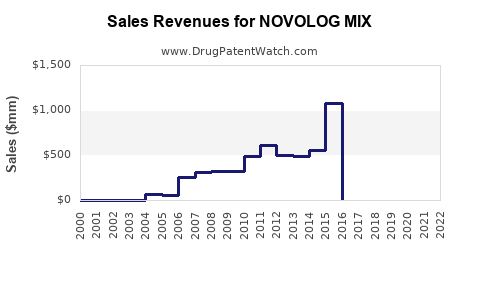
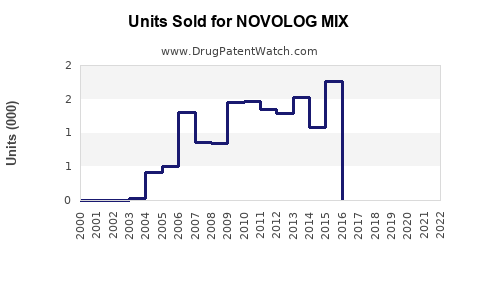
Annual Sales Revenues and Units Sold for NOVOLOG MIX
| Drug Name | Revenues (USD) | Units | Year |
|---|---|---|---|
| NOVOLOG MIX | ⤷ Start Trial | ⤷ Start Trial | 2022 |
| NOVOLOG MIX | ⤷ Start Trial | ⤷ Start Trial | 2021 |
| NOVOLOG MIX | ⤷ Start Trial | ⤷ Start Trial | 2020 |
| >Drug Name | >Revenues (USD) | >Units | >Year |
NovoLog Mix 70/30 Market Analysis, Patent Position, and Sales Projections
NovoLog Mix 70/30 is a mature premixed insulin franchise with declining strategic importance for Novo Nordisk. The product combines 30% rapid-acting insulin aspart with 70% intermediate-acting insulin aspart protamine. Its market remains supported by convenience, established physician familiarity, and lower-cost insulin programs, but faces structural erosion from basal-bolus therapy, GLP-1 medicines, automated insulin delivery, biosimilar insulin, and competing premixed products.
Novo Nordisk does not separately report NovoLog Mix 70/30 revenue. The projections below are analyst estimates based on the product’s mature-market position, Novo Nordisk’s reported insulin trends, U.S. utilization patterns, and expected price pressure.
| Metric | Estimate |
|---|---|
| Product | NovoLog Mix 70/30 |
| Active ingredients | Insulin aspart and insulin aspart protamine |
| Manufacturer | Novo Nordisk |
| Primary dosage forms | FlexPen, vial, and regional presentations |
| U.S. regulatory status | FDA-approved insulin product |
| Estimated 2024 global sales | $300 million-$450 million |
| Estimated 2024 U.S. sales | $100 million-$160 million |
| Base-case 2029 global sales | Approximately $200 million |
| Base-case 2024-2029 revenue CAGR | Approximately -10% |
| Principal competitors | Humalog Mix, Humulin 70/30, human premixed insulin, biosimilar and follow-on insulin products |
What is NovoLog Mix 70/30 and how is it used?
NovoLog Mix 70/30 is a twice-daily premixed insulin intended for patients with diabetes who require both mealtime and intermediate-duration insulin coverage. The formulation contains:
- 30% insulin aspart, a rapid-acting insulin;
- 70% insulin aspart protamine, an intermediate-acting component.
The product is used primarily in type 1 and type 2 diabetes. Its principal commercial advantage is reduced injection complexity compared with separate basal and mealtime insulin administration. Its principal clinical limitation is reduced dosing flexibility. Patients with variable meal timing or changing insulin requirements may obtain better control from basal-bolus regimens or insulin pump therapy.
The product is distinct from NovoLog, which is insulin aspart without the protamine component. NovoLog Mix 70/30 should not be treated as a separate active pharmaceutical ingredient franchise for revenue analysis because Novo Nordisk reports insulin sales at broader portfolio levels.
What is the FDA status of NovoLog Mix 70/30?
NovoLog Mix 70/30 was approved in the United States as a prescription insulin product. The FDA-approved label covers subcutaneous administration for diabetes mellitus, with dosing individualized according to metabolic needs, blood-glucose monitoring, meal intake, and treatment response (U.S. Food and Drug Administration, n.d.-a).
The FDA label identifies important product risks, including hypoglycemia, hypokalemia, hypersensitivity, medication errors, and fluid retention when insulin is combined with certain glucose-lowering therapies. The product must not be administered intravenously and should not be mixed with other insulins unless specifically permitted by the labeling.
The U.S. regulatory framework for insulin changed in March 2020, when insulin products were transitioned from the Federal Food, Drug, and Cosmetic Act pathway to the Public Health Service Act biologics framework. This change created a clearer pathway for biosimilar and interchangeable insulin competition.
What patents protect NovoLog Mix 70/30?
NovoLog Mix 70/30 is a mature product whose original composition and core-use patent barriers have largely expired or reached the end of their commercial life. The remaining competitive protection is more likely to arise from manufacturing know-how, device design, formulation control, trademarks, regulatory data, and supply-chain execution than from a blocking composition-of-matter patent.
| Protection category | Current commercial relevance |
|---|---|
| Insulin aspart composition | Low; original product protection is expired or substantially exhausted |
| Protamine-containing premix formulation | Low to moderate, depending on jurisdiction and claim scope |
| Manufacturing process | Moderate; process patents and trade secrets can complicate replication |
| Prefilled pen device | Moderate for specific device generations |
| Label and method of use | Low as a barrier to standard insulin treatment |
| Trademark rights | Ongoing, but trademarks do not prevent non-branded competition |
| Regulatory exclusivity | No meaningful new-product exclusivity expected for this mature product |
The commercial question is not whether a rival can reproduce the active ingredients. It is whether the rival can obtain regulatory approval, demonstrate comparable quality and pharmacology, manufacture at scale, secure device compatibility, and win payer access.
Does NovoLog Mix 70/30 have Orange Book protection?
NovoLog Mix 70/30 has no widely recognized, commercially decisive Orange Book patent position comparable to newer small-molecule medicines. Because insulin products transitioned to the biologics framework, future competition is assessed through the applicable biologics and biosimilar systems rather than through a conventional small-molecule generic model alone.
The FDA Orange Book and Purple Book should be reviewed for product-specific listings before a litigation or launch decision. A current product-level patent search is required to determine whether any device, formulation, or manufacturing claims remain enforceable in a particular jurisdiction.
When does NovoLog Mix 70/30 lose exclusivity?
Core market exclusivity has already expired. The product is no longer protected by a meaningful period of new-drug exclusivity that would prevent competing insulin products from entering the market.
The relevant timing is therefore competitive erosion rather than a single patent cliff:
| Period | Market event |
|---|---|
| 1990s-early 2000s | Original insulin aspart development and U.S. approvals |
| 2000s-2010s | Expansion of premixed insulin use and pen presentations |
| 2020 | U.S. insulin products transitioned to the biologics framework |
| 2020s | Increasing biosimilar, interchangeable insulin, and low-price competition |
| 2025-2029 | Continued volume migration to lower-cost insulin and newer diabetes therapies |
A rival does not need to invalidate a single remaining patent to pressure NovoLog Mix 70/30. Payer substitution, formulary exclusion, government pricing, and lower-cost human insulin can reduce net sales without patent litigation.
How many patents cover NovoLog Mix 70/30?
There is no reliable public basis for assigning a single current patent count to the global NovoLog Mix 70/30 franchise. Patent coverage varies by country and may include separate rights for insulin analogs, protamine formulations, injection devices, cartridges, manufacturing methods, and packaging.
A practical freedom-to-operate review should distinguish:
- active ingredient patents;
- formulation and particle-size claims;
- pen, cartridge, and delivery-device patents;
- recombinant production and purification claims;
- combination or co-packaging claims;
- trademark and regulatory barriers.
For U.S. commercial planning, the product’s patent strength should be rated low for composition protection, moderate for manufacturing and device execution, and low for method-of-use protection. Manufacturing know-how can delay entry, but it is not equivalent to an enforceable market monopoly.
What generic, biosimilar, and follow-on insulin entry risks exist?
NovoLog Mix 70/30 faces several forms of competition.
Biosimilar and interchangeable insulin risk
Insulin aspart competitors can seek approval through the biosimilar pathway. A competitor may not need to copy the exact branded delivery system to reduce the product’s value. A vial, pen, or alternative presentation can compete for the same prescription and payer budget.
Interchangeability could increase pharmacy-level substitution where state law and payer policies permit it. Even without interchangeable status, formulary placement and physician switching programs can generate significant volume loss.
Human premixed insulin risk
Human insulin 70/30 products, including Walmart’s ReliOn-branded human insulin and other low-cost presentations, compete directly on price. Their pharmacokinetic profile differs from NovoLog Mix 70/30, but they remain commercially relevant for price-sensitive patients and public programs.
Therapeutic substitution risk
Basal insulin combined with mealtime insulin, continuous glucose monitoring, insulin pumps, and automated insulin delivery systems compete with premixed insulin on flexibility and glucose control. GLP-1 receptor agonists and dual incretin therapies also reduce insulin initiation or delay intensification for many patients with type 2 diabetes.
Which companies compete with NovoLog Mix 70/30?
| Company | Competing product or category | Competitive position |
|---|---|---|
| Eli Lilly | Humalog Mix 75/25 and Humalog Mix 50/50 | Closest branded analog-premix competitor |
| Eli Lilly | Humulin 70/30 | Low-cost human premixed insulin |
| Novo Nordisk | Human insulin and other insulin aspart products | Internal portfolio substitution risk |
| Biocon Biologics | Follow-on and biosimilar insulin products | Potential price competitor in selected markets |
| Viatris and partners | Insulin glargine and other follow-on insulin products | Indirect basal-insulin substitution |
| Sanofi | Lantus and other basal insulin products | Competes for insulin budgets and treatment regimens |
| Walmart and regional suppliers | Low-cost human insulin | Strong price-based competition |
Humalog Mix 75/25 is the closest branded competitor by therapeutic positioning. It contains 75% insulin lispro protamine suspension and 25% insulin lispro, while NovoLog Mix 70/30 contains 70% insulin aspart protamine and 30% insulin aspart. The two products are not automatically interchangeable.
How does NovoLog Mix 70/30 compare with Humalog Mix 75/25?
| Attribute | NovoLog Mix 70/30 | Humalog Mix 75/25 |
|---|---|---|
| Rapid-acting component | Insulin aspart | Insulin lispro |
| Protamine component | 70% | 75% |
| Rapid-acting share | 30% | 25% |
| Manufacturer | Novo Nordisk | Eli Lilly |
| Primary market | Premixed insulin | Premixed insulin |
| Main advantage | Established Novo Nordisk supply and pen platform | Strong Lilly contracting and formulary presence |
| Main weakness | Mature product and limited dosing flexibility | Same premix limitations |
| Substitution status | Product-specific | Product-specific |
Competition is determined less by small differences in the rapid-acting component than by price, formulary position, device availability, patient training, and supply reliability.
What are NovoLog Mix 70/30 sales projections through 2029?
Novo Nordisk reports broader insulin revenue rather than a separate NovoLog Mix 70/30 line. The following estimate uses a 2024 global revenue midpoint of $375 million and models annual erosion from volume decline, net-price reduction, and geographic substitution.
Base-case projection
| Year | Estimated global sales | Year-over-year change |
|---|---|---|
| 2024 | $375 million | Baseline |
| 2025 | $340 million | -9% |
| 2026 | $305 million | -10% |
| 2027 | $275 million | -10% |
| 2028 | $240 million | -13% |
| 2029 | $210 million | -13% |
The base case implies a 2024-2029 compound annual decline of approximately 10%.
Scenario analysis
| Scenario | 2029 global sales | Implied 2024-2029 CAGR | Key drivers |
|---|---|---|---|
| Upside | $285 million | -5% | Stable access, limited biosimilar substitution, persistent premix demand |
| Base | $210 million | -10% | Normal price erosion and gradual volume migration |
| Downside | $125 million | -19% | Rapid payer substitution, supply disruptions, stronger use of basal-bolus and incretin therapies |
The U.S. is likely to decline faster in net revenue than some emerging markets because price concessions, government negotiation pressure, insulin affordability programs, and formulary competition are more developed. Emerging markets may retain higher unit growth but generate lower net sales per patient.
What is the revenue exposure for Novo Nordisk?
NovoLog Mix 70/30 is unlikely to represent a material share of Novo Nordisk’s consolidated revenue. The company’s current growth is concentrated in obesity medicines, GLP-1 diabetes products, newer insulin products, and broader chronic-disease franchises.
A $375 million global product estimate would represent less than 1% of Novo Nordisk’s total annual revenue based on the company’s recent revenue scale. The product can still matter operationally because it occupies manufacturing capacity, supports prescriber relationships, and contributes to insulin portfolio contracting.
The principal financial risk is not a sudden loss of a major revenue stream. It is cumulative margin compression across mature insulin products.
What patent litigation and settlement risks affect NovoLog Mix 70/30?
There is no single widely reported, high-value Paragraph IV litigation event that defines the current commercial outlook for NovoLog Mix 70/30. Traditional Paragraph IV litigation is less central than in small-molecule drugs because insulin competition is governed by biologics, follow-on insulin, device rights, and product-specific regulatory pathways.
Potential disputes may still involve:
- biosimilar or follow-on insulin approval;
- insulin aspart sequence or formulation claims;
- pen and cartridge design;
- manufacturing and purification processes;
- state substitution rules;
- trade secrets and employee mobility;
- supply and distribution agreements.
Settlement agreements could delay a competitor’s launch without preserving long-term pricing power. For a mature insulin product, a settlement that permits early entry may produce erosion before the nominal end of all patent rights.
What manufacturing and intellectual-property barriers remain?
Manufacturing is the strongest remaining barrier. A competitor must produce a highly consistent insulin analog and premix, control protamine particle characteristics, meet sterility and potency requirements, and maintain reliable cold-chain distribution.
Key barriers include:
- recombinant insulin production;
- purification and refolding;
- protamine complex formation;
- suspension uniformity;
- device compatibility;
- fill-finish capacity;
- stability testing;
- global regulatory comparability;
- supply reliability during shortages.
These barriers favor large insulin manufacturers but do not protect NovoLog Mix 70/30 from price competition indefinitely. Once a rival has regulatory approval and adequate supply, the product’s limited patent protection leaves contracting and manufacturing cost as the principal defenses.
What is the commercial outlook for NovoLog Mix 70/30?
NovoLog Mix 70/30 is a declining, cash-generative product rather than a growth asset. Its strongest markets are those where injection simplicity and lower treatment complexity remain important. Its weakest markets are those with rapid uptake of insulin pumps, continuous glucose monitoring, GLP-1 therapies, automated insulin delivery, or low-cost biosimilar insulin.
Novo Nordisk can extend the product’s commercial life through:
- competitive net pricing;
- reliable pen and vial supply;
- government and employer affordability programs;
- targeted use in type 2 diabetes;
- distribution in emerging markets;
- retention of patients who prefer premixed dosing.
The product is unlikely to regain sustained growth without a materially differentiated device, pricing structure, or clinical positioning.
Key Takeaways
- NovoLog Mix 70/30 is a mature premixed insulin product with declining global revenue.
- Novo Nordisk does not separately disclose product-level sales.
- Estimated 2024 global revenue is $300 million-$450 million, with a base-case decline to about $210 million by 2029.
- Core composition and regulatory exclusivity have expired or are commercially exhausted.
- Current protection depends more on manufacturing know-how, devices, supply, and contracting than on blocking patents.
- Humalog Mix 75/25, human insulin 70/30, biosimilar insulin, basal-bolus therapy, pumps, and GLP-1 medicines are the main competitive pressures.
- Paragraph IV litigation is less relevant than biologics competition, biosimilar entry, device rights, and payer substitution.
- The product has low strategic revenue exposure for Novo Nordisk but contributes to mature-insulin margin erosion.
FAQs
Is NovoLog Mix 70/30 interchangeable with Humalog Mix 75/25?
No. The products contain different rapid-acting insulin analogs and different premix ratios. A switch requires clinical direction and patient-specific dosing assessment.
Is NovoLog Mix 70/30 a biosimilar?
No. NovoLog Mix 70/30 is the branded reference product. Other insulin aspart or premixed insulin products may seek biosimilar, interchangeable, or follow-on approval depending on the jurisdiction.
Can NovoLog Mix 70/30 be used in an insulin pump?
No. NovoLog Mix 70/30 is a premixed suspension intended for subcutaneous injection and is not labeled for pump administration.
What is the main reason for declining NovoLog Mix 70/30 sales?
The main reasons are lower-cost insulin competition, movement toward flexible basal-bolus regimens and automated delivery, and growing use of GLP-1 and dual incretin therapies in type 2 diabetes.
Does NovoLog Mix 70/30 have biosimilar launch risk before 2029?
Yes. The risk is commercially credible because core product exclusivity is mature and insulin competition increasingly operates through biosimilar and follow-on biologic pathways, although approval timing, device substitution, interchangeability, and payer adoption will determine the actual impact.
References
-
Novo Nordisk A/S. (2024). Annual report 2023. Novo Nordisk.
-
Novo Nordisk A/S. (2025). Annual report 2024. Novo Nordisk.
-
U.S. Food and Drug Administration. (n.d.-a). NovoLog Mix 70/30 prescribing information. U.S. Department of Health and Human Services.
-
U.S. Food and Drug Administration. (n.d.-b). Purple Book: Database of licensed biological products. U.S. Department of Health and Human Services.
-
U.S. Food and Drug Administration. (2020). Transition of insulin and other biological products from the Federal Food, Drug, and Cosmetic Act to the Public Health Service Act. U.S. Department of Health and Human Services.
-
American Diabetes Association Professional Practice Committee. (2024). Standards of care in diabetes - 2024. Diabetes Care, 47(Supplement 1).
-
Centers for Medicare & Medicaid Services. (2024). Medicare Part D prescription drug event data and insulin affordability provisions. U.S. Department of Health and Human Services.
More… ↓
