Share This Page
Drug Sales Trends for NITROLINGUAL
✉ Email this page to a colleague
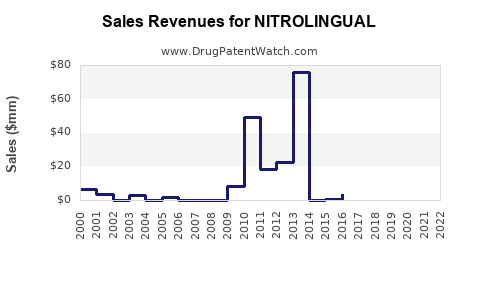
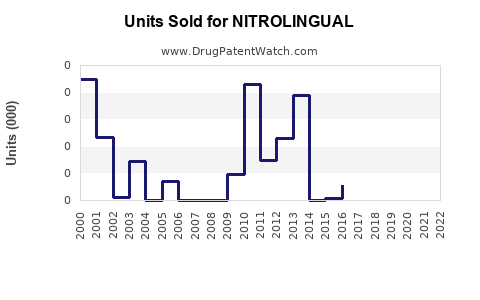
Annual Sales Revenues and Units Sold for NITROLINGUAL
| Drug Name | Revenues (USD) | Units | Year |
|---|---|---|---|
| NITROLINGUAL | ⤷ Start Trial | ⤷ Start Trial | 2022 |
| NITROLINGUAL | ⤷ Start Trial | ⤷ Start Trial | 2021 |
| NITROLINGUAL | ⤷ Start Trial | ⤷ Start Trial | 2020 |
| NITROLINGUAL | ⤷ Start Trial | ⤷ Start Trial | 2019 |
| NITROLINGUAL | ⤷ Start Trial | ⤷ Start Trial | 2018 |
| NITROLINGUAL | ⤷ Start Trial | ⤷ Start Trial | 2017 |
| >Drug Name | >Revenues (USD) | >Units | >Year |
Nitrolingual Market Analysis, Sales Forecast, Patent Risk, and Competitive Outlook
Nitrolingual is a prescription nitroglycerin lingual spray used for rapid relief or prophylaxis of angina pectoris. The product has an established FDA approval, limited public sales disclosure, no material biologic or biosimilar risk, and a commercial position constrained by low-cost sublingual nitroglycerin tablets. Its defensibility depends more on brand recognition, device reliability, distribution, and prescriber familiarity than on active patent exclusivity.
The U.S. Nitrolingual market is likely a niche branded opportunity. A reasonable base-case estimate places annual U.S. product-level sales at approximately $35 million in 2025, increasing to about $42 million by 2030, assuming stable reimbursement and modest growth in spray adoption. The estimate is a market model, not reported manufacturer revenue.
What is Nitrolingual and how is it used?
Nitrolingual Pumpspray contains nitroglycerin, a nitrate vasodilator. Each metered spray delivers 0.4 mg of nitroglycerin to the oral mucosa. The FDA label indicates use for acute relief of an attack of angina, acute prophylaxis of angina, and prevention of angina associated with activities known to provoke attacks. Patients may administer one or two sprays under or onto the tongue, with repeat dosing subject to product labeling and medical direction. [1]
| Product attribute | Nitrolingual Pumpspray |
|---|---|
| Active ingredient | Nitroglycerin |
| Dosage form | Metered lingual/oral spray |
| Strength | 0.4 mg per spray |
| U.S. regulatory status | Prescription drug |
| FDA application | NDA 018166 |
| Primary use | Acute angina relief and prophylaxis |
| Administration | Under or onto the tongue |
| Reference product | Nitrolingual Pumpspray |
| Primary alternatives | Sublingual nitroglycerin tablets, other sprays, transdermal products |
| Biosimilar exposure | None |
Nitrolingual is not a chronic disease-modifying therapy. It is used episodically, which limits prescription volume but supports repeat demand among patients with established coronary artery disease.
What is the U.S. market size for Nitrolingual?
Public filings do not provide a separately reported revenue line for Nitrolingual. The product is not marketed by a large public company that routinely discloses brand-level sales. Market sizing therefore requires a bottom-up estimate based on patient use, prescription frequency, retail pricing, and the share of nitroglycerin rescue therapy supplied by sprays.
Estimated U.S. market scenarios
| Scenario | 2025 estimated sales | 2030 estimated sales | 2025-2030 CAGR | Key assumptions |
|---|---|---|---|---|
| Low | $18 million | $19 million | 1.1% | Increased tablet substitution, pricing pressure |
| Base | $35 million | $42 million | 3.7% | Stable patient base, modest spray preference |
| High | $62 million | $78 million | 4.7% | Greater emergency preparedness, higher branded pricing, stronger specialty distribution |
These figures represent estimated U.S. gross product sales for Nitrolingual and closely substitutable nitroglycerin spray demand. Net manufacturer revenue would be lower after rebates, wholesaler discounts, payer concessions, and pharmacy margins.
The market is likely characterized by:
- Low unit volume compared with chronic cardiovascular drugs.
- Relatively high revenue per package compared with generic nitroglycerin tablets.
- Repeat refills driven by expiration, loss, device depletion, and patient replacement.
- Demand concentrated in cardiology, primary care, emergency preparedness, and long-term-care channels.
- High therapeutic substitutability with sublingual tablets.
What are the main growth drivers for Nitrolingual sales?
The strongest commercial drivers are product convenience, patient preference, and distribution availability.
Patient and prescriber factors
Spray delivery can be attractive for patients who have difficulty handling small tablets, experience dry mouth, or want a product that can be used without placing a tablet under the tongue. The metered device also gives patients a visible dosing mechanism and may reduce concerns about tablet storage or loss.
Nitroglycerin remains relevant because coronary artery disease and angina persist in an aging population. The American Heart Association identifies coronary heart disease as a major source of cardiovascular morbidity in the United States. [2]
Refill and replacement demand
Nitroglycerin products are often carried for emergency use rather than consumed on a predictable daily schedule. That creates a replacement market that is larger than usage volume alone would imply. Patients may obtain a new container when:
- The product approaches its labeled expiration date.
- The device is lost or damaged.
- The patient changes insurance or pharmacy.
- The patient wants a second unit for a vehicle, workplace, or travel.
- The container is used during an angina episode.
Pricing
Spray products generally command a premium over generic sublingual tablets. That premium creates revenue opportunity but also increases formulary and payer substitution risk. If a payer applies a high copay or excludes the branded product, pharmacists may shift patients to lower-cost tablets.
How does Nitrolingual compare with competing nitroglycerin products?
Nitrolingual competes within a mature nitrate market rather than against a single direct rival.
| Product category | Commercial advantage | Limitation relative to Nitrolingual |
|---|---|---|
| Sublingual nitroglycerin tablets | Low cost, broad generic availability | Tablet handling and storage concerns |
| Nitroglycerin lingual spray | Rapid administration, metered delivery, convenience | Higher price and device dependence |
| Nitroglycerin ointment | Longer duration, useful in selected settings | Slower and less convenient for acute rescue |
| Transdermal nitroglycerin | Continuous prophylaxis | Not designed for immediate rescue |
| Intravenous nitroglycerin | Hospital titration and acute-care use | Hospital-only administration |
The principal competitive threat is not another branded spray. It is substitution to generic nitroglycerin tablets, especially when payers use reference pricing or step therapy.
What is the FDA regulatory status of Nitrolingual?
Nitrolingual is an FDA-approved prescription product associated with NDA 018166. FDA labeling identifies the product as nitroglycerin lingual spray with a 0.4 mg dose per spray. [1]
The product is subject to the standard prescription-drug framework, including:
- Labeling requirements for nitrate-associated hypotension and contraindicated drug combinations.
- Manufacturing and device quality requirements.
- Pharmacovigilance obligations.
- Prescription-only distribution.
- Potential ANDA competition if a generic applicant demonstrates pharmaceutical equivalence and bioequivalence or satisfies applicable FDA requirements.
The most important safety limitation is concomitant use with phosphodiesterase-5 inhibitors and soluble guanylate cyclase stimulators. The combination can cause severe hypotension. [1]
What is the Orange Book status of Nitrolingual?
The commercial protection profile appears to be weak from a current Orange Book perspective. Nitrolingual’s protection is not primarily supported by a long-lived active-ingredient patent estate.
Orange Book and exclusivity assessment
| Protection category | Current commercial assessment |
|---|---|
| Active ingredient patent | Expired or commercially irrelevant |
| Original FDA approval exclusivity | Expired |
| Current NCE exclusivity | None |
| Listed formulation patents | No material current protection identified in the public Orange Book record |
| Listed method-of-use patents | No material current protection identified |
| Device protection | Any relevant early patents are likely expired; know-how may remain non-public |
| ANDA vulnerability | Potentially high if a technically acceptable generic is approved |
The absence of meaningful Orange Book patent protection does not guarantee immediate generic entry. A spray product requires a suitable metering pump, container-closure system, dose-delivery performance, manufacturing controls, and regulatory documentation. Those requirements can delay entry even when the drug substance is old and unpatented.
The FDA Orange Book is the controlling public source for listed patents and exclusivity associated with approved drug products. [3]
What patents protect Nitrolingual?
The original nitroglycerin compound is long off-patent. Any current protection would need to arise from a specific formulation, container, metering system, manufacturing process, or method of use.
The practical IP position is therefore divided into two parts:
Expired platform protection
Nitroglycerin itself has no meaningful remaining composition-of-matter protection. Earlier patents covering nitrate formulations, delivery systems, or spray mechanisms do not create an enforceable commercial barrier if their terms have expired.
Non-patent barriers
The more relevant barriers are:
- Dose uniformity across the container’s life.
- Pump priming and re-priming performance.
- Stability of nitroglycerin in the container-closure system.
- Packaging that limits evaporation and degradation.
- Manufacturing validation.
- Bioequivalence or performance testing for an ANDA.
- Supplier qualification for specialized components.
These factors can preserve a product’s market position after patent expiry, but they are not equivalent to regulatory exclusivity.
Are there Paragraph IV challenges to Nitrolingual?
A Paragraph IV challenge is possible if an applicant files an ANDA referencing Nitrolingual and asserts that listed patents are invalid, unenforceable, or not infringed. The public Orange Book record does not indicate a major current patent litigation campaign around Nitrolingual.
The absence of a visible Paragraph IV dispute suggests one of three commercial conditions:
- No active listed patent creates a meaningful litigation target.
- The market is too small to justify extensive litigation.
- Potential entrants are constrained by formulation, device, manufacturing, or commercial economics rather than patent claims.
For a spray product with limited market volume, a generic entrant may prefer to avoid litigation and pursue a non-infringing product pathway where available. The commercial decision will depend on development cost, expected reimbursement, manufacturing scale, and the ability to win pharmacy substitution.
What generic entry risks exist for Nitrolingual?
Generic entry risk is structurally high because nitroglycerin is an old active ingredient and the principal product use is well established.
Near-term risk
The near-term threat is moderate rather than immediate. A competitor must reproduce a metered spray with acceptable dose delivery and stability, not simply manufacture a tablet. That technical requirement narrows the field compared with conventional solid oral dosage forms.
Medium-term risk
The five-year risk is higher. A successful generic spray could reduce net prices, compress pharmacy reimbursement, and weaken the brand’s share among price-sensitive patients. The likely market effect would be:
| Event | Expected impact |
|---|---|
| First generic spray approval | 15%-30% price pressure |
| Two or more generic sprays | 30%-50% price pressure |
| Broad payer substitution | Faster branded share loss |
| Limited distribution or supply problems | Temporary brand retention |
| Device or manufacturing failure by entrant | Delayed substitution |
The most credible launch scenario is a single generic spray entering with limited initial capacity, followed by payer-driven conversion if the product demonstrates reliable supply.
What litigation and settlement risks affect Nitrolingual?
No major current U.S. patent litigation or publicly prominent settlement involving Nitrolingual is apparent from the available regulatory and commercial record. The litigation exposure is therefore more likely to arise from:
- Product liability claims involving hypotension, syncope, or drug interactions.
- Manufacturing or quality disputes.
- Trade-secret or supplier disagreements involving the delivery device.
- ANDA litigation if a new spray applicant encounters a listed patent.
- False-marking or labeling disputes if legacy patent references are used commercially.
The lack of active patent litigation reduces near-term legal cost but also indicates that the brand cannot rely on litigation as a principal exclusivity strategy.
How strong is the Nitrolingual patent estate?
The patent estate is weak as a standalone barrier. Its strength can be summarized as follows:
| Dimension | Assessment |
|---|---|
| Composition-of-matter protection | None |
| Regulatory exclusivity | Expired |
| Orange Book protection | Limited or none currently material |
| Formulation protection | Weak based on public information |
| Device protection | Potentially relevant but likely expired or nonblocking |
| Manufacturing know-how | Moderate practical value |
| Brand and prescriber familiarity | Moderate commercial value |
| Generic vulnerability | High over the medium term |
The product’s commercial durability is therefore based on execution rather than exclusivity. Reliable supply, pharmacy availability, patient education, and reimbursement management are more important than patent prosecution.
What licensing deals or partnerships affect Nitrolingual?
No major publicly disclosed licensing transaction is central to Nitrolingual’s current market position. The product’s economics are more likely to involve ordinary manufacturer, wholesaler, pharmacy, and distribution agreements than high-value strategic licensing.
Potential partnership value would be concentrated in:
- U.S. commercialization rights.
- Specialty pharmacy distribution.
- Contract manufacturing for the metered pump.
- Device-component supply.
- Regional marketing rights outside the United States.
Because the product is mature and relatively small, a licensing transaction would likely be evaluated on cash flow, manufacturing reliability, and regulatory continuity rather than patent duration.
What are the 2025-2030 sales projections for Nitrolingual?
The base-case forecast assumes stable U.S. angina prevalence, modest growth in spray preference, no major supply interruption, and generic entry that remains limited during the first part of the forecast period.
| Year | Low case | Base case | High case |
|---|---|---|---|
| 2025 | $18M | $35M | $62M |
| 2026 | $18M | $37M | $66M |
| 2027 | $18M | $38M | $69M |
| 2028 | $19M | $39M | $72M |
| 2029 | $19M | $41M | $75M |
| 2030 | $19M | $42M | $78M |
Forecast risks
The main downside risks are:
- Generic spray approval.
- Increased use of low-cost sublingual tablets.
- Payer exclusion or higher patient copays.
- Reduced angina incidence due to improved revascularization and preventive therapy.
- Supply constraints affecting the metered pump or container.
- Product recalls or quality findings.
Upside potential is limited but could come from higher replacement frequency, greater use in elderly patients who prefer sprays, improved distribution, or a licensing arrangement that expands geographic access.
Key Takeaways
- Nitrolingual is a mature nitroglycerin lingual spray with FDA approval under NDA 018166.
- The U.S. market is niche, with a base-case estimated value of $35 million in 2025 and $42 million in 2030.
- Sublingual nitroglycerin tablets are the primary competitive threat.
- No meaningful current composition-of-matter, regulatory, or Orange Book exclusivity protects the product.
- Generic entry risk is high over a five-year horizon, although spray-device requirements may slow development.
- The commercial moat is based on brand familiarity, reliable device performance, supply, and distribution.
- No major current Paragraph IV litigation or settlement is central to the product’s outlook.
- Revenue growth is likely to be modest unless the product gains share from tablets or expands through new distribution arrangements.
FAQs
Is Nitrolingual still under patent protection?
No material current patent protection appears to cover the nitroglycerin active ingredient. Any remaining protection would need to involve a specific formulation, device, manufacturing process, or method of use.
Is Nitrolingual available as a generic?
Generic nitroglycerin tablets are widely available. Generic lingual spray competition is more limited because the applicant must reproduce the metered delivery system and demonstrate acceptable product performance.
Does Nitrolingual have FDA exclusivity?
No current new-chemical-entity or approval-based exclusivity is expected to remain for this mature nitroglycerin product.
What is the biggest threat to Nitrolingual revenue?
The largest threat is substitution to lower-cost sublingual nitroglycerin tablets, followed by entry of a generic nitroglycerin spray.
Is Nitrolingual a biologic or subject to biosimilar competition?
No. Nitrolingual is a small-molecule nitroglycerin product. Biosimilar competition does not apply.
References
-
U.S. Food and Drug Administration. (2024). Nitrolingual Pumpspray: Prescribing information. Pohl-Boskamp GmbH & Co. KG.
-
American Heart Association. (2024). Heart disease and stroke statistics: 2024 update. Circulation.
-
U.S. Food and Drug Administration. (2025). Approved drug products with therapeutic equivalence evaluations: Orange Book. FDA.
More… ↓
