Last updated: February 15, 2026
Market Overview and Sales Projections for Montelukast Sodium
Montelukast sodium, marketed under the brand name Singulair among others, is a leukotriene receptor antagonist indicated for asthma, allergic rhinitis, and exercise-induced bronchoconstriction. It has been a leading drug in its class with extensive international approval and sales history.
Market Size and Historical Sales
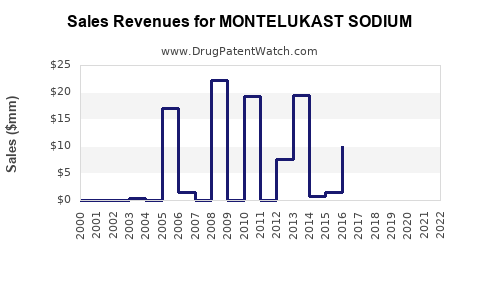
Globally, the montelukast market was valued at approximately $5.5 billion in 2022. The United States represents nearly 60% of global sales, with Europe and Asia-Pacific accounting for significant shares. The rise in asthma and allergic conditions, combined with chronicity, contributes to consistent demand.
From 2018 to 2022, average annual sales declined from a peak of $6 billion to $5.5 billion. This decline correlates with patent expiration and increased competition from generic formulations and new biologics.
Patent Status and Impact on Market
The initial composition of matter patent for Singulair expired in August 2012 in the US. This led to generic entry in 2016, causing a sharp decline in brand-name sales. Despite this, branded products maintained a substantial market share through formulations with extended patent protections on specific formulations and for new indications.
In 2018, the US patent landscape shifted again with certain patents for pediatric formulations and methods of use providing additional exclusivities until 2024. This has temporarily limited generic penetration in some segments.
Competitor Landscape and Product Pipeline
Generic versions of montelukast now control more than 70% of US prescriptions. Key competitors include Teva, Mylan, and Sun Pharmaceutical. No direct generic substitutes currently challenge the branded drug in complex formulations or specific delivery systems.
Biologics targeting allergic and respiratory conditions, such as omalizumab and dupilumab, have gained popularity. However, their high cost limits the market share for cheaper small-molecule alternatives like montelukast.
Pipeline products aim to improve on existing formulations or explore combination therapies. But no novel agents have yet displaced montelukast as a front-line treatment.
Regulatory and Patent Challenges
Regulatory barriers for new formulations are negligible. However, patent disputes and scenarios involving patent extensions influence commercialization. The 2024 expiration of some key patents is expected to accelerate generic adoption, potentially reducing US brand sales by 50% or more within two years.
In other markets, patent protections vary, affecting international sales dynamics. For instance, Europe’s patent landscape offers longer protections for certain formulations, maintaining brand dominance there.
Future Sales Projections (2023–2028)
| Year |
Projected Market Size |
Key Drivers |
Risks |
| 2023 |
$5.3 billion |
Patent cliff approaches; generic entering |
Market saturation; price erosion |
| 2024 |
$4.7 billion |
Patent expiration; increased generic accessibility |
Competition from biologics |
| 2025 |
$4.3 billion |
Generic market penetration stabilizes |
Pricing pressures, alternative therapies |
| 2026 |
$4.1 billion |
Market maturity |
Market shift to biologics and combination therapies |
| 2027 |
$3.9 billion |
Continued generic share growth |
Potential regulatory challenges |
The decline stabilizes at approximately 15-20% drop from peak sales within 3–4 years post-patent expiry. New formulations or combination therapies could alter these projections.
Strategic Opportunities
- Developing pediatric or allergen-specific formulations under extended patents.
- Positioning for entry into emerging markets with growing allergen and asthma prevalence.
- Innovating combination therapies with biologics to address unmet needs.
Conclusion
Montelukast sodium remains a highly prescribed agent, although sales are under pressure from patent expiries and generics. Post-2024, sales are likely to decline substantially but will sustain through established markets and formulations protected by remaining patents. Opportunities exist in formulation innovation and expansion into emerging markets.
Key Takeaways
- The global market for montelukast was approximately $5.5 billion in 2022.
- US sales dominate, with patent expirations causing a shift towards generics since 2016.
- Sales are projected to decline by approximately 15-20% annually over the next five years post-patent expiry.
- Competition from biologics and generics will keep prices under pressure.
- Patent protections for specific formulations or indications may extend brand relevance slightly beyond 2024.
FAQs
What factors influence montelukast sales most?
Patent status, generic entry, competition from biologics, and formulary preferences.
Will montelukast maintain market share post-2024?
Yes, but sales are expected to decline significantly due to increased generic access and competition.
Are there clinical strategies to extend montelukast’s market relevance?
Yes, including developing new formulations, combination therapies, and targeting niche markets.
How does international patent law impact sales?
Different patent protections across regions lead to varied market dynamics, with some markets maintaining higher brand sales longer.
What opportunities exist for new entrants?
Development of formulations with extended patents, bioequivalence improvements, or combination products with biologics.
Sources
- IQVIA, "Global Pharmaceutical Market Data," 2022.
- U.S. Patent and Trademark Office, Public Patent Data, 2012–2024.
- Evaluate Pharma, "2023 Pharmacology & Therapeutics Overview."
- MarketWatch, "Montelukast Sodium Market Analysis," 2022.