Drug Sales Trends for MONODOX
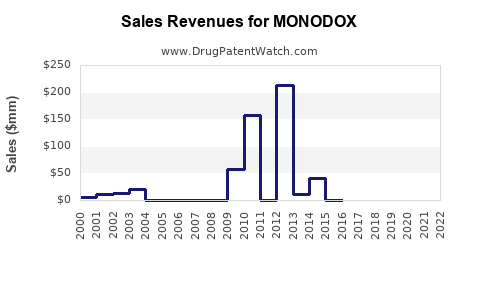
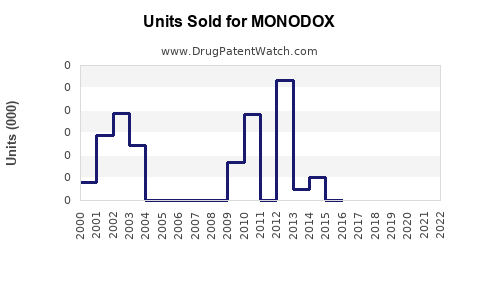
Annual Sales Revenues and Units Sold for MONODOX
| Drug Name | Revenues (USD) | Units | Year |
|---|---|---|---|
| MONODOX | ⤷ Start Trial | ⤷ Start Trial | 2022 |
| MONODOX | ⤷ Start Trial | ⤷ Start Trial | 2021 |
| MONODOX | ⤷ Start Trial | ⤷ Start Trial | 2020 |
| MONODOX | ⤷ Start Trial | ⤷ Start Trial | 2019 |
| MONODOX | ⤷ Start Trial | ⤷ Start Trial | 2018 |
| MONODOX | ⤷ Start Trial | ⤷ Start Trial | 2017 |
| MONODOX | ⤷ Start Trial | ⤷ Start Trial | 2016 |
| >Drug Name | >Revenues (USD) | >Units | >Year |
Monodox Market Analysis, Sales Projections, Patent Status, and Competitive Outlook
Monodox is a mature doxycycline monohydrate capsule marketed in the United States by Mayne Pharma. Its commercial opportunity is driven by prescription volume for acne, rosacea, sexually transmitted infections, respiratory infections, and tick-borne disease rather than patent exclusivity. The product has limited pricing power against generic doxycycline hyclate and other doxycycline monohydrate products.
A base-case model estimates U.S. Monodox net sales of approximately $35 million to $55 million in 2025, with sales declining toward $25 million to $40 million by 2029 unless the sponsor expands payer access, wins institutional contracts, or increases share in dermatology and infectious-disease channels. These are modeled estimates, not reported company guidance.
What is Monodox and how is it used?
Monodox is an oral capsule containing doxycycline monohydrate, a tetracycline-class antibacterial. FDA labeling covers a broad group of susceptible bacterial infections and certain noninfectious dermatology-related indications, including acne as adjunctive therapy. The product is also prescribed for conditions such as chlamydial infections, atypical respiratory infections, rickettsial disease, and Lyme disease when clinically appropriate. [1]
Monodox dosage forms and strengths
Monodox is marketed as an immediate-release capsule product. FDA labeling has included 50 mg, 75 mg, 100 mg, and 150 mg strengths, although commercial availability can vary by package configuration and wholesaler inventory. The 100 mg strength is the principal commercial strength because it aligns with common twice-daily and once-daily treatment regimens.
| Product attribute | Monodox |
|---|---|
| Active ingredient | Doxycycline monohydrate |
| Drug class | Tetracycline antibiotic |
| Route | Oral |
| Dosage form | Immediate-release capsule |
| Primary commercial strength | 100 mg |
| Main prescriber groups | Dermatology, primary care, infectious disease, emergency medicine |
| U.S. regulatory status | FDA-approved prescription drug |
| Biosimilar relevance | None |
| Patent-based exclusivity | No material current exclusivity identified |
| Principal alternatives | Generic doxycycline hyclate, generic doxycycline monohydrate, Doryx, Oracea, Acticlate |
Monodox competes principally on availability, wholesaler supply, product familiarity, and contract pricing. It does not have the clinical differentiation associated with delayed-release doxycycline products such as Doryx MPC or low-dose Oracea.
How large is the doxycycline market?
The U.S. doxycycline market is large in prescription volume but fragmented across manufacturers, dosage forms, strengths, and National Drug Codes. Doxycycline is used in primary care, dermatology, sexual health, urgent care, emergency medicine, travel medicine, and public-health treatment programs.
A reasonable commercial model places annual U.S. doxycycline prescription volume in the tens of millions. Generic immediate-release products account for most prescriptions. Branded and specialty formulations capture a smaller share but can generate higher revenue per prescription.
Key demand segments
| Segment | Demand characteristics | Relevance to Monodox |
|---|---|---|
| Acne and rosacea | High recurring use; concentrated among dermatologists and younger patients | Attractive volume segment, but heavy generic substitution |
| Chlamydia and other STIs | Guideline-driven, episodic treatment | Stable demand with public-health sensitivity |
| Respiratory infections | Broad primary-care use | Large volume but high price pressure |
| Tick-borne disease | Seasonal and geographically concentrated | Growth depends on disease incidence and diagnosis |
| Malaria prophylaxis | Travel-related and episodic | Smaller, price-sensitive segment |
| Hospital and institutional use | Formulary and contract driven | Potential volume channel, usually low margin |
CDC treatment guidelines continue to support doxycycline as a preferred or important therapy for several common infectious diseases, including chlamydia and selected tick-borne illnesses. [2] The drug's low cost, broad clinical familiarity, and oral availability support continued demand.
What are the 2025-2029 Monodox sales projections?
The following forecast uses a bottom-up framework based on estimated U.S. prescriptions, average net revenue per prescription, generic substitution, and a declining branded share. Because Monodox-specific revenue is not separately disclosed in Mayne Pharma's public financial reporting, the forecast should be interpreted as a market model.
Base-case U.S. net sales forecast
| Year | Estimated Monodox prescriptions | Estimated net revenue per prescription | Projected U.S. net sales |
|---|---|---|---|
| 2024A | 0.65 million | $68 | $44 million |
| 2025E | 0.63 million | $70 | $44 million |
| 2026E | 0.60 million | $70 | $42 million |
| 2027E | 0.57 million | $69 | $39 million |
| 2028E | 0.54 million | $68 | $37 million |
| 2029E | 0.51 million | $67 | $34 million |
The base case implies a compound annual revenue decline of approximately 6% from 2025 to 2029. The decline reflects generic competition and a gradual shift toward lower-cost doxycycline products rather than a collapse in clinical demand.
Scenario analysis
| Scenario | 2025 sales | 2029 sales | Main assumptions |
|---|---|---|---|
| Upside | $55 million | $50 million | Improved supply, stronger dermatology distribution, stable reimbursement |
| Base case | $44 million | $34 million | Moderate volume erosion and stable net pricing |
| Downside | $32 million | $20 million | Payer substitution, wholesaler delisting, aggressive generic pricing |
The key variable is not the size of the doxycycline market. It is Monodox's share of prescriptions and the net price retained after wholesaler discounts, rebates, chargebacks, and pharmacy concessions.
What is the FDA regulatory status of Monodox?
Monodox is an FDA-approved prescription product. It is not a new molecular entity and does not receive the regulatory exclusivity profile associated with a recently approved innovative drug.
The FDA label identifies doxycycline monohydrate as the active ingredient and includes warnings relating to photosensitivity, esophageal irritation, tooth discoloration, fetal and pediatric exposure, and bacterial overgrowth. [1]
Regulatory factors affecting demand
Monodox demand is supported by:
- Continued guideline use of doxycycline in sexually transmitted infections.
- Use in acne, rosacea, and inflammatory dermatology.
- Oral treatment convenience.
- Broad prescriber familiarity.
- Low manufacturing complexity relative to biologics or sterile injectables.
Demand is constrained by:
- Generic substitution.
- Tetracycline-class safety warnings.
- Availability of doxycycline hyclate and other monohydrate products.
- Payer preference for the lowest-cost NDC.
- Clinical resistance concerns in some bacterial settings.
Monodox has no biosimilar exposure because it is a small-molecule oral capsule. The relevant competitive risk comes from ANDA-approved generic products, not biosimilar applicants.
What patents protect Monodox?
No significant active patent estate appears to protect the underlying doxycycline monohydrate molecule or the standard immediate-release Monodox capsule. Doxycycline has been marketed for decades, and the basic compound is long off patent.
The FDA Orange Book is the principal public source for listed patents and regulatory exclusivity associated with approved drug products. [3] Monodox's commercial position is therefore based on product approval, manufacturing, distribution, trademark recognition, and supply reliability rather than enforceable compound or formulation patents.
Patent and exclusivity profile
| Protection category | Monodox position |
|---|---|
| New chemical entity exclusivity | Expired |
| Basic compound patent | Expired |
| Standard capsule formulation patent | No material current protection identified |
| Method-of-use patents | No material current protection identified for routine labeled uses |
| Pediatric exclusivity | Not a current commercial protection |
| Orphan exclusivity | Not applicable |
| Trademark | May protect the MONODOX name, not doxycycline itself |
| Trade secrets | May protect manufacturing know-how and sourcing |
The absence of meaningful patent protection increases the importance of manufacturing economics. A competitor does not need to invent a new delivery system to enter the market. It needs an approved product, compliant manufacturing, commercial supply, and access to pharmacy and wholesaler channels.
Are there Paragraph IV challenges to Monodox?
Monodox is not a typical Paragraph IV litigation target because the product is a mature genericized drug with no important listed patent barrier. Paragraph IV litigation generally matters when an ANDA applicant challenges a listed patent for a branded drug. The commercial threat to Monodox is more likely to arise from ordinary generic substitution and price competition than from a new Paragraph IV launch.
No material current Paragraph IV dispute involving the standard Monodox capsule is identified in the public regulatory profile reviewed for this analysis. The absence of litigation does not create exclusivity. It indicates that the competitive field is already open.
What formulations are protected in the doxycycline market?
The strongest remaining formulation differentiation in doxycycline is concentrated in products that claim improved tolerability, modified release, or specialized dosing.
| Product or category | Formulation position | Commercial effect |
|---|---|---|
| Monodox | Immediate-release doxycycline monohydrate capsule | Low differentiation; price and supply driven |
| Generic doxycycline hyclate | Immediate-release capsule or tablet | Direct substitution risk |
| Doryx and Doryx MPC | Delayed-release tablets | Higher price and formulation differentiation |
| Oracea | Low-dose delayed-release capsule for rosacea | Specialty dermatology positioning |
| Acticlate | Doxycycline hyclate tablet | Branded or authorized-generic competition depending on channel |
| Liquid formulations | Oral suspension products | Pediatric and swallowing-related niche |
Monodox may benefit from the general perception that doxycycline monohydrate can be better tolerated than some doxycycline hyclate products. That positioning is commercially useful only if supported by payer coverage, prescriber preference, or formulary placement. The FDA label does not create a broad exclusivity right for that distinction.
How strong is the Monodox patent estate?
The Monodox patent estate is weak as a barrier to entry and strong only in the limited sense that the brand name and approved product identity can support commercial continuity.
Strength assessment
| Factor | Assessment | Commercial implication |
|---|---|---|
| Compound protection | Very weak or expired | No molecule-level barrier |
| Formulation protection | Limited | Immediate-release products are readily substitutable |
| Regulatory exclusivity | None of material current value | Competitors can enter through generic pathways |
| Trademark | Moderate | Protects brand identity, not active ingredient |
| Manufacturing know-how | Potentially moderate | May support quality and supply but is difficult to monetize as exclusivity |
| Distribution relationships | Potentially important | Can preserve volume in selected channels |
| Clinical differentiation | Low | Guidelines generally reference doxycycline rather than Monodox |
The estate's value is therefore operational. Reliable supply, low defect rates, favorable wholesaler terms, and pharmacy availability can matter more than patent enforcement.
Which companies challenge Monodox commercially?
The principal competitors are manufacturers of generic doxycycline monohydrate and doxycycline hyclate. Competition can change by NDC, strength, dosage form, and channel.
Relevant competitive groups include:
- Large generic manufacturers supplying retail pharmacies.
- Contract manufacturers selling through private-label distributors.
- Specialty-drug companies marketing delayed-release or dermatology-focused doxycycline.
- Hospital suppliers with formulary contracts.
- Authorized-generic distributors.
The most important direct threat is a lower-priced 100 mg generic capsule with dependable supply. Specialty brands such as Oracea and Doryx compete less directly on unit price but can reduce Monodox use in dermatology when physicians prioritize formulation-specific tolerability or payer-approved specialty coverage.
What patent litigation and settlement agreements affect Monodox?
No material active patent litigation or settlement agreement is identified as a central commercial issue for standard Monodox capsules. The product is not positioned behind a major patent cliff, and no high-value settlement structure is apparent from the public regulatory profile.
Litigation risk is more relevant to:
- Product liability and adverse-event claims.
- Manufacturing or current-good-manufacturing-practice disputes.
- Trademark conflicts.
- Distribution and supply contracts.
- Competing delayed-release doxycycline products.
These risks can affect cost and availability but are unlikely to create long-term market exclusivity for Monodox.
What is the competitive outlook for Monodox?
Monodox should remain commercially viable as a mature oral antibiotic, but its growth ceiling is low. Volume is supported by broad clinical use, while revenue is limited by generic pricing.
Revenue exposure by channel
| Channel | Expected role | Margin outlook |
|---|---|---|
| Retail pharmacy | Largest volume channel | Low to moderate |
| Specialty dermatology | Smaller volume, better potential pricing | Moderate |
| Hospital and clinic contracts | Volume stabilizer | Low |
| Public-health programs | Episodic volume | Low |
| Mail-order and managed care | Access-dependent | Low to moderate |
The product can outperform the base case if the sponsor secures preferred formulary status or captures supply disruptions affecting competing NDCs. It can underperform if payers impose mandatory substitution or if wholesalers reduce inventory because of low turns.
Generic launch scenarios
A new generic entrant would probably have the greatest impact on Monodox in the 100 mg capsule segment. The likely effects are:
- Lower reimbursement benchmarks.
- Greater pharmacy-level substitution.
- Reduced gross-to-net pricing.
- More frequent wholesaler switching.
- Pressure on brand retention in dermatology and primary care.
A shortage or quality recall among competing manufacturers could temporarily increase Monodox prescriptions and improve net pricing. Such gains would likely be episodic rather than structural.
How does Monodox compare with Doryx and Oracea?
Monodox has greater exposure to price competition but broader potential use across infectious-disease indications. Doryx and Oracea have stronger formulation or indication positioning but depend more heavily on specialty reimbursement and dermatology prescribing.
| Attribute | Monodox | Doryx | Oracea |
|---|---|---|---|
| Core ingredient | Doxycycline monohydrate | Doxycycline hyclate or related delayed-release formulation | Low-dose doxycycline |
| Release profile | Immediate release | Delayed release | Delayed release |
| Primary use | Broad antibacterial use | Acne and selected infections | Rosacea |
| Price level | Low to moderate | Higher | Higher |
| Patent leverage | Limited | Formulation and product-specific history | Formulation and indication-specific history |
| Generic substitution | High | Moderate to high depending on product | Lower in selected specialty uses |
| Principal commercial advantage | Availability and broad use | Delivery-system differentiation | Specialty dermatology positioning |
Monodox is better positioned for volume than premium pricing. Oracea and Doryx are better positioned for premium pricing but face their own reimbursement and generic-entry risks.
Key Takeaways
- Monodox is a mature doxycycline monohydrate capsule with broad clinical use and no material current compound exclusivity.
- Estimated U.S. net sales are approximately $44 million in 2025 under the base case.
- Base-case sales decline to approximately $34 million by 2029, implying about 6% annual erosion.
- Generic doxycycline hyclate and doxycycline monohydrate products are the main competitive threat.
- No major current Paragraph IV dispute, patent settlement, or active patent barrier is central to the product's outlook.
- The commercial value of Monodox depends on supply reliability, pharmacy access, payer treatment, and contract pricing.
- Dermatology can support higher-value prescriptions, but immediate-release Monodox remains vulnerable to substitution by lower-cost products.
- Biosimilar risk is irrelevant because Monodox is a small-molecule oral capsule.
- Manufacturing and distribution execution are more important than patent enforcement for preserving revenue.
FAQs about Monodox market size and commercial outlook
Does Monodox have generic competition?
Yes. Monodox competes with generic doxycycline monohydrate and doxycycline hyclate products, as well as branded and specialty formulations such as Doryx and Oracea.
Is Monodox listed in the FDA Orange Book?
Monodox is an FDA-approved prescription product, but its commercial position is not based on a meaningful active patent estate. The FDA Orange Book should be used to confirm current product-specific patent and exclusivity entries. [3]
What is the biggest risk to Monodox sales?
The largest risk is ordinary generic substitution, particularly for the 100 mg capsule. Payer-directed dispensing and lower-priced competing NDCs can reduce both prescription volume and net revenue.
Can Monodox sales increase during antibiotic shortages?
Yes. Temporary shortages, recalls, or quality problems affecting competing doxycycline suppliers can shift prescriptions to Monodox. Such gains are generally temporary and depend on the sponsor's available inventory.
Is Monodox a good candidate for a licensing deal?
Monodox is more suitable for a supply, distribution, or regional commercialization agreement than for a royalty-heavy patent license. The absence of strong exclusivity limits the value of an intellectual-property transaction, while established manufacturing and distribution can retain practical commercial value.
References
-
U.S. Food and Drug Administration. (n.d.). Monodox: Doxycycline monohydrate capsule prescribing information. DailyMed.
-
Centers for Disease Control and Prevention. (2021). Sexually transmitted infections treatment guidelines, 2021. U.S. Department of Health and Human Services.
-
U.S. Food and Drug Administration. (2025). Approved drug products with therapeutic equivalence evaluations: Orange Book. U.S. Department of Health and Human Services.
More… ↓
