Share This Page
Drug Sales Trends for METHOCARBAMOL
✉ Email this page to a colleague
Payment Methods and Pharmacy Types for METHOCARBAMOL (2022)
Revenues by Pharmacy Type
Units Sold by Pharmacy Type
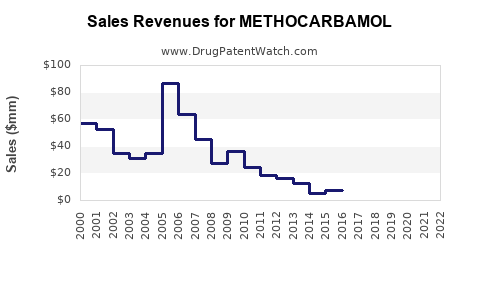
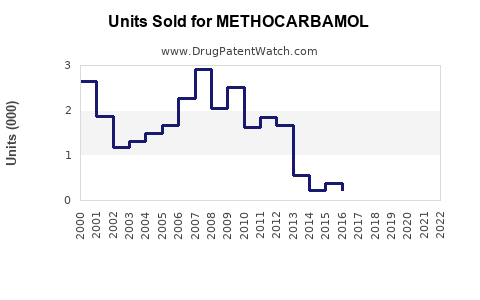
Annual Sales Revenues and Units Sold for METHOCARBAMOL
| Drug Name | Revenues (USD) | Units | Year |
|---|---|---|---|
| METHOCARBAMOL | ⤷ Start Trial | ⤷ Start Trial | 2022 |
| METHOCARBAMOL | ⤷ Start Trial | ⤷ Start Trial | 2021 |
| METHOCARBAMOL | ⤷ Start Trial | ⤷ Start Trial | 2020 |
| METHOCARBAMOL | ⤷ Start Trial | ⤷ Start Trial | 2019 |
| >Drug Name | >Revenues (USD) | >Units | >Year |
ecutive summary: Methocarbamol is a mature, low-cost skeletal muscle relaxant with limited branded exposure, no meaningful FDA exclusivity, and a largely commoditized generic market. U.S. demand is supported by acute musculoskeletal pain, back pain, and muscle spasm treatment, but volume growth is likely to remain modest. The strongest commercial opportunities are in injectable supply, hospital contracts, private-label distribution, and selected international markets rather than in a new branded oral product. An analyst scenario places global methocarbamol sales across finished-dose products at approximately $350 million to $600 million in 2025, with a base-case market value of $425 million and annual growth of 2% to 4% through 2030.
Methocarbamol Market Analysis, Sales Projections, Patent Status, and Generic Competition
What is the current market position of methocarbamol?
Methocarbamol is an oral and injectable centrally acting skeletal muscle relaxant. In the United States, it is sold mainly as a generic product under tablet and injection formulations. The historical brand Robaxin has limited commercial relevance compared with generic methocarbamol.
The drug is prescribed as an adjunct to rest, physical therapy, and other measures for acute, painful musculoskeletal conditions. FDA labeling does not establish methocarbamol as a disease-modifying treatment. Its commercial use is concentrated in short-duration therapy rather than chronic maintenance treatment. [1]
| Market attribute | Methocarbamol position |
|---|---|
| Active ingredient | Methocarbamol |
| Drug class | Centrally acting skeletal muscle relaxant |
| Main dosage forms | 500 mg and 750 mg tablets; injectable solution |
| Primary use | Acute musculoskeletal pain and muscle spasm |
| U.S. regulatory pathway | Generic ANDA products and legacy NDA/brand history |
| Market structure | Fragmented generic supply |
| Core patent status | No commercially important active composition-of-matter exclusivity |
| Biosimilar exposure | None |
| Main competitors | Cyclobenzaprine, tizanidine, baclofen, metaxalone, carisoprodol |
| Pricing profile | Low-cost oral generic; higher-value sterile injectable |
The product’s low price limits revenue per prescription. Its long history of use and broad generic availability support prescription volume but reduce pricing power for manufacturers.
How large is the methocarbamol market?
Public company filings do not generally report methocarbamol sales as a separate product line. Generic manufacturers usually combine the drug with broader portfolios of oral solids, injectables, hospital products, or contract-manufactured medicines. Public market reports also differ substantially because some count retail sales, while others include hospital purchases, distributor revenue, or the broader muscle relaxant category.
An analyst market model is therefore more useful than a single claimed market-size figure.
| Scenario | Estimated 2025 global sales | 2025-2030 CAGR | Estimated 2030 sales |
|---|---|---|---|
| Low case | $350 million | 1.5% | $377 million |
| Base case | $425 million | 3.0% | $493 million |
| High case | $600 million | 4.5% | $748 million |
These figures represent estimated finished-dose product sales, not total physician spending or the full skeletal muscle relaxant market. The base case assumes stable U.S. prescription volume, modest growth in international generic markets, and periodic price erosion in oral tablets.
The U.S. likely accounts for the largest single national market because of established prescribing, broad insurance coverage, and the availability of both 500 mg and 750 mg tablets. Europe and other developed markets have more heterogeneous regulatory and reimbursement conditions. Growth in Asia-Pacific and Latin America is more dependent on local registration, distributor access, and hospital procurement.
What are the main revenue drivers for methocarbamol?
Acute musculoskeletal prescribing
Methocarbamol benefits from continued prescribing for short-term back pain, neck pain, strains, sprains, and other acute musculoskeletal conditions. Demand is linked to primary care, emergency medicine, urgent care, orthopedics, and occupational medicine.
The main limitation is treatment duration. Short courses generate repeat demand through patient volume rather than through long-term refill behavior.
Oral tablet availability
The 500 mg and 750 mg tablets address standard outpatient prescribing. Tablets are generally easy to manufacture and distribute. Multiple suppliers reduce the risk of prolonged shortages but create significant price competition.
Injectable supply
The injectable product has a more favorable commercial profile than oral tablets because sterile manufacturing, inventory requirements, quality controls, and hospital purchasing create higher barriers to entry. Hospitals and emergency departments may use injectable methocarbamol when oral administration is unsuitable.
The injectable market is smaller than the oral market but can produce better margins for reliable suppliers. Capacity interruptions, manufacturing changes, and hospital-contract awards can materially affect product availability.
Substitution within the muscle relaxant class
Methocarbamol competes with several established agents:
| Drug | Key commercial characteristic | Competitive effect |
|---|---|---|
| Cyclobenzaprine | High prescribing familiarity and broad generic supply | Strong outpatient substitute |
| Tizanidine | Useful in spasticity and selected acute conditions | Competes where sedation and dosing are managed |
| Baclofen | Stronger position in neurologic spasticity | Less direct competition in routine strains |
| Metaxalone | Perceived tolerability and branded history | Competes in outpatient prescriptions |
| Carisoprodol | Controlled-substance restrictions and abuse concerns | Reduced but persistent substitution risk |
| Methocarbamol | Established, low-cost, oral and injectable availability | Competitive in acute musculoskeletal treatment |
The product’s main advantage is a combination of familiarity, low price, and multiple dosage forms. Its disadvantages include sedation, generic price pressure, and a lack of strong differentiation.
What are the methocarbamol sales projections through 2030?
The following base-case model assumes global sales of $425 million in 2025, 3% annual growth, and continued generic price erosion offset by volume growth and injectable demand.
| Year | Base-case sales | Low case | High case |
|---|---|---|---|
| 2025 | $425 million | $350 million | $600 million |
| 2026 | $438 million | $355 million | $627 million |
| 2027 | $451 million | $361 million | $655 million |
| 2028 | $465 million | $366 million | $684 million |
| 2029 | $479 million | $372 million | $715 million |
| 2030 | $493 million | $377 million | $748 million |
The base case implies approximately $68 million of incremental annual global sales between 2025 and 2030. That increase is more likely to come from additional unit volume and geographic expansion than from price increases.
U.S. projection
A practical U.S. scenario is a flat-to-low-growth market in nominal unit demand, with declining average selling prices for oral tablets. Net sales may therefore remain broadly stable even if prescription volume rises.
| U.S. segment | 2025 outlook | 2030 outlook |
|---|---|---|
| Oral tablets | Largest segment; high price pressure | Stable to modest unit growth |
| Injectable product | Smaller volume; higher entry barriers | Above-market growth potential |
| Institutional contracts | Concentrated purchasing | Margin and supply reliability remain critical |
| Retail pharmacy | Broad generic access | Continued discounting |
A supplier with differentiated sterile capacity could outperform the broader market. A supplier focused only on standard oral tablets would face a lower-growth, lower-margin profile.
What is the FDA regulatory status of methocarbamol?
Methocarbamol is an established FDA-approved active ingredient. Generic tablets and injectable products are generally marketed through abbreviated new drug applications. ANDA applicants must demonstrate pharmaceutical equivalence and bioequivalence to the relevant reference product, subject to FDA requirements for the specific dosage form. [2]
Methocarbamol does not have the regulatory profile of a new chemical entity. There is no current expectation of five-year new chemical entity exclusivity for new generic launches. Any commercial protection would have to come from product differentiation, manufacturing capability, regulatory exclusivity associated with a genuinely new product, or contractual access.
FDA-approved labeling warns about central nervous system depression and sedation. These safety considerations affect prescribing and can limit use in patients taking other sedating medicines. [1]
What patents protect methocarbamol products?
The original methocarbamol composition is old and does not provide a commercially relevant period of remaining composition-of-matter protection. Current generic competition is not constrained by an active core patent.
For practical market analysis, the relevant protection categories are:
| Protection category | Commercial relevance |
|---|---|
| Composition-of-matter patent | Expired or no longer relevant |
| Basic tablet formulation patent | No material barrier to ordinary generic entry |
| Method-of-use patent | Limited practical significance for standard indications |
| Injectable formulation patent | Potentially relevant only if tied to a differentiated formulation or process |
| Manufacturing process patent | May protect a specific process but usually does not block ordinary supply |
| Regulatory exclusivity | No material current exclusivity identified for ordinary generic products |
Orange Book-listed patent protection is not the principal barrier to methocarbamol entry. FDA Orange Book analysis should focus on the specific reference-listed drug and dosage form because listings can differ by product and application. [3]
Are there Paragraph IV challenges for methocarbamol?
Paragraph IV litigation is unlikely to be commercially significant for standard methocarbamol tablets because the principal patents associated with the original product have expired or no longer create a meaningful barrier. Generic applicants normally enter through ANDA procedures without needing to win a high-value patent challenge.
A Paragraph IV filing could arise for a newly patented formulation, delivery system, or method of use. Such a case would concern the incremental patent, not the underlying methocarbamol molecule. No major active Paragraph IV dispute is central to the current market thesis.
When does methocarbamol lose exclusivity?
Methocarbamol lost meaningful market exclusivity decades ago. Generic competition is established in the United States and other major markets. The commercial question is no longer the timing of molecule-level loss of exclusivity. It is the durability of individual suppliers’ approvals, manufacturing capacity, hospital contracts, and product availability.
| Exclusivity issue | Status |
|---|---|
| Molecule-level exclusivity | Expired |
| Standard oral generic entry | Established |
| Injectable generic entry | Established but operationally more difficult |
| New product exclusivity | Possible only for a materially differentiated product |
| Biosimilar exclusivity | Not applicable |
What generic entry risks exist?
Generic entry risk is already realized rather than prospective. The principal risks for an incumbent manufacturer are:
- Additional oral tablet suppliers entering with lower prices.
- Retail and wholesaler substitution toward the lowest-cost approved product.
- Hospital purchasing consolidation.
- Contract loss after supply interruptions.
- Regulatory observations affecting sterile manufacturing.
- Private-label distributors switching suppliers.
- Substitution by other muscle relaxants.
For oral products, the competitive moat is weak. For injectables, the moat is stronger because of facility qualification, sterile validation, inspections, and customer procurement requirements.
Which companies compete in the methocarbamol market?
Competition varies by country and dosage form. U.S. generic methocarbamol has historically been supplied by a mix of major generic manufacturers, specialty pharmaceutical companies, contract manufacturers, and private-label distributors. Product listings can change because manufacturers discontinue products, transfer approvals, or update label ownership.
Relevant competitive groups include:
- Large generic manufacturers with national distribution.
- Specialty injectable suppliers.
- Hospital-focused pharmaceutical companies.
- Contract development and manufacturing organizations.
- Retail pharmacy private-label suppliers.
- Regional manufacturers in emerging markets.
Company-level market share is difficult to determine because sales are not normally disclosed separately. A supplier’s ability to maintain FDA compliance and uninterrupted supply may be more important than nominal manufacturing scale.
How strong is the methocarbamol patent estate?
The patent estate is weak from an exclusivity perspective and moderate only in narrow technical areas.
| Factor | Assessment |
|---|---|
| Core molecule protection | Very weak or expired |
| Oral tablet differentiation | Weak |
| Injectable manufacturing | Moderate operational barrier |
| Method-of-use protection | Limited |
| Regulatory exclusivity | Low |
| Freedom-to-operate for standard generics | Generally favorable |
| Litigation exposure | Low relative to newer medicines |
A company evaluating methocarbamol should prioritize regulatory records, manufacturing inspection history, product availability, and channel access over conventional patent valuation.
What manufacturing and intellectual-property barriers affect the market?
Oral tablets have low manufacturing complexity. Competition is primarily commercial. Active pharmaceutical ingredient sourcing, formulation scale, quality systems, and distribution efficiency determine margins.
Injectable methocarbamol has greater technical and regulatory risk. Relevant barriers include:
- Sterile filling capacity.
- Container-closure integrity.
- Particulate and sterility controls.
- Validated cleaning and aseptic processes.
- Stability data for the commercial package.
- Reliable API supply.
- FDA inspection readiness.
- Hospital purchasing qualification.
These barriers can support better pricing, but they do not create molecule-level exclusivity. A supply interruption can temporarily shift market share among approved manufacturers.
What licensing deals and settlement agreements affect methocarbamol?
No major current licensing transaction or high-value patent settlement is central to the methocarbamol market. The product is generally supplied through ordinary generic manufacturing, distribution, private-label, or contract arrangements.
Potential deal structures include:
- ANDA acquisition or transfer.
- Contract manufacturing of tablets or injection.
- Exclusive regional distribution.
- Hospital supply agreements.
- Private-label commercialization.
- API sourcing and finished-dose manufacturing.
The value of such agreements depends on approved manufacturing capacity, customer access, and supply reliability rather than patent exclusivity.
What is the commercial outlook for methocarbamol?
Methocarbamol is a defensive generic asset with predictable demand but limited pricing power. The best investment case is operational rather than innovation-led.
Attractive opportunities include:
- Injectable supply for hospitals and emergency departments.
- Dual sourcing strategies for distributors.
- Regional registration in underpenetrated generic markets.
- Private-label tablet supply.
- Combination products, where legally and clinically supportable.
- Improved packaging, dosing convenience, or inventory reliability.
The weakest opportunity is a conventional oral tablet launch with no cost or distribution advantage. That segment has low barriers, numerous substitutes, and limited ability to sustain premium pricing.
Key Takeaways
- Methocarbamol is a mature generic muscle relaxant with no meaningful molecule-level exclusivity.
- Estimated global finished-dose sales are approximately $350 million to $600 million in 2025.
- The base-case projection is $425 million in 2025, rising to approximately $493 million by 2030.
- Oral tablets are the largest segment but have weak margins and intense generic competition.
- Injectable methocarbamol has stronger operational barriers and better margin potential.
- No major current Paragraph IV dispute, patent settlement, or licensing transaction drives the market.
- Biosimilar risk is irrelevant because methocarbamol is a small molecule.
- Commercial success depends on manufacturing reliability, hospital contracts, API access, and geographic distribution.
- A standard oral generic launch has limited strategic value unless it has a cost, supply, or channel advantage.
FAQs
Is methocarbamol still profitable for generic manufacturers?
It can be profitable at scale, particularly when a manufacturer has efficient oral-solid production, reliable API sourcing, or hospital access for injectable products. Standalone oral tablet economics are less attractive because of price competition.
Does methocarbamol have an active U.S. patent?
The original methocarbamol molecule is not protected by an active composition-of-matter patent that blocks ordinary generic competition. Any relevant current patent would need to concern a specific formulation, process, or use.
Is methocarbamol subject to biosimilar competition?
No. Methocarbamol is a chemically synthesized small molecule, so competition occurs through generic drug pathways rather than biosimilar pathways.
Which methocarbamol dosage form has the strongest market opportunity?
The injectable form has the strongest relative opportunity because sterile manufacturing and institutional procurement create higher barriers than standard tablets. The tablet market remains larger but more commoditized.
Could a new methocarbamol formulation obtain market exclusivity?
Potentially, if the formulation is novel, clinically meaningful, patentable, and approved under a pathway that provides exclusivity. A minor change in strength, packaging, or tablet appearance would generally not create a durable commercial moat.
References
-
U.S. Food and Drug Administration. (n.d.). Methocarbamol prescribing information. FDA labeling database.
-
U.S. Food and Drug Administration. (n.d.). Abbreviated new drug application (ANDA) process. FDA.
-
U.S. Food and Drug Administration. (n.d.). Approved drug products with therapeutic equivalence evaluations, Orange Book. FDA.
More… ↓
