Share This Page
Drug Sales Trends for METADATE
✉ Email this page to a colleague
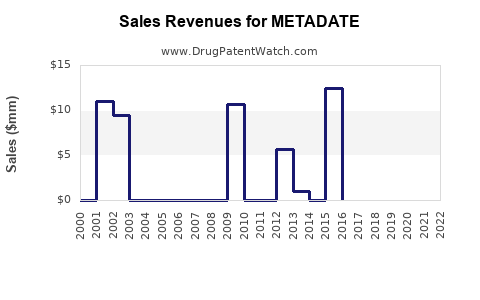
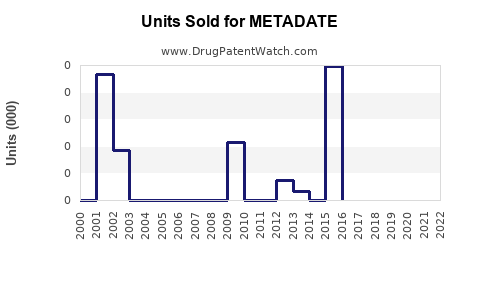
Annual Sales Revenues and Units Sold for METADATE
| Drug Name | Revenues (USD) | Units | Year |
|---|---|---|---|
| METADATE | ⤷ Start Trial | ⤷ Start Trial | 2022 |
| METADATE | ⤷ Start Trial | ⤷ Start Trial | 2021 |
| METADATE | ⤷ Start Trial | ⤷ Start Trial | 2020 |
| >Drug Name | >Revenues (USD) | >Units | >Year |
METADATE Market Analysis, Sales Projections, Patent Status, and Competitive Outlook
Metadate is a methylphenidate product family used to treat attention-deficit/hyperactivity disorder (ADHD). The commercial opportunity is concentrated in generic methylphenidate extended-release capsules and tablets, not in the discontinued or limited branded products. Standalone Metadate sales are not publicly reported. Based on its regulatory status, generic competition, and the broader U.S. ADHD market, branded Metadate revenue is likely negligible, while generic methylphenidate products retain a modest but durable opportunity.
What is Metadate and which products are included?
Metadate is associated with two principal formulations:
| Product | Active ingredient | Dosage form | Release profile | Commercial position |
|---|---|---|---|---|
| Metadate CD | Methylphenidate hydrochloride | Extended-release capsule | Immediate-release and extended-release beads | Generic competition; brand availability appears limited |
| Metadate ER | Methylphenidate hydrochloride | Extended-release tablet | Sustained release | Legacy product with generic competition |
| Metadate chewable or immediate-release products | Methylphenidate hydrochloride | Tablet or chewable tablet | Immediate release | Smaller segment and greater generic substitution |
Metadate CD uses a biphasic delivery system intended to provide an initial dose followed by extended methylphenidate exposure. The FDA-approved strengths historically included 10 mg, 20 mg, 30 mg, 40 mg, 50 mg, and 60 mg capsules.[1]
Methylphenidate is a Schedule II controlled substance in the United States. Its use is subject to prescription controls, state monitoring programs, manufacturing quotas, and pharmacy supply constraints.[2]
What is the FDA regulatory status of Metadate?
The FDA approved Metadate CD for ADHD under New Drug Application No. 021259. The product was developed as an extended-release methylphenidate formulation intended for once-daily administration.[1]
The current commercial status is more relevant than the original approval. Metadate has been exposed to generic substitution for years, and brand-level availability is limited compared with major active ADHD brands such as Concerta, Vyvanse, Adderall XR, and Ritalin LA.
The FDA Orange Book distinguishes between products that are approved but no longer marketed and products that remain actively marketed. A product’s presence in the Orange Book does not establish that the branded product is commercially available.[3]
FDA status summary
| Regulatory issue | Metadate position |
|---|---|
| Active ingredient | Methylphenidate hydrochloride |
| FDA pathway | NDA approval |
| Controlled-substance classification | Schedule II |
| Pediatric indication | ADHD |
| Generic availability | Yes |
| Orange Book relevance | Historical reference and generic approval pathway |
| Current branded commercial scale | Limited or negligible relative to generic products |
How large is the market for Metadate and methylphenidate?
Metadate participates in the larger U.S. ADHD stimulant market. That market includes methylphenidate and amphetamine products, with amphetamine-based treatments generally accounting for a larger share of prescriptions and sales.
The main market drivers are:
- Continued ADHD diagnosis in children and adults.
- Long-term pharmacologic treatment.
- Demand for once-daily formulations.
- Switching between methylphenidate and amphetamine products because of efficacy, tolerability, insurance coverage, or supply.
- Periodic shortages affecting Adderall, Vyvanse, Concerta, and generic methylphenidate products.
- Growth in adult ADHD treatment.
The Centers for Disease Control and Prevention reported that millions of U.S. children have received an ADHD diagnosis, while adult diagnosis and treatment have also expanded.[4] The CDC data support durable demand for stimulant medicines but do not isolate Metadate sales.
Market segmentation
| Segment | Metadate exposure | Commercial attractiveness |
|---|---|---|
| Branded Metadate CD | Low | Low |
| Generic methylphenidate ER capsules | Moderate | Moderate |
| Generic methylphenidate ER tablets | Moderate | Moderate |
| Immediate-release methylphenidate | Limited to moderate | Low to moderate |
| Branded Concerta | Indirect competitor | High relative to Metadate |
| Ritalin LA and other methylphenidate brands | Direct therapeutic competitors | Moderate |
| Amphetamine stimulants | Substitutable competitors | High |
No reliable public source provides a separately reported current revenue figure for Metadate CD or Metadate ER. Manufacturers generally report ADHD products within broader pharmaceutical portfolios or do not disclose product-level revenue for generic products.
What are the sales projections for Metadate?
The most defensible forecast separates branded Metadate from the generic methylphenidate market.
Branded Metadate revenue forecast
| Year | Low case | Base case | High case |
|---|---|---|---|
| 2024 | $0 million | $1 million | $3 million |
| 2025 | $0 million | $1 million | $3 million |
| 2026 | $0 million | $1 million | $4 million |
| 2027 | $0 million | $1 million | $4 million |
| 2028 | $0 million | $1 million | $5 million |
These figures represent a commercial scenario estimate for branded Metadate products in the United States, not reported company revenue. The base case assumes limited brand availability, high generic substitution, and no major relaunch.
The high case requires a commercial partner to reintroduce or reposition a branded product, secure reliable supply, and obtain favorable payer coverage. That scenario is less likely than continued generic dominance.
Generic methylphenidate extended-release opportunity
A separate opportunity exists in generic methylphenidate ER capsules and tablets. The market is larger than the branded Metadate market but remains price competitive.
| Scenario | 2025 estimated U.S. generic Metadate-related revenue pool | 2025-2028 annual growth |
|---|---|---|
| Low | $25 million-$50 million | 0%-2% |
| Base | $50 million-$100 million | 2%-5% |
| High | $100 million-$175 million | 5%-8% |
The estimates reflect manufacturer revenue rather than pharmacy retail sales. The market can expand during shortages of competing ADHD products, but price erosion and new generic entrants constrain long-term growth.
What factors will drive Metadate sales through 2028?
Adult ADHD treatment
Adult ADHD treatment is the strongest structural demand driver. Expanded diagnosis increases the addressable population, but treatment may shift toward amphetamine products, nonstimulants, or newer delivery systems rather than Metadate.
Supply reliability
Shortages can temporarily increase demand for methylphenidate products when patients and prescribers switch away from unavailable amphetamine medicines. This benefit is unpredictable and may reverse when supply normalizes.
Generic pricing
Generic methylphenidate products compete primarily on price, wholesaler availability, pharmacy stocking, and payer formulary status. Additional entrants generally reduce average selling prices.
Prescriber preference
Metadate CD’s combination of immediate and extended release can appeal to prescribers seeking early-day symptom coverage without a separate morning immediate-release dose. Its clinical differentiation is limited because alternative methylphenidate delivery systems offer similar pharmacologic objectives.
Controlled-substance manufacturing quotas
The Drug Enforcement Administration establishes annual production quotas for Schedule II stimulants. Quotas can restrict supply even when demand remains strong.[2] Manufacturers with reliable quota allocation and active ingredient access have a competitive advantage.
How does Metadate compare with Concerta, Ritalin LA, and Vyvanse?
| Product | Active ingredient | Delivery system | Competitive relationship |
|---|---|---|---|
| Metadate CD | Methylphenidate | Biphasic bead capsule | Direct methylphenidate competitor |
| Concerta | Methylphenidate | OROS osmotic-release tablet | Direct once-daily competitor |
| Ritalin LA | Methylphenidate | Biphasic bead capsule | Closest branded formulation competitor |
| Vyvanse | Lisdexamfetamine | Prodrug with prolonged conversion | Therapeutic substitute |
| Adderall XR | Mixed amphetamine salts | Extended-release capsule | Therapeutic substitute |
| Jornay PM | Methylphenidate | Delayed evening administration | Differentiated methylphenidate competitor |
Concerta has historically had stronger brand recognition and a broader commercial footprint. Vyvanse and Adderall XR compete for the same ADHD treatment population but use amphetamine-based mechanisms.
Metadate’s primary weakness is limited brand differentiation after generic entry. Its primary strength is established clinician familiarity and compatibility with methylphenidate-responsive patients.
What patents protect Metadate?
The original Metadate CD protection centered on the extended-release methylphenidate formulation and delivery technology. Patent protection for the original product has largely expired or lost practical commercial significance because generic products have entered the market.
Historical patent families associated with extended-release methylphenidate technologies included formulation and dosage-form claims covering multiparticulate systems, release profiles, and controlled delivery. The key commercial barrier was not a long-lived active-ingredient patent. Methylphenidate itself is an old active pharmaceutical ingredient.
Patent estate assessment
| Patent category | Current commercial strength |
|---|---|
| Methylphenidate compound patent | None of practical relevance |
| Original Metadate formulation patents | Expired or commercially weak |
| Release-profile patents | Limited remaining value |
| Method-of-use patents | Limited, because ADHD use is established |
| Manufacturing know-how | Moderate for reliable multiparticulate production |
| Supply-chain controls | More important than patent exclusivity |
The remaining barriers are primarily manufacturing, regulatory, controlled-substance quota, quality-control, and distribution barriers. They are not equivalent to market exclusivity.
What is the Orange Book and generic-entry status of Metadate?
Metadate’s Orange Book significance is historical. Generic manufacturers could rely on the reference product’s approved safety and efficacy data through abbreviated new drug applications. Depending on the product and filing date, generic applicants could use Paragraph IV certifications to challenge listed patents or certify that relevant patents had expired.
The practical effect of generic entry has been substantial erosion of brand pricing. Once multiple generic manufacturers receive approval, pharmacy substitution usually shifts volume away from the brand unless the brand maintains a meaningful rebate, supply, or clinical advantage.
No major current Paragraph IV litigation is widely associated with Metadate comparable to the patent disputes involving newer branded ADHD products. The principal market issue is generic competition rather than ongoing patent litigation.
Which companies compete in the Metadate market?
The competitive field includes generic manufacturers of methylphenidate ER capsules and tablets, as well as branded ADHD companies.
Relevant competitors have included:
- Janssen Pharmaceuticals, associated with Concerta.
- Novartis, associated with Ritalin products.
- Takeda, associated with Vyvanse.
- Teva Pharmaceutical Industries.
- Mallinckrodt Pharmaceuticals.
- Rhodes Pharmaceuticals.
- Amneal Pharmaceuticals.
- Tris Pharma.
- Lannett and other generic manufacturers, depending on product availability and market participation.
Participation can change because of shortages, manufacturing discontinuations, FDA approvals, controlled-substance quotas, and commercial portfolio decisions.
What litigation and settlement risks affect Metadate?
Metadate has a lower current litigation profile than recently launched ADHD products because its core exclusivity period has passed. The principal legal risks are:
- Product-liability claims associated with stimulant use.
- Controlled-substance compliance investigations.
- Manufacturing and quality disputes.
- Antitrust issues involving generic supply or distribution.
- Patent disputes involving newer methylphenidate formulations rather than legacy Metadate products.
A new branded relaunch would create greater litigation exposure if the sponsor asserted formulation, dosing, or delivery patents against generic competitors.
What is the generic launch outlook for Metadate?
The likely launch pattern is continued generic availability rather than a new branded entry. Generic manufacturers may enter or exit based on:
- FDA approval economics.
- Active pharmaceutical ingredient supply.
- DEA quota allocation.
- Wholesale acquisition price.
- Expected generic competition.
- Manufacturing complexity.
- Shortage conditions.
Generic launch risk for an incumbent manufacturer is moderate. The product is established, but additional suppliers can reduce pricing. A new generic entrant would have a stronger opportunity during a supply shortage than in a stable market.
How strong is the Metadate commercial and patent estate?
The Metadate patent estate is weak as a current exclusivity asset. The commercial franchise has more value as an established product platform than as a protected branded medicine.
| Asset category | Rating | Rationale |
|---|---|---|
| Brand recognition | Low to moderate | Established but overshadowed by larger brands |
| Patent protection | Low | Core protection has expired or has limited remaining force |
| Generic market access | Moderate | Product category is established |
| Manufacturing difficulty | Moderate | Multiparticulate extended-release production requires specialized controls |
| Pricing power | Low | Multiple methylphenidate alternatives |
| Supply scarcity upside | Moderate | Shortages can increase short-term demand |
| Long-term revenue visibility | Low | Brand sales are not independently reported |
| Regulatory risk | Moderate | Schedule II controls and quota requirements |
What generic entry scenarios exist for Metadate?
Base scenario
Generic products remain available, brand Metadate remains commercially limited, and the market grows at a low single-digit rate through 2028. Revenue is concentrated among manufacturers with reliable supply and contracts with wholesalers and payers.
Upside scenario
Extended shortages of competing stimulant products increase substitution into methylphenidate ER. Generic manufacturers capture higher volumes, while a branded relaunch generates a small niche business.
Downside scenario
Additional generic entrants increase price erosion, supply normalizes across competing ADHD drugs, and methylphenidate loses share to amphetamine products and nonstimulant treatments.
Key Takeaways
- Metadate is a legacy methylphenidate ADHD product family with limited branded commercial value.
- Generic methylphenidate ER capsules and tablets represent the main continuing market opportunity.
- Branded Metadate revenue is likely negligible without a commercial relaunch.
- A reasonable branded forecast is approximately $0 million to $5 million annually through 2028, with the base case near $1 million.
- Generic Metadate-related revenue has a larger but low-margin opportunity, estimated at $50 million to $100 million in U.S. manufacturer revenue in 2025 under the base case.
- Patent protection is not the main barrier. Supply reliability, DEA quotas, manufacturing capability, payer access, and pharmacy distribution are more important.
- The strongest near-term volume catalyst is substitution during shortages of competing ADHD stimulants.
- Metadate has no obvious biosimilar risk because methylphenidate is a small-molecule drug, not a biologic.
FAQs
Is Metadate still being manufactured?
Generic methylphenidate products associated with the Metadate formulation remain the principal commercial products. Branded availability is limited and may vary by dosage strength, distributor, and manufacturer.
Is Metadate CD more profitable than generic methylphenidate?
Historically, the branded product had greater pricing power. After generic entry, generic methylphenidate generally offers the more durable volume opportunity, although margins are substantially lower.
Can a company launch a new generic Metadate product?
Yes. A manufacturer can pursue an abbreviated new drug application if it meets FDA requirements for pharmaceutical equivalence, bioequivalence, manufacturing quality, labeling, and controlled-substance compliance.
Does Metadate have biosimilar competition?
No. Biosimilar rules apply to biologic products. Metadate is a synthetic small-molecule methylphenidate product and competes with generic drugs instead.
What is the most valuable intellectual property in a new Metadate product?
The strongest potential protection would likely involve a differentiated delivery system, dosing schedule, abuse-deterrent design, or clinically meaningful pharmacokinetic profile. The methylphenidate active ingredient itself does not provide meaningful new exclusivity.
References
-
U.S. Food and Drug Administration. (2001). Metadate CD prescribing information. FDA Drugs@FDA.
-
U.S. Drug Enforcement Administration. (2024). Established aggregate production quotas for controlled substances. U.S. Department of Justice.
-
U.S. Food and Drug Administration. (2024). Approved drug products with therapeutic equivalence evaluations: Orange Book. FDA.
-
Centers for Disease Control and Prevention. (2023). Data and statistics on ADHD. U.S. Department of Health and Human Services.
More… ↓
