Share This Page
Drug Sales Trends for LORSARTAN
✉ Email this page to a colleague
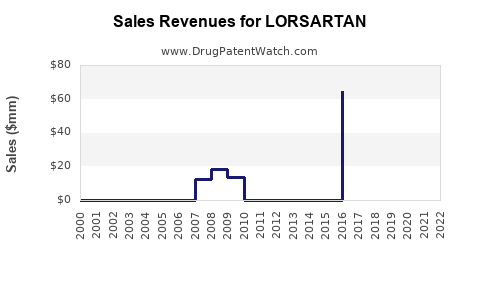
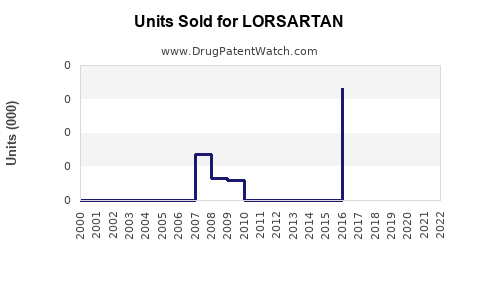
Annual Sales Revenues and Units Sold for LORSARTAN
| Drug Name | Revenues (USD) | Units | Year |
|---|---|---|---|
| LORSARTAN | ⤷ Start Trial | ⤷ Start Trial | 2022 |
| LORSARTAN | ⤷ Start Trial | ⤷ Start Trial | 2021 |
| LORSARTAN | ⤷ Start Trial | ⤷ Start Trial | 2020 |
| LORSARTAN | ⤷ Start Trial | ⤷ Start Trial | 2019 |
| LORSARTAN | ⤷ Start Trial | ⤷ Start Trial | 2018 |
| >Drug Name | >Revenues (USD) | >Units | >Year |
Losartan Market Analysis and Sales Projections, Patent Status, and Competitive Outlook
Losartan, the active ingredient in Cozaar and Hyzaar, is a mature, off-patent angiotensin II receptor blocker (ARB). Its market is driven by high prescription volume, broad generic availability, low prices, combination products, and continued use in hypertension and diabetic nephropathy. Originator revenue has largely disappeared, while generic manufacturers compete on supply reliability, pharmacy contracts, regulatory compliance, and combination-product breadth.
The most likely market trajectory is stable prescription demand with declining nominal value. A base-case model indicates global losartan product sales of approximately $350 million to $500 million in 2025, declining to $280 million to $420 million by 2030 as prices erode and treatment shifts toward newer ARBs and fixed-dose combinations. Volume should remain comparatively resilient because losartan is inexpensive and widely included in hypertension treatment guidelines.
What is losartan and how is it used?
Losartan is an oral, non-peptide ARB that selectively blocks the angiotensin II type 1 receptor. It reduces vasoconstriction and aldosterone-mediated sodium retention without inhibiting angiotensin-converting enzyme.
The FDA-approved uses for losartan potassium include:
| Indication | Commercial relevance |
|---|---|
| Hypertension | Primary demand driver |
| Reduction of stroke risk in patients with hypertension and left ventricular hypertrophy | Niche method-of-use demand |
| Diabetic nephropathy in patients with type 2 diabetes and hypertension | Important specialist and chronic-care use |
| Pediatric hypertension in patients aged six years and older | Small but durable segment |
| Combination treatment with hydrochlorothiazide | Major generic product segment |
Losartan is sold primarily as 25 mg, 50 mg, and 100 mg tablets. Losartan potassium and hydrochlorothiazide combinations are marketed in several strengths, including 50/12.5 mg and 100/25 mg.
What is the FDA regulatory status of losartan?
The FDA approved Cozaar, Merck’s losartan product, in 1995. Hyzaar, the losartan/hydrochlorothiazide combination, received FDA approval in 1995. The products are approved as prescription oral tablets and are not biologics, so biosimilar regulation does not apply.
Generic losartan products are approved through abbreviated new drug applications under section 505(j) of the Federal Food, Drug, and Cosmetic Act. Generic applicants generally demonstrate pharmaceutical equivalence and bioequivalence rather than repeating the full clinical development program conducted for Cozaar.
FDA regulatory factors affecting the market
The main regulatory factors are:
- Drug supply and manufacturing compliance
- Recalls involving nitrosamine impurities in ARB supply chains
- ANDA approval and supplement timing
- Tablet dissolution and bioequivalence requirements
- Stability and packaging controls
- Manufacturing-site inspection outcomes
Losartan was affected by the broader ARB nitrosamine recall cycle that began in 2018. Recalls involving certain lots of losartan, valsartan, and irbesartan were linked to impurities including NDMA and NDEA. The episode increased demand for supplier qualification, impurity testing, and manufacturing transparency across the ARB category (U.S. Food and Drug Administration, 2024a).
When did losartan lose patent exclusivity?
Losartan’s key U.S. composition patent was U.S. Patent No. 5,138,069, assigned to E. I. du Pont de Nemours and later associated with Merck’s Cozaar franchise. The patent covered losartan and related compounds and expired in 2010 after patent-term adjustments and pediatric exclusivity considerations.
The core exclusivity timeline was:
| Event | Date |
|---|---|
| Losartan first approved in the United States | April 1995 |
| Cozaar commercial launch | 1995 |
| Hyzaar approval | 1995 |
| Core U.S. patent expiration | 2010 |
| Broad generic entry | 2010 onward |
| Current market status | Mature generic market |
The original patent estate no longer prevents ordinary losartan tablets from entering the U.S. market. Commercial protection now depends on manufacturing economics, procurement contracts, product availability, and any remaining product-specific regulatory barriers.
What patents protect losartan today?
No active composition patent is expected to block ordinary generic losartan potassium tablets in the United States. Patent risk is materially lower than for recently launched ARBs or branded combination therapies.
Potentially relevant patent categories include:
| Patent category | Current market impact |
|---|---|
| Core chemical composition | Expired |
| Losartan salt forms | Generally not a meaningful barrier for standard losartan potassium |
| Losartan/hydrochlorothiazide combinations | Core commercial patents expired or no longer blocking routine generic entry |
| Formulation and release technologies | Limited relevance for immediate-release tablets |
| Manufacturing processes | Can affect cost or freedom to operate but rarely blocks all market entry |
| Method-of-use claims | May have historical relevance, but they do not prevent broad generic hypertension use after core expiry |
| Device or specialty-delivery claims | Limited relevance because standard losartan is an oral tablet |
What formulations are protected by losartan patents?
The commercially important formulations are immediate-release tablets and fixed-dose tablets containing losartan and hydrochlorothiazide. These products are technically straightforward relative to extended-release drugs, inhaled products, transdermal systems, or injectable formulations.
The main formulation risks are not patent barriers but:
- Bioequivalence failure
- Dissolution variability
- Impurity formation
- Tablet stability
- Inconsistent active pharmaceutical ingredient supply
- Combination-product manufacturing complexity
Losartan does not have a commercially significant long-acting injectable, implantable, or specialty-delivery franchise. That limits differentiation and keeps pricing pressure high.
How many companies compete in the losartan market?
The U.S. market includes multiple ANDA holders and contract manufacturers. Commercial participation varies by strength, combination product, supply status, and pharmacy-channel contracts.
Representative manufacturers and suppliers have included:
- Teva Pharmaceuticals
- Torrent Pharmaceuticals
- Lupin
- Aurobindo Pharma
- Zydus Pharmaceuticals
- Camber Pharmaceuticals
- Rising Pharmaceuticals
- Solco Healthcare
- Macleods Pharmaceuticals
- Apotex
- NorthStar Rx
- Major distributor and private-label suppliers
The precise active supplier count changes because companies discontinue low-margin presentations, transfer ANDAs, or temporarily leave the market after manufacturing issues. The market remains structurally competitive because technical entry barriers are modest and the active ingredient is widely available.
What is the competitive landscape for losartan?
Losartan competes with other ARBs and with ACE inhibitors, calcium-channel blockers, thiazide diuretics, and combination antihypertensive products.
| Drug | Competitive position |
|---|---|
| Losartan | Low-cost, high-recognition generic; strong diabetic nephropathy and hypertension use |
| Valsartan | Broad ARB use; strong combination and heart-failure presence |
| Irbesartan | Competitive in hypertension and diabetic nephropathy |
| Telmisartan | Longer half-life and cardiovascular-risk positioning |
| Candesartan | Strong clinical reputation, particularly in heart failure |
| Olmesartan | Potent once-daily ARB; generic price competition |
| ACE inhibitors | Often preferred where cost, guidelines, or clinical history favor ACE inhibition |
| Amlodipine and other calcium-channel blockers | Major alternatives in first-line hypertension |
| Fixed-dose multi-drug combinations | Increasing substitute for standalone ARB tablets |
Losartan retains advantages in price, physician familiarity, generic availability, and clinical experience. Its disadvantages include shorter duration of action than some competing ARBs and weaker commercial differentiation.
What are the losartan sales projections for 2025 to 2030?
The following projection estimates global product revenue across branded and generic losartan tablets, including losartan/hydrochlorothiazide combinations. It is a modeled market estimate rather than reported company revenue.
| Year | Low case | Base case | High case |
|---|---|---|---|
| 2025 | $300 million | $425 million | $550 million |
| 2026 | $292 million | $415 million | $545 million |
| 2027 | $286 million | $405 million | $540 million |
| 2028 | $280 million | $390 million | $530 million |
| 2029 | $275 million | $375 million | $515 million |
| 2030 | $270 million | $360 million | $500 million |
The base case implies a compound annual decline of approximately 3.3% from 2025 through 2030.
Projection assumptions
The model assumes:
- Stable or slightly increasing global hypertension prevalence
- Continued generic substitution
- Annual net price erosion of roughly 4% to 7% in mature markets
- Stable treatment volume in emerging markets
- Gradual substitution toward valsartan, telmisartan, olmesartan, and combination products
- No major manufacturing disruption
- Continued availability of losartan/hydrochlorothiazide products
- Limited contribution from branded products
Volume should perform better than revenue. In some emerging markets, increased diagnosis and treatment of hypertension can offset declining unit prices. In the United States and Western Europe, the market is more likely to show flat or declining volume because losartan competes with several low-cost ARBs and broader generic hypertension regimens.
Which regions offer the strongest losartan growth potential?
United States
The U.S. is a large but low-growth market. Generic substitution is nearly complete, and reimbursement pressure keeps pricing low. Opportunity is concentrated in:
- Reliable supply to large pharmacy chains
- Medicaid and Medicare contract channels
- Private-label products
- Losartan/hydrochlorothiazide combinations
- Manufacturing cost reduction
- Supply continuity after competitor recalls
The U.S. is attractive for scale but not for high margins.
Europe
European demand is mature and heavily controlled by national reimbursement systems and tender procurement. Pricing is under pressure, but stable demand supports predictable volume. The strongest commercial opportunities are in countries with large generic utilization and recurring public tenders.
China
China has substantial hypertension prevalence and a large generic pharmaceutical base. Centralized procurement can create significant volume but sharply reduce prices. Market access depends on tender participation, local manufacturing economics, and compliance with national procurement requirements.
India
India has strong demand growth from expanding diagnosis and treatment. Competition is intense, and retail branding remains more relevant than in the U.S. Losartan is sold both as a standalone product and in numerous combinations with hydrochlorothiazide, amlodipine, and other agents.
Latin America and other emerging markets
Losartan remains commercially relevant because of its low cost and established physician familiarity. Growth depends on healthcare access, generic penetration, and public-sector procurement. Currency volatility and tender pricing can materially affect revenue.
What generic entry risks exist for losartan?
Ordinary generic entry risk is low because the core patent estate has expired. The main risks are commercial and operational.
| Risk | Impact |
|---|---|
| Price erosion | High |
| Supplier consolidation | Medium |
| Nitrosamine or other impurity findings | High |
| FDA warning letters or import alerts | Medium to high |
| API disruption | Medium |
| Pharmacy-contract loss | High for individual manufacturers |
| Formulation differentiation | Low |
| Patent litigation | Low |
| New clinical restrictions | Low |
| Substitution by newer ARBs | Medium |
A new entrant would face limited intellectual-property risk but substantial margin risk. The product is suitable for companies with efficient API sourcing, established tablet manufacturing, and access to large-volume procurement channels.
What patent litigation and Paragraph IV activity affect losartan?
No major current Paragraph IV dispute is expected to block standard losartan tablets because the principal composition patent expired years ago. Historical Paragraph IV activity was relevant before broad generic launch, particularly for Cozaar and Hyzaar-related products.
Current litigation exposure is more likely to involve:
- Manufacturing contracts
- ANDA ownership or transfer disputes
- Product liability
- Recall-related claims
- False-marketing or pricing allegations
- Supply agreements
- Combination-product regulatory matters
Losartan has a low litigation profile compared with active patented drugs in oncology, immunology, rare disease, or specialty cardiology.
How does losartan compare with valsartan and telmisartan?
| Metric | Losartan | Valsartan | Telmisartan |
|---|---|---|---|
| Patent status | Mature generic | Mature generic | Mature generic |
| Price pressure | Very high | Very high | High |
| Brand differentiation | Low | Moderate historical brand recognition | Moderate |
| Half-life profile | Shorter | Intermediate | Long |
| Key use areas | Hypertension, diabetic nephropathy | Hypertension, heart failure, post-MI, combinations | Hypertension and cardiovascular-risk positioning |
| Combination breadth | High | High | Moderate to high |
| Growth outlook | Flat to declining value | Flat to declining value | More resilient in some markets |
Losartan has the broadest low-cost accessibility but less commercial differentiation. Telmisartan has stronger pharmacokinetic positioning, while valsartan benefits from broader cardiovascular indications and extensive fixed-dose combinations.
What is the revenue exposure for manufacturers?
Losartan is usually a portfolio product rather than a primary revenue driver. Individual manufacturer exposure depends on supply contracts and product concentration.
A manufacturer with a high-volume losartan franchise can generate meaningful absolute revenue but is unlikely to sustain premium margins. The most exposed companies are those that:
- Depend on a narrow generic portfolio
- Have high U.S. pharmacy-channel concentration
- Rely on a single API supplier
- Lack combination products
- Compete solely on price
- Have limited ability to absorb recall or compliance costs
The strongest commercial strategy is to use losartan as an anchor product within a broader cardiovascular portfolio that includes hydrochlorothiazide combinations, amlodipine combinations, valsartan, telmisartan, and related antihypertensive products.
What is the commercial strength of the losartan patent estate?
The patent estate is weak for blocking new standard-tablet entry and has low strategic value for licensing. Its commercial strength can be summarized as follows:
| Factor | Assessment |
|---|---|
| Core composition protection | Expired |
| Formulation protection | Limited |
| Method-of-use protection | Limited practical blocking power |
| Manufacturing know-how | Moderate operational value |
| Regulatory exclusivity | Expired |
| Generic entry barrier | Low |
| Licensing value | Low for the active ingredient itself |
| Supply-chain value | Moderate |
| Litigation risk | Low |
Licensing opportunities are more likely to involve manufacturing capacity, regional commercialization rights, private-label supply, or combination-product portfolios than proprietary losartan intellectual property.
Key Takeaways
- Losartan is a mature generic ARB with broad global use and low patent risk.
- The core U.S. patent protection expired in 2010.
- Standard losartan tablets face little meaningful Paragraph IV or composition-patent risk.
- The main commercial opportunity is high-volume, low-margin supply.
- Losartan/hydrochlorothiazide combinations remain important to the product franchise.
- Base-case global product revenue is estimated at $425 million in 2025 and $360 million in 2030.
- Revenue is expected to decline faster than prescription volume because of generic price erosion.
- The strongest competitive threats are valsartan, telmisartan, irbesartan, and combination antihypertensive products.
- Manufacturing quality, impurity control, supply continuity, and procurement access matter more than patent exclusivity.
- Losartan is more valuable as part of a cardiovascular generic portfolio than as a standalone licensing asset.
FAQs
Is losartan still a profitable drug?
Losartan can be profitable at scale, but margins are generally low because multiple generic suppliers compete on price. Profitability depends on manufacturing cost, API sourcing, procurement contracts, and supply reliability.
Is losartan a biosimilar opportunity?
No. Losartan is a chemically synthesized small-molecule drug, not a biologic. Generic companies use the ANDA pathway rather than the biosimilar pathway.
Can a company still obtain a patent on a losartan product?
A company may seek patents on genuinely novel formulations, manufacturing methods, or combinations, but a new patent would not recreate broad composition protection for ordinary losartan potassium tablets.
Does losartan have a branded market in the United States?
The branded Cozaar and Hyzaar franchises no longer control the U.S. market. Generic products account for the overwhelming majority of commercial demand.
Will losartan sales increase with global hypertension prevalence?
Prescription volume may increase in some emerging markets, but global revenue is more likely to remain flat or decline because mature-market prices continue to fall and alternative ARBs are widely available.
References
-
U.S. Food and Drug Administration. (2024a). FDA updates and press announcements on angiotensin receptor blocker recalls. https://www.fda.gov/drugs/drug-safety-and-availability
-
U.S. Food and Drug Administration. (2024b). Drugs@FDA: Cozaar (losartan potassium) and Hyzaar (losartan potassium and hydrochlorothiazide). https://www.accessdata.fda.gov/scripts/cder/daf/
-
U.S. Food and Drug Administration. (2024c). Approved drug products with therapeutic equivalence evaluations. https://www.fda.gov/drugs/drug-approvals-and-databases/orange-book-data-files
-
Merck & Co., Inc. (1995). Cozaar prescribing information. U.S. Food and Drug Administration.
-
U.S. Patent No. 5,138,069. (1992). Imidazole-5-acetic acid derivatives, processes for their preparation, compositions containing them and their use as pharmaceuticals. United States Patent and Trademark Office.
-
World Health Organization. (2023). Global report on hypertension: The race against a silent killer. World Health Organization. https://www.who.int/publications/i/item/9789240081062
More… ↓
