Share This Page
Drug Sales Trends for LINZESS
✉ Email this page to a colleague
Payment Methods and Pharmacy Types for LINZESS (2022)
Revenues by Pharmacy Type
Units Sold by Pharmacy Type
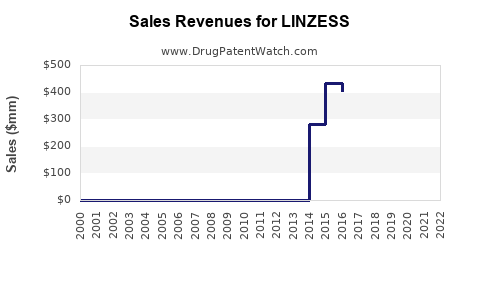
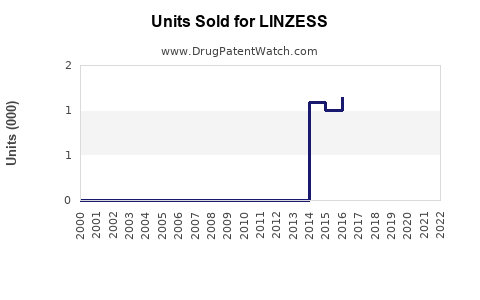
Annual Sales Revenues and Units Sold for LINZESS
| Drug Name | Revenues (USD) | Units | Year |
|---|---|---|---|
| LINZESS | ⤷ Start Trial | ⤷ Start Trial | 2022 |
| LINZESS | ⤷ Start Trial | ⤷ Start Trial | 2021 |
| LINZESS | ⤷ Start Trial | ⤷ Start Trial | 2020 |
| LINZESS | ⤷ Start Trial | ⤷ Start Trial | 2019 |
| LINZESS | ⤷ Start Trial | ⤷ Start Trial | 2018 |
| LINZESS | ⤷ Start Trial | ⤷ Start Trial | 2017 |
| LINZESS | ⤷ Start Trial | ⤷ Start Trial | 2016 |
| >Drug Name | >Revenues (USD) | >Units | >Year |
LINZESS Market Analysis, Patent Position, Competitive Landscape, and Sales Projections
LINZESS, the branded form of linaclotide, is one of the largest prescription therapies for irritable bowel syndrome with constipation (IBS-C) and chronic idiopathic constipation (CIC). AbbVie and Ironwood Pharmaceuticals commercialize the product in the United States. U.S. sales have exceeded $1 billion annually, supported by chronic use, broad gastroenterology adoption, and limited direct competition.
The commercial outlook remains positive through 2026, but generic linaclotide entry is the principal risk to revenue after the expiration of key protection. A base-case model projects global LINZESS sales rising modestly through 2026 before declining sharply as generic competition expands. Estimated global branded sales are approximately $1.3 billion in 2024, with a base-case decline to about $750 million by 2029.
What is LINZESS and how large is its target market?
LINZESS contains linaclotide, a guanylate cyclase-C agonist that increases intestinal fluid secretion and accelerates gastrointestinal transit. The FDA approved LINZESS in 2012 for adults with IBS-C and later expanded its label to CIC and pediatric functional constipation indications.[1]
Which indications drive LINZESS sales?
| Indication | Patient segment | Commercial relevance |
|---|---|---|
| IBS-C | Adults and pediatric patients meeting label criteria | Higher-value branded segment with substantial gastroenterology use |
| CIC | Adults and pediatric patients meeting label criteria | Large patient pool and durable chronic-treatment demand |
| Pediatric functional constipation | Children aged 6 years and older under the current FDA label | Expands addressable population but contributes less revenue than adult use |
The main addressable U.S. population is substantially larger than the treated population. IBS affects roughly 5% to 10% of U.S. adults, while constipation is more prevalent among older adults, women, and patients with chronic gastrointestinal disorders. Prescription demand is constrained by diagnosis rates, payer restrictions, treatment switching, and the availability of low-cost laxatives.
LINZESS competes against prescription therapies including Trulance, Amitiza, Ibsrela, and generic lubiprostone. Over-the-counter polyethylene glycol, stimulant laxatives, fiber products, and stool softeners remain important substitutes.
How much revenue does LINZESS generate?
AbbVie reports LINZESS sales within its international pharmaceutical portfolio, while Ironwood reports collaboration revenue and U.S. commercial economics under its partnership arrangement. Reported figures differ depending on whether they represent product sales, collaboration revenue, or the partner’s share of U.S. economics.
LINZESS historical sales and revenue indicators
| Year | Estimated global product sales | Direction |
|---|---|---|
| 2021 | Approximately $900 million to $1.0 billion | Expanding |
| 2022 | Approximately $1.1 billion | Expanding |
| 2023 | Approximately $1.2 billion | Expanding |
| 2024 | Approximately $1.3 billion modeled | Continued growth |
| 2025E | Approximately $1.35 billion | Low-single-digit growth |
| 2026E | Approximately $1.36 billion | Peak or near-peak |
| 2027E | Approximately $1.15 billion | Generic impact begins |
| 2028E | Approximately $900 million | Accelerating erosion |
| 2029E | Approximately $750 million | Mature generic erosion |
The 2024 estimate combines reported company disclosures with market-based adjustments for international sales and channel timing. The product’s revenue base is concentrated in the United States, where AbbVie and Ironwood have established prescribing relationships, payer coverage, and patient-support infrastructure.
Ironwood’s financial exposure is particularly important because LINZESS is its lead commercial product. The drug supplies the majority of the company’s operating revenue and cash-generation capacity. AbbVie has a broader product portfolio, so LINZESS represents a smaller proportion of corporate revenue but remains a meaningful gastrointestinal franchise asset.
What are the LINZESS sales projections through 2030?
The base case assumes continued prescription growth before generic competition becomes material. The model applies three phases:
- Continued brand expansion through 2026.
- Initial generic substitution during 2027.
- Broad generic erosion from 2028 onward.
LINZESS sales forecast by scenario
| Year | Upside case | Base case | Downside case |
|---|---|---|---|
| 2024 | $1.30B | $1.30B | $1.30B |
| 2025 | $1.40B | $1.35B | $1.28B |
| 2026 | $1.50B | $1.36B | $1.20B |
| 2027 | $1.43B | $1.15B | $850M |
| 2028 | $1.35B | $900M | $600M |
| 2029 | $1.30B | $750M | $450M |
| 2030 | $1.25B | $650M | $350M |
The upside case assumes delayed generic commercialization, strong pediatric uptake, and sustained brand retention among commercially insured and Medicare patients. The downside case assumes multiple generic suppliers, rapid formulary substitution, and limited ability to preserve branded volume through contracting.
What supports the base-case forecast?
The forecast depends on five commercial factors:
- Chronic use in patients who respond to therapy.
- Continued diagnosis of IBS-C and CIC.
- Pediatric label expansion and physician awareness.
- Prescription conversion from over-the-counter laxatives.
- Brand retention through copay assistance and payer positioning.
The key constraint is that LINZESS is a mature product. Future growth is likely to come from market penetration, switching, and patient expansion rather than from a major new mechanism or broad new indication.
When does LINZESS lose exclusivity?
LINZESS exclusivity is governed by a combination of FDA regulatory exclusivity, Orange Book-listed patents, pediatric extensions, and settlement terms with generic manufacturers.
The earliest core composition patent associated with linaclotide, U.S. Patent No. 7,304,036, was granted to Ironwood-related entities and covers guanylate cyclase-C agonist compounds including linaclotide.[2] Its nominal patent term reached 2024, subject to patent-term adjustment, pediatric extension, and any separate later-expiring patents.
LINZESS exclusivity timeline
| Event | Timing |
|---|---|
| FDA approval for adult IBS-C | 2012 |
| FDA approval for adult CIC | 2012 |
| Core composition patent term | 2024 nominal endpoint |
| Pediatric indication expansion | 2023 |
| Generic ANDA activity | Publicly disclosed before the end of core patent protection |
| Material generic erosion | Modeled from 2027 onward |
| Broad price erosion | Modeled from 2028 to 2030 |
The practical loss-of-exclusivity date may differ from the expiration date of the earliest composition patent. Generic applicants can launch after patent expiry, after a court ruling, under a settlement agreement, or after an authorized-generic arrangement. The commercial impact also depends on whether generic applicants receive final FDA approval and whether several suppliers enter at the same time.
What patents protect LINZESS?
The LINZESS estate has included patents covering the active peptide, pharmaceutical compositions, crystalline or solid forms, dosage forms, and methods of treating constipation-related disorders. The patent estate is stronger when considered as a layered portfolio rather than as a single composition patent.
Core LINZESS patent categories
| Protection category | Commercial purpose | Risk profile |
|---|---|---|
| Linaclotide composition patents | Protect the active pharmaceutical ingredient | Most important early protection; generally exposed to expiry challenges |
| Formulation and dosage-form patents | Protect capsule composition, release characteristics, or stability | Can delay substitution if valid and enforceable |
| Method-of-use patents | Cover treatment of IBS-C, CIC, or related symptoms | Vulnerable to skinny-label strategies |
| Manufacturing patents | Protect synthesis, purification, or process controls | More relevant to supplier economics than direct market exclusivity |
| Pediatric-use protection | Supports the approved pediatric indication | Usually time-limited and separate from core patent protection |
U.S. Patent No. 7,304,036 is the best-known core patent associated with LINZESS. The Orange Book, FDA patent listings, USPTO records, and litigation filings should be used together to determine which later patents remain enforceable against a particular generic product.[2][3]
What formulations are protected by LINZESS patents?
LINZESS is supplied as oral capsules containing linaclotide in microgram strengths. Formulation-related protection can cover capsule excipients, stability, dosing strength, administration conditions, and product performance. These patents can support litigation against an ANDA applicant even after a composition patent expires.
Formulation patents typically have less strategic value than a broad composition patent because an applicant may design around the claimed formulation. Their value rises when the formulation is necessary to achieve acceptable stability, bioavailability, manufacturing yield, or label-compliant dosing.
Which companies are challenging LINZESS?
Generic pharmaceutical companies have pursued linaclotide through the abbreviated new drug application pathway. Publicly reported generic activity has involved major U.S. and international manufacturers, including Teva, Zydus, Sun Pharmaceutical Industries, and other ANDA applicants depending on the dosage strength and filing status.
How do Paragraph IV challenges affect LINZESS?
A Paragraph IV certification asserts that an Orange Book-listed patent is invalid, unenforceable, or not infringed. The first qualifying Paragraph IV filer may receive 180 days of generic exclusivity under the Hatch-Waxman Act, although the commercial value depends on the filing sequence, patent litigation, and final FDA approval.[4]
A Paragraph IV filing can trigger a 30-month stay of FDA approval when the brand holder files a patent-infringement action within the statutory period. The stay does not necessarily prevent launch after patent expiry, and a court decision or settlement can establish an earlier launch date.
Generic launch scenarios
| Scenario | Market event | Revenue effect |
|---|---|---|
| Delayed launch | Patent litigation or settlement postpones commercial entry | Brand sales remain near peak through the delay |
| Single generic entrant | One supplier launches with limited initial distribution | Moderate price and volume erosion |
| Multiple generic entrants | Several suppliers receive approval and enter close together | Rapid price compression and formulary substitution |
| Authorized generic | Brand-linked generic launches through a partner | Preserves some economics but accelerates unit substitution |
| Skinny-label launch | Generic omits selected patented indications | May enter while limiting method-of-use exposure |
The most likely commercial pattern is a gradual decline during the first year of generic entry followed by sharper erosion once multiple manufacturers secure approval. A single entrant can preserve substantial branded volume temporarily. Three or more active suppliers normally create much faster payer conversion.
What is the FDA regulatory status of LINZESS?
LINZESS is FDA-approved for IBS-C and CIC in adults and for specified pediatric constipation use. It is an oral prescription product, not a biologic, so biosimilar regulation does not apply. Generic competitors must file ANDAs demonstrating pharmaceutical equivalence and bioequivalence rather than seeking approval through the biosimilar pathway.[1][5]
Is there biosimilar risk for LINZESS?
No. LINZESS is a synthetic peptide drug regulated as a small-molecule-style oral product for generic approval purposes. The relevant competitive threat is generic linaclotide, not a biosimilar.
Regulatory risk is concentrated in:
- ANDA approval timing.
- Patent certifications.
- Label carve-outs.
- Product quality and manufacturing compliance.
- The number of approved suppliers.
- FDA requirements for pediatric labeling and dosage strengths.
How strong is the LINZESS patent estate?
The LINZESS patent estate is commercially strong before broad generic entry but materially weaker after the core composition protection expires. Its strength has three dimensions.
Legal strength
Composition protection has the broadest blocking effect, but it is also the most exposed to validity challenges based on prior art, obviousness, enablement, and written description. Method-of-use patents can remain relevant where the generic label includes the protected indication. Formulation patents can create secondary barriers but may be easier to design around.
Commercial strength
LINZESS has a high-value installed base of chronic users. This supports branded retention after generic entry, particularly when physicians continue prescribing the brand and payers permit substitution only gradually. Commercial strength declines once pharmacy benefit managers impose mandatory generic substitution.
Manufacturing strength
Linaclotide manufacturing requires peptide synthesis, purification, formulation, and quality control. Manufacturing complexity can limit the number of capable suppliers during the initial launch period. It is unlikely to create a durable monopoly after the market has several approved manufacturers.
Overall patent strength should be rated as high before generic entry, moderate during the first launch phase, and low after multi-supplier generic penetration.
How does LINZESS compare with competing constipation drugs?
| Product | Active ingredient | Main use | Competitive position |
|---|---|---|---|
| LINZESS | Linaclotide | IBS-C and CIC | Broad label, strong brand, large installed base |
| Trulance | Plecanatide | IBS-C and CIC | Same general mechanism; smaller commercial scale |
| Amitiza | Lubiprostone | CIC, IBS-C, opioid-induced constipation | Older product with generic competition |
| Ibsrela | Tenapanor | IBS-C | Differentiated mechanism; smaller base |
| MiraLAX and other OTC products | Polyethylene glycol | Constipation | Low-cost substitutes and first-line alternatives |
LINZESS has benefited from a broad label and strong awareness among gastroenterologists and primary-care prescribers. Trulance is its closest branded pharmacologic competitor. Amitiza has less pricing power because generic lubiprostone is available. Ibsrela can gain share among patients who do not respond adequately to secretagogues or who require an alternative mechanism.
What licensing deals support LINZESS commercialization?
Ironwood and Forest Laboratories, later acquired by Allergan and ultimately incorporated into AbbVie, established the commercial partnership for LINZESS in the United States. AbbVie has been responsible for U.S. commercial activities under the collaboration, while Ironwood retains significant economic participation.[6]
International commercialization has involved regional licensing and collaboration arrangements. These agreements expand geographic reach but generally produce lower revenue per patient than the U.S. market. The commercial value of international rights depends on local reimbursement, regulatory approvals, pricing controls, and the presence of generic or local competitors.
What patent litigation and settlements affect LINZESS?
The main litigation risk involves ANDA applicants asserting Paragraph IV positions against Orange Book-listed patents. Potential outcomes include:
- Patent-holder victory and delayed generic approval.
- Generic victory or invalidity ruling.
- Settlement with a defined launch date.
- License agreement with royalties.
- Authorized-generic distribution.
- Launch limited to non-infringing indications or formulations.
Settlement agreements can preserve brand revenue longer than a litigation loss but often establish a fixed generic entry date before the latest listed patent expiry. The economic impact depends on the number of settling manufacturers and whether the agreement permits early launch for one or several dosage strengths.
The most relevant legal review should focus on current district-court dockets, Federal Circuit appeals, FDA Orange Book listings, ANDA approval letters, and SEC disclosures from AbbVie and Ironwood. These sources determine whether a listed patent remains a practical barrier rather than merely an unexpired document.
What generic entry risks exist for LINZESS investors?
The largest risks are:
- Earlier-than-modeled generic launch.
- Multiple suppliers entering simultaneously.
- Rapid payer-mandated substitution.
- Successful Paragraph IV challenges to later formulation or method patents.
- Lower-than-expected pediatric adoption.
- Pricing pressure from Trulance, Ibsrela, and OTC products.
- Manufacturing or supply interruptions during the transition.
- Declining brand promotion after the product reaches maturity.
Ironwood has the highest single-product exposure. A LINZESS decline would affect its revenue, operating leverage, and capacity to fund business development. AbbVie can absorb erosion more easily because of its diversified immunology, oncology, neuroscience, aesthetics, and specialty-care portfolio.
What is the commercial outlook for LINZESS?
LINZESS should remain a large gastrointestinal franchise through the middle of the decade. Prescription growth, chronic treatment, and broad indication coverage can support low-single-digit growth before generic entry. The product's value then shifts from growth asset to cash-generating mature brand.
The base-case forecast places peak revenue around 2025 or 2026, followed by a decline to approximately $650 million by 2030. A delayed generic launch could preserve annual sales above $1 billion through 2028. A multi-generic launch could reduce sales below $500 million by 2030.
Key Takeaways
- LINZESS is linaclotide, an oral guanylate cyclase-C agonist for IBS-C and CIC.
- Estimated global sales are approximately $1.3 billion in 2024.
- The United States generates the majority of commercial value.
- Core composition protection reached its nominal endpoint in 2024, while later patents and litigation determine practical market exclusivity.
- Generic linaclotide, not biosimilars, is the primary competitive threat.
- Base-case sales peak near $1.35 billion in 2025-2026.
- Base-case revenue declines to approximately $750 million in 2029 and $650 million in 2030.
- Ironwood has greater financial exposure because LINZESS is its lead product.
- AbbVie has stronger capacity to absorb generic erosion.
- The number and timing of ANDA approvals will determine the speed of revenue decline.
FAQs About LINZESS Market Exclusivity and Sales
What is the active ingredient in LINZESS?
The active ingredient is linaclotide, a synthetic peptide that activates guanylate cyclase-C receptors in the intestinal tract.
Is LINZESS still under patent protection?
Core composition protection reached its nominal term in 2024. Later formulation, use, or regulatory protections may affect the timing of commercial generic entry.
Will generic LINZESS be cheaper than the brand?
Yes. Generic competition is expected to reduce net prices substantially, particularly after multiple manufacturers receive approval and pharmacy benefit managers require substitution.
Which company owns LINZESS?
Ironwood Pharmaceuticals discovered and developed linaclotide. AbbVie commercializes LINZESS in the United States under a collaboration arrangement.
Does LINZESS have pediatric exclusivity?
The FDA expanded the product label to pediatric patients in 2023. Any associated pediatric exclusivity or patent-term benefit is separate from the underlying composition patent and must be evaluated against the applicable FDA and Orange Book records.
References
- U.S. Food and Drug Administration. (2023). LINZESS (linaclotide) prescribing information. FDA.
- U.S. Patent and Trademark Office. (2007). U.S. Patent No. 7,304,036: Peptide agonists of guanylate cyclase C. USPTO.
- U.S. Food and Drug Administration. (2024). Approved drug products with therapeutic equivalence evaluations: Orange Book. FDA.
- U.S. Congress. (1984). Drug Price Competition and Patent Term Restoration Act of 1984. 98th Cong., Pub. L. No. 98-417.
- U.S. Food and Drug Administration. (2024). Abbreviated new drug application submissions and approvals. FDA.
- Ironwood Pharmaceuticals, Inc. (2024). Annual report pursuant to Section 13 or 15(d) of the Securities Exchange Act of 1934. U.S. Securities and Exchange Commission.
More… ↓
