Last updated: February 19, 2026
JARDIANCE (empagliflozin), developed by Boehringer Ingelheim and Eli Lilly, is an SGLT2 inhibitor approved for type 2 diabetes management. It has expanded its indications to include heart failure and chronic kidney disease, influencing its market potential.
Market Position and Current Sales Data
| Parameter |
Data |
Source |
| 2022 global sales |
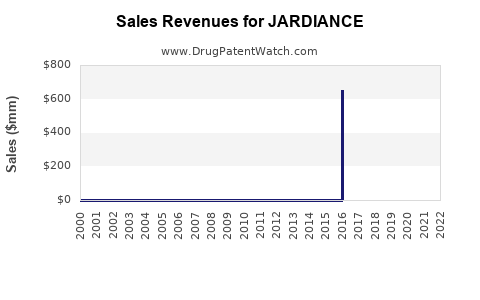
$3.0 billion |
Eli Lilly quarterly reports |
| Top markets |
U.S., EU, Japan |
IMS Health (IQVIA) |
| Market share in SGLT2 inhibitors |
35% (2022) |
EvaluatePharma |
JARDIANCE ranks as the leading SGLT2 inhibitor in terms of sales, owing to its early approval in 2014, extensive label expansion, and positive clinical data supporting cardiovascular and renal benefits.
Key Drivers
Clinical and Regulatory Expansion
- Heart failure: Approved in 2020 for reducing cardiovascular death in heart failure with reduced ejection fraction.
- Chronic kidney disease: Approved in 2021, broadening patient eligibility.
- These approvals drive market expansion beyond glycemic control.
Population Demographics
- Over 400 million people with type 2 diabetes globally.
- Increasing prevalence of cardiovascular and renal comorbidities enhances the therapeutic need for JARDIANCE.
Competitive Landscape
| Competitors |
Market Share (2022) |
Key Differentiators |
| Farxiga (dapagliflozin) |
27% |
Same class, branded in heart failure and CKD |
| Invokana (canagliflozin) |
15% |
Older approval, but with safety concerns |
| Jardiance |
35% |
Superior CV/renal outcomes, broader label |
Sales Projections (2023–2028)
Assumptions
- Continued label expansion success.
- Increasing adoption for heart failure and CKD.
- Moderate pricing growth aligned with inflation.
- Competitive dynamics remain stable with top position maintained.
Forecast Overview
| Year |
Estimated Global Sales (USD) |
Growth Rate |
Notes |
| 2023 |
$3.8 billion |
26.7% |
Post-COVID recovery, market access improving |
| 2024 |
$4.5 billion |
18.4% |
Expanded indications penetrate new regions |
| 2025 |
$5.2 billion |
15.6% |
Increased adoption in CKD and heart failure |
| 2026 |
$6.0 billion |
15.4% |
Prescriber familiarity increases |
| 2027 |
$6.7 billion |
11.7% |
Market saturation begins, slower growth |
| 2028 |
$7.4 billion |
10.4% |
Steady, mature market with ongoing expansion |
Note: These projections assume a compound annual growth rate (CAGR) of approximately 15% from 2024 onward.
Risks and Challenges
- Safety concerns: Rare but serious side effects could impact prescriber confidence.
- Pricing pressures: Payer restrictions or biosimilar entries could limit revenue.
- Competition: Dapagliflozin’s expanding indications threaten market share.
- Market access: Variability in healthcare systems, especially in emerging markets.
Opportunities for Growth
- Combination therapies: JARDIANCE marketing with GLP-1 receptor agonists could improve treatment adherence.
- Regional expansion: Increasing focus on Asian markets; emerging economies will adopt SGLT2 inhibitors.
- Research pipeline: Ongoing studies in heart failure with preserved ejection fraction and other indications.
Key Takeaways
- JARDIANCE maintains a leading position among SGLT2 inhibitors, driven by broad clinical approvals.
- Sales are projected to increase to approximately $7.4 billion by 2028, with a steady CAGR of around 15%.
- Market growth hinges on expanding indications, regional adoption, and competitive landscape stability.
- Risks include safety concerns, market access challenges, and emerging competitors.
- Future growth opportunities include combination therapies and new health indications.
FAQs
1. What factors have contributed to JARDIANCE’s market leadership?
Its early approval, extensive clinical data demonstrating cardiovascular and renal benefits, and expanding indications have established JARDIANCE as a preferred SGLT2 inhibitor.
2. How does JARDIANCE compare to competitors?
It has the highest market share among SGLT2 inhibitors, partly due to superior cardiovascular and renal outcomes shown in clinical trials, and broader labeling.
3. What regions are expected to drive future sales?
The U.S., European Union, Japan, and emerging markets such as China and India offer significant growth potential due to rising diabetes prevalence.
4. What challenges could slow sales growth?
Safety concerns, generic competition, payer restrictions, and saturation of the existing market could impact revenues.
5. Will JARDIANCE’s indications expand further?
Yes. Research into additional uses such as obesity, other cardiovascular conditions, and prevention in high-risk populations is ongoing, potentially further broadening its market.
References
[1] Eli Lilly quarterly reports. (2022).
[2] EvaluatePharma. (2022). Diabetes market overview.
[3] IMS Health (IQVIA). (2022). Global diabetes medication sales analysis.