Share This Page
Drug Sales Trends for JANUVIA
✉ Email this page to a colleague
Payment Methods and Pharmacy Types for JANUVIA (2022)
Revenues by Pharmacy Type
Units Sold by Pharmacy Type
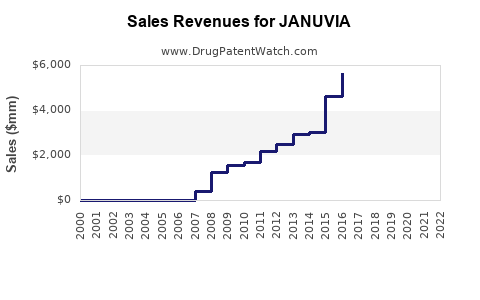
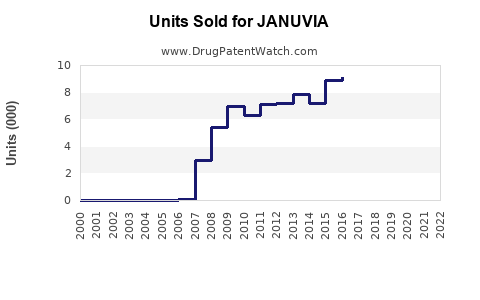
Annual Sales Revenues and Units Sold for JANUVIA
| Drug Name | Revenues (USD) | Units | Year |
|---|---|---|---|
| JANUVIA | ⤷ Start Trial | ⤷ Start Trial | 2022 |
| JANUVIA | ⤷ Start Trial | ⤷ Start Trial | 2021 |
| JANUVIA | ⤷ Start Trial | ⤷ Start Trial | 2020 |
| >Drug Name | >Revenues (USD) | >Units | >Year |
Executive summary: Januvia (sitagliptin) remains a large global type 2 diabetes franchise, but its growth phase has ended. Merck's sales are under pressure from U.S. pricing reductions, generic sitagliptin risk, and competition from GLP-1 receptor agonists and SGLT2 inhibitors. A base-case forecast places Januvia product sales at roughly $3.4 billion in 2025, $2.8 billion in 2026, $1.8 billion in 2027, and below $1 billion by 2029 as generic access expands. The principal commercial risk is U.S. generic entry following the expiration or settlement of residual sitagliptin patent rights.
Januvia Market Analysis, Sales Projections, Patent Expiration, and Generic Entry Risk
What is Januvia and how does it compete in type 2 diabetes?
Januvia is Merck's branded sitagliptin product, an oral dipeptidyl peptidase-4, or DPP-4, inhibitor approved for adults with type 2 diabetes. It is available primarily as 25 mg, 50 mg, and 100 mg tablets. Sitagliptin is also marketed with metformin as Janumet and Janumet XR.
Januvia's principal commercial attributes are:
- Oral, once-daily administration
- Low hypoglycemia risk when used without insulin or a sulfonylurea
- Weight neutrality
- Long physician familiarity
- Broad use in patients who cannot tolerate or do not prefer injectable therapies
Its main clinical limitations are modest glucose-lowering efficacy compared with GLP-1 drugs and the absence of the cardiovascular, renal, and weight-loss benefits associated with leading GLP-1 receptor agonists and SGLT2 inhibitors.
How does Januvia compare with competing diabetes drugs?
| Product class | Representative products | Main advantage over Januvia | Main disadvantage |
|---|---|---|---|
| DPP-4 inhibitors | Januvia, Tradjenta, Onglyza | Oral dosing, tolerability, weight neutrality | Lower efficacy and limited outcome benefits |
| GLP-1 receptor agonists | Ozempic, Trulicity, Mounjaro | Greater glucose reduction and weight loss | Injectable or oral-specialty dosing, higher cost |
| SGLT2 inhibitors | Jardiance, Farxiga | Cardiovascular and renal outcome benefits | Genitourinary adverse effects and renal-use restrictions |
| Sulfonylureas | Glipizide, glyburide | Low acquisition cost | Hypoglycemia and weight gain |
| Metformin combinations | Janumet, generic metformin combinations | Familiar fixed-dose regimen | Generic competition and gastrointestinal effects |
Januvia is most exposed to generic DPP-4 competition and to therapeutic substitution by GLP-1 and SGLT2 products. Its strongest remaining segments are patients seeking an oral, weight-neutral medicine and patients who are not candidates for more intensive therapies.
How much revenue does Januvia generate?
Merck reports Januvia separately from Janumet in its annual financial disclosures. Product sales have remained in the multibillion-dollar range but have declined from peak levels because of U.S. price pressure, loss of exclusivity, and changes in diabetes treatment patterns.
| Fiscal year | Approximate Januvia sales | Direction |
|---|---|---|
| 2021 | $4.0 billion | Stable to modest growth |
| 2022 | $4.5 billion | Peak-period performance |
| 2023 | $4.5 billion | Broadly stable before full generic erosion |
| 2024 | Approximately $4.1 billion | Decline from pricing and market pressure |
| 2025E | $3.4 billion | Continued erosion |
| 2026E | $2.8 billion | Pre-generic and early generic pressure |
| 2027E | $1.8 billion | Material post-entry decline |
| 2028E | $1.2 billion | Established generic substitution |
| 2029E | $0.9 billion | Mature branded residual market |
| 2030E | $0.7 billion | Residual brand and international sales |
Merck's reported Januvia figure excludes Janumet. The combined sitagliptin franchise is larger, but Janumet has separate commercial dynamics because metformin combinations face their own generic substitution and pricing pressures. Merck's annual reports identify lower Januvia sales as a continuing headwind to pharmaceutical revenue growth. [1]
What are the Januvia sales projections through 2030?
The base-case forecast assumes no major new indication, no material improvement in DPP-4 market share, and generic sitagliptin availability in the United States around the late-2026 to 2027 period.
| Scenario | 2025E | 2026E | 2027E | 2028E | 2030E |
|---|---|---|---|---|---|
| Upside | $3.7B | $3.3B | $2.5B | $1.9B | $1.3B |
| Base case | $3.4B | $2.8B | $1.8B | $1.2B | $0.7B |
| Downside | $3.1B | $2.2B | $1.1B | $0.6B | $0.3B |
What assumptions drive the forecast?
The base case uses five assumptions:
- Januvia sales decline by approximately 15% to 20% annually before broad U.S. generic substitution.
- Generic entry reduces branded U.S. volume and increases payer pressure on remaining branded prescriptions.
- The product retains a meaningful non-U.S. market through the end of the decade.
- Janumet is not counted in the Januvia forecast.
- GLP-1 and SGLT2 products continue taking share from DPP-4 inhibitors in treatment intensification.
The upside case assumes slower generic conversion, stronger international demand, and greater retention among older patients and patients requiring oral therapy. The downside case assumes multiple generic suppliers launch close to the earliest permitted date and payers move quickly to mandatory substitution.
When does Januvia lose exclusivity?
Januvia's principal U.S. compound patent, U.S. Patent No. 6,699,871, reached its original term in 2022. A pediatric exclusivity extension extended relevant protection into 2023. The core composition protection therefore no longer provides a meaningful barrier to generic development. [2]
Residual protection has centered on sitagliptin salt, crystalline-form, formulation, and related process patents. The practical generic-entry date depends on:
- The validity and enforceability of remaining patents
- ANDA applicant Paragraph IV certifications
- Patent litigation outcomes
- Settlement agreements with Merck
- Regulatory approval timing
- Authorized-generic arrangements
Publicly reported settlements have generally created a commercial-entry window around late 2026 or 2027 for certain generic applicants, rather than allowing immediate broad market entry after the core compound patent expired. The settlement date is therefore more important to near-term revenue forecasting than the original compound patent expiration.
What is the Orange Book status of Januvia?
Januvia is an FDA-approved small-molecule drug listed in the Orange Book. It is not a biologic and does not receive biologic exclusivity or biosimilar protection.
The relevant U.S. regulatory structure is:
| Regulatory issue | Januvia status |
|---|---|
| FDA pathway | New Drug Application |
| Active ingredient | Sitagliptin |
| Dosage form | Immediate-release oral tablet |
| Reference product | Januvia |
| Generic pathway | Abbreviated New Drug Application |
| Patent challenge mechanism | Paragraph IV certification |
| Biosimilar pathway | Not applicable |
| Orange Book relevance | Listed patents and regulatory exclusivity |
The FDA Orange Book remains the controlling source for the current patent listing and exclusivity record. Patent listings can change as patents expire, delistings occur, or litigation settlements alter the practical entry timetable. [3]
Which companies are challenging Januvia patents?
Generic drug companies have pursued sitagliptin through ANDA filings and patent litigation. Publicly reported challengers and potential commercial participants have included Teva, Sun Pharmaceutical, Zydus, Torrent, and other generic manufacturers.
The competitive threat has two layers:
Paragraph IV litigation
An ANDA applicant can certify that a listed patent is invalid, unenforceable, or will not be infringed. This certification can trigger patent litigation and a statutory stay of FDA approval for up to 30 months, subject to litigation developments.
For Januvia, Paragraph IV activity has focused on residual patents rather than the already expired core compound patent. The commercial consequence is delayed launch, not permanent exclusion, unless Merck prevails on enforceability and obtains an injunction.
Settlement agreements
Merck's settlements with generic applicants can establish permitted launch dates, supply arrangements, or authorized-generic terms. These agreements typically reduce litigation uncertainty but can also preserve branded revenue until a negotiated date.
The key business issue is whether the first generic launches alone or whether several applicants enter simultaneously. A single entrant can produce a steep price decline while preserving some branded volume. Multiple entrants generally produce faster net-sales erosion.
What generic launch scenarios exist for Januvia?
Scenario 1: Delayed single-generic entry
A first generic launches in late 2026 or 2027, with additional suppliers entering later. Januvia retains substantial managed-care coverage and physician familiarity. U.S. brand sales decline sharply but do not disappear immediately.
Estimated impact: 35% to 50% U.S. revenue decline in the first full year after entry.
Scenario 2: Coordinated multi-generic entry
Several manufacturers launch within a short period. Pharmacy substitution rises quickly, and payers place sitagliptin generics on preferred tiers.
Estimated impact: 60% to 75% U.S. brand revenue decline in the first full year.
Scenario 3: Authorized-generic competition
Merck or a commercial partner supplies an authorized generic. This can protect some franchise economics while accelerating overall sitagliptin availability. Reported Januvia brand revenue would fall, but Merck could retain a portion of generic economics.
Estimated impact: lower reported brand sales, with partial offset from generic supply revenue.
What formulation and method-of-use patents protect Januvia?
Januvia's commercial protection has included more than the original active-ingredient patent. Relevant categories include:
- Sitagliptin phosphate salt
- Crystalline and polymorphic forms
- Tablet formulations
- Manufacturing and purification processes
- Fixed-dose combinations with metformin
- Methods of treating type 2 diabetes
- Dosing in patients with renal impairment
Formulation and process patents generally provide narrower protection than a composition-of-matter patent. They can delay a generic launch if valid and infringed, but they are more vulnerable to design-around strategies. A generic applicant may use a different salt, polymorph, excipient system, or manufacturing route, depending on the scope of the claims and FDA product requirements.
Janumet has a separate patent and litigation profile. A generic sitagliptin launch does not automatically establish generic Janumet availability, although it increases the probability of broader franchise erosion.
How strong is the Januvia patent estate?
Januvia's patent estate is weak as a long-term exclusivity platform but can remain commercially relevant in the near term.
| Patent category | Current strategic value |
|---|---|
| Core compound patent | Low after expiration |
| Pediatric exclusivity | Expired |
| Salt and polymorph patents | Moderate if valid and not designed around |
| Formulation patents | Moderate to low |
| Method-of-use patents | Generally limited against routine generic use |
| Process patents | Potentially useful but difficult to enforce commercially |
| Janumet combination patents | Separate and potentially longer-lived |
| International patents | Country-specific and uneven |
The estate's value is therefore concentrated in timing. It may defer generic entry or support settlement terms, but it is unlikely to preserve Januvia's historical U.S. revenue base through the 2030s.
What FDA regulatory factors affect Januvia sales?
FDA approval of generic sitagliptin requires demonstration of pharmaceutical equivalence and bioequivalence to the reference product. Generic applicants must also address listed patents through Paragraph III or Paragraph IV certifications.
Januvia's regulatory risk is lower than that of a complex biologic because it is an oral small molecule with an established tablet formulation. Manufacturing barriers are also limited relative to products requiring sterile production, complex delivery devices, or advanced biologic analytics.
The main regulatory variables are:
- ANDA approval timing
- Patent certification status
- 30-month litigation stays
- Product labeling requirements
- Renal dosing instructions
- Manufacturing-site readiness
- FDA inspection outcomes
What geographic markets remain attractive for Januvia?
The United States is the largest value market but also the market with the highest generic-entry risk. International erosion is likely to occur on different schedules because patent terms, reimbursement systems, and substitution rules vary by country.
| Region | Market outlook |
|---|---|
| United States | Rapid decline after broad generic substitution |
| Europe | Mature market with country-specific generic erosion |
| Japan | Continued oral-treatment demand but pricing pressure |
| China | High volume potential, strong local generic competition |
| Emerging markets | Longer branded tail in some countries, lower pricing |
| Middle East and Latin America | Distributor and reimbursement dependent |
Merck can preserve part of the international franchise through local pricing, physician familiarity, and supply continuity. That revenue is unlikely to offset U.S. loss at historical margins.
How does Januvia affect Merck's revenue exposure?
Januvia is strategically important because it generates billions of dollars annually, but it is no longer a primary growth driver for Merck. The principal exposure is concentrated in:
- U.S. diabetes revenue
- Gross-to-net price deductions
- Managed-care formulary access
- Generic substitution timing
- Janumet franchise spillover
- Manufacturing and distribution scale
At a $4.1 billion 2024 sales base, a decline to $700 million by 2030 would remove approximately $3.4 billion in annual product revenue. The percentage impact on Merck's total revenue is smaller because the company has a much larger oncology portfolio, particularly Keytruda, but Januvia's decline remains material to the pharmaceutical segment.
What licensing deals affect Januvia?
No major external licensing transaction is required to explain Januvia's current commercial position. Merck developed and markets the product. The more relevant commercial arrangements are generic settlements, potential authorized-generic supply agreements, and regional commercialization agreements.
Any authorized-generic transaction would change the revenue mix rather than eliminate loss-of-exclusivity risk. It could reduce the speed of total sitagliptin price collapse while accelerating substitution away from the Januvia brand.
What litigation status affects Januvia?
The central litigation question is whether residual patents can delay generic entry beyond the settlement windows reported by the parties. Litigation outcomes can alter the forecast by several quarters, but the core compound patent has already expired and does not support a long-term monopoly.
The most important diligence points are:
- Active Orange Book patent listings
- ANDA applicants with Paragraph IV certifications
- District court validity and infringement decisions
- Federal Circuit appeals
- Settlement-permitted launch dates
- Any authorized-generic provisions
- Separate Janumet litigation
Key Takeaways
- Januvia is a mature oral diabetes franchise based on sitagliptin.
- Merck Januvia sales were approximately $4.1 billion in 2024, based on company-reported product sales.
- The core U.S. compound patent expired in 2022, with pediatric exclusivity extending relevant protection into 2023.
- Residual salt, formulation, and process patents have greater importance for launch timing than for long-term exclusivity.
- Generic entry is most likely to produce material U.S. erosion around late 2026 to 2027, subject to settlement and regulatory timing.
- Base-case Januvia sales are projected to fall below $1 billion by 2029.
- Januvia has no biosimilar risk because it is a small-molecule drug; its relevant threat is ANDA-based generic competition.
- GLP-1 receptor agonists and SGLT2 inhibitors are the main therapeutic substitutes.
- Janumet requires separate patent and sales analysis because generic Januvia entry does not automatically determine generic Janumet timing.
FAQs About Januvia Sales, Patents, and Generic Competition
When will generic Januvia be available in the United States?
Broad generic availability is most likely around late 2026 or 2027 based on reported settlement-related entry windows and residual patent considerations.
Is Januvia still protected by a composition-of-matter patent?
The principal U.S. composition patent expired in 2022, followed by pediatric exclusivity into 2023. Current protection depends on narrower patents and litigation settlements.
Does Januvia have biosimilar competition?
No. Januvia is a chemically synthesized small molecule. FDA-approved competitors would be generics submitted through the ANDA pathway, not biosimilars.
Will generic Januvia reduce Janumet sales?
Yes, generic sitagliptin can increase payer and physician acceptance of sitagliptin-based treatment and weaken the broader franchise. Janumet's direct generic-entry timing remains separate.
What is the long-term market outlook for DPP-4 inhibitors?
DPP-4 inhibitors will retain a mature market among patients who prioritize oral dosing, tolerability, and weight neutrality. Their share is likely to decline as GLP-1 and SGLT2 therapies expand, while generic pricing limits revenue growth.
References
-
Merck & Co., Inc. (2025). 2024 annual report and Form 10-K. https://www.merck.com/investor-relations/financial-information/annual-reports/
-
U.S. Patent and Trademark Office. (2004). U.S. Patent No. 6,699,871: Beta-amino tetrahydrotriazolopyrazine compounds. https://patents.google.com/patent/US6699871
-
U.S. Food and Drug Administration. (n.d.). Approved drug products with therapeutic equivalence evaluations, Orange Book. https://www.accessdata.fda.gov/scripts/cder/ob/
More… ↓
