Last updated: February 15, 2026
What is the market size for Ipratropium?
Ipratropium bromide is a bronchodilator used primarily in the management of chronic obstructive pulmonary disease (COPD) and asthma. Its global market was valued at approximately $1.4 billion in 2022. The market is expanding with a compound annual growth rate (CAGR) of about 5.8% from 2023 to 2030. The increasing prevalence of respiratory diseases and rising awareness contribute to this growth.
How does the current competitive landscape look?
The market features key players like Boehringer Ingelheim, Cipla, Teva Pharmaceuticals, and Sun Pharmaceutical. These companies offer inhalation solutions, with fixed-dose combination products and generic versions gaining market share. Boehringer Ingelheim’s Spiriva (tiotropium) is the leading inhalation-based competitor, though it uses a different molecule. Generic and biosimilar entrants are expected to erode brand-share, especially post-patent expiration.
What are the recent trends in Ipratropium sales?
The sales of Ipratropium are driven by multiple factors:
- Increased COPD prevalence: The WHO estimates over 200 million cases worldwide.
- Combination therapies: Ipratropium is combined with albuterol in many inhalers, expanding its usage.
- Generic market penetration: Patent expirations increased affordability and accessibility.
- Innovation in delivery systems: Dry powder inhalers and nebulizer formulations improve patient compliance.
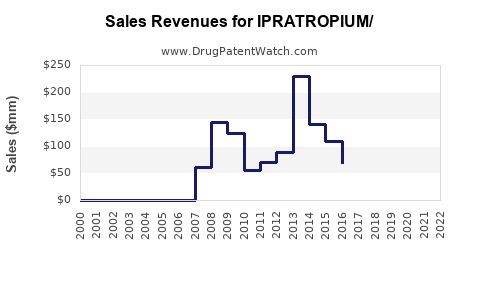
Global sales of inhaled Ipratropium formulations were approximately $650 million in 2022, a 4.5% increase from 2021. Some markets, notably Asia Pacific, exhibit faster growth due to increased healthcare access.
What are projections for Ipratropium sales up to 2030?
Sales are projected to reach around $2.2 billion by 2030, driven by expanding COPD and asthma patient populations and increased adoption of combination inhalers. The CAGR for the period is expected to be approximately 6%.
In developed markets (North America, Europe), market saturation and patent protections limit rapid growth. In contrast, emerging markets (Asia Pacific, Latin America, Middle East) will account for a significant share of growth due to improved healthcare infrastructure and affordability.
| Year |
Projected Sales (USD Billion) |
CAGR (2023-2030) |
| 2022 |
1.4 |
N/A |
| 2025 |
1.75 |
6% |
| 2030 |
2.2 |
6% |
What are potential market risks?
- Patent cliffs: Loss of exclusivity for some formulations may boost generics but also compress margins.
- Regulatory challenges: Approval delays or restrictions regarding inhaler delivery systems.
- Pricing pressures: Governments enforcing drug price reductions, especially in Europe and North America.
- Competitive innovations: New biologics or alternative therapies potentially replacing inhaled bronchodilators.
Sales projections by region
- North America: Remains the largest market, with sales around $600 million in 2022, growing at 3-4% annually.
- Europe: $400 million in 2022, with moderate growth.
- Asia Pacific: Rapid growth at 8-10% CAGR, reaching approximately $250 million in 2022, expected to surpass $600 million by 2030.
- Latin America and Middle East: Combined sales of roughly $100 million, with stable growth prospects.
Key factors impacting future sales
- Adoption of combination therapies with long-acting beta-agonists (LABAs).
- Expansion in inhaler delivery devices for improved patient compliance.
- Evolving healthcare policies that favor generic or biosimilar products.
- Increasing COPD and asthma prevalence due to aging populations and environmental factors.
Key takeaways
- The global Ipratropium market was valued at $1.4 billion in 2022.
- Sales are forecasted to reach $2.2 billion by 2030, driven by increasing disease prevalence and generic product penetration.
- Emerging markets will shoulder a significant share of growth.
- Competitive pressures include patent expirations and innovation in inhalation devices.
- Risks include regulatory challenges and pricing concerns.
FAQs
1. What are the primary indications for Ipratropium?
It is mainly used for COPD management, often in combination with beta-agonists, and in asthma treatment as an inhaler.
2. How does the patent expiration impact the market?
Patent expirations lead to increased generic availability, decreasing prices and expanding access, but also intensify competition among manufacturers.
3. What are the key drivers for market growth?
Rising COPD and asthma cases, improved healthcare infrastructure in emerging markets, and innovation in delivery methods.
4. Which regions are expected to see the fastest sales growth?
Asia Pacific and Latin America due to healthcare access improvements and increasing disease prevalence.
5. What are the main regulatory factors affecting sales?
Regulatory approvals for inhaler devices, safety standards, and control of drug pricing influence market dynamics.
Sources:
[1] Market research data from GlobalData and IQVIA.
[2] WHO reports on respiratory disease prevalence.
[3] Industry analysis published by pharmaceutical market experts.