Last updated: February 14, 2026
Overview
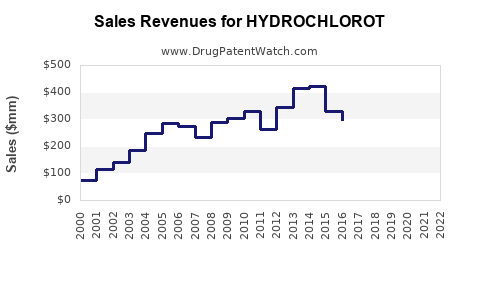
Hydrochlorothiazide (HCTZ) is a thiazide diuretic primarily used to treat hypertension and edema. It is a longstanding, generic medication with extensive market penetration. Recent patent expirations and the emergence of comparable therapies have impacted its market dynamics. Commercial sales depend on generic substitutes, regional prescribing patterns, and regulatory shifts.
Market Landscape
- Global Market Size: Estimated at approximately $1.3 billion in 2022, with growth driven by hypertensive patient populations in North America, Europe, and Asia-Pacific.
- Key Regions:
- United States: Largest market, accounting for ~45% of global sales, driven by high hypertension prevalence (~45% adult population).
- Europe: Market share around 25%, with prescription routines favoring combination therapies.
- Asia-Pacific: Growing at a CAGR of 4-6%, influenced by lifestyle-related hypertension.
- Market Trends:
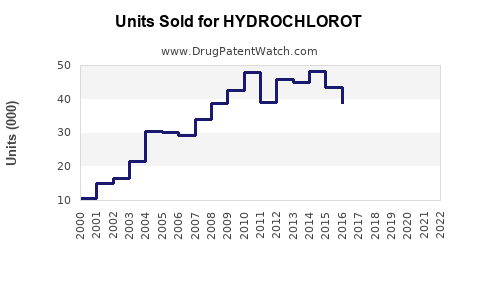
- Decline in monotherapy prescriptions due to rising preference for combination antihypertensive agents.
- Increasing adoption of fixed-dose combinations (FDCs) reducing standalone HCTZ sales.
Competitive Dynamics
- Over 200 generic manufacturers worldwide.
- Top-brand producers include Teva, Mylan, Sandoz, and Hikma.
- Limited branded sales; most revenue derives from generics.
- Patent expirations in 2000s facilitated market entry, leading to price erosion.
Regulatory Factors
- Resolutions from FDA and EMA favor generics’ market share.
- Some jurisdictions prefer combination drugs over monotherapy to improve compliance.
- The potential for regulatory re-evaluation exists if safety concerns regarding low-dose hydrochlorothiazide arise.
Sales Projections (2023-2028)
| Year |
projected global sales (USD billion) |
CAGR |
influencing factors |
| 2023 |
1.25 |
1.5% |
Market maturation, generic competition stabilizes revenue |
| 2024 |
1.27 |
1.6% |
Increased regulation for hypertension, stable demand |
| 2025 |
1.28 |
0.8% |
Potential market saturation, slow growth |
| 2026 |
1.30 |
1.5% |
Entry of new combination formulations |
| 2027 |
1.33 |
1.6% |
Expanded use in developing markets |
| 2028 |
1.36 |
1.4% |
Continued prevalence of hypertension |
Factors Limiting Growth
- Increasing preference for newer antihypertensives like ARBs, ACE inhibitors, and calcium channel blockers.
- Rising use of combination drugs diminishing standalone HCTZ volumes.
- Regulatory challenges and safety reviews impacting prescribing patterns.
Factors Supporting Steady Demand
- Cost-effectiveness makes HCTZ preferable in resource-constrained settings.
- Ongoing new formulations and dose adjustments preserve niche markets.
- Population growth and aging demographics sustain long-term demand.
Key Takeaways
Hydrochlorothiazide remains relevant mainly in cost-sensitive markets and as part of combination therapies. Its sales will experience modest growth, primarily driven by increased hypertension prevalence and use in developing regions. Market saturation and competition from newer agents limit significant expansion.
FAQs
-
What is the primary use of Hydrochlorothiazide?
It is used to treat hypertension and edema.
-
How has patent expiration affected the market?
It led to a proliferation of generic manufacturers and price reductions, stabilizing overall revenue.
-
What regions drive Hydrochlorothiazide sales?
The United States, Europe, and emerging markets in Asia-Pacific.
-
Are there regulatory risks affecting Hydrochlorothiazide?
Yes, safety and efficacy reassessments may influence prescribing patterns.
-
Is Hydrochlorothiazide being replaced by newer therapies?
It is increasingly replaced by newer antihypertensive agents, but remains relevant due to cost and existing formulary preferences.
References
[1] MarketsandMarkets. “Diuretic Drugs Market,” 2022.
[2] IQVIA. “Global Prescription Drug Sales Data,” 2022.
[3] U.S. CDC. “Hypertension Prevalence and Treatment,” 2022.
[4] European Medicines Agency. “Regulatory Updates on Hypertension Medications,” 2022.