Share This Page
Drug Sales Trends for HUMULIN R
✉ Email this page to a colleague
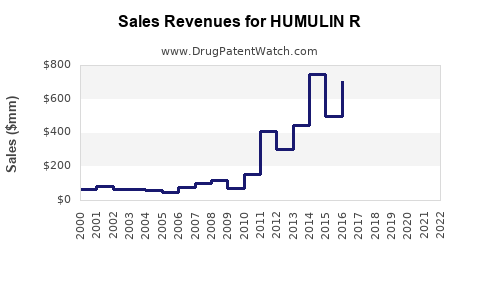
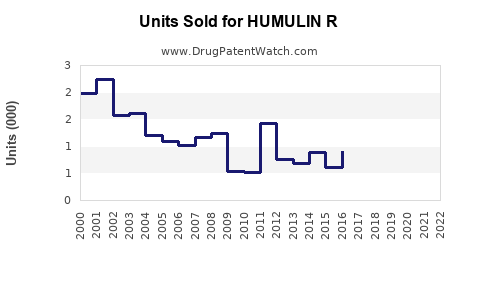
Annual Sales Revenues and Units Sold for HUMULIN R
| Drug Name | Revenues (USD) | Units | Year |
|---|---|---|---|
| HUMULIN R | ⤷ Start Trial | ⤷ Start Trial | 2022 |
| HUMULIN R | ⤷ Start Trial | ⤷ Start Trial | 2021 |
| HUMULIN R | ⤷ Start Trial | ⤷ Start Trial | 2020 |
| >Drug Name | >Revenues (USD) | >Units | >Year |
HUMULIN R Market Analysis, Sales Forecast, Patent Position, and Generic Risk
Humulin R is a mature human insulin franchise marketed by Eli Lilly and Company. Its commercial value is supported by chronic demand, established physician familiarity, hospital use, and the high-concentration U-500 product. Growth is constrained by declining use of regular human insulin relative to rapid-acting analogs, reimbursement pressure, low-cost competitors, and public scrutiny of insulin pricing.
Lilly does not publicly disclose a separate revenue line for every Humulin R presentation. The projections below therefore use the broader Humulin franchise as the closest public benchmark and apply an analyst estimate for the Humulin R portion.
What is Humulin R and how is it used?
Humulin R contains recombinant human insulin, also called regular human insulin. It is a short-acting insulin used to control blood glucose in patients with diabetes mellitus.
| Product | Concentration | Primary use | Administration |
|---|---|---|---|
| Humulin R U-100 | 100 units/mL | Mealtime and basal supplementation | Subcutaneous injection; intravenous use under medical supervision |
| Humulin R U-500 | 500 units/mL | Severe insulin resistance requiring more than 200 units per day | Subcutaneous injection |
| Humulin R U-500 KwikPen | 500 units/mL | High-dose insulin therapy | Prefilled pen |
Humulin R U-100 is generally administered about 30 minutes before meals. U-500 has a longer glucose-lowering profile than U-100 regular insulin because of its high concentration and pharmacokinetic behavior. The U-500 product is aimed at a narrower but commercially important population with severe insulin resistance.
The FDA approved Humulin in 1982 as the first commercially available recombinant human insulin. The product is manufactured using recombinant DNA technology in genetically modified microorganisms. Lilly remains the reference sponsor and principal global manufacturer.[1][2]
How large is the Humulin R market?
The addressable market is the global human-insulin market, but Humulin R competes in a narrower segment against Novo Nordisk’s Novolin R and lower-priced human insulin products sold through retail, government, and private-label channels.
The main demand drivers are:
- Growth in the global diabetes population.
- Continued insulin use in type 1 diabetes.
- Advanced type 2 diabetes requiring insulin.
- Severe insulin resistance treated with U-500 insulin.
- Hospital and institutional use of regular human insulin.
- Access programs and lower-cost insulin channels.
The main structural constraints are:
- Rapid-acting analogs, including insulin lispro and insulin aspart, have replaced regular insulin for many mealtime patients.
- Basal insulin and GLP-1 therapies reduce or delay progression to intensive insulin regimens in some type 2 diabetes patients.
- Medicare and commercial formulary negotiations pressure net prices.
- Biosimilar and follow-on insulin products create additional payer leverage.
- Retail switching to lower-cost human insulin products reduces brand loyalty.
Humulin R retains a stronger position in U-500 insulin than in standard U-100 mealtime insulin. The U-500 category has fewer direct alternatives and requires specialized prescribing and dosing practices, which creates switching friction.
What are Eli Lilly’s Humulin sales?
Lilly reports Humulin as a product-level revenue category in some annual-report disclosures, but it does not consistently provide revenue for Humulin R U-100 and Humulin R U-500 separately. Reported Humulin revenue includes multiple presentations and geographic markets.
Public filings indicate that Humulin is a mature, declining or low-growth franchise rather than a core expansion product. The franchise remains commercially material because insulin demand is recurring and global, but it is less strategically important to Lilly than Mounjaro, Zepbound, Verzenio, Trulicity, Taltz, and newer pipeline products.[3][4]
Estimated Humulin franchise revenue
The following figures are analyst estimates based on Lilly’s reported product trends, the mature insulin market, and the absence of separately disclosed Humulin R product-level revenue.
| Fiscal year | Estimated Humulin franchise revenue | Estimated annual change |
|---|---|---|
| 2023 | $1.1 billion-$1.3 billion | Down to flat |
| 2024 | $0.95 billion-$1.15 billion | Down 8% to 12% |
| 2025E | $0.90 billion-$1.05 billion | Down 3% to 8% |
| 2026E | $0.86 billion-$1.00 billion | Down 2% to 5% |
| 2027E | $0.82 billion-$0.96 billion | Down 2% to 5% |
| 2028E | $0.78 billion-$0.92 billion | Down 2% to 5% |
A reasonable estimate is that Humulin R accounts for approximately 60% to 75% of Humulin franchise revenue, with U-500 contributing a disproportionate share of profit because of its differentiated concentration and limited direct substitution.
On that basis, estimated Humulin R revenue is approximately $600 million to $850 million annually, with U-500 representing roughly 25% to 40% of Humulin R sales.
What are the Humulin R sales projections through 2028?
Base-case projection
The base case assumes continuing unit demand, annual net-price erosion, gradual channel migration, and stable U-500 utilization.
| Year | Estimated Humulin R revenue | Key assumption |
|---|---|---|
| 2024A/estimate | $600 million-$850 million | Mature demand and price pressure |
| 2025E | $575 million-$820 million | Low-single-digit decline |
| 2026E | $555 million-$790 million | Formulary and channel pressure |
| 2027E | $535 million-$765 million | Continued analog substitution |
| 2028E | $515 million-$740 million | Stable U-500; declining U-100 |
The base case implies a 2024-2028 compound annual decline of approximately 3% to 4%.
Bull case
The bull case produces 2028 revenue of approximately $800 million to $950 million if:
- U-500 demand grows with severe obesity and advanced type 2 diabetes.
- Lilly retains favorable formulary access.
- Supply reliability improves relative to lower-cost competitors.
- Patient-assistance and affordability programs expand unit access without proportionate net-price erosion.
- Hospital and institutional use remains stable.
Bear case
The bear case produces 2028 revenue of approximately $400 million to $550 million if:
- Payers accelerate mandatory substitution to lower-cost human insulin.
- A competing concentrated regular insulin product gains share.
- U-500 patients migrate to alternative high-dose insulin regimens.
- Retail cash-pay channels expand at materially lower prices.
- Lilly reduces promotional and manufacturing investment in U-100 products.
What is the competitive landscape for Humulin R?
Humulin R competes against both branded and lower-cost human insulin products.
| Competitor | Company | Product relevance |
|---|---|---|
| Novolin R | Novo Nordisk | Direct U-100 regular human insulin competitor |
| ReliOn Novolin R | Walmart/Novo Nordisk | Lower-price retail channel |
| Insulin regular products | Various manufacturers | Hospital and low-cost substitution |
| Humalog | Eli Lilly | Rapid-acting analog that substitutes for some U-100 use |
| NovoLog | Novo Nordisk | Rapid-acting analog competitor |
| Fiasp | Novo Nordisk | Faster-acting mealtime insulin alternative |
| Lyumjev | Eli Lilly | Faster-acting mealtime insulin alternative |
| Insulin glargine products | Multiple manufacturers | Basal insulin alternatives, not direct substitutes |
Humulin R U-500 has a more defensible position than U-100 because the number of direct high-concentration regular-insulin alternatives is limited. The standard U-100 product competes in a commoditized market where clinical differentiation is modest.
What is the FDA regulatory status of Humulin R?
Humulin R was originally approved as a drug product under the Federal Food, Drug, and Cosmetic Act. FDA transitioned insulin products, including Humulin, from the drug framework to the biologics framework on March 23, 2020.[5]
The transition affects regulatory classification and the pathway for follow-on insulin products. It does not create new commercial exclusivity for an old product.
| Regulatory issue | Humulin R status |
|---|---|
| Active ingredient | Recombinant human insulin |
| FDA sponsor | Eli Lilly and Company |
| Original approval | 1982 |
| Product type | Biologic insulin product after 2020 transition |
| U.S. reference product | Yes |
| Biosimilar relevance | Applicable in principle, but no major direct U.S. Humulin R biosimilar has materially disrupted the market |
| Interchangeability | Depends on the competing insulin product and FDA designation |
| Prescription status | Standard prescription product; retail access rules can vary by product and jurisdiction |
FDA-approved follow-on insulin competition has been more visible in insulin glargine than in regular human insulin. Semglee, Rezvoglar, and other insulin glargine products demonstrate the pathway’s commercial viability, but they do not directly replace Humulin R’s active ingredient or U-500 concentration.[6]
What patents protect Humulin R?
Humulin R’s core composition and recombinant-insulin patents are long expired. The product’s commercial protection now depends primarily on manufacturing know-how, regulatory history, trademarks, device configuration, supply scale, and customer familiarity.
| Protection category | Current commercial relevance |
|---|---|
| Core human-insulin composition patents | Expired |
| Recombinant production patents | Expired or no longer effective against routine generic entry |
| U-500 concentration concept | No meaningful modern composition exclusivity |
| Formulation patents | Limited practical exclusivity for an old human-insulin product |
| Delivery-device patents | Potentially relevant to pen presentations, but generally narrow and presentation-specific |
| Manufacturing know-how | Important operational barrier |
| Trademark protection | Protects the Humulin name, not the active ingredient |
| Regulatory exclusivity | No meaningful new-product exclusivity expected for the mature franchise |
Humulin R does not have the type of active composition-patent estate associated with a recently launched small molecule or biologic. Competitors can develop products containing human insulin if they satisfy FDA requirements, establish manufacturing controls, and avoid enforceable device or process claims.
Is Humulin R listed in the Orange Book?
Humulin R was historically approved under an NDA, but insulin products transitioned to the biologics system in 2020. Patent and reference-product analysis therefore requires review of both legacy NDA records and current FDA biologics resources.
The Orange Book is not the central source of biologic interchangeability information for post-transition insulin products. The Purple Book is the relevant FDA resource for biologic reference products, biosimilars, and interchangeable products.[5][7]
For commercial diligence, the important conclusion is that Humulin R has no apparent remaining core patent barrier that would prevent a competing regular human-insulin product from entering the U.S. market.
Are there Paragraph IV challenges to Humulin R?
Paragraph IV litigation is unlikely to be the primary entry mechanism for a new Humulin R competitor because the product’s principal composition patents are expired and insulin competition increasingly proceeds through biologic or follow-on pathways.
A competitor could still raise patent issues involving:
- Prefilled pen components.
- Dose-delivery mechanisms.
- Cartridge or container configurations.
- Manufacturing processes.
- Labeling or method-of-use claims.
- Device combinations.
Those issues would not normally recreate broad exclusivity over regular human insulin. The greater entry barriers are FDA development requirements, manufacturing validation, sterile production, supply reliability, payer contracting, and retail distribution.
How strong is the Humulin R patent estate?
The Humulin R patent estate is weak for broad product exclusivity and moderate for operational protection.
| Factor | Assessment |
|---|---|
| Core active-ingredient protection | Weak; expired |
| Product differentiation | Moderate for U-500 |
| Manufacturing complexity | High |
| Device protection | Narrow to moderate |
| Regulatory barrier | Moderate |
| Switching barrier | Moderate for U-500 |
| Generic or follow-on entry risk | Moderate overall; higher for U-100 |
| Near-term patent litigation risk | Low |
| Price erosion risk | High |
U-500’s practical defensibility exceeds its legal exclusivity. Prescribers must manage dosing carefully, and patients may be reluctant to change a stable high-dose insulin regimen. That commercial friction can preserve share even when patents do not.
What generic and biosimilar entry risks exist?
The largest risk is not a conventional generic launch against a strong patent estate. It is gradual commoditization through lower-priced human-insulin products and follow-on biologics.
U-100 risk
U-100 Humulin R has high substitution risk because:
- Novolin R is an established direct competitor.
- Human insulin is clinically familiar and technically reproducible.
- Hospital systems and public programs prioritize acquisition cost.
- Retail consumers are sensitive to cash prices.
- Rapid-acting analogs already pressure regular insulin demand.
U-500 risk
U-500 has lower immediate substitution risk because:
- Fewer direct competitors are marketed.
- Dosing errors and concentration differences create safety concerns.
- Severe insulin resistance requires specialized management.
- Pen and vial systems are not interchangeable from a practical-use perspective.
- High-volume users may value reduced injection burden.
The U-500 franchise remains exposed to future concentrated-insulin products, biosimilar-style follow-ons, and alternative high-dose treatment approaches.
What litigation and settlement risks affect Humulin R?
No major current patent litigation is central to the Humulin R investment thesis based on the mature status of its core patents. Litigation risk is more likely to arise from:
- Product liability claims.
- Pricing and rebate disputes.
- Manufacturing or supply agreements.
- Device patents.
- Antitrust claims involving insulin pricing or market access.
- State and federal investigations concerning affordability.
Any settlement involving a future competing insulin product would likely focus on launch timing, manufacturing readiness, regulatory approval, or device rights rather than a long-dated composition-patent exclusion period.
How does Humulin R compare with Humalog?
Humalog has a stronger commercial position in the mealtime insulin market because insulin lispro acts faster than regular human insulin and is widely used in intensive insulin therapy, insulin pumps, and hospital protocols.
| Category | Humulin R | Humalog |
|---|---|---|
| Active ingredient | Human regular insulin | Insulin lispro |
| Onset | Slower | Faster |
| Typical meal timing | About 30 minutes before meals | At or near mealtime |
| U-500 availability | Yes | No directly equivalent Lilly U-500 lispro product |
| Patent strength | Mature and limited | More recent device and formulation history, but core patents largely mature |
| Price pressure | High | High |
| Differentiation | U-500 concentration and familiarity | Pharmacokinetic profile and delivery flexibility |
| Long-term outlook | Declining to stable | Larger but pressured mature franchise |
Humulin R is more dependent on price, access, and U-500 retention. Humalog has broader modern mealtime utility but also faces substantial biosimilar and follow-on competition.
What is the revenue exposure for Eli Lilly?
Humulin R is unlikely to be a major driver of Lilly’s total corporate growth. Its strategic value is defensive:
- It provides recurring insulin revenue.
- It supports manufacturing scale.
- It maintains a presence across insulin treatment stages.
- It serves high-dose patients who are difficult to switch.
- It contributes cash flow despite declining pricing.
The principal financial risk is margin compression rather than a sudden patent cliff. A 5% annual decline in estimated Humulin R revenue would reduce annual sales by approximately $30 million to $45 million at the current estimated revenue base. A severe U-500 disruption could produce a larger impact because U-500 revenue is concentrated among high-volume insulin users.
What is the likely generic launch scenario for Humulin R?
The most likely scenario is continued gradual erosion rather than a single disruptive launch.
- Lower-priced U-100 human insulin maintains or expands share in cash-pay, retail, hospital, and public-program channels.
- Humulin R U-100 declines faster than U-500.
- Lilly protects U-500 through product familiarity, supply reliability, pen adoption, and contracting.
- Future follow-on insulin products increase payer leverage.
- Net prices decline faster than units, particularly in government and managed-care channels.
A disruptive U-500 competitor would be the most material event risk. Such a launch could reduce pricing power, force contracting concessions, and accelerate substitution among high-dose patients.
Key Takeaways
- Humulin R is a mature recombinant human-insulin franchise owned by Eli Lilly.
- The core composition and recombinant-production patents are expired.
- U-100 faces high price and substitution pressure from Novolin R, low-cost human insulin, and rapid-acting analogs.
- U-500 is commercially more defensible because it serves severe insulin resistance and has fewer direct alternatives.
- Estimated Humulin R revenue is approximately $600 million to $850 million annually.
- Base-case revenue declines about 3% to 4% annually through 2028.
- Patent litigation risk is low; manufacturing, regulatory, payer, and supply barriers matter more.
- Biosimilar and follow-on insulin risk is real but is more likely to produce gradual price erosion than an immediate market collapse.
- Humulin R is a cash-generating mature product, not a primary growth asset for Lilly.
FAQs About Humulin R Sales and Market Exclusivity
When does Humulin R lose exclusivity?
Humulin R’s core composition and recombinant-insulin patent protection has already expired. Remaining protection is mainly associated with trademarks, manufacturing know-how, and particular delivery presentations.
Is Humulin R a biosimilar?
No. Humulin R is the original Lilly human-insulin product. Competing follow-on insulins may use biologic pathways, but Humulin R itself is not a biosimilar.
Can Novolin R replace Humulin R?
Novolin R is a direct U-100 regular-human-insulin competitor, but substitution depends on physician direction, formulation, device, concentration, payer coverage, and patient circumstances.
Why is Humulin R U-500 more defensible than U-100?
U-500 serves patients requiring very high daily insulin doses. Its concentration reduces injection volume, and the clinical risks associated with concentration switching create practical barriers to substitution.
Does Humulin R have an FDA interchangeable biosimilar?
No major FDA-designated interchangeable product directly equivalent to Humulin R U-100 or Humulin R U-500 has established the same market position as Lilly’s product. FDA interchangeability developments have been more prominent in insulin glargine.
References
-
U.S. Food and Drug Administration. (1982). Humulin R prescribing information. FDA.
-
Eli Lilly and Company. (2024). Humulin R U-100 and Humulin R U-500 prescribing information. Lilly USA, LLC.
-
Eli Lilly and Company. (2024). 2023 annual report. Eli Lilly and Company.
-
Eli Lilly and Company. (2025). 2024 annual report. Eli Lilly and Company.
-
U.S. Food and Drug Administration. (2020). Insulin and insulin products: Transition of biological products licensed under the Public Health Service Act. FDA.
-
U.S. Food and Drug Administration. (2024). Biosimilar and interchangeable products. FDA.
-
U.S. Food and Drug Administration. (2024). Purple Book: Database of licensed biological products. FDA.
More… ↓
