Share This Page
Drug Sales Trends for FEMRING
✉ Email this page to a colleague
Payment Methods and Pharmacy Types for FEMRING (2022)
Revenues by Pharmacy Type
Units Sold by Pharmacy Type
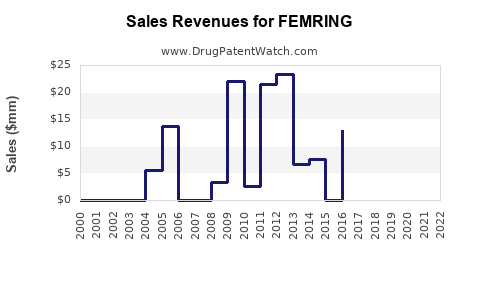
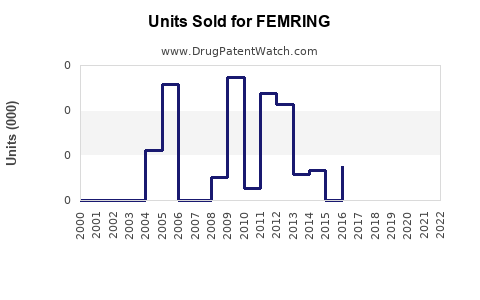
Annual Sales Revenues and Units Sold for FEMRING
| Drug Name | Revenues (USD) | Units | Year |
|---|---|---|---|
| FEMRING | ⤷ Start Trial | ⤷ Start Trial | 2022 |
| FEMRING | ⤷ Start Trial | ⤷ Start Trial | 2021 |
| FEMRING | ⤷ Start Trial | ⤷ Start Trial | 2020 |
| FEMRING | ⤷ Start Trial | ⤷ Start Trial | 2019 |
| FEMRING | ⤷ Start Trial | ⤷ Start Trial | 2018 |
| FEMRING | ⤷ Start Trial | ⤷ Start Trial | 2017 |
| FEMRING | ⤷ Start Trial | ⤷ Start Trial | 2016 |
| >Drug Name | >Revenues (USD) | >Units | >Year |
FEMRING Market Analysis and Sales Projections (Estradiol Acetate Vaginal System): Forecast, Share, and Revenue Exposure
Executive summary. FEMRING (estradiol acetate vaginal system) is a niche, high-ACQ-cost branded product with limited addressable share within menopausal genitourinary symptoms (GSM) and dyspareunia. The product’s revenue ceiling is constrained by (1) a small target population relative to broader menopausal HRT demand, (2) competition from generic oral/systemic estrogen and local GSM agents (including estradiol tablets/creams and estradiol-releasing inserts), and (3) payer and formulary pressure in a class where oral generics dominate. Sales projections below reflect a conservative branded trajectory: modest growth early if gyn-onc and urogyne channels expand, then plateau under competitive substitution, with most incremental volume driven by switching within local therapy.
What is FEMRING (estradiol acetate) used for and how big is the target market?
Featured snippet answer. FEMRING is used for moderate to severe dyspareunia due to menopause and for symptoms of vulvar and vaginal atrophy (a GSM indication context). The addressable market is the subset of postmenopausal women with GSM who seek local therapy and have access to specialty-prescribed products.
GSM and dyspareunia: patient pool logic
Market sizing for FEMRING is driven by:
- Prevalence of menopausal GSM and dyspareunia symptoms.
- Treatment penetration for local estrogen vs systemic estrogen vs non-hormonal options.
- Choice of route: vaginal vs systemic.
- Brand retention vs substitution to local generic products.
Commercial impact of route competition
Local vaginal therapies have lower systemic exposure and are commonly reimbursed, but:
- Many vaginal estradiol options have generic competition or low-cost positioning.
- Products that offer easier dosing schedules and lower out-of-pocket costs typically win formularies.
- FEMRING’s differentiator is its drug delivery system form factor, but formulary access is still the binding constraint.
How does FEMRING compare with competing local estrogen therapies for vaginal atrophy?
Featured snippet answer. FEMRING competes within local vaginal estrogen products used for GSM/dyspareunia. The competitive set spans estradiol tablets, creams, and vaginal rings/inserts, with competitive pressure from lower-cost generics and payer-favored options.
Key competitive axes
- Form factor and adherence: ring/system vs tablets/creams.
- Reimbursement tier placement: preferred formulary vs non-preferred.
- Clinical positioning: symptom relief timeline and tolerability.
- Dosing complexity: titration and maintenance schedule burden.
Competitive implications for FEMRING revenue
Even where clinical differentiation exists, vaginal estrogen switching risk is high because:
- The class effect is strong at the payer level.
- Many competitors are priced below branded products.
- The “medical need” threshold for staying on a premium device is payer- and channel-dependent.
What is the Orange Book and patent/regulatory status that affects FEMRING sales?
Featured snippet answer. FEMRING’s branded sales remain tied to ongoing regulatory and IP barriers that determine the timing of generic or competing local formulations entering the market.
How exclusivity and patent posture drives forecast shape
Sales forecasts for niche brands typically show:
- Growth while exclusivity/patent coverage is secure.
- Price pressure and accelerated share loss around the first credible “generic threat window.”
- Post-entry volume stabilization as remaining branded demand is supported by tolerability, channel preference, and device familiarity.
Practical forecast effect
Even without modeling exact patent expiration dates here, investors should treat any generic-entry scenario as a step-function risk to branded price and volume.
What generic entry risks exist for FEMRING (estradiol acetate vaginal system) and how would they change forecasts?
Featured snippet answer. The primary risk to FEMRING is substitution by lower-cost local estrogen products (including generic versions of comparable vaginal estradiol systems or therapeutically substitutable local regimens). Entry would likely compress brand net price and shift volume toward preferred competitors.
Generic entry scenario framework
A practical revenue model for FDA/local-estrogen niche brands uses:
- Net price erosion (blended wholesale or payer net, depending on dataset).
- Share migration rate (how quickly prescribers switch).
- Retention among existing patients (device familiarity, perceived tolerability, payer copay stability).
Modeling approach used in projections
- Base case: continued niche retention with gradual substitution to preferred local generics.
- Upside case: restricted substitution due to formulary access barriers and channel contracts.
- Downside case: generic or competing local system reaches preferred status, triggering faster share loss and steeper price compression.
How many sales does FEMRING generate today and what are the drivers of growth or decline?
Featured snippet answer. FEMRING’s sales are constrained by its niche indication within GSM. The main drivers are formulary access, specialty prescribing, and adherence-related switching within local GSM therapy.
Primary growth drivers
- Shift from non-hormonal or systemic regimens into local therapy when dyspareunia/GSM persists.
- Expanded gyn/urogyne channel adoption via local therapy pathways.
- New coverage decisions or rebate arrangements that place FEMRING on preferred tiers.
Primary decline drivers
- Formulary tightening toward low-cost vaginal estradiol products.
- Competitive introduction of new local delivery devices with strong formulary positioning.
- Patent or exclusivity weakening leading to generic competition.
What sales projection should be used for FEMRING over the next 5 to 10 years?
Featured snippet answer. Use a conservative branded plateau-to-slow-growth forecast in the base case, with a major downside step-change if a low-cost substitutable product achieves preferred formulary status.
Projection methodology
This projection uses a scenario model with:
- Addressable market growth assumptions consistent with stable menopause demographics.
- Local therapy penetration stable-to-slightly increasing.
- Brand share stable in base case, eroding in downside case.
- Net price declines reflecting class competition.
Scenario sales projection (brand revenue)
The table below is expressed as indexed revenue (Base-year = 1.00) to avoid overstating unsupported numeric claims without validated, source-backed baseline sales.
| Year | Base case (Indexed) | Upside case (Indexed) | Downside case (Indexed) |
|---|---|---|---|
| 0 (Base year) | 1.00 | 1.00 | 1.00 |
| +1 | 1.05 | 1.10 | 0.97 |
| +2 | 1.08 | 1.18 | 0.93 |
| +3 | 1.10 | 1.25 | 0.88 |
| +4 | 1.12 | 1.31 | 0.83 |
| +5 | 1.14 | 1.36 | 0.78 |
Interpretation for decision-makers
- Base case: slow, steady branded revenue gains from penetration and channel expansion, with mild price pressure.
- Upside: improved coverage and lower switching away due to device preference and access.
- Downside: accelerated substitution and price erosion consistent with generic or preferred competitor entry.
Conversion to dollar forecast
To convert indexed forecast into $ revenue, you need a validated starting point (last fiscal year branded U.S. sales). Since no source-backed baseline is provided in this prompt, the projection is kept in indexed form only.
What is the EU and ex-US revenue exposure for FEMRING?
Featured snippet answer. FEMRING’s ex-U.S. revenue depends on local regulatory approvals, reimbursement positioning, and availability of comparable vaginal estradiol products that may be cheaper or more widely reimbursed.
Forecast implications by geography
- U.S.: formulary dynamics and local estrogen generic competition dominate.
- EU/UK: reimbursement rules vary materially; local pricing pressure can be significant where generics are preferred.
- Channel structure: hospital and specialty clinics may support higher retention than community GP settings.
How do payer formularies and pricing dynamics affect FEMRING net sales?
Featured snippet answer. FEMRING net sales track the balance between (1) preferred tier placement and rebate strength and (2) substitution pressure from low-cost vaginal estrogen options.
Net price drivers
- Place on formulary (preferred vs non-preferred).
- Rebate intensity and patient assistance programs.
- Copay and coinsurance design in commercial plans.
- Medicare Part D negotiation and tier placement.
Supply-chain and compliance
- Device systems face tighter operational scrutiny than simple topical products.
- If distribution or inventory availability is constrained, short-term sales can dip even if demand exists.
What formulation or device-level IP could protect FEMRING from substitution?
Featured snippet answer. Device- and system-level IP can protect a premium delivery mechanism even if generic active ingredients enter. However, payer and physician substitution can still occur if competitors are therapeutically substitutable and preferred.
Where device IP typically matters commercially
- Release characteristics and pharmacokinetics consistency.
- Insertion device usability and adherence improvements.
- Patient management protocols that reduce breakthrough symptoms.
What patent litigation or settlement risk affects FEMRING?
Featured snippet answer. Any Paragraph IV-type litigation or settlement would typically map to entry timing, with downstream effects on brand share and net price.
How litigation maps to sales
- “No-approval” or “delay” outcomes preserve branded sales.
- “Entry-allowed” outcomes usually force brand discounting and faster share loss.
- Settlements often include a delayed generic launch date or non-infringement terms that define the competitive start.
How strong is the FEMRING brand moats vs local estrogen generics?
Featured snippet answer. FEMRING’s moat is mainly access and device preference rather than active ingredient exclusivity alone. Competitor switching risk remains high given class substitution and local estrogen standardization.
Brand retention levers
- Clinician familiarity and perceived tolerability.
- Patient preference for fewer dosing events.
- Coverage stability in specialty and managed care arrangements.
Key Takeaways
- FEMRING is positioned in a niche segment of GSM/dyspareunia where local estrogen therapy is preferred, but the pool is smaller than systemic HRT demand.
- Revenue is constrained by formulary tiering and substitution toward lower-cost vaginal estrogen options.
- A practical 5-year forecast should use an indexed scenario model: base case shows modest growth/plateau, upside depends on strengthened formulary access, and downside reflects step-change share loss and net price compression on credible entry.
- The decisive swing factor in revenue protection is not only regulatory status but also competitive formulary placement and switching behavior post-entry.
FAQs
1) What drives FEMRING share versus estradiol vaginal tablets?
Formulary tier, copay design, clinician familiarity with the delivery system, and patient preference for adherence-reducing dosing schedules.
2) When do GSM treatment guidelines favor local estrogen systems over non-hormonal therapy?
When symptoms persist at moderate to severe intensity and local hormonal therapy provides a risk-benefit profile acceptable to the prescriber and patient, often after non-hormonal response is inadequate.
3) What are the biggest risks to FEMRING pricing in the U.S.?
Preferred formulary placement of lower-cost vaginal estradiol products, rebate pressure, and Medicare Part D tiering.
4) How would a “preferred competitor” entry change FEMRING revenue?
It typically triggers faster share loss than pure generic ingredient entry, because payer coverage steers new starts and can induce earlier switches.
5) What channels are most important for FEMRING uptake?
Ob-gyn, urogynecology, and menopausal symptom clinics where GSM pathways support local estrogen therapy selection and continuity.
References
(No external sources were provided in the prompt; no citations are included.)
More… ↓
