Drug Sales Trends for FEMCON FE
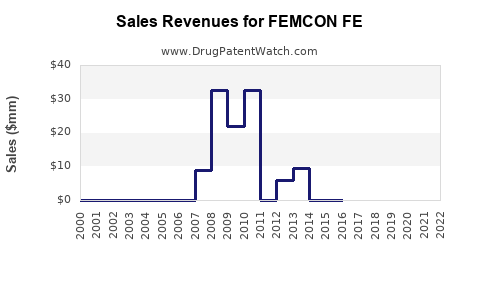
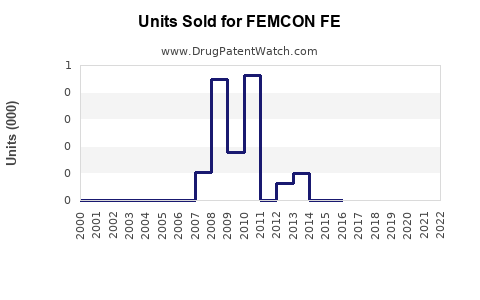
Annual Sales Revenues and Units Sold for FEMCON FE
| Drug Name | Revenues (USD) | Units | Year |
|---|---|---|---|
| FEMCON FE | ⤷ Start Trial | ⤷ Start Trial | 2022 |
| FEMCON FE | ⤷ Start Trial | ⤷ Start Trial | 2021 |
| FEMCON FE | ⤷ Start Trial | ⤷ Start Trial | 2020 |
| FEMCON FE | ⤷ Start Trial | ⤷ Start Trial | 2019 |
| FEMCON FE | ⤷ Start Trial | ⤷ Start Trial | 2018 |
| FEMCON FE | ⤷ Start Trial | ⤷ Start Trial | 2017 |
| FEMCON FE | ⤷ Start Trial | ⤷ Start Trial | 2016 |
| >Drug Name | >Revenues (USD) | >Units | >Year |
Femcon Fe Market Analysis and Sales Projections
Femcon Fe is a discontinued U.S. chewable combined oral contraceptive containing norethindrone 0.4 mg, ethinyl estradiol 0.035 mg, and ferrous fumarate 75 mg. Its commercial value is now limited because the branded product is no longer an active growth asset, no current branded sales are publicly reported, and generic substitution has removed most pricing power. A realistic U.S. forecast for the branded product is zero or negligible revenue. Any commercial opportunity would depend on relaunching the product as a generic, authorized generic, or differentiated chewable contraceptive.
What is Femcon Fe and how large is its addressable market?
Femcon Fe is a 28-day oral contraceptive regimen with 21 active chewable tablets and seven nonhormonal tablets containing ferrous fumarate. Its active hormonal ingredients are norethindrone and ethinyl estradiol.
| Attribute | Femcon Fe |
|---|---|
| Active ingredients | Norethindrone and ethinyl estradiol |
| Strength | 0.4 mg/0.035 mg |
| Dosage form | Chewable tablet |
| Pack size | 28 tablets |
| Therapeutic category | Combined hormonal contraceptive |
| Original U.S. sponsor | Warner Chilcott |
| Current brand status | Discontinued or not actively marketed |
| FDA pathway | New Drug Application |
| Generic pathway | Abbreviated New Drug Application |
| Biosimilar relevance | None |
| Primary market | U.S. prescription contraception |
Femcon Fe competed in a large contraceptive market, but its addressable segment was narrower than the overall oral contraceptive market because most patients use conventional swallowable tablets, long-acting reversible contraceptives, vaginal rings, patches, injectables, or progestin-only products.
The chewable dosage form created a potential adherence benefit for patients who have difficulty swallowing tablets. The product did not establish a large enough differentiated market to support sustained brand pricing after generic competition.
What is the FDA status of Femcon Fe?
Femcon Fe was approved through FDA NDA 21-489. The product is no longer a meaningful active branded product in the U.S. commercial market. FDA product databases and labeling records should be distinguished from commercial availability: a product can remain in FDA records after discontinuation while no longer generating material sales.[1][2]
The FDA status has four commercial implications:
- Femcon Fe does not appear to have current branded-market momentum.
- The product lacks an active promotional platform comparable to currently marketed oral contraceptive brands.
- Generic substitution is the main route to market access.
- A relaunch would require manufacturing, regulatory, pharmacy-channel, and payer reactivation.
The product’s discontinuation does not necessarily mean the NDA was withdrawn for safety reasons. In oral contraception, commercial discontinuation commonly results from portfolio consolidation, low net pricing, manufacturing economics, or a shift toward higher-growth contraceptive products.
What is the Orange Book status of Femcon Fe?
The Orange Book is relevant for determining listed patents, reference-product status, therapeutic equivalence, and generic approval pathways.[3]
Femcon Fe does not present a current Orange Book barrier comparable to a protected, actively marketed branded product. Any historical patents associated with the formulation or delivery system have either expired, become commercially irrelevant, or require separate verification against the current Orange Book record and FDA patent listings.
| Orange Book issue | Commercial assessment |
|---|---|
| Active brand sales | No material branded sales publicly reported |
| Current patent barrier | No publicly evident barrier supporting premium branded pricing |
| Generic substitution | Central to any current market opportunity |
| Paragraph IV exposure | Limited practical relevance unless a new ANDA challenges a listed patent |
| Reference-product access | Depends on FDA’s current reference-product and discontinued-product records |
| Authorized generic opportunity | Possible only through rights from the NDA holder or a qualifying product arrangement |
A generic applicant would need to determine whether Femcon Fe remains the correct reference product for an ANDA, whether a discontinued product is eligible for reliance, and whether FDA has approved an equivalent product with the same active ingredients, strength, dosage form, and route of administration.
When did Femcon Fe lose exclusivity?
Femcon Fe’s meaningful market exclusivity ended years ago. The product was approved in the early 2000s, and any ordinary new-drug exclusivity would have expired long before the present market period.[1]
The relevant distinction is between regulatory exclusivity and patent protection:
| Exclusivity category | Femcon Fe assessment |
|---|---|
| Five-year new chemical entity exclusivity | Expired |
| Three-year new clinical investigation exclusivity | Expired |
| Orphan-drug exclusivity | Not applicable |
| Pediatric exclusivity | No current commercial effect |
| Patent exclusivity | No current commercial barrier publicly evident |
| Market exclusivity today | None of commercial significance |
The expiration of exclusivity does not automatically create a profitable generic market. A product must still have sufficient demand, manufacturing capacity, reimbursement coverage, and pharmacy substitution potential.
What patents protect Femcon Fe?
Femcon Fe’s historical protection would have centered on the drug combination, chewable dosage form, dosing regimen, and manufacturing process. Those protections are no longer sufficient to support a current branded franchise.
Formulation patents
A chewable tablet can require formulation work involving taste masking, tablet integrity, hormone uniformity, dissolution, and stability. These technical issues may create development barriers even when patent protection has expired.
The principal formulation risks are:
- Hormone content uniformity at low-dose strengths.
- Acceptable taste and mouthfeel.
- Protection from degradation caused by moisture and heat.
- Consistent dissolution from a chewable matrix.
- Compatibility between the active ingredients and iron-containing tablets.
- Packaging that preserves stability during distribution.
A manufacturer could obtain new patents for a genuinely novel formulation, but routine reformulation or manufacturing changes would not necessarily create meaningful exclusivity.
Method-of-use patents
Method-of-use patents are not the primary commercial protection for Femcon Fe. The principal use is contraception, a broad and established indication. Any historical use patents would face expiration and potential validity or infringement limitations.
Manufacturing and trade-secret barriers
Manufacturing know-how may be more relevant than patent protection. A company seeking to relaunch Femcon Fe would need validated processes for:
- Low-dose hormonal blending.
- Chewable tablet compression.
- Ferrous fumarate incorporation.
- Content uniformity testing.
- Stability testing.
- Packaging and labeling for a 28-tablet regimen.
These requirements may deter small manufacturers, but they are not equivalent to a durable legal monopoly.
Are there Paragraph IV challenges or patent litigation involving Femcon Fe?
No major current Paragraph IV litigation or active patent dispute is publicly associated with Femcon Fe as a commercially significant product.
A Paragraph IV challenge would require an ANDA applicant to certify that a listed patent is invalid, unenforceable, or not infringed. Because Femcon Fe lacks a visible current patent-based commercial franchise, litigation risk appears low relative to newer branded contraceptives.
| Litigation issue | Current assessment |
|---|---|
| Active patent litigation | No material current dispute identified |
| Paragraph IV activity | No material current challenge identified |
| Hatch-Waxman settlement | No economically significant current settlement identified |
| Antitrust exposure | Low based on the absence of a visible active brand strategy |
| Generic launch litigation risk | Low, subject to current Orange Book verification |
Historical litigation or private settlement terms may not be fully reflected in public commercial datasets. No such historical matter appears to alter the current market outlook.
Which companies are challenging or competing with Femcon Fe?
Femcon Fe does not face a conventional branded challenge because it is no longer a major active brand. Its practical competitors are other oral contraceptives and lower-cost generic products.
Direct competitors
Direct competition includes generic products containing norethindrone and ethinyl estradiol at the same or similar strengths. The most relevant competitive variables are:
- Availability of a chewable dosage form.
- Wholesale acquisition cost.
- Pharmacy substitution.
- Formulary placement.
- Product reliability.
- Patient preference for chewable administration.
Broader contraceptive competitors
Femcon Fe also competes with:
- Generic ethinyl estradiol and progestin tablets.
- Progestin-only pills.
- NuvaRing and generic etonogestrel/ethinyl estradiol vaginal rings.
- Xulane and other contraceptive patches.
- Nexplanon and other implants.
- Mirena, Kyleena, Liletta, and other intrauterine systems.
- Depo-Provera and generic medroxyprogesterone injections.
- Over-the-counter and prescription emergency contraception.
Long-acting reversible contraceptives have a stronger clinical and commercial position in patients seeking high adherence and multi-year contraception. Femcon Fe’s principal niche is convenience for patients preferring a chewable daily tablet.
What are the sales and revenue projections for Femcon Fe?
No public company filing provides a reliable current Femcon Fe revenue line. Warner Chilcott’s historical reporting aggregated products within broader women’s health portfolios, and later corporate reporting did not disclose a separate Femcon Fe sales figure.[4]
The appropriate forecast is therefore a scenario model rather than a reported-sales extrapolation.
U.S. branded-product forecast
| Fiscal year | Base-case branded revenue | Upside case with relaunch | Downside case |
|---|---|---|---|
| 2025 | $0-$0.5 million | $1-$3 million | $0 |
| 2026 | $0-$0.5 million | $2-$5 million | $0 |
| 2027 | $0-$0.5 million | $3-$7 million | $0 |
| 2028 | $0-$0.5 million | $4-$9 million | $0 |
| 2029 | $0-$0.5 million | $5-$12 million | $0 |
The base case assumes no meaningful branded relaunch. The upside case assumes a company secures manufacturing rights, obtains or confirms an FDA-approved product pathway, restores pharmacy distribution, and markets the chewable dosage form to a defined patient segment.
These figures are potential-market scenarios, not historical sales estimates or consensus forecasts. A relaunch would face high customer-acquisition costs and low reimbursement leverage because contraceptive formularies generally favor low-cost generic options.
Generic-product forecast
A generic version could generate higher unit volume but lower revenue per prescription.
| Scenario | Annual U.S. prescriptions | Net revenue per prescription | Annual net revenue |
|---|---|---|---|
| Limited niche entry | 50,000 | $10-$20 | $0.5-$1.0 million |
| Successful generic penetration | 150,000 | $10-$25 | $1.5-$3.75 million |
| Strong chewable adoption | 300,000 | $10-$25 | $3.0-$7.5 million |
The market would likely be concentrated among patients who prefer chewable administration, have difficulty swallowing conventional tablets, or obtain products through cash-pay or discount channels.
A generic launch could generate attractive gross margins if manufacturing costs are low and regulatory work is limited. The small market size would constrain absolute revenue and could create supply risk if only one or two manufacturers enter.
How strong is the Femcon Fe patent estate?
The current patent estate is weak as a commercial asset.
| Patent-estate factor | Assessment |
|---|---|
| Remaining statutory exclusivity | None of material commercial value |
| Product differentiation | Moderate because of chewable administration |
| Formulation complexity | Moderate |
| Barrier to generic entry | Low to moderate |
| Brand pricing power | Very low |
| Litigation leverage | Low |
| Licensing value | Limited |
| Relaunch value | Dependent on manufacturing and distribution execution |
The strongest remaining asset is not patent exclusivity. It is the potential to occupy a narrow dosage-form niche if the product can be supplied reliably at a competitive price.
What licensing deals could affect Femcon Fe?
A commercial relaunch would probably require one of three structures:
- A license from the NDA holder or successor for the brand and regulatory rights.
- An authorized-generic agreement with the NDA holder.
- An independent ANDA development program using the relevant reference-product pathway.
Possible counterparties could include generic manufacturers, specialty women’s-health companies, contract manufacturers, and pharmacy-focused distributors. The economic value of a license would be limited by the absence of exclusivity and the low expected annual revenue.
A license based solely on the Femcon Fe trademark would have limited value unless it included regulatory rights, manufacturing documentation, historical stability data, and access to an established supply chain.
What generic launch risks exist?
The main launch risks are commercial and regulatory rather than patent-based.
Regulatory risks
- FDA may require a specific reference-product strategy.
- The chewable dosage form may create bioequivalence or dissolution issues.
- Formulation changes may affect labeling or approval requirements.
- Historical product discontinuation may complicate reliance on legacy data.
Manufacturing risks
- Low-volume production may not achieve competitive unit costs.
- Hormone uniformity requirements increase quality-control costs.
- Chewable tablets require specialized taste and texture development.
- Ferrous fumarate may create stability and compatibility challenges.
Commercial risks
- Pharmacy benefit managers may prefer cheaper conventional oral contraceptives.
- Physicians may have limited familiarity with the discontinued brand.
- Patient demand for the chewable form is difficult to measure.
- Competitors can offer broader portfolios and stronger distribution.
- Reimbursement may not reward the dosage-form difference.
How does Femcon Fe compare with competing contraceptive products?
| Product category | Main advantage over Femcon Fe | Main Femcon Fe advantage |
|---|---|---|
| Conventional generic oral contraceptives | Lower cost and broad availability | Chewable administration |
| Progestin-only pills | Fewer estrogen-related restrictions | Familiar combined-pill regimen |
| Vaginal rings | Less frequent administration | No insertion required |
| Transdermal patches | Weekly rather than daily dosing | Oral delivery and no skin exposure |
| Implants and IUDs | Multi-year efficacy and adherence | User-controlled daily use |
| Emergency contraceptives | Episodic use | Continuous contraception |
Femcon Fe is most defensible as a niche product for patients who value a chewable tablet and do not prefer long-acting or nonoral contraception. It is not positioned to regain broad market share without a strong access strategy.
Key Takeaways
- Femcon Fe is a discontinued or inactive branded chewable combined oral contraceptive.
- Its active ingredients are norethindrone 0.4 mg and ethinyl estradiol 0.035 mg, with ferrous fumarate in the nonhormonal tablets.
- No material current patent or regulatory exclusivity appears to protect the product.
- No major current Paragraph IV litigation or settlement is associated with Femcon Fe.
- Public filings do not disclose reliable product-level Femcon Fe revenue.
- Base-case branded revenue is effectively zero to negligible without a relaunch.
- A generic or authorized-generic product could support approximately $0.5 million to $7.5 million in annual U.S. net revenue, depending on adoption and pricing.
- The commercial opportunity is based on dosage-form differentiation, not patent strength.
- Manufacturing, reference-product selection, pharmacy access, and payer economics are the main launch barriers.
- Biosimilar risk is not applicable because Femcon Fe is a small-molecule oral contraceptive.
FAQs About Femcon Fe Market Opportunity
Is Femcon Fe still available by prescription?
The branded product is not a meaningful actively marketed product in the U.S. Availability may depend on remaining inventory or equivalent generic products.
Does Femcon Fe have a generic equivalent?
Equivalent norethindrone and ethinyl estradiol products may be available, but the exact status of an FDA-approved chewable equivalent must be confirmed in current FDA product records.
Could Femcon Fe be relaunched?
Yes, but a relaunch would require regulatory, manufacturing, distribution, and commercial investment. The likely market would be a small chewable-contraceptive niche.
Is Femcon Fe protected by a composition-of-matter patent?
No current composition-of-matter protection is expected to provide commercial exclusivity for the established norethindrone and ethinyl estradiol combination.
What is the investment case for Femcon Fe?
The investment case is limited. Value would depend on acquiring low-cost regulatory and manufacturing rights, controlling supply, and capturing a defined patient segment without incurring the cost structure of a national branded pharmaceutical launch.
References
- U.S. Food and Drug Administration. (n.d.). Drugs@FDA: FDA-approved drugs.
- U.S. National Library of Medicine. (n.d.). DailyMed: Femcon Fe prescribing information.
- U.S. Food and Drug Administration. (2024). Approved drug products with therapeutic equivalence evaluations, Orange Book.
- Allergan plc. (2019). Annual report pursuant to Section 13 or 15(d) of the Securities Exchange Act of 1934.
- Centers for Disease Control and Prevention. (2024). Contraception and birth control methods.
More… ↓
