Share This Page
Drug Sales Trends for ERYTHROCIN
✉ Email this page to a colleague
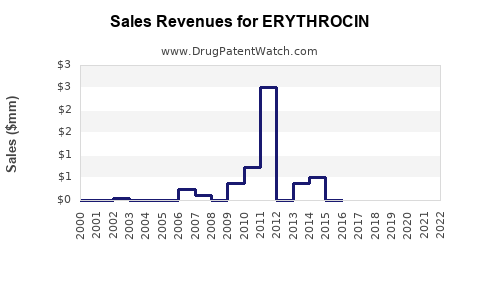
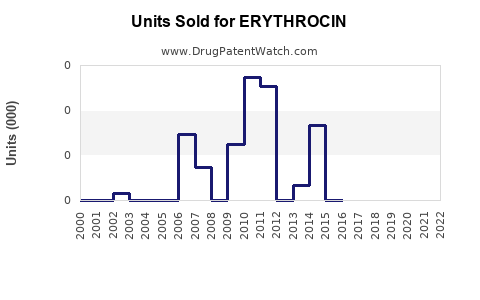
Annual Sales Revenues and Units Sold for ERYTHROCIN
| Drug Name | Revenues (USD) | Units | Year |
|---|---|---|---|
| ERYTHROCIN | ⤷ Start Trial | ⤷ Start Trial | 2022 |
| ERYTHROCIN | ⤷ Start Trial | ⤷ Start Trial | 2021 |
| ERYTHROCIN | ⤷ Start Trial | ⤷ Start Trial | 2020 |
| >Drug Name | >Revenues (USD) | >Units | >Year |

Market Analysis and Sales Projections for Erythromycin (ERYTHROCIN)
What is the Current Market Status for Erythromycin?
Erythromycin is a macrolide antibiotic used to treat bacterial infections such as respiratory tract infections, skin infections, and sexually transmitted diseases. It was first introduced in the 1950s and remains a core antibiotic in many treatment protocols. The global erythromycin market has experienced moderate growth driven by demand in both developed and emerging markets.
Market size (2022): Approximately $250 million USD, with a compound annual growth rate (CAGR) of around 2-3% projected through 2030 [1].
Key markets:
- North America: 40%
- Europe: 25%
- Asia Pacific: 20%
- Latin America and Middle East: 10-15%
Patent status: Erythromycin is off-patent, leading to increased generic competition, which has suppressed prices. Major manufacturers include Pfizer, GlaxoSmithKline, and Teva Pharmaceuticals.
Pricing: The average wholesale price for erythromycin capsules in the U.S. ranges from $0.20 to $0.50 per capsule, with generics dominating the supply.
What Are the Drivers of Market Demand?
- Antimicrobial Resistance (AMR): Rising resistance to first-line antibiotics prompts use of erythromycin as an alternative, especially in cases of penicillin allergy.
- Prevalence of infections: High in regions with limited access to advanced healthcare; respiratory infections account for a significant portion.
- Off-label use: Erythromycin is used for gastrointestinal motility disorders and as a component in Helicobacter pylori eradication therapies.
- Regulatory approvals: Some markets have restricted erythromycin use due to resistance concerns, but it remains a standard in others.
What Challenges Exist for Erythromycin Sales?
- Resistance Development: Increased bacterial resistance reduces efficacy, leading to decreased prescribing.
- Market competition: Rise of newer antibiotics with superior efficacy, safety profiles, and dosing convenience.
- Generic saturation: Price pressure from multiple manufacturers cuts margins.
- Safety concerns: Potential for gastrointestinal side effects and drug interactions limits use in some populations.
What Are the Future Sales Projections?
Forecast period: 2023–2030
| Global Sales Projections: | Year | Estimated Market Size (USD millions) | Growth Rate (%) | Notes |
|---|---|---|---|---|
| 2023 | 255 | 2% | Slight market growth continues | |
| 2025 | 275 | 2.5% | Steady demand in developing regions | |
| 2030 | 300 | 2.2% | Slow growth due to resistance and competition |
Asia Pacific: Expected to outperform other regions, with a CAGR of approximately 3%, driven by increasing infections, improving healthcare infrastructure, and expanding antibiotic access [2].
North America and Europe: Market growth stabilizes near 1-2%, impacted by prescribing restrictions and resistance concerns.
What Factors Will Influence Future Growth?
- Development of resistance: As resistance patterns evolve, erythromycin's market share may decline unless new formulations or indications are developed.
- New formulations: Liposomal or controlled-release formulations could improve compliance and efficacy, boosting sales.
- Combination therapies: Use of erythromycin as part of multi-drug regimens, particularly for H. pylori, may sustain demand.
- Regulatory changes: Approval for indications such as gastrointestinal motility disorders could open new markets.
What Is the Competitive Landscape?
| Manufacturer | Market Share | Key Products | Focus Areas |
|---|---|---|---|
| Pfizer | 30% | Erythromycin base, stearate | Infection treatment, GI indications |
| GSK | 20% | Erythromycin derivatives | Respiratory, skin infections |
| Teva | 15% | Generic erythromycin | Broad antibiotic access |
Other players hold smaller shares. Price competition and patent expirations favor generics, limiting margins for branded versions.
What Are Regulatory Outlooks?
- In the U.S., erythromycin has faced regulatory restrictions due to resistance and safety concerns but remains available with guidance.
- Europe maintains similar position but with some restrictions in specific countries.
- Development of new formulations or indications may require additional clinical trials and regulatory filings.
Summary
Erythromycin's market is mature, with steady but slow growth projected over the next decade. Resistance development, generic competition, and safety concerns present challenges. Opportunities exist in niche indications, new formulations, and expanding markets in Asia Pacific.
Key Takeaways
- The global erythromycin market was approximately $250 million in 2022.
- Growth remains modest at 2-3% annually, primarily driven by developing regions.
- Resistance and competition from newer antibiotics are the main constraints.
- Development of new formulations and expanded indications could sustain future sales.
- The Asia Pacific region is poised for the highest growth due to healthcare infrastructure improvements.
FAQs
1. Will erythromycin regain market share with new formulations?
Potentially, if formulations improve efficacy and compliance, especially in resistant bacterial infections.
2. How does resistance impact erythromycin sales?
Rising resistance reduces prescribing, leading to decreased sales unless new indications or formulations are developed.
3. Are regulatory restrictions likely to change?
Current restrictions focus on resistance concerns; unless new data emerge supporting safety and efficacy, regulation is unlikely to relax substantially.
4. Which regions will drive future growth?
Asia Pacific will see higher growth rates due to increasing access and incidence of bacterial infections.
5. What are prospects for erythromycin in H. pylori eradication?
Continued utility exists; however, rising resistance demands combination therapy optimization. Future sales depend on clinical outcomes and guideline acceptance.
References
[1] MarketWatch. (2022). Global erythromycin market size and forecast.
[2] Research and Markets. (2023). Asia Pacific antibiotic market trends.
More… ↓
