Drug Sales Trends for EPIDUO FORTE
Payment Methods and Pharmacy Types for EPIDUO FORTE (2022)
Revenues by Pharmacy Type
Units Sold by Pharmacy Type
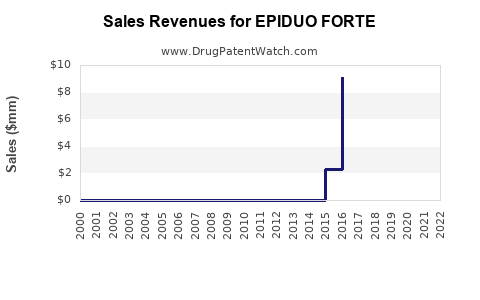
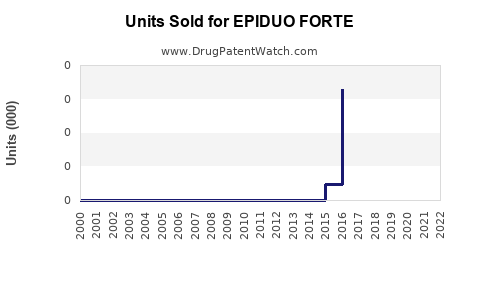
Annual Sales Revenues and Units Sold for EPIDUO FORTE
| Drug Name | Revenues (USD) | Units | Year |
|---|---|---|---|
| EPIDUO FORTE | ⤷ Start Trial | ⤷ Start Trial | 2022 |
| EPIDUO FORTE | ⤷ Start Trial | ⤷ Start Trial | 2021 |
| EPIDUO FORTE | ⤷ Start Trial | ⤷ Start Trial | 2020 |
| EPIDUO FORTE | ⤷ Start Trial | ⤷ Start Trial | 2019 |
| EPIDUO FORTE | ⤷ Start Trial | ⤷ Start Trial | 2018 |
| EPIDUO FORTE | ⤷ Start Trial | ⤷ Start Trial | 2017 |
| >Drug Name | >Revenues (USD) | >Units | >Year |
Epiduo Forte Market Analysis, Sales Projections, Patent Position, and Generic Entry Risk
Epiduo Forte is a prescription topical acne treatment containing adapalene 0.3% and benzoyl peroxide 2.5%. Galderma markets the product in the United States for acne vulgaris in patients aged 12 years and older. Its commercial position depends on premium pricing, dermatologist prescribing, pharmacy access, and differentiation from generic adapalene/benzoyl peroxide products.
Standalone Epiduo Forte revenue is not publicly reported by Galderma. Based on estimated U.S. prescription volume, branded net pricing, and erosion from generic alternatives, a reasonable base-case forecast is approximately $70 million to $90 million in U.S. net sales in 2025, declining toward $45 million to $65 million by 2029 unless Galderma expands payer access or gains meaningful share in higher-severity acne treatment.
What is Epiduo Forte and how does it compare with Epiduo?
Epiduo Forte combines two established topical acne mechanisms:
- Adapalene 0.3%, a topical retinoid.
- Benzoyl peroxide 2.5%, an antimicrobial and comedolytic agent.
The original Epiduo formulation contains adapalene 0.1% and benzoyl peroxide 2.5%. Epiduo Forte raises the adapalene concentration to 0.3%, targeting patients who need stronger retinoid treatment or have not achieved adequate control with lower-strength therapy.
| Product | Active ingredients | Main positioning | Manufacturer |
|---|---|---|---|
| Epiduo | Adapalene 0.1% / benzoyl peroxide 2.5% | First-line combination topical therapy | Galderma |
| Epiduo Forte | Adapalene 0.3% / benzoyl peroxide 2.5% | Higher-strength acne therapy | Galderma |
| Generic adapalene/benzoyl peroxide | Usually adapalene 0.1% / benzoyl peroxide 2.5% | Lower-cost substitution | Multiple generic companies |
| Tretinoin products | Tretinoin at several strengths | Retinoid-based acne treatment | Multiple companies |
| Winlevi | Clascoterone 1% | Topical androgen-receptor inhibitor | Cosmo Pharmaceuticals |
| Arazlo | Tazarotene 0.045% | Topical retinoid | Ortho Dermatologics |
The product’s clinical and commercial differentiation is based more on formulation, strength, tolerability, and physician familiarity than on a novel molecular entity. The active ingredients are mature generic compounds, which limits long-term pricing power.
What is the FDA regulatory status of Epiduo Forte?
The FDA approved Epiduo Forte gel for the topical treatment of acne vulgaris in patients 12 years and older. The product is a prescription drug and is supplied as a topical gel.
The FDA labeling identifies common adverse reactions associated with topical acne therapy, including erythema, scaling, dryness, burning, and stinging. Benzoyl peroxide can also cause skin irritation and bleaching of hair or fabrics. [1]
FDA milestones
| Event | Date |
|---|---|
| Original Epiduo approval | 2008 |
| Epiduo Forte approval | 2015 |
| Dosage form | Topical gel |
| Route | Topical |
| Approved indication | Acne vulgaris |
| Pediatric population | Patients aged 12 years and older |
| Regulatory pathway | Section 505(b)(2) or new drug application framework, depending on product filing history |
Epiduo Forte does not have biologic status. Biosimilar competition is therefore not relevant. Competitive risk comes from generic topical products, authorized generics, compounded products, and branded dermatology products.
How large is the Epiduo Forte market?
The addressable market is the U.S. prescription acne market, which includes topical retinoids, topical antibiotics, benzoyl peroxide combinations, oral antibiotics, hormonal therapies, isotretinoin, and newer agents such as clascoterone.
The U.S. acne market is large in patient terms but fragmented in revenue. Most patients receive low-cost generic therapy. Branded products retain value in patients with moderate disease, irritation concerns, treatment failure, or strong dermatologist preference.
Epiduo Forte’s principal market segments are:
- Adolescents with moderate inflammatory and comedonal acne.
- Adults with persistent acne who prefer prescription topical therapy.
- Patients who have failed lower-strength adapalene/benzoyl peroxide.
- Patients treated by dermatologists rather than primary-care physicians.
- Commercially insured patients with access to copay support.
The product competes against generic adapalene/benzoyl peroxide, generic tretinoin, tazarotene, dapsone, clascoterone, oral doxycycline, and isotretinoin for more severe disease.
What are the Epiduo Forte sales projections?
Because Galderma does not disclose product-level revenue, the following projection uses a modeled U.S. net-sales framework. The model assumes a mature branded topical product, stable diagnosis rates, moderate prescription volume, and gradual generic substitution.
Base-case U.S. net-sales projection
| Year | Estimated net sales | Estimated annual change | Primary driver |
|---|---|---|---|
| 2024 | $75 million-$95 million | Baseline | Established brand and dermatologist use |
| 2025 | $70 million-$90 million | -5% to -7% | Generic substitution and payer controls |
| 2026 | $64 million-$84 million | -6% to -8% | Price pressure and lower branded volume |
| 2027 | $58 million-$78 million | -6% to -8% | Greater generic penetration |
| 2028 | $51 million-$71 million | -7% to -9% | Mature product erosion |
| 2029 | $45 million-$65 million | -8% to -10% | Continued substitution and discounting |
These figures represent analyst estimates, not reported Galderma results. Gross-to-net deductions may be substantial because topical dermatology products commonly use copay cards, rebates, wholesaler discounts, and payer concessions.
Scenario analysis
| Scenario | 2025 sales | 2029 sales | Assumptions |
|---|---|---|---|
| Upside | $95 million-$115 million | $80 million-$100 million | Strong dermatologist retention, improved coverage, limited direct substitution |
| Base case | $70 million-$90 million | $45 million-$65 million | Gradual erosion and stable acne treatment demand |
| Downside | $50 million-$70 million | $25 million-$40 million | Broad generic substitution, formulary exclusion, lower copay support |
The downside case becomes more likely if a generic product obtains favorable payer placement, if pharmacies substitute aggressively, or if Galderma reduces promotional spending.
What patents protect Epiduo Forte?
Epiduo Forte relies primarily on formulation and combination-product protection rather than composition-of-matter protection for a new chemical entity. Adapalene and benzoyl peroxide are established active ingredients with extensive generic competition in other dosage forms and concentrations.
Potential protection categories include:
- The combination of adapalene and benzoyl peroxide.
- The 0.3% adapalene and 2.5% benzoyl peroxide concentration.
- Gel composition and excipient selection.
- Stability and homogeneity of the formulation.
- Manufacturing processes.
- Methods of treating acne with the combination.
- Packaging and delivery characteristics.
The FDA Orange Book is the controlling public source for patents listed against an approved drug product and for any associated pediatric exclusivity information. Patent listings can change through delisting, expiration, court decisions, or regulatory updates. [2]
How strong is the Epiduo Forte patent estate?
The patent estate is structurally weaker than the estate for a novel small molecule because:
- The active ingredients are old.
- The therapeutic indication is established.
- Generic manufacturers can seek approval through an abbreviated pathway.
- Formulation claims may be vulnerable to invalidity or non-infringement arguments.
- Design-around options may exist through different excipients, particle sizes, manufacturing conditions, or gel systems.
The strongest commercial protection would come from a formulation claim that is difficult to design around and supported by measurable product performance, such as stability, uniformity, skin delivery, or reduced irritation. Method-of-use patents are generally weaker commercial barriers when generic labels can omit the patented use.
When does Epiduo Forte lose exclusivity?
Epiduo Forte’s practical exclusivity depends on more than a single patent expiration date. Relevant milestones include:
- Expiration of listed U.S. patents.
- Expiration of any pediatric exclusivity extension.
- Approval of an abbreviated new drug application.
- Resolution of Paragraph IV litigation.
- Availability of a therapeutically substitutable generic.
- Payer and pharmacy adoption after generic launch.
For a mature topical combination product, commercial erosion can begin before complete legal patent expiry if a generic company launches after settlement, obtains a non-infringing approval, or enters with a limited label.
The timing of generic entry must be determined from current Orange Book listings, FDA approval records, court dockets, and any settlement agreements. A single public source does not establish the full commercial exclusivity position. [2, 3]
Are there Paragraph IV challenges to Epiduo Forte?
A Paragraph IV certification is a generic applicant’s assertion that a listed patent is invalid, unenforceable, or not infringed. A filing can trigger patent litigation under the Hatch-Waxman Act.
The commercial impact depends on:
- Number of generic applicants.
- Date of the first Paragraph IV notice.
- Whether the patent holder files suit within the statutory period.
- Availability of a 30-month stay.
- Court outcome.
- Settlement terms.
- Whether the generic can launch “at risk.”
Publicly available FDA resources do not provide a consolidated commercial summary of every potential Epiduo Forte Paragraph IV event. The FDA Orange Book identifies listed patents, while court records and FDA approval documents are required to assess challenges and launch timing. [2, 3]
What formulation patents protect Epiduo Forte?
Formulation patents are likely to focus on the gel vehicle, active-ingredient dispersion, product stability, and manufacturing controls. These claims matter because generic topical products must demonstrate pharmaceutical equivalence and bioequivalence under the applicable FDA standards.
Key technical barriers include:
- Maintaining uniform adapalene distribution.
- Preventing benzoyl peroxide degradation.
- Controlling particle size and suspension behavior.
- Reproducing viscosity and spreadability.
- Matching the product’s release and skin-delivery profile.
- Ensuring stability during shipping and storage.
Topical products can create greater development complexity than oral tablets because bioequivalence may involve comparative skin delivery, pharmacodynamic measurements, in vitro release testing, or other product-specific requirements. The FDA’s product-specific guidance and ANDA review standards influence the probability and cost of generic entry. [4]
Which companies are challenging Epiduo Forte?
Potential challengers include generic dermatology manufacturers with topical formulation capabilities and established pharmacy distribution. The relevant competitive groups are:
- Large generic manufacturers with topical production capacity.
- Specialty generic companies focused on dermatology.
- Contract development and manufacturing organizations.
- Branded dermatology companies using reformulation or authorized-generic strategies.
A definitive list of active challengers requires current FDA ANDA data, Paragraph IV notices, litigation records, and commercial launch announcements. Generic competition is more likely to emerge from companies already selling adapalene, benzoyl peroxide, tretinoin, or related topical products.
What is the Orange Book status of Epiduo Forte?
The Orange Book determines whether FDA-listed patents and exclusivity apply to the approved product. It also identifies therapeutic-equivalence ratings for approved generic products.
For Epiduo Forte, the key diligence points are:
- Whether the product has active listed patents.
- Whether any patent has an expiration date beyond the expected generic filing window.
- Whether pediatric exclusivity extends a listed period.
- Whether an ANDA has been approved with a “TE” rating.
- Whether a generic product is approved for the same strength and dosage form.
- Whether an authorized generic is commercially available.
The Orange Book should be reviewed by National Drug Code, active ingredient, strength, dosage form, and reference listed drug status. [2]
What patent litigation and settlement agreements affect Epiduo Forte?
Patent litigation can delay generic entry, but a settlement may establish a licensed entry date earlier than the final patent expiration. Typical settlement structures include:
- Entry on a fixed date.
- Entry after invalidation or expiration of a specified patent.
- Authorized-generic restrictions.
- No-challenge provisions, subject to antitrust limitations.
- Royalty-bearing licenses.
- Supply or distribution arrangements.
No settlement should be treated as commercially decisive without reviewing the full agreement, court order, FTC materials, and FDA approval status. The FTC has historically scrutinized pharmaceutical settlements that may delay generic competition. [5]
How does Epiduo Forte compare with competing acne drugs?
| Product | Competitive advantage | Main weakness |
|---|---|---|
| Epiduo Forte | Established combination; stronger adapalene concentration | Brand pricing and irritation risk |
| Generic adapalene/benzoyl peroxide | Low price and broad access | Usually lower adapalene strength |
| Tretinoin | Extensive physician familiarity | Irritation and multiple formulation differences |
| Tazarotene | Potent retinoid activity | Irritation, tolerability, and pregnancy restrictions |
| Winlevi | Non-retinoid mechanism | Higher branded cost and newer market position |
| Arazlo | Lower-irritation tazarotene positioning | Limited duration of commercial experience |
| Oral doxycycline | Useful for inflammatory acne | Systemic exposure and antimicrobial concerns |
| Isotretinoin | High efficacy for severe disease | Monitoring, safety, and pregnancy controls |
Epiduo Forte has the strongest position where physicians want combination topical treatment but do not want to escalate immediately to oral therapy. Its weakest position is among price-sensitive patients and formularies that treat generic adapalene/benzoyl peroxide as an adequate substitute.
What generic launch risks exist for Epiduo Forte?
The principal generic launch risks are:
- ANDA approval for the same strength and dosage form.
- Successful design-around of formulation claims.
- Paragraph IV litigation settlement.
- Payer exclusion of the branded product.
- Pharmacy-level substitution.
- Loss of copay support effectiveness.
- Authorized-generic launch by the brand owner.
- Lower-cost alternative products gaining dermatologist acceptance.
The highest-risk period begins when a therapeutically equivalent generic reaches major pharmacy channels. Topical brands can retain some volume after generic entry, but net pricing generally declines faster than prescription volume because rebates and discounts increase.
What is the revenue exposure for Galderma?
Epiduo Forte is unlikely to be one of Galderma’s largest global revenue contributors because it is a mature topical prescription product. Its strategic value is higher than its standalone revenue may indicate because it:
- Supports dermatologist relationships.
- Anchors a broader acne portfolio.
- Provides a recognized combination therapy.
- Generates repeat prescriptions.
- Can be used in patient conversion programs.
- Complements other Galderma prescription and consumer dermatology products.
A 30% decline in U.S. Epiduo Forte net sales would likely have limited impact on Galderma’s consolidated revenue but could materially affect the profitability of the specific product franchise.
Key Takeaways
- Epiduo Forte is a prescription combination gel containing adapalene 0.3% and benzoyl peroxide 2.5%.
- Galderma does not publicly disclose standalone Epiduo Forte sales.
- Estimated U.S. net sales are approximately $70 million to $90 million in 2025 under the base case.
- Base-case sales are projected to decline to $45 million to $65 million by 2029.
- Generic substitution is the primary commercial risk.
- Patent protection is likely centered on formulation, concentration, manufacturing, and method-of-use claims rather than new-molecule protection.
- Biosimilar competition does not apply because Epiduo Forte is not a biologic.
- Orange Book listings, Paragraph IV notices, ANDA approvals, and settlement agreements determine actual generic-entry timing.
- The product retains value through dermatologist familiarity, combination therapy, and use in patients who need stronger topical treatment.
FAQs
Is Epiduo Forte stronger than regular Epiduo?
Yes. Epiduo Forte contains adapalene 0.3%, compared with 0.1% in regular Epiduo. Both contain benzoyl peroxide 2.5%.
Is there a generic version of Epiduo Forte?
Generic availability depends on FDA approval for the same strength and dosage form. Generic adapalene/benzoyl peroxide products at lower adapalene strengths do not automatically substitute for Epiduo Forte.
Can Epiduo Forte be substituted at the pharmacy?
Substitution depends on the approved generic product, FDA therapeutic-equivalence rating, state law, prescriber instructions, and payer policy.
Does Epiduo Forte have biologic or biosimilar competition?
No. Epiduo Forte is a topical small-molecule combination product. Its competitive threat comes from generic and branded topical acne treatments.
What would most improve Epiduo Forte sales?
Improved formulary coverage, lower patient out-of-pocket cost, strong dermatologist retention, evidence supporting tolerability or adherence, and protection against direct same-strength generic substitution would have the greatest commercial impact.
References
- U.S. Food and Drug Administration. (2015). Epiduo Forte prescribing information.
- U.S. Food and Drug Administration. (2024). Approved drug products with therapeutic equivalence evaluations: Orange Book.
- U.S. Food and Drug Administration. (2024). Abbreviated new drug application approvals and regulatory information.
- U.S. Food and Drug Administration. (2022). Product-specific guidance for adapalene and benzoyl peroxide topical products.
- Federal Trade Commission. (2023). Agreements filed with the Federal Trade Commission under the Medicare Prescription Drug, Improvement, and Modernization Act.
More… ↓
