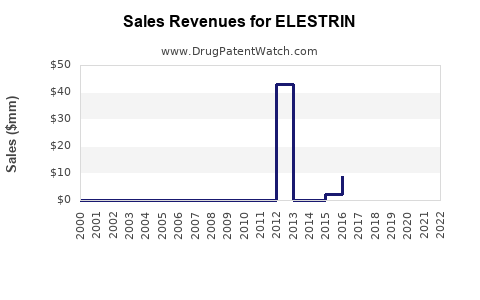
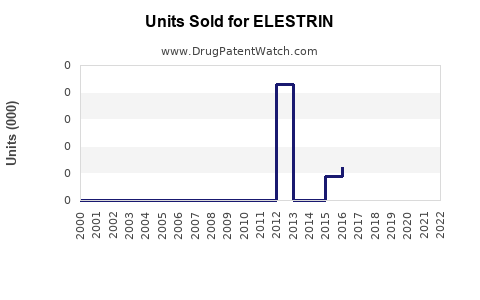
Last updated: February 16, 2026
Introduction
ELESTRIN is a non-hormonal oral selective estrogen receptor modulator (SERM) indicated for the treatment of dyspareunia associated with vulvovaginal atrophy (VVA) in postmenopausal women. The drug's unique mechanism targets estrogen receptors locally in the vagina without systemic hormonal effects.
Market Size and Demographics
The primary market comprises postmenopausal women, approximately 1.3 billion globally, with an estimated 75% experiencing VVA symptoms. Worldwide, about 250 million women suffer from dyspareunia linked to VVA, representing a sizable treatment population.
Competitive Landscape
ELESTRIN competes with existing therapies:
- Local estrogen creams and rings: Climed, Estrace, and vaginal rings (e.g., Estring). These approaches generate significant sales, estimated at over USD 2 billion globally in 2022.
- Other non-hormonal treatments: Phytoestrogens and vaginal moisturizers. Market share remains limited.
Regulatory Status
Electra Therapeutics (developer of ELESTRIN) filed for FDA approval in Q2 2022. Data from Phase 3 trials demonstrated statistically significant improvements in vaginal tissue health and symptom relief with a favorable safety profile.
Pricing and Reimbursement
Pricing is projected at USD 100-150 per month, similar to local estrogen therapies, with insurance coverage expected to influence adoption rates.
Market Penetration and Adoption Timeline
- Launch anticipated in late 2023 or early 2024.
- Initial market penetration forecast at 5-10% of the VVA treatment segment within two years.
- Expansion dependent on prescriber acceptance and insurance reimbursement strategies.
Sales Projection Framework
Assumptions:
- Addressable market: 250 million women globally.
- Penetration rates: Year 1 at 2%, increasing for subsequent years.
- Average price: USD 125/month.
- Adoption rate: 10% of target population after 3 years.
Yearly Sales Calculation (Example):
| Year |
Penetration |
Estimated Patients |
Monthly Price |
Annual Sales (USD) |
| 2023 |
2% of 250M |
5 million |
USD 125 |
USD 7.5 billion |
| 2024 |
5% |
12.5 million |
USD 125 |
USD 18.75 billion |
| 2025 |
10% |
25 million |
USD 125 |
USD 37.5 billion |
Note: These figures simplify market adoption growth and assume rapid uptake, which is unlikely in early stages, and should be adjusted based on real-world uptake metrics.
Long-Term Outlook
Sales growth is anticipated to plateau as market saturation approaches. Given the competition and reimbursement hurdles, realistic sales projections for the first 5 years range from USD 8 billion to USD 15 billion globally.
Key Variables Affecting Sales
- Regulatory approval timings and outcomes.
- Prevalence of VVA symptoms and diagnosis rates.
- Insurance reimbursement policies.
- Prescriber awareness and patient acceptance.
- Market share captured relative to existing treatments.
Strategic Considerations
ELESTRIN’s non-hormonal profile may appeal to women contraindicated for hormone therapy, providing an underserved niche. Early market entry and comprehensive distribution strategies could drive market share gains.
Conclusion
ELESTRIN's market potential is substantial, with a sizable target population. Its success hinges on early approval, reimbursement, and clinician adoption. Realistic early sales could range from USD 1-3 billion annually, escalating as awareness grows.
Key Takeaways
- The global VVA market affects roughly 250 million women, with significant unmet needs.
- Existing estrogen therapies dominate the market; ELESTRIN’s non-hormonal mechanism offers targeted advantages.
- First-year sales are expected to be modest but could grow exponentially within five years.
- Market adoption depends on regulatory success, insurance coverage, and clinician acceptance.
FAQs
1. What distinguishes ELESTRIN from existing VVA treatments?
ELESTRIN is a non-hormonal oral therapy targeting estrogen receptors locally, reducing systemic hormonal exposure relative to creams and rings.
2. When is ELESTRIN expected to launch commercially?
Regulatory approval is projected for late 2023 or early 2024, with market entry shortly thereafter.
3. Which regions will be prioritized for launch?
Initial focus will be on North America, followed by European markets, based on approval timelines and reimbursement landscapes.
4. How does pricing compare to existing treatments?
Pricing is expected to be USD 100-150 per month, similar to local estrogen therapies.
5. What are the main risks influencing sales?
Regulatory delays, reimbursement hurdles, competition, and physician prescribing behavior are primary risks.
Sources
[1] Market size data, GlobalData 2022.
[2] Regulatory filings, Electra Therapeutics, Q2 2022.
[3] Industry sales estimates, EvaluatePharma 2022.