Share This Page
Drug Sales Trends for EFFEXOR XR
✉ Email this page to a colleague
Payment Methods and Pharmacy Types for EFFEXOR XR (2022)
Revenues by Pharmacy Type
Units Sold by Pharmacy Type
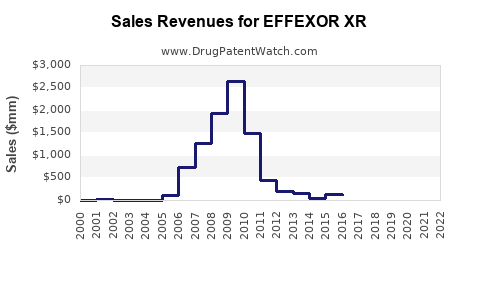
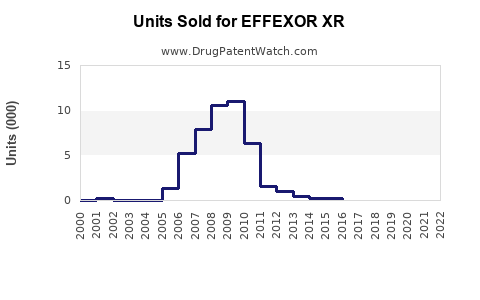
Annual Sales Revenues and Units Sold for EFFEXOR XR
| Drug Name | Revenues (USD) | Units | Year |
|---|---|---|---|
| EFFEXOR XR | ⤷ Start Trial | ⤷ Start Trial | 2022 |
| EFFEXOR XR | ⤷ Start Trial | ⤷ Start Trial | 2021 |
| EFFEXOR XR | ⤷ Start Trial | ⤷ Start Trial | 2020 |
| EFFEXOR XR | ⤷ Start Trial | ⤷ Start Trial | 2019 |
| EFFEXOR XR | ⤷ Start Trial | ⤷ Start Trial | 2018 |
| >Drug Name | >Revenues (USD) | >Units | >Year |
Effexor XR Market Analysis, Patent Expiration, Generic Competition, and Sales Projections
Effexor XR, the extended-release formulation of venlafaxine hydrochloride, is a mature antidepressant with no meaningful branded-growth profile in the United States. Its commercial market is now driven by generic venlafaxine ER capsules, pharmacy benefit manager pricing, prescription persistence, and supply reliability. U.S. brand revenue is limited, while the broader venlafaxine ER market remains commercially relevant because of established use in major depressive disorder, generalized anxiety disorder, social anxiety disorder, and panic disorder.
The base-case outlook is for a stable-to-declining U.S. venlafaxine ER market through 2030, with annual market value broadly in the range of $150 million to $350 million at manufacturer-level sales, depending on prescription volume, generic pricing, and channel assumptions. A return to large-scale branded Effexor XR sales is unlikely without a new formulation, indication, or commercial relaunch.
What is Effexor XR and how is it used?
Effexor XR contains venlafaxine hydrochloride in an extended-release dosage form. Pfizer markets the brand in the United States under NDA 020699. The product is available as once-daily capsules in 37.5 mg, 75 mg, and 150 mg strengths [1].
The FDA-approved indications include:
| Indication | Commercial relevance |
|---|---|
| Major depressive disorder | Largest historical use |
| Generalized anxiety disorder | Important maintenance market |
| Social anxiety disorder | Smaller but established segment |
| Panic disorder | Smaller specialty segment |
Venlafaxine is a serotonin-norepinephrine reuptake inhibitor. Its extended-release design supports once-daily administration and differentiates Effexor XR from immediate-release venlafaxine tablets, although generic ER products now provide the same basic delivery profile.
What is the FDA regulatory status of Effexor XR?
Effexor XR is an FDA-approved prescription product. The active ingredient is venlafaxine hydrochloride, and the reference listed drug has been used to support abbreviated new drug applications for generic venlafaxine extended-release products.
The product’s regulatory position is mature:
- Original U.S. approval: Wyeth Pharmaceuticals.
- Current brand owner and marketer: Pfizer.
- Dosage form: extended-release capsule.
- Administration: once daily, with food.
- Generic pathway: ANDA approvals for venlafaxine hydrochloride ER capsules.
- Regulatory category: small-molecule drug, not a biologic.
- Biosimilar pathway: not applicable.
Generic products are approved through the ANDA pathway and must demonstrate pharmaceutical equivalence and bioequivalence to the reference product. FDA-approved generic venlafaxine ER products are therefore the principal competitive threat to the brand [2].
When did Effexor XR lose exclusivity?
Effexor XR lost practical market exclusivity when generic venlafaxine ER products entered the U.S. market in 2010. The exact timing reflected the resolution of patent litigation and generic approval activity rather than the expiration of a single commercially decisive patent.
By the early 2010s, multiple generic manufacturers had entered or prepared to enter the market. The most important competitive event was the transition from a branded product with limited direct competition to a multi-supplier generic market.
Effexor XR exclusivity timeline
| Period | Event | Commercial effect |
|---|---|---|
| 1990s | Effexor introduced in immediate-release form | Initial venlafaxine franchise established |
| 1997 | Effexor XR U.S. approval | Once-daily extended-release product launched |
| 2000s | Brand expansion across anxiety and depression indications | Prescription base increased |
| 2008-2010 | Generic regulatory and patent activity accelerated | Branded exclusivity weakened |
| 2010 | Generic venlafaxine ER entry | Rapid price erosion began |
| 2011 onward | Multiple generic suppliers | Brand share and price declined sharply |
| 2025-2030 | Mature generic market | Volume remains, pricing remains pressured |
Patent protection and regulatory exclusivity should be distinguished. Effexor XR’s original market protection has expired, and no current exclusivity period supports a premium U.S. brand position.
What patents protect Effexor XR?
The principal historical protection related to Effexor XR covered the extended-release formulation and related pharmaceutical composition. The relevant patent estate included formulation claims directed to controlled release of venlafaxine and capsule products.
The key commercial patent issues were:
- Extended-release venlafaxine formulation technology.
- Pharmaceutical compositions containing venlafaxine hydrochloride.
- Dosing and administration claims associated with once-daily treatment.
- Method-of-use claims for approved psychiatric indications.
Historical patent disputes included challenges to formulation and method-of-use patents by generic applicants. These disputes were material before generic entry but no longer create a meaningful barrier to ordinary U.S. generic commercialization.
What is the Orange Book status of Effexor XR?
The FDA Orange Book is the primary source for listed patents and regulatory exclusivity associated with an approved drug. Effexor XR’s historical Orange Book listings supported patent certification requirements for ANDA applicants, including Paragraph IV certifications where applicants asserted that listed patents were invalid, unenforceable, or would not be infringed [3].
The commercial significance of the Orange Book estate has largely ended because generic venlafaxine ER products are already approved and marketed. Any remaining listing would need to be evaluated for claim scope, expiration, pediatric relevance, and whether it covers an active commercial product rather than an obsolete formulation.
Which companies compete with Effexor XR?
The competitive market has two levels: branded antidepressants and generic venlafaxine ER suppliers.
Direct generic competitors
Generic venlafaxine ER has been supplied by companies including:
- Teva Pharmaceuticals
- Zydus Pharmaceuticals
- Solco Healthcare
- Rising Pharmaceuticals
- Torrent Pharmaceuticals
- Lupin
- Dr. Reddy’s Laboratories
- Alvogen and related commercial entities
- Other FDA-approved ANDA holders and contract manufacturers
Supplier participation changes over time because manufacturers enter or exit based on margins, manufacturing economics, FDA inspections, shortages, and wholesaler contracts.
Therapeutic competitors
Effexor XR also competes with:
- Duloxetine, including Cymbalta and generic duloxetine.
- Desvenlafaxine, including Pristiq and generic desvenlafaxine.
- Escitalopram and citalopram.
- Sertraline.
- Fluoxetine.
- Mirtazapine.
- Bupropion.
- Vortioxetine.
Venlafaxine has retained a clinical position because prescribers use it across depression and anxiety disorders and because generic pricing is low. Its main commercial weakness is that competing SSRIs often have broader first-line use and simpler titration profiles.
How large is the Effexor XR and venlafaxine ER market?
The relevant market is generic venlafaxine ER, not branded Effexor XR alone. Public company filings generally do not disclose product-level revenue for venlafaxine ER, and Pfizer does not report Effexor XR as a major standalone growth product.
A reasonable market-sizing framework is:
| Market component | Base assumption |
|---|---|
| U.S. annual venlafaxine prescriptions, all forms | 12 million to 18 million |
| ER share of prescriptions | 70% to 85% |
| ER prescription equivalents | 8 million to 15 million |
| Average manufacturer-level revenue per prescription | $15 to $25 |
| Implied U.S. manufacturer market | $120 million to $375 million |
The range reflects the difference between gross sales, net sales, pharmacy acquisition cost, and actual manufacturer revenue. Retail spending can be materially higher than manufacturer-level revenue because of wholesaler, pharmacy, payer, and dispensing margins.
The brand’s share of this value is likely small. Generic substitution is standard, and many formularies place brand Effexor XR in a non-preferred tier or require prior authorization.
What are the sales projections for Effexor XR through 2030?
The following projections address the U.S. venlafaxine ER market rather than Pfizer’s separately reported brand revenue. They are scenario estimates based on mature prescription volume, annual generic price erosion, and limited brand participation.
U.S. venlafaxine ER manufacturer-sales projections
| Year | Bear case | Base case | Bull case |
|---|---|---|---|
| 2025 | $125 million | $225 million | $350 million |
| 2026 | $115 million | $218 million | $350 million |
| 2027 | $105 million | $211 million | $347 million |
| 2028 | $95 million | $204 million | $344 million |
| 2029 | $86 million | $197 million | $337 million |
| 2030 | $78 million | $190 million | $330 million |
| 2025-2030 CAGR | -8.9% | -3.3% | -1.2% |
The base case assumes:
- Prescription volume declines approximately 1% annually.
- Generic net pricing declines approximately 2% annually.
- No major supply shortage creates sustained price increases.
- Brand Effexor XR remains commercially available but captures limited volume.
- No new indication materially expands venlafaxine use.
The bull case assumes stable prescription volume and fewer active generic suppliers. The bear case assumes further price compression, loss of manufacturer participation, and continued migration to competing antidepressants.
Brand Effexor XR projection
| Year | Estimated U.S. brand revenue range |
|---|---|
| 2025 | $5 million to $20 million |
| 2026 | $4 million to $18 million |
| 2027 | $3 million to $16 million |
| 2028 | $3 million to $14 million |
| 2029 | $2 million to $13 million |
| 2030 | $2 million to $12 million |
These figures are directional estimates rather than reported Pfizer guidance. The brand’s economic value is primarily residual revenue, portfolio continuity, and any non-U.S. sales rather than U.S. growth.
How strong is the Effexor XR patent estate?
The current patent estate is weak for blocking ordinary generic venlafaxine ER products. The strongest historical protection was formulation-based, but those rights were litigated and overcome or expired before the mature generic market developed.
| Patent-strength factor | Assessment |
|---|---|
| Core composition protection | Expired or commercially exhausted |
| Extended-release formulation protection | Historically important; no longer a broad market barrier |
| Method-of-use protection | Limited practical value after generic entry |
| New chemical entity protection | Expired |
| Orange Book leverage | Low |
| Generic litigation risk | Low for ordinary ER capsules |
| Reformulation opportunity | Potentially meaningful if supported by new claims |
| Manufacturing know-how | Moderate operational value, weak exclusionary value |
A new patent estate could be created around a differentiated delivery system, abuse-deterrent design, combination product, precision dosing system, or novel prodrug. Those strategies would face obviousness, enablement, written-description, and freedom-to-operate challenges.
What generic entry risks exist for Effexor XR?
Generic entry risk is no longer an anticipated event. It is the current market structure.
The principal commercial risks are:
- Continued price erosion from multi-source generic competition.
- Loss of pharmacy shelf preference.
- Formulary substitution.
- Manufacturer exits after margin compression.
- FDA manufacturing or supply disruptions.
- Therapeutic substitution into SSRIs, duloxetine, desvenlafaxine, or bupropion.
- Patient switching caused by capsule appearance, excipient differences, or payer policy.
- Regulatory scrutiny of manufacturing consistency and dissolution performance.
A short-term price increase is possible if several suppliers exit simultaneously. That would benefit remaining generic manufacturers more than the Effexor XR brand unless payers permit brand substitution.
What patent litigation affects Effexor XR?
The material Effexor XR litigation occurred during the period preceding generic entry. Generic applicants used Paragraph IV certifications to challenge listed patents, leading to Hatch-Waxman litigation involving Wyeth and generic manufacturers.
The commercial result was generic market entry beginning around 2010. There is no current litigation pattern comparable to an active branded-product patent defense program. Any new dispute would more likely involve manufacturing, trademark, supply, or a reformulated venlafaxine product rather than the original Effexor XR franchise.
Are there Effexor XR settlement agreements or licensing deals?
Historical generic settlements may have governed the timing of individual generic launches, but they do not preserve current brand exclusivity. Pfizer’s acquisition of Wyeth transferred the relevant product rights and commercial responsibilities within the broader Pfizer portfolio.
No major current licensing transaction is necessary to explain the market. Generic manufacturers generally rely on ANDA approvals, contract manufacturing, and commercial supply arrangements rather than licenses to the original Effexor XR brand.
How does Effexor XR compare with Cymbalta and Pristiq?
| Product | Active ingredient | Brand status | Generic status | Market position |
|---|---|---|---|---|
| Effexor XR | Venlafaxine ER | Mature brand | Widely genericized | Broad depression and anxiety use |
| Cymbalta | Duloxetine | Mature brand | Widely genericized | Depression, anxiety, pain indications |
| Pristiq | Desvenlafaxine | Mature brand | Generic available | Narrower SNRI franchise |
| Lexapro | Escitalopram | Mature brand | Widely genericized | Strong SSRI first-line position |
| Wellbutrin XL | Bupropion XL | Mature brand | Widely genericized | Depression and smoking cessation relevance |
Effexor XR has a larger historical prescription base than Pristiq but faces more direct substitution from generic duloxetine and SSRIs. Cymbalta has an advantage in pain-related indications. Escitalopram and sertraline have stronger primary-care positioning in many treatment algorithms.
What manufacturing and intellectual-property barriers remain?
The active ingredient is commercially established, and multiple manufacturers have produced venlafaxine ER. Manufacturing barriers are therefore operational rather than exclusionary.
Relevant barriers include:
- Consistent extended-release dissolution profiles.
- API sourcing and impurity control.
- Capsule filling and bead-coating technology.
- Stability across the labeled shelf life.
- Bioequivalence across strengths.
- FDA inspection compliance.
- Reliable supply to wholesalers and large pharmacy chains.
A manufacturer with a robust supply record can maintain share even in a low-price market. The advantage is contractual and operational, not a durable patent moat.
What is the geographic coverage of Effexor XR protection?
U.S. patent protection has expired as a practical barrier. Other jurisdictions may have had different patent terms, supplementary protection rules, or generic launch dates, but the product is globally mature.
Commercial opportunity is more likely in markets where:
- Generic substitution is incomplete.
- Branded psychiatric products retain reimbursement preference.
- Venlafaxine remains widely prescribed.
- Local manufacturing capacity is limited.
- Regulatory approval creates a temporary supply advantage.
The largest remaining opportunity is generic supply, not global branded relaunch.
Key Takeaways
- Effexor XR is a mature venlafaxine ER product with limited remaining branded revenue potential.
- U.S. generic entry began around 2010, eliminating practical brand exclusivity.
- The relevant commercial market is generic venlafaxine ER, estimated at approximately $120 million to $375 million annually in U.S. manufacturer sales.
- Base-case U.S. market revenue is projected to decline from about $225 million in 2025 to $190 million in 2030.
- Brand Effexor XR revenue is likely to remain below $20 million annually in the United States.
- The historical formulation patent estate no longer creates a broad barrier to generic competition.
- The main investment risks are price erosion, supplier exits, manufacturing disruption, and therapeutic substitution.
- A commercially meaningful growth strategy would require a differentiated formulation, new indication, or delivery technology.
FAQs
Is Effexor XR still patented?
The original patent protection that supported Effexor XR’s commercial exclusivity has expired or no longer creates a meaningful barrier to standard generic venlafaxine ER products.
Can a generic company launch venlafaxine ER without a license from Pfizer?
Yes. Approved generic manufacturers can rely on the ANDA pathway and applicable patent certifications. A license from Pfizer is not generally required for an unbranded bioequivalent product after relevant patent barriers have expired or been resolved.
Does Effexor XR have orphan-drug exclusivity?
No. Effexor XR’s approved psychiatric indications are not associated with orphan-drug exclusivity.
Is venlafaxine ER exposed to biosimilar competition?
No. Venlafaxine is a chemically synthesized small molecule. Its competitors are generic drugs approved under the ANDA pathway, not biosimilars approved under the biologics framework.
Could a new Effexor XR formulation regain market exclusivity?
A new formulation could receive patent protection if it satisfies patentability requirements and provides a distinct, non-obvious technical or clinical benefit. Regulatory approval alone would not restore the original product’s lost exclusivity.
References
-
Pfizer Inc. (2024). Effexor XR prescribing information. U.S. Food and Drug Administration labeling database.
-
U.S. Food and Drug Administration. (2024). Approved drug products with therapeutic equivalence evaluations. FDA Orange Book.
-
U.S. Food and Drug Administration. (2024). Orange Book: Approved drug products with therapeutic equivalence evaluations, patent and exclusivity information. FDA.
-
U.S. Food and Drug Administration. (2024). Drugs@FDA: FDA-approved drugs, Effexor XR NDA 020699. FDA.
-
Pfizer Inc. (2010-2024). Annual reports and Form 10-K filings. Pfizer investor relations.
More… ↓