Share This Page
Drug Sales Trends for DULERA
✉ Email this page to a colleague
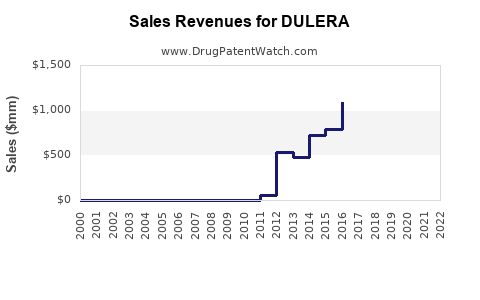
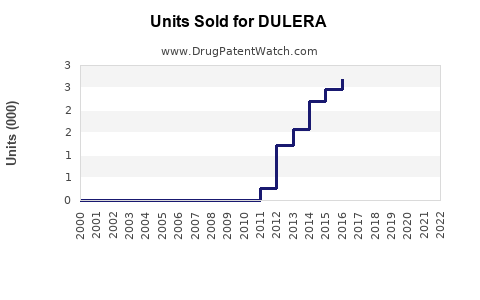
Annual Sales Revenues and Units Sold for DULERA
| Drug Name | Revenues (USD) | Units | Year |
|---|---|---|---|
| DULERA | ⤷ Start Trial | ⤷ Start Trial | 2022 |
| DULERA | ⤷ Start Trial | ⤷ Start Trial | 2021 |
| DULERA | ⤷ Start Trial | ⤷ Start Trial | 2020 |
| DULERA | ⤷ Start Trial | ⤷ Start Trial | 2019 |
| DULERA | ⤷ Start Trial | ⤷ Start Trial | 2018 |
| >Drug Name | >Revenues (USD) | >Units | >Year |
DULERA Market Analysis, Sales Forecast, Patent Risk, and Generic Entry Outlook
DULERA, the fixed-dose inhaled combination of mometasone furoate and formoterol fumarate, is a mature asthma product facing long-term erosion from generic competition, lower-cost inhaled corticosteroid/long-acting beta agonist alternatives, and increasing use of newer respiratory therapies. U.S. sales are not separately disclosed by Merck, so market projections require a scenario model rather than a company-reported baseline. A reasonable base case places current global DULERA sales in the low hundreds of millions of dollars annually, with global revenue declining at approximately 8% to 15% per year after broad generic availability.
What is DULERA and how does it work?
DULERA is a prescription metered-dose inhaler containing mometasone furoate, an inhaled corticosteroid, and formoterol fumarate, a long-acting beta2-adrenergic agonist. The product is approved for the twice-daily maintenance treatment of asthma in patients aged 5 years and older, depending on strength and labeling jurisdiction. It is not indicated for the relief of acute bronchospasm. (U.S. Food and Drug Administration, 2024a)
The U.S. product is marketed in two strengths:
| Product | Mometasone furoate | Formoterol fumarate |
|---|---|---|
| DULERA 50/5 | 50 mcg per actuation | 5 mcg per actuation |
| DULERA 100/5 | 100 mcg per actuation | 5 mcg per actuation |
| DULERA 200/5 | 200 mcg per actuation | 5 mcg per actuation |
The principal commercial value comes from the combination product, not either active ingredient individually. Mometasone is also marketed in other respiratory products, including NASONEX, while formoterol is used in several combination inhalers.
What therapeutic category does DULERA compete in?
DULERA competes in the inhaled corticosteroid/long-acting beta agonist, or ICS/LABA, market. Its principal branded competitors include:
- ADVAIR and authorized or generic fluticasone/salmeterol products
- BREO ELLIPTA, containing fluticasone furoate/vilanterol
- SYMBICORT and generic budesonide/formoterol
- AIRDUO RESPICLICK and generic fluticasone propionate/salmeterol
- WIXELA INHUB, a generic-equivalent fluticasone/salmeterol product
- TRELEGY ELLIPTA for patients requiring triple therapy
DULERA has a smaller commercial position than SYMBICORT, ADVAIR, and BREO. Its main differentiator is the mometasone/formoterol combination delivered through a pressurized metered-dose inhaler.
What is the FDA regulatory status of DULERA?
DULERA received FDA approval in 2010. The product is regulated as a small-molecule drug-device combination rather than a biologic. Generic versions are therefore expected to enter through the abbreviated new drug application, or ANDA, pathway rather than through the biosimilar pathway. (U.S. Food and Drug Administration, 2010)
The FDA label identifies DULERA as a maintenance therapy for asthma. Important prescribing considerations include:
- It is not a rescue inhaler.
- The LABA component should not be used as monotherapy for asthma.
- Patients should use a short-acting bronchodilator for acute symptoms when prescribed.
- Long-term corticosteroid exposure can create systemic risks, including effects on bone density, ocular health, adrenal function, and growth in pediatric patients. (U.S. Food and Drug Administration, 2024a)
DULERA does not have biosimilar exposure because biosimilars apply to biologic products. Its competitive threat is conventional generic substitution and therapeutic substitution within the ICS/LABA class.
What are DULERA sales and revenue projections?
Merck does not report DULERA as a standalone revenue line in its principal public financial disclosures. The product is included within broader pharmaceutical or other-product reporting, which prevents direct reconciliation of DULERA sales from Merck’s annual reports. (Merck & Co., 2024)
The following projection is an analytical estimate based on DULERA’s mature U.S. position, international availability, competitive class pricing, and expected generic erosion. It is not company guidance.
Base-case DULERA revenue forecast
| Year | Estimated global net sales | Annual change | Primary market condition |
|---|---|---|---|
| 2023 | $250 million-$350 million | -5% to -10% | Mature branded demand |
| 2024 | $225 million-$320 million | -7% to -10% | Continued formulary pressure |
| 2025 | $205 million-$295 million | -7% to -10% | Early generic preparation and contracting |
| 2026 | $175 million-$260 million | -10% to -15% | Initial generic substitution |
| 2027 | $145 million-$225 million | -10% to -15% | Wider generic availability |
| 2028 | $120 million-$195 million | -8% to -14% | Price erosion and share loss |
| 2029 | $105 million-$175 million | -7% to -12% | Mature generic market |
The base case assumes first meaningful U.S. generic competition during the 2026-2028 period. Earlier approval of a therapeutically substitutable product would accelerate the decline. Delayed generic launch, patent litigation, device-development difficulty, or limited pharmacy substitution could preserve a larger branded revenue base.
Scenario analysis
| Scenario | Generic timing | 2029 estimated global sales | Commercial outcome |
|---|---|---|---|
| Downside | 2025-2026 | $60 million-$110 million | Rapid substitution and price compression |
| Base case | 2026-2028 | $105 million-$175 million | Gradual share loss |
| Upside | 2028 or later | $170 million-$250 million | Delayed entry and stable prescriber loyalty |
DULERA is unlikely to become a major growth product for Merck. Its residual value is more likely to come from established prescriber use, patients stable on the device, international sales, and managed-care contracts.
How large is the DULERA addressable market?
The underlying asthma market is large, but DULERA’s addressable segment is narrower. The relevant patient population consists of asthma patients who require an ICS/LABA combination and are treated with a twice-daily metered-dose inhaler.
The market is constrained by four factors:
- Many patients can be controlled with lower-cost inhaled corticosteroid monotherapy.
- Generic budesonide/formoterol and fluticasone/salmeterol products reduce the price ceiling.
- Some patients are moved to once-daily products such as BREO ELLIPTA.
- Severe asthma patients may progress to biologic therapy or triple inhaler therapy.
The largest commercial opportunity is in patients who remain on a familiar pressurized inhaler and in payer channels where DULERA receives preferred or acceptable formulary treatment. The largest loss risk is in Medicaid, Medicare Part D, and other highly price-sensitive channels.
What patents protect DULERA?
DULERA’s protection has historically relied on patents covering the mometasone/formoterol combination, pharmaceutical compositions, inhaler formulations, and related methods of treatment. The FDA Orange Book is the controlling source for listed U.S. patents and regulatory exclusivity. (U.S. Food and Drug Administration, 2024b)
Public patent records identify early DULERA-related U.S. patents associated with Schering Corporation and Merck, including patents directed to combination compositions and inhaled pharmaceutical formulations. Patent protection has been affected by filing-date adjustments, patent-term extension rules, terminal disclaimers, and the specific claims asserted in ANDA litigation.
| Protection category | Commercial relevance | Generic-entry impact |
|---|---|---|
| Mometasone/formoterol combination claims | Protects the active ingredient pairing | High if claims remain enforceable |
| Inhaled formulation claims | Protects particle, excipient, or suspension characteristics | Moderate to high |
| Inhaler-device claims | Protects delivery architecture or dose uniformity | Moderate |
| Method-of-use claims | Covers asthma maintenance treatment | Variable; often easier to design around |
| Manufacturing claims | Protects production or suspension processes | Moderate if process is difficult to replicate |
The key risk is not simply the earliest listed patent expiration. An ANDA applicant may challenge patents through Paragraph IV certification, seek a judgment of invalidity or noninfringement, or wait for expiration of only the patents that create a practical launch barrier.
When does DULERA lose exclusivity?
DULERA’s original U.S. regulatory exclusivity expired years ago. The remaining commercial question is patent-based generic timing rather than new-drug exclusivity.
The product has entered the late-life stage of its commercial cycle. Any remaining Orange Book patents should be assessed by claim scope, expiration date, terminal disclaimer, litigation history, and whether a generic applicant can omit or alter the protected feature. A patent that covers the branded product does not automatically prevent an ANDA applicant from launching a noninfringing alternative.
What is the Orange Book status of DULERA?
DULERA is an Orange Book-listed approved drug product. The Orange Book identifies the reference listed drug, dosage forms, strengths, therapeutic equivalence information, and patents or exclusivity entries submitted by the sponsor. (U.S. Food and Drug Administration, 2024b)
DULERA’s Orange Book position should be analyzed at the strength and dosage-form level. The 50/5, 100/5, and 200/5 strengths may not have identical commercial relevance for a generic applicant. A generic manufacturer may initially target the highest-volume strength or pursue multiple strengths in a coordinated filing.
The Orange Book does not determine whether a patent is valid. It records listed patents and regulatory information. Invalidity, noninfringement, and enforceability are determined through litigation or settlement.
Which companies are challenging DULERA patents?
DULERA is exposed to the same competitive filing behavior that affects other mature combination inhalers. Potential ANDA applicants include large generic manufacturers with inhalation-device capabilities, such as Viatris, Teva, Sandoz, Cipla, Lupin, and related respiratory-product developers. The identity and timing of a commercial entrant depend on FDA approval, patent certification, litigation, and manufacturing readiness.
A Paragraph IV challenge would create a potential 30-month stay if Merck filed timely patent litigation after receiving notice of the certification. The stay would not guarantee continued market exclusivity through the full period because litigation can terminate the stay or produce an earlier judgment. (U.S. Food and Drug Administration, 2024c)
The main generic barriers are:
- Demonstrating pharmaceutical equivalence and bioequivalence
- Matching dose delivery across the inhaler life cycle
- Establishing consistent suspension performance
- Satisfying device and dose-counter requirements
- Resolving listed patent claims
- Securing commercial-scale manufacturing capacity
What formulation patents and manufacturing barriers affect DULERA?
DULERA is more difficult to copy than a conventional oral tablet. Its formulation uses micronized active ingredients in a pressurized inhalation system. A generic manufacturer must reproduce delivered dose, aerodynamic particle-size distribution, spray characteristics, valve performance, plume geometry, and stability.
The device and formulation create practical barriers even after core composition patents expire. Generic applicants may pursue one of three strategies:
- Replicate the reference inhaler closely.
- Use a different device with equivalent performance.
- Design around formulation or device claims while preserving therapeutic equivalence.
This complexity can delay launch, reduce the number of approved competitors, and moderate post-entry price erosion. It does not eliminate generic risk. The U.S. market has established regulatory experience with complex inhalation products, and large respiratory manufacturers have the technical capabilities needed for development.
What patent litigation and settlement agreements affect DULERA?
DULERA’s commercial outlook depends more on the existence of a credible ANDA filing than on brand-company litigation alone. A Paragraph IV case may lead to:
- A judgment sustaining one or more patents
- Invalidity or noninfringement findings
- A settlement with a delayed launch date
- A license allowing earlier entry
- Launch after settlement subject to a negotiated date
No material licensing deal or settlement should be treated as a confirmed market event without a court filing, FDA record, Securities and Exchange Commission disclosure, or company announcement. Merck’s acquisition of Schering-Plough transferred the legacy respiratory portfolio into Merck’s ownership; it was not a separate DULERA generic-license transaction. (Merck & Co., 2009)
How does DULERA compare with competing ICS/LABA products?
| Product | Active ingredients | Device profile | Generic pressure | Commercial position |
|---|---|---|---|---|
| DULERA | Mometasone/formoterol | Pressurized metered-dose inhaler | High | Mature, smaller branded franchise |
| SYMBICORT | Budesonide/formoterol | Pressurized inhaler and other presentations | High | Large installed base |
| ADVAIR | Fluticasone/salmeterol | Diskus and inhaler presentations | Very high | Large historical market, substantial generic erosion |
| BREO ELLIPTA | Fluticasone furoate/vilanterol | Dry-powder inhaler | Increasing | Once-daily differentiation |
| AIRDUO/WIXELA | Fluticasone propionate/salmeterol | Dry-powder or breath-actuated inhalers | High | Price-oriented competition |
DULERA has no strong once-daily advantage and faces lower-cost substitutes with substantial clinical familiarity. Its principal defense is patient and prescriber continuity rather than a clearly superior dosing schedule.
What generic launch scenarios exist for DULERA?
Early launch scenario
A generic applicant obtains approval, defeats or settles patent litigation, and launches in 2025 or 2026. DULERA could lose 30% to 60% of U.S. volume within the first two years, depending on payer substitution and the number of entrants.
Delayed launch scenario
Launch occurs in 2027 or later after litigation or regulatory delays. Merck retains a larger branded share for several additional years, but contracting pressure still reduces net price.
Limited-competition scenario
One approved generic enters without broad pharmacy substitution, or device manufacturing limits supply. Volume erosion is slower, but brand net pricing remains under pressure.
A typical multi-generic inhaler market can experience significant price compression once two or more reliable suppliers are available. The first entrant may receive a temporary commercial advantage, while later entrants compete primarily through rebate and acquisition pricing.
What is the DULERA revenue exposure for Merck?
Because Merck does not separately report DULERA sales, the product is unlikely to represent a material proportion of consolidated company revenue. Its strategic value is greater as part of the respiratory portfolio and prescriber relationship network than as a major growth driver.
The principal financial exposures are:
- Loss of branded U.S. prescription volume
- Lower net price from formulary concessions
- Inventory and manufacturing adjustments before generic entry
- Potential litigation expense
- Reduced portfolio leverage in respiratory contracting
Merck’s broader revenue profile is dominated by products such as KEYTRUDA, GARDASIL, and other major franchises. DULERA erosion should therefore have limited impact on consolidated revenue but may be material to the legacy respiratory product category.
How strong is the DULERA patent estate?
DULERA’s patent estate is best characterized as moderate but declining in commercial strength.
| Factor | Assessment |
|---|---|
| Core active ingredients | Weak protection because both ingredients are established |
| Combination claims | Potentially meaningful, subject to expiration and validity |
| Formulation claims | Moderate strength because inhaled suspensions are technically complex |
| Device claims | Moderate; design-around potential exists |
| Method-of-use claims | Limited to moderate practical value |
| Regulatory exclusivity | Expired |
| Generic substitution risk | High |
| Manufacturing barriers | Moderate |
The estate can delay or complicate entry, but it is unlikely to support long-term premium pricing once a fully substitutable generic is approved.
Key Takeaways
- DULERA is a mature ICS/LABA asthma product containing mometasone furoate and formoterol fumarate.
- Merck does not separately disclose DULERA revenue, so sales estimates must be modeled.
- Estimated global sales are approximately $225 million to $320 million for 2024.
- Base-case global sales decline to approximately $105 million to $175 million by 2029.
- Original FDA exclusivity has expired; the remaining issue is patent-based generic timing.
- DULERA has no biosimilar risk because it is a small-molecule drug.
- Generic risk is high, but inhaler-device and formulation complexity may delay or limit entry.
- The product competes against generic budesonide/formoterol, generic fluticasone/salmeterol, BREO ELLIPTA, and other ICS/LABA products.
- DULERA is unlikely to be a material consolidated revenue driver for Merck.
- The most probable commercial outcome is gradual U.S. share loss followed by sustained price erosion after generic entry.
FAQs
Is DULERA being discontinued?
There is no basis to treat DULERA as discontinued. Its commercial position is mature, and future erosion is more likely to result from generic competition and formulary pressure than from immediate withdrawal.
Is there a generic version of DULERA?
A generic version requires FDA approval as an equivalent inhaled combination product. Generic development is technically more complex than tablet development because the applicant must demonstrate equivalent delivered performance and device functionality.
Is DULERA stronger than Symbicort?
Neither product is universally stronger. Clinical selection depends on inhaled corticosteroid dose, patient response, inhaler technique, adherence, formulary status, and physician judgment. DULERA and SYMBICORT use different corticosteroids but share formoterol as the LABA component.
Can DULERA be used as a rescue inhaler?
No. DULERA is a maintenance therapy and is not intended to relieve acute bronchospasm. Patients generally require a separate short-acting rescue inhaler when prescribed by a clinician.
What is the main investment risk for DULERA?
The main risk is loss of branded volume and net price after an approved generic inhaler enters the U.S. market. The timing depends on Orange Book patents, Paragraph IV litigation, regulatory approval, device manufacturing, and payer substitution.
References
- Merck & Co., Inc. (2009). Merck to acquire Schering-Plough in a merger of equals. https://www.merck.com
- Merck & Co., Inc. (2024). 2023 annual report. https://www.merck.com/investor-relations/financial-information/annual-reports
- U.S. Food and Drug Administration. (2010). DULERA prescribing information. https://www.accessdata.fda.gov
- U.S. Food and Drug Administration. (2024a). DULERA: Prescribing information. https://www.accessdata.fda.gov
- U.S. Food and Drug Administration. (2024b). Approved drug products with therapeutic equivalence evaluations: Orange Book. https://www.fda.gov/drugs/drug-approvals-and-databases/approved-drug-products-therapeutic-equivalence-evaluations-orange-book
- U.S. Food and Drug Administration. (2024c). Paragraph IV drug product and patent litigation. https://www.fda.gov/drugs/abbreviated-new-drug-application-anda/paragraph-iv-drug-product-and-patent-litigation-information
More… ↓
