Share This Page
Drug Sales Trends for DORYX
✉ Email this page to a colleague
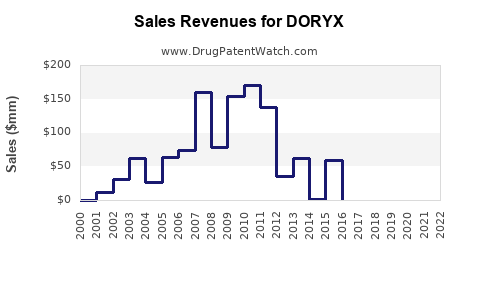
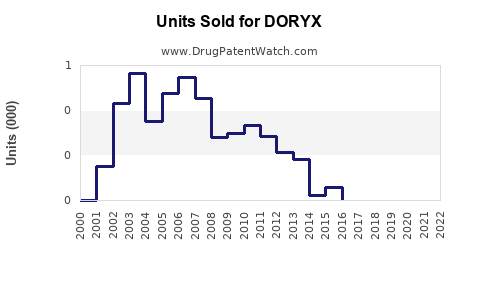
Annual Sales Revenues and Units Sold for DORYX
| Drug Name | Revenues (USD) | Units | Year |
|---|---|---|---|
| DORYX | ⤷ Start Trial | ⤷ Start Trial | 2022 |
| DORYX | ⤷ Start Trial | ⤷ Start Trial | 2021 |
| DORYX | ⤷ Start Trial | ⤷ Start Trial | 2020 |
| DORYX | ⤷ Start Trial | ⤷ Start Trial | 2019 |
| DORYX | ⤷ Start Trial | ⤷ Start Trial | 2018 |
| DORYX | ⤷ Start Trial | ⤷ Start Trial | 2017 |
| >Drug Name | >Revenues (USD) | >Units | >Year |
Doryx Market Analysis and Sales Projections
Doryx is a branded delayed-release doxycycline product with a narrow commercial position inside the much larger doxycycline market. Its value comes from formulation differentiation, reduced gastrointestinal exposure, and dermatology prescribing rather than from the antibiotic molecule itself. The brand faces sustained generic pressure, limited pricing power, and no biosimilar risk.
Under a base-case model, U.S. Doryx net sales are estimated at approximately $40 million to $50 million annually in 2025, declining at roughly 4% to 8% per year through 2029. Upside depends on maintaining reimbursement for delayed-release tablets and retaining dermatology prescriptions. Downside risk is greater if additional generic delayed-release competitors gain broad payer coverage.
What is Doryx and how does it compete?
Doryx contains doxycycline hyclate in a delayed-release oral tablet. The product is marketed primarily for acne vulgaris and other susceptible infections consistent with doxycycline labeling. Doryx MPC is a modified formulation designed to improve tablet handling and reduce direct doxycycline exposure in the upper gastrointestinal tract.
The commercial distinction is formulation, not active ingredient. Immediate-release doxycycline products are widely available at low generic prices. Doryx must therefore justify a premium through:
- Delayed-release delivery
- Reduced risk of esophageal irritation and gastrointestinal intolerance
- Dermatology familiarity with the brand
- Product-specific dosing and tablet technology
- Formulary positioning and physician preference
The underlying doxycycline market remains broad. It includes generic immediate-release capsules and tablets, delayed-release tablets, injectable products, veterinary formulations, and branded dermatology products.
Doryx product profile
| Attribute | Doryx |
|---|---|
| Active ingredient | Doxycycline hyclate |
| Dosage form | Delayed-release tablet |
| Primary commercial use | Acne and susceptible bacterial infections |
| Product category | Small-molecule prescription antibiotic |
| Main alternative | Generic immediate-release doxycycline |
| U.S. regulatory pathway | NDA product |
| Biosimilar exposure | None |
| Key commercial risk | Generic substitution and payer exclusion |
| Key commercial defense | Formulation differentiation |
The FDA-approved label requires patients to take delayed-release tablets as directed and warns about common tetracycline-class risks, including gastrointestinal effects, photosensitivity, tooth discoloration in certain populations, and esophageal irritation if taken improperly (FDA, 2024a).
How large is the Doryx market?
Doryx addresses a small premium segment of the U.S. oral doxycycline market. Generic immediate-release doxycycline captures most prescription volume because it is inexpensive, broadly available, and accepted across primary care, dermatology, infectious disease, and other specialties.
A reasonable market structure for 2025 is:
| Segment | Estimated share of U.S. doxycycline prescription volume | Commercial profile |
|---|---|---|
| Immediate-release generic doxycycline | 80% to 90% | Low price, high substitution |
| Delayed-release generic doxycycline | 5% to 10% | Formulation-specific competition |
| Doryx and Doryx MPC | 3% to 7% | Premium branded segment |
| Other branded doxycycline products | Less than 5% | Mostly indication- or formulation-specific |
These percentages are analytical estimates rather than reported company figures. Public company disclosures generally do not provide current standalone Doryx revenue, prescription volume, gross-to-net deductions, or market share. Mayne Pharma reports broader commercial performance and portfolio results rather than a complete product-level income statement for Doryx (Mayne Pharma, 2023, 2024).
What drives Doryx demand?
Doryx demand is concentrated in dermatology, particularly acne treatment. Volume is affected by:
- New patient starts for moderate-to-severe acne.
- Duration of oral antibiotic therapy.
- Use of topical combination treatment.
- Insurance coverage and prior authorization.
- Generic substitution rules.
- Physician willingness to pay for delayed-release delivery.
- Competition from other acne therapies.
The acne market is increasingly competitive. Oral doxycycline competes with topical retinoids, topical antibiotics, benzoyl peroxide combinations, hormonal therapies, isotretinoin, and newer branded acne products. Doryx is usually prescribed as part of a broader regimen rather than as a stand-alone long-term treatment.
What are Doryx sales projections through 2029?
The following model estimates U.S. Doryx net sales. It is based on a modeled 2025 base, expected generic erosion, stable acne demand, and modest price increases. It is not company guidance.
| Year | Bear case | Base case | Bull case |
|---|---|---|---|
| 2025 | $30 million | $45 million | $60 million |
| 2026 | $26 million | $42 million | $59 million |
| 2027 | $22 million | $39 million | $58 million |
| 2028 | $18 million | $36 million | $57 million |
| 2029 | $15 million | $33 million | $55 million |
| 2025-2029 CAGR | -16.2% | -7.5% | -2.2% |
Base-case assumptions
The base case assumes:
- U.S. net sales of approximately $45 million in 2025.
- Annual unit erosion of 5% to 8%.
- Low-single-digit price increases, partly offset by rebates and payer pressure.
- No major product withdrawal.
- No material expansion into a new high-value indication.
- Continued availability of generic doxycycline alternatives.
- No major improvement in formulary access.
The base case produces cumulative 2025-2029 sales of approximately $195 million.
Scenario interpretation
The bear case assumes broader generic substitution, reduced reimbursement, and lower physician preference for branded delayed-release doxycycline. The bull case assumes delayed-release products retain a meaningful premium, payer coverage remains stable, and the manufacturer improves specialty-pharmacy or dermatology access.
The most probable outcome is gradual decline rather than an abrupt revenue collapse. Doryx remains commercially viable because physicians continue to prescribe doxycycline and some patients benefit from the delayed-release formulation. The brand is unlikely to regain the growth profile associated with a protected novel medicine.
When does Doryx lose exclusivity?
Doryx’s active ingredient has been generic for decades. The relevant exclusivity question is formulation and regulatory protection, not doxycycline molecule protection.
Doryx has faced generic competition for delayed-release doxycycline products. The existence of generic delayed-release products materially weakens any argument that the brand retains market exclusivity based solely on its dosage form. Current competitive conditions should be assessed through the FDA Orange Book, FDA ANDA approvals, product-level labeling, and pharmacy substitution data (FDA, 2024b).
Exclusivity profile
| Protection category | Doryx position |
|---|---|
| New chemical entity exclusivity | Expired or not applicable |
| Orphan-drug exclusivity | Not applicable |
| Pediatric exclusivity | Not a current commercial defense |
| Active-ingredient patent | Not available as a commercial barrier |
| Formulation patents | Historically important, but generic entry has reduced practical protection |
| Method-of-use patents | Limited relevance where generic doxycycline is used for the same indications |
| Trademark protection | Continues independently of patent protection |
| Regulatory exclusivity | No current exclusivity sufficient to block all generic competition |
A current patent opinion requires a live Orange Book and patent-family review. Patent expiration dates for formulation claims should not be treated as a reliable forecast of market exclusivity because generic manufacturers may enter after Paragraph IV certifications, patent settlements, invalidity findings, or non-infringement positions.
What is the Orange Book status of Doryx?
Doryx is an NDA-regulated product, while competing generic delayed-release doxycycline products are generally approved through ANDA pathways referencing the relevant listed drug. The Orange Book is the controlling public source for current listed patents, patent-use codes, therapeutic equivalence codes, and approved products (FDA, 2024b).
The commercial implications are:
- Doryx is exposed to ANDA competition.
- The brand’s listed patents do not necessarily prevent generic approval.
- Therapeutic equivalence and substitution status influence pharmacy-level erosion.
- A generic product can obtain significant share even if it does not replicate every commercial attribute of the brand.
- Formulation differences can preserve some brand demand without preserving premium pricing.
The key Orange Book indicators for Doryx are the number of approved delayed-release ANDAs, their therapeutic equivalence ratings, and any currently listed patents with unexpired terms. Those factors matter more than the number of historical Doryx patent filings.
Which companies challenge Doryx?
Generic doxycycline competition has historically included large manufacturers such as Actavis/Teva, Mylan or Viatris, Hikma, Amneal, Zydus, and other ANDA sponsors. The competitive set can change as approvals are transferred, discontinued, or commercially launched.
The principal competitive threat is not one manufacturer. It is the aggregate effect of multiple low-cost suppliers. Once several equivalent or substitutable products are available, pharmacy benefit managers and wholesalers can shift volume toward the lowest net-cost supplier.
Competitive comparison
| Product type | Price position | Prescription role | Threat to Doryx |
|---|---|---|---|
| Generic immediate-release doxycycline | Lowest | Broad first-line use | High |
| Generic delayed-release doxycycline | Low to moderate | Formulation-sensitive patients | Very high |
| Doryx | Premium | Dermatology and brand-preference use | Incumbent |
| Doryx MPC | Premium | Modified delayed-release option | Moderate to high |
| Other acne drugs | Variable | Alternative mechanisms or regimens | Moderate |
What patent litigation affects Doryx?
Doryx’s major legal exposure is tied to formulation patents and ANDA litigation rather than disputes over doxycycline itself. Generic applicants may file Paragraph IV certifications asserting that listed patents are invalid, unenforceable, or not infringed under the Hatch-Waxman Act.
A Paragraph IV filing can trigger litigation and a 30-month stay of FDA approval in qualifying circumstances. The stay does not guarantee eventual market exclusivity. Patent litigation may end through:
- Settlement with an agreed launch date
- Patent invalidation
- A non-infringement judgment
- Withdrawal or amendment of the ANDA
- Licensing or authorized-generic arrangements
No assumption of a continuing litigation-based launch block should be included in a Doryx valuation without a current docket review of the relevant NDA holder, patent owner, and ANDA applicants.
What manufacturing and intellectual-property barriers protect Doryx?
Doryx’s manufacturing barriers are moderate. The product requires controlled delayed-release characteristics, consistent doxycycline loading, tablet stability, dissolution performance, and compliance with FDA quality standards. Those requirements can increase development and launch costs compared with immediate-release doxycycline.
They do not create a strong long-term barrier once multiple manufacturers have demonstrated bioequivalence and commercial production capability.
The strongest remaining defenses are commercial:
- Brand recognition among dermatologists
- Existing payer contracts
- Physician familiarity
- Patient tolerance advantages
- Distribution relationships
- Formulation-specific prescribing
- Potential authorized-generic or licensing arrangements
How does Doryx compare with generic doxycycline?
Doryx has a higher price and a narrower use case. Generic immediate-release doxycycline has lower acquisition cost, broader availability, and greater formulary acceptance.
| Factor | Doryx | Generic immediate-release doxycycline |
|---|---|---|
| Active ingredient | Doxycycline hyclate | Usually doxycycline hyclate or monohydrate |
| Release profile | Delayed release | Immediate release |
| Cost | High relative to generic | Low |
| Payer access | Variable | Broad |
| Substitution | Brand-dependent | Standard generic substitution |
| Physician rationale | Tolerability and formulation | Cost and familiarity |
| Long-term growth | Limited | Stable to modest |
| Margin profile | Premium but pressured | Low price, high volume |
Doryx can retain value where the delayed-release profile improves adherence or tolerability. It is less defensible when payers treat it as interchangeable with low-cost doxycycline.
What licensing deals and commercial partnerships matter?
Doryx’s commercial value depends on rights ownership, U.S. marketing control, manufacturing arrangements, and any authorized-generic agreement. Product-level public disclosures do not consistently provide a complete current map of Doryx licensing economics, royalty rates, transfer prices, or partner obligations.
For valuation, the relevant deal terms are:
- U.S. commercialization rights
- Royalty or profit-sharing obligations
- Supply and manufacturing costs
- Minimum purchase commitments
- Authorized-generic rights
- Patent settlement terms
- Change-of-control provisions
- Product liability allocation
Without those terms, revenue should be valued on a net-sales basis rather than as a direct proxy for operating profit.
What regulatory status does Doryx have?
Doryx remains an FDA-approved prescription doxycycline product. The FDA labeling supports delayed-release tablets for approved doxycycline indications, including acne-related use depending on the specific strength and product label (FDA, 2024a).
Regulatory risks include:
- Labeling changes
- Manufacturing observations
- Product shortages
- Dissolution or stability issues
- Adverse-event trends common to tetracyclines
- Pediatric-use restrictions
- Antibiotic stewardship pressure
The regulatory risk is lower than for a novel drug because the active ingredient has an established safety and clinical history. The commercial risk is primarily reimbursement and competition.
Key Takeaways
- Doryx is a premium delayed-release doxycycline product competing against low-cost generic doxycycline.
- Its commercial value comes from formulation and physician familiarity, not molecule exclusivity.
- Estimated U.S. net sales are approximately $45 million in 2025 under a base case.
- Base-case sales decline to approximately $33 million by 2029.
- Generic delayed-release competition is the principal revenue threat.
- Biosimilar risk is irrelevant because Doryx is a small-molecule product.
- Patent protection is less important than Orange Book-listed patents, ANDA approvals, therapeutic equivalence, and payer behavior.
- The likely market outcome is gradual erosion, with a sharp decline possible if additional generics obtain broad reimbursement.
- Doryx remains commercially viable but does not have the characteristics of a high-growth branded pharmaceutical asset.
FAQs
Is Doryx still a brand-name drug?
Yes. Doryx is a branded delayed-release doxycycline product, although generic doxycycline products compete across immediate-release and delayed-release formulations.
Is Doryx more effective than generic doxycycline?
Doryx and generic doxycycline contain doxycycline, but their release profiles differ. Clinical selection depends on indication, dosing, tolerability, formulation, and payer coverage.
Can a generic manufacturer substitute Doryx automatically?
Substitution depends on the specific generic product, FDA therapeutic equivalence designation, state law, and payer or pharmacy policy. Not every doxycycline product is automatically interchangeable with every Doryx presentation.
Does Doryx have biosimilar competition?
No. Biosimilars apply to biologic products. Doryx is a small-molecule antibiotic and faces generic, not biosimilar, competition.
What would increase Doryx’s sales?
Improved formulary coverage, stronger dermatology prescribing, evidence supporting tolerability or adherence advantages, reduced generic availability, and successful authorized-generic or licensing strategies could support sales.
References
-
U.S. Food and Drug Administration. (2024a). Doryx delayed-release tablets prescribing information. FDA.
-
U.S. Food and Drug Administration. (2024b). Approved drug products with therapeutic equivalence evaluations: Orange Book. FDA.
-
Mayne Pharma Group Limited. (2023). Annual report 2023. Mayne Pharma.
-
Mayne Pharma Group Limited. (2024). Annual report 2024. Mayne Pharma.
-
U.S. Congress. (1984). Drug Price Competition and Patent Term Restoration Act of 1984, 21 U.S.C. § 355(j).
More… ↓
