Last Updated: June 24, 2026

Drug Sales Trends for DIFFERIN


✉ Email this page to a colleague
« Back to Dashboard


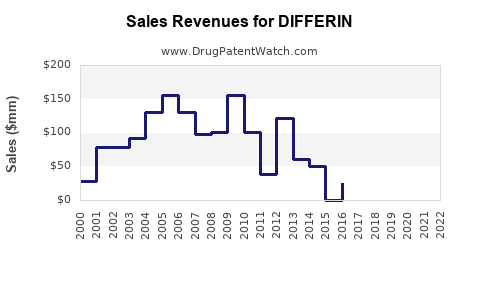
Drug Sales Revenue Trends for DIFFERIN
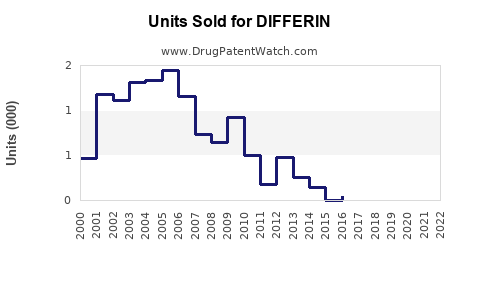
Drug Units Sold Trends for DIFFERIN

Annual Sales Revenues and Units Sold for DIFFERIN

These sales figures are drawn from a US national survey of drug expenditures
Drug Name Revenues (USD) Units Year
DIFFERIN ⤷  Start Trial ⤷  Start Trial 2022
DIFFERIN ⤷  Start Trial ⤷  Start Trial 2021
DIFFERIN ⤷  Start Trial ⤷  Start Trial 2020
DIFFERIN ⤷  Start Trial ⤷  Start Trial 2019
DIFFERIN ⤷  Start Trial ⤷  Start Trial 2018
DIFFERIN ⤷  Start Trial ⤷  Start Trial 2017
>Drug Name >Revenues (USD) >Units >Year

DIFFERIN (Adapalene) Market Analysis and Sales Projections

Last updated: February 19, 2026

Differin (adapalen), a topical retinoid, generated an estimated $350 million in global sales in 2023. The market is characterized by established brand recognition, a broad range of approved indications, and ongoing patent exclusivity. Sales are projected to experience moderate growth, driven by increasing consumer demand for effective acne treatments and potential expansion into new geographic markets and formulations.

What is the current market position of Differin?

Differin holds a significant position in the global acne treatment market. Its active pharmaceutical ingredient, adapalene, is a third-generation topical retinoid that targets multiple pathways involved in acne pathogenesis, including abnormal follicular keratinization, inflammation, and proliferation of Cutibacterium acnes.

  • Brand Strength: Differin is a well-established brand, recognized by both consumers and healthcare professionals for its efficacy in treating mild to moderate acne vulgaris. Its over-the-counter (OTC) availability in key markets has broadened its accessibility.
  • Indications: Differin is approved for the topical treatment of acne vulgaris. Its primary utility lies in managing comedones, papules, and pustules.
  • Competition: The acne treatment market is competitive, featuring other topical retinoids (e.g., tretinoin, tazarotene), topical antibiotics, benzoyl peroxide, and combination therapies. Differin competes on efficacy, tolerability profile, and cost-effectiveness, particularly in its OTC formulation.
  • Market Share: While precise market share data for specific brands is proprietary, industry reports consistently place adapalene-based products, with Differin as a leading example, among the top-selling topical acne treatments globally. Estimated global sales for adapalene products are approximately $450 million, with Differin accounting for the majority of this figure.

What is the patent landscape for Differin?

The original patent protection for adapalene has expired in major markets. However, the market position of branded Differin has been sustained through strategic patent filings and lifecycle management.

  • Original Composition of Matter Patent: The foundational patent for adapalene expired in the United States in 2009 and in Europe in 2010. This allowed for the introduction of generic adapalene products.
  • Formulation Patents: Galderma, the originator, has pursued and obtained patents on specific formulations of adapalene. For instance, the development of Differin Gel 0.1% and later 0.3% formulations, as well as gel and cream bases designed for improved tolerability and efficacy, have been subject to patent protection.
  • Method of Use Patents: Patents may also cover specific methods of using adapalene for treating particular types of acne or patient populations.
  • Evergreening Strategies: The company has employed lifecycle management strategies, including the development of new strengths (e.g., the 0.3% gel) and potentially combination products, to extend market exclusivity.
  • Generic Erosion: The presence of generic adapalene products has created price pressure. However, the strength of the Differin brand and Galderma's marketing efforts continue to support its market share. The market for generic adapalene is estimated to be approximately $100 million globally.

What are the key sales drivers and restraints for Differin?

Several factors influence Differin's sales performance.

Sales Drivers

  • Increasing Acne Prevalence: Acne vulgaris remains a highly prevalent dermatological condition, affecting an estimated 80% of adolescents and young adults and a significant percentage of adults. This creates a large and consistent demand for effective treatments.
  • OTC Availability: The transition of Differin Gel 0.1% to over-the-counter status in the United States in 2016 (and subsequently in other regions) has significantly expanded its market reach. This allows consumers to purchase the product without a prescription, increasing accessibility and unit sales.
  • Efficacy and Tolerability: Adapalene is recognized for its efficacy in treating comedonal acne, inflammatory acne, and for maintenance therapy to prevent new lesions. While retinoids can cause initial irritation, adapalene is generally considered to have a more favorable tolerability profile compared to older retinoids like tretinoin, especially at lower concentrations.
  • Physician Recommendation: Despite OTC availability, physician recommendations remain a significant driver, particularly for persistent or moderate acne cases. Dermatologists often recommend Differin as a first-line or adjunctive therapy.
  • Global Market Expansion: Opportunities exist for further market penetration in emerging economies where access to advanced dermatological treatments is growing.
  • Consumer Education: Increased public awareness and education about acne causes and treatment options, facilitated by digital platforms and healthcare provider outreach, positively impacts demand.

Sales Restraints

  • Generic Competition: The availability of low-cost generic adapalene products directly competes with branded Differin, leading to price erosion and capturing a portion of the market volume.
  • Retinoid Irritation: Despite its improved tolerability, some users experience skin dryness, redness, peeling, and photosensitivity, which can lead to treatment discontinuation. This necessitates patient education and careful initiation of therapy.
  • Alternative Treatments: The market offers a wide array of alternative treatment modalities, including other prescription and OTC medications, as well as cosmetic procedures, which can fragment the market.
  • Regulation and Reimbursement: While OTC status reduces regulatory hurdles for access, prescription markets are subject to healthcare provider prescribing habits and insurance reimbursement policies, which can influence market access and patient adherence.
  • Development of Resistance: While not a primary concern for topical retinoids in acne, the broader trend of antimicrobial resistance for certain adjunctive acne therapies can indirectly influence treatment choices.

What are the global sales projections for Differin?

Global sales for Differin (branded adapalene products) are projected to grow at a compound annual growth rate (CAGR) of 3.5% to 4.5% over the next five years (2024-2029).

  • 2024 Projected Sales: Approximately $360 million
  • 2029 Projected Sales: Approximately $440 million

These projections are based on:

  • Sustained Demand: Continued high prevalence of acne worldwide.
  • OTC Market Strength: The ongoing success and expansion of OTC markets for Differin Gel 0.1%.
  • New Market Entry: Strategic launches in underserved regions.
  • Price Adjustments: Modest price increases for the branded product, balanced against generic competition.
  • Formulation Innovation (Limited): While significant new patentable formulations are less likely, minor improvements or line extensions could offer marginal growth.

The generic adapalene market is expected to grow at a similar or slightly higher CAGR, driven by cost-consciousness. However, the brand loyalty and established trust in Differin are expected to maintain its leading position within the adapalene segment.

What are the manufacturing and regulatory considerations for Differin?

Manufacturing and regulatory processes for Differin are critical to its market access and profitability.

  • Active Pharmaceutical Ingredient (API) Manufacturing: Adapalene is a synthetic molecule requiring specialized chemical synthesis. API production is concentrated among a few global manufacturers.
  • Finished Dosage Form (FDF) Manufacturing: Galderma and its contract manufacturers produce the final gel and cream formulations. Manufacturing sites must adhere to Current Good Manufacturing Practices (cGMP).
  • Regulatory Approvals: Differin requires marketing authorization from regulatory bodies such as the U.S. Food and Drug Administration (FDA), the European Medicines Agency (EMA), and others globally. The OTC status in the U.S. was a significant regulatory achievement, requiring extensive data submission for safety and efficacy.
  • Quality Control: Stringent quality control measures are in place to ensure product purity, potency, and consistency. This includes testing for impurities, degradation products, and physical characteristics of the formulation.
  • Stability Testing: Products undergo rigorous stability testing to determine shelf life under various storage conditions. This data is crucial for labeling and regulatory compliance.
  • Post-Market Surveillance: Regulatory bodies require ongoing monitoring of product safety and effectiveness once on the market. This includes pharmacovigilance activities to report adverse events.

What is the competitive landscape for topical acne treatments?

The topical acne treatment market is highly competitive, with a range of active ingredients and product types. Differin competes within this broad landscape.

Key Competitors and Treatments

  • Other Topical Retinoids:
    • Tretinoin: Available by prescription, it is a well-established first-generation retinoid. Generic forms are widely available.
    • Tazarotene: A third-generation retinoid, generally more potent but also potentially more irritating than adapalene. Available by prescription.
  • Benzoyl Peroxide (BPO): Available OTC and by prescription in various strengths. Effective against C. acnes and has anti-inflammatory properties. Often used in combination with other agents.
  • Topical Antibiotics:
    • Clindamycin: Often used in combination with BPO or retinoids to combat C. acnes and reduce inflammation. Prescription-only.
    • Erythromycin: Less commonly used due to increasing resistance, but still an option. Prescription-only.
  • Combination Therapies: Products combining multiple active ingredients (e.g., adapalene/BPO, clindamycin/BPO, clindamycin/retinoid) are prevalent and often preferred for moderate to severe acne due to their broad-spectrum efficacy.
  • Newer Agents:
    • Clascoterone: A novel topical androgen receptor inhibitor approved for acne.
    • Hyaluronic Acid-based Products: While not directly therapeutic for acne, these are often incorporated into formulations for hydration and to mitigate retinoid-induced dryness.

Competitive Positioning of Differin

Differin's competitive advantage stems from its OTC availability for the 0.1% formulation, its established safety and efficacy profile, and its brand recognition. It occupies a space as a highly accessible and effective daily treatment for mild to moderate acne, particularly comedonal types. Its primary weakness is the increasing availability of generics and potent combination therapies that may offer faster or more comprehensive results for severe cases.

What are the future outlook and strategic considerations for Differin?

The future of Differin will be shaped by evolving market dynamics, competitive pressures, and potential product line extensions.

  • Sustaining Brand Loyalty: Galderma will need to continue investing in brand marketing and patient/physician education to counter generic erosion and maintain brand preference.
  • Geographic Expansion: Focus on expanding OTC availability and market presence in Asia, Latin America, and other emerging markets where acne prevalence is high and access to effective OTC treatments is increasing.
  • Potential for New Formulations or Combinations: While major patentable innovations are less probable, Galderma might explore:
    • Improved Delivery Systems: Formulations with enhanced skin penetration or reduced irritation.
    • Combination Products: Investigating synergistic combinations with other established or novel acne ingredients, though this would likely involve new regulatory pathways and potentially prescription status.
    • Different Strengths or Bases: Expanding the range of strengths or vehicle types to cater to specific skin types or preferences.
  • Digital Health Integration: Leveraging digital platforms for patient support, adherence programs, and direct-to-consumer engagement, especially for the OTC product.
  • Impact of Global Acne Trends: Monitoring trends in acne treatment preferences, such as a growing demand for "clean beauty" ingredients or a preference for less irritating options, will be crucial.

Key Takeaways

Differin (adapalene) is a well-established topical retinoid with strong brand recognition, benefiting from its OTC availability in key markets. Global sales are projected to reach approximately $440 million by 2029, driven by persistent acne prevalence and market expansion. However, generic competition poses a significant challenge, necessitating continued investment in brand marketing and lifecycle management. Future growth may depend on exploring new formulations or market entries, alongside robust patient and physician engagement strategies.

FAQs

  1. What is the current patent status of Differin's primary active ingredient, adapalene? The original composition of matter patents for adapalene have expired in major markets like the United States and Europe, allowing for generic competition.
  2. How has the OTC availability of Differin impacted its sales? The transition to over-the-counter status in 2016 significantly broadened Differin's accessibility and unit sales by removing the prescription barrier.
  3. What are the primary therapeutic indications for Differin? Differin is indicated for the topical treatment of acne vulgaris, particularly for comedones, papules, and pustules.
  4. What is the projected compound annual growth rate (CAGR) for Differin's global sales over the next five years? Global sales for branded Differin products are projected to grow at a CAGR of 3.5% to 4.5% between 2024 and 2029.
  5. Besides branded Differin, what other forms of adapalene contribute to the overall market? The market includes numerous generic adapalene products, which compete on price and contribute significantly to the total volume of adapalene-based treatments sold globally.

Citations

[1] Market Research Report on Acne Treatment Market. (2023). Global Industry Analysts, Inc. [2] U.S. Food and Drug Administration. (2016). FDA Approves First Over-the-Counter Topical Acne Treatment. Press Release. [3] Galderma. (2023). Annual Report 2023. [4] European Medicines Agency. (2022). Public Assessment Report for Adapalene. [5] Global Dermatology Market Analysis. (2024). Mordor Intelligence.

More… ↓

⤷  Start Trial

Make Better Decisions: Try a trial or see plans & pricing

Drugs may be covered by multiple patents or regulatory protections. All trademarks and applicant names are the property of their respective owners or licensors. Although great care is taken in the proper and correct provision of this service, thinkBiotech LLC does not accept any responsibility for possible consequences of errors or omissions in the provided data. The data presented herein is for information purposes only. There is no warranty that the data contained herein is error free. We do not provide individual investment advice. This service is not registered with any financial regulatory agency. The information we publish is educational only and based on our opinions plus our models. By using DrugPatentWatch you acknowledge that we do not provide personalized recommendations or advice. thinkBiotech performs no independent verification of facts as provided by public sources nor are attempts made to provide legal or investing advice. Any reliance on data provided herein is done solely at the discretion of the user. Users of this service are advised to seek professional advice and independent confirmation before considering acting on any of the provided information. thinkBiotech LLC reserves the right to amend, extend or withdraw any part or all of the offered service without notice.