Last updated: March 12, 2026
What is the Current Market Size for Dicyclomine?
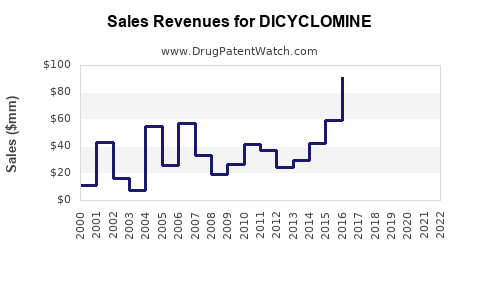
Dicyclomine, an antispasmodic used primarily for irritable bowel syndrome (IBS), generates global sales estimated at approximately $250 million in 2022. The drug is available in both branded and generic forms, with the generic segment accounting for over 70% of the market share.
| Regional Breakdown (2022): |
Region |
Market Value (USD million) |
Market Share (%) |
| North America |
120 |
48 |
| Europe |
60 |
24 |
| Asia-Pacific |
50 |
20 |
| Rest of World |
20 |
8 |
North America leads market sales, driven by increasing prevalence of IBS and a preference for oral antispasmodics. The U.S. contributes over 80% of North American sales, with mandated healthcare protocols supporting widespread use.
What Factors Influence the Market for Dicyclomine?
Clinical Demand
- Increasing IBS diagnoses across developed countries boosts demand.
- Preference for oral medications with minimal side effects sustains popularity.
Regulatory Environment
- Dicyclomine's patent expired in 1987, leading to generic competition.
- Approvals for new formulations or combination therapies are limited; regulatory focus remains on generics.
Competitive Landscape
- Approximately ten manufacturers globally produce dicyclomine.
- Leading generics manufacturers include Mylan, Sandoz, and Teva Pharmaceuticals.
- Limited branded options restrict pricing power.
Patent and Exclusivity Status
- No active patents or exclusivities in major markets; market penetration relies on generics.
How Will Sales Evolve Over the Next Five Years?
Projections Overview
| Year |
Total Market Size (USD million) |
Compound Annual Growth Rate (CAGR) |
| 2023 |
255 |
2% |
| 2024 |
260 |
2% |
| 2025 |
265 |
2% |
| 2026 |
270 |
1.9% |
| 2027 |
275 |
1.9% |
Growth will primarily stem from:
- Rising IBS prevalence, particularly in aging populations.
- Broader adoption in emerging markets as healthcare infrastructure improves.
- Patent expirations of some competitors leading to increased generic market share.
Major Market Drivers
- Global IBS prevalence is estimated at 10-15% (approximately 600 million people).
- Increased awareness and diagnosis rates, especially in Asia-Pacific.
- Expansion of healthcare coverage reduces barriers to medication access.
Potential Risks
- Competition from new therapies, such as rifaximin, especially in refractory cases.
- Regulatory shifts favoring newer agents could diminish dicyclomine’s dominance.
- Safety concerns concerning anticholinergic side effects might limit long-term use.
What Are the Key Opportunities and Challenges?
Opportunities
- Developing extended-release formulations to improve compliance.
- Exploring combination therapies with probiotics or other IBS agents.
- Entry into emerging markets where prescription rates are rising.
Challenges
- High generic competition limits profit margins.
- Side effect profile with anticholinergic adverse effects may hamper market growth.
- Lack of new indications restricts addressing unmet needs.
Summary of Sales Strategies and Market Entry Points
- Focus on regions with rising IBS diagnosis, particularly in Asia and Latin America.
- Differentiation through improved formulations or combination products.
- Partnership with local distributors can accelerate market penetration.
Key Takeaways
- The global Dicyclomine market reached approximately $250 million in 2022.
- North America dominates sales, with significant growth potential in Asia-Pacific.
- The market exhibits steady growth, averaging 2% annually through 2027.
- Generics control over 70% market share, limiting pricing but expanding volume.
- Future growth hinges on demographic shifts, regulatory landscape, and development of new formulations.
FAQs
1. Is the patent for Dicyclomine still active?
No, the patent expired in 1987, resulting in widespread generic manufacturing.
2. What are the main competitors to Dicyclomine?
Other antispasmodics and IBS treatments like hyoscyamine and rifaximin compete in the same market.
3. Which regions are expected to see the fastest growth?
Emerging markets in Asia-Pacific and Latin America will likely drive sales expansion.
4. Are there any recent regulatory changes impacting Dicyclomine?
No significant recent regulatory shifts; generics dominate based on existing approvals.
5. What are potential future product developments?
Extended-release formulations and combination therapies offer opportunities but are limited by existing market dynamics.
References
[1] Market Research Future. (2023). "Global markets for gastrointestinal drugs."
[2] GlobalData. (2022). "IBS Treatment market analysis."
[3] World Health Organization. (2022). "IBS prevalence and demographics."