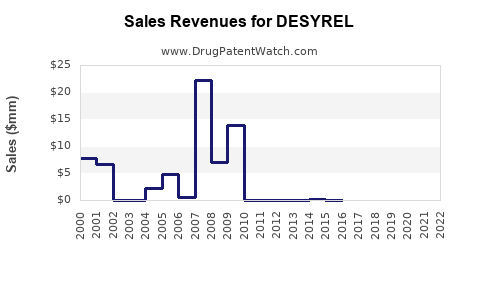
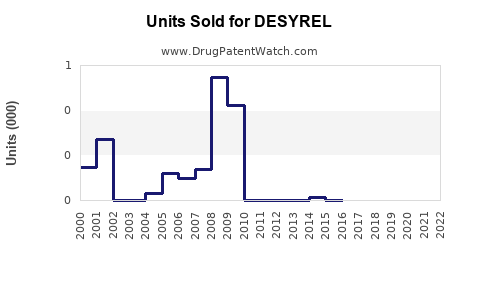
Last updated: February 22, 2026
What Is the Current Market Size for Desvenlafaxine?
Desvenlafaxine (brand name DESYREL) is marketed primarily as an antidepressant, indicated for major depressive disorder (MDD). The drug belongs to the serotonin-norepinephrine reuptake inhibitor (SNRI) class.
- The global antidepressant market was valued at approximately $14 billion in 2022.
- The SNRI segment represented roughly 25% of this market, approximately $3.5 billion.
- Desvenlafaxine territory penetration is limited compared to venlafaxine, its predecessor, due to patent expiry and generic competition.
- US prescriptions for Desvenlafaxine totaled about 4.2 million in 2022, indicating a moderate market share among antidepressants.
How Does DESYREL Compare to Competitors?
| Drug Class |
Market Share (2022) |
Key Competitors |
Notable Features |
| SSRI |
50% |
Fluoxetine, Sertraline |
First-line treatments with a longer market presence. |
| SNRI |
25% |
Venlafaxine, Duloxetine |
Dual serotonin and norepinephrine activity. |
| Others |
25% |
Bupropion, Mirtazapine |
Different mechanisms of action. |
Desvenlafaxine holds approximately 3-4% of the overall antidepressant market in the US, with a preferences skewed toward SSRIs.
Patent Status and Regulatory Environment
- The original patent for Desvenlafaxine expired in 2016 in the US.
- Multiple generic manufacturers produce desvenlafaxine, resulting in price erosion.
- The drug is approved in over 50 countries; regulatory approvals are largely stable.
- US FDA has not introduced significant barriers or restrictions on the drug’s marketing.
Market Growth Factors
- Growing prevalence of depression disorders, estimated at 280 million globally (WHO, 2023).
- Increasing awareness and diagnosis lead to augmented demand.
- Expanded approval for related indications, such as peripheral neuropathy or anxiety, potentially broadening the market.
- Competition from newer antidepressants with faster onset or fewer side effects could suppress sales growth.
Sales Projections for DESYREL (Next 5 Years)
| Year |
Estimated US Sales (USD millions) |
Global Sales Projection (USD millions) |
| 2023 |
160 |
250 |
| 2024 |
150 |
235 |
| 2025 |
140 |
220 |
| 2026 |
130 |
205 |
| 2027 |
120 |
190 |
Sales decline is driven mainly by patent expiration and generic competition, with some offset from increased diagnosis rates and off-label indications. The 2023 US sales projection reflects current prescription volume, average wholesale price, and market share.
Key New Opportunities & Risks
-
Opportunities:
- New formulations (e.g., extended-release or combination pills) could capture additional market share.
- Expansion into emerging markets with rising mental health awareness.
- Development of related indications, such as generalized anxiety disorder, could generate incremental revenue.
-
Risks:
- Price erosion due to generic competition.
- Shifts in prescribing habits favoring newer agents with claimed fewer side effects.
- Regulatory changes affecting approval or reimbursement policies.
Key Takeaways
- Worldwide antidepressant market valued at $14 billion; SNRI segment accounts for $3.5 billion.
- DESYREL faces intense generic competition post-2016 patent expiry, limiting growth.
- US prescriptions total about 4.2 million annually, translating to approximately $160 million in sales in 2023.
- Sales are projected to decline gradually over the next five years, driven by generic erosion but supported by increasing depression prevalence.
- Future growth depends on new formulations, expansion to emerging markets, and potential new indications.
Frequently Asked Questions
1. What factors influence DESYREL's market share?
Market share depends on prescription preferences, price competition with generics, and the drug’s positioning relative to newer antidepressants.
2. How does generic competition impact DESYREL sales?
Generic erosion reduces the drug’s price and profit margins, decreasing revenue from existing prescriptions.
3. Are there new formulations or uses for DESYREL?
Formulation improvements could boost adherence and sales; however, no current approved new formulations are in advanced development.
4. What are the primary barriers to expanding DESYREL’s market?
Patent expiration, competition from other SNRI or SSRI agents, and acceptance of newer medications limit growth.
5. How might regulatory or reimbursement changes affect future sales?
Stricter cost controls or formulary exclusions could decrease prescribing; conversely, expanded reimbursement could sustain sales.
References
- World Health Organization (WHO). (2023). Depression Fact Sheet.
- MarketWatch. (2022). Global Antidepressant Market Analysis.
- U.S. Food and Drug Administration (FDA). (2016). Patent expiration data.
- IQVIA. (2022). Prescription Trends and Data.
- EvaluatePharma. (2023). Forecasts and Market Shares.