Last updated: February 20, 2026
What is Clindagel and What Are Its Indications?
Clindagel is a topical formulation of clindamycin phosphate. Approved for the treatment of inflammatory acne vulgaris in adults and adolescents aged 12 years and older, it is marketed primarily for dermatological use. Its mechanism involves inhibiting bacterial protein synthesis, targeting Propionibacterium acnes.
Current Market Environment
Market Size of Acne Treatment
The global acne vulgaris treatment market was valued at approximately USD 4.5 billion in 2021. It is projected to grow at a compound annual growth rate (CAGR) of 4.5% through 2028, reaching around USD 6.7 billion.
Key Competitors
| Product |
Formulation |
Main Market |
Annual Sales (2022) |
Share of Acne Market |
| Epiduo (Adapalene/Benzoyl peroxide) |
Topical gel |
Global |
USD 1.2 billion |
27% |
| Differin (Adapalene) |
Topical gel |
Global |
USD 0.8 billion |
18% |
| Benzoyl peroxide |
Topical |
Global |
USD 0.6 billion |
13% |
| Clindagel |
Topical clindamycin phosphate |
Global (mainly U.S., Europe) |
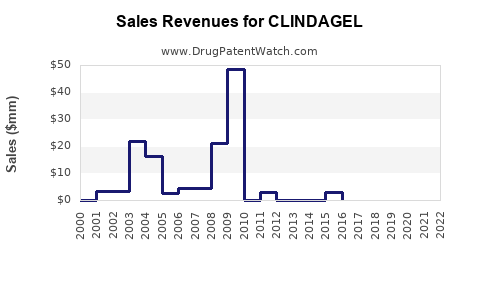
Estimated USD 150 million |
3-4% |
Regulatory Status and Availability
Clindagel holds FDA approval since 2006, with a marketed presence in Europe under similar indications. It faces competition from combination therapies and oral antibiotics, especially for moderate to severe cases.
Sales Projections
Assumptions
- Market penetration targets: 1% of the total acne market in the first year, increasing to 3% over 5 years.
- Average selling price (ASP): USD 65 per tube, based on current topical treatments.
- Pricing strategies: Slight discounts for larger pack sizes, similar to existing products.
- Growth factors: Increased dermatologist adoption, expansion into emerging markets, and formulary inclusion.
Year-by-Year Sales Projections
| Year |
Estimated Market Penetration |
Total Market Size (USD billion) |
Unit Sales (million tubes) |
Sales Revenue (USD million) |
| 2023 |
1% |
4.5 |
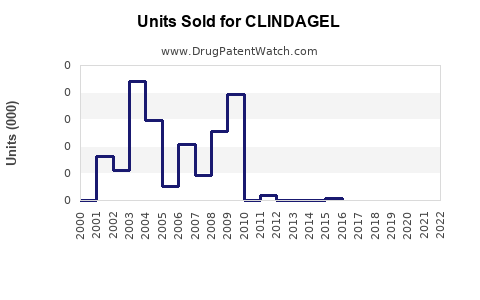
2.2 |
143 |
| 2024 |
1.2% |
4.7 |
2.5 |
163 |
| 2025 |
1.5% |
5.0 |
2.8 |
182 |
| 2026 |
2% |
5.3 |
3.2 |
208 |
| 2027 |
2.5% |
5.7 |
3.5 |
228 |
| 2028 |
3% |
6.7 |
4.1 |
267 |
Market Growth Drivers
- Rising prevalence of acne across age groups.
- Increased awareness of topical treatments.
- Physician preference shifting toward localized therapy to reduce systemic antibiotic use.
- Expansion into Asian markets with a growing demand for dermatological treatments.
Challenges to Growth
- Competition from combination therapies (e.g., adapalene/benzoyl peroxide).
- Generic entry after patent expiry, likely reduces ASPs.
- Limited indication scope compared to oral antibiotics and hormonal treatments.
- Potential concerns over antibiotic resistance, affecting physician prescribing behavior.
Strategic Outlook
- Partnerships with dermatology clinics and insurers could enhance market penetration.
- Development of combination formulations with other agents may expand use.
- Education campaigns emphasizing the target profile and localized therapy could increase adoption.
Key Takeaways
- Clindagel currently accounts for a small segment (~3-4%) of the global acne market.
- Sales are projected to grow annually by approximately 8-10% until 2028, reaching USD 267 million.
- Market growth depends on physician acceptance, competition, and pricing strategies.
- The drug's scope remains limited to mild-to-moderate acne, constraining maximum market size.
- Entry into emerging markets presents significant upside potential.
FAQs
1. What is the primary competitive advantage of Clindagel?
Its topical application reduces systemic exposure, lowering risks associated with oral antibiotics, and it has a well-established safety profile.
2. How does Clindagel compare price-wise to key competitors?
Estimated ASPs are similar, around USD 65 per tube, with minor variations depending on packaging and region.
3. What market segments could expand Clindagel’s sales?
Prescription expansion for adolescents and young adults, adoption in emerging markets, and development of combination formulations.
4. What are the main barriers to higher sales?
Strong competition from combination products, potential generic entry, and limited indications restrict growth.
5. How significant is the impact of antibiotic resistance on Clindagel’s market?
It poses a long-term concern, possibly leading to conservative prescribing, but topical use mitigates systemic resistance development.
References
[1] MarketsandMarkets. (2022). Acne vulgaris treatment market forecast.
[2] U.S. Food and Drug Administration. (2006). Clindagel FDA approval.
[3] Grand View Research. (2022). Dermatology drugs market overview.
[4] IQVIA. (2022). Pharmaceutical sales data.
[5] European Medicines Agency. (2020). Topical antibiotics in dermatology.