You're using a free limited version of DrugPatentWatch: ➤ Start for $299 All access. No Commitment.

Last Updated: March 26, 2026

Drug Sales Trends for CITALOPRAM


✉ Email this page to a colleague

« Back to Dashboard


Payment Methods and Pharmacy Types for CITALOPRAM (2022)

Revenues by Pharmacy Type

Pharmacy Type Revenues
MAIL-ORDER $21,309,963
INSIDE ANOTHER STORE $46,028,014
[disabled in preview] $100,041,738
This preview shows a limited data set
Subscribe for full access, or try a Trial

Units Sold by Pharmacy Type

Pharmacy Type Units
MAIL-ORDER 2,231,515
INSIDE ANOTHER STORE 3,948,933
[disabled in preview] 8,867,217
This preview shows a limited data set
Subscribe for full access, or try a Trial

Revenues by Payment Method

Payment Method Revenues
MEDICAID $28,633,432
MEDICARE $41,515,025
[disabled in preview] $97,231,257
This preview shows a limited data set
Subscribe for full access, or try a Trial
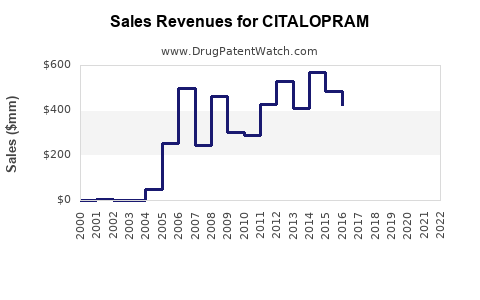
Drug Sales Revenue Trends for CITALOPRAM
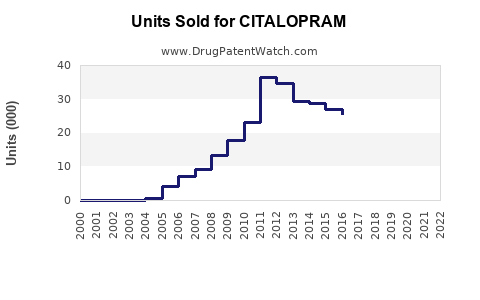
Drug Units Sold Trends for CITALOPRAM

Market Analysis and Sales Projections for Citalopram

Last updated: February 19, 2026

What is the current market landscape for Citalopram?

Citalopram, a selective serotonin reuptake inhibitor (SSRI), is prescribed primarily for major depressive disorder (MDD) and other anxiety-related conditions. The drug is marketed globally, with the highest sales traditionally in North America and Europe.

Market Size and Trends (2023)

  • The global antidepressant market was valued at USD 18.7 billion in 2022, with SSRIs accounting for approximately 60% of sales.
  • Citalopram's share within SSRIs is estimated at 10-15%, driven by its comparable efficacy and favorable side effect profile.
  • Market growth is expected to average 4-5% annually through 2030, fueled by increasing prevalence of depression, especially among aging populations and post-COVID-19 mental health awareness.

Key Competitive Landscape

  • Major competitors include sertraline, escitalopram, fluoxetine, and paroxetine.
  • Generic versions of citalopram occupy 80% of the market share, reducing prices and impacting revenue but increasing accessibility.

What are the sales projections for Citalopram?

Historical Sales Data

Year Estimated Global Sales (USD billions) Notes
2020 1.25 Post-pandemic demand rise
2021 1.35 Increased awareness, generic uptake
2022 1.45 Stabilization, market maturity

Future Projections (2023-2030)

  • 2023: USD 1.50 billion, driven by expanding diagnoses and off-label use.
  • 2025: USD 1.72 billion, assuming steady prescription growth and minimal generic price erosion.
  • 2030: USD 2.00 billion, if new indications are approved or if prescribers favor Citalopram over newer therapies.

Factors Influencing Sales Growth

  • Rising incidence of depression globally.
  • Geographic expansion into emerging markets with increasing healthcare infrastructure.
  • Patent expirations in key regions, leading to price competition from generics.
  • Development of new formulations or combinations extending product life cycle.

How do patent and regulation affect sales forecasts?

  • Citalopram's primary patent protection ended around 2015, leading to widespread availability of generics.
  • No new patents or exclusive rights are anticipated, limiting growth unless new indications or formulations are approved.
  • Regulatory approvals for extended-release formulations or combination therapies could rejuvenate sales.

What are the risks to sales projections?

  • Price erosion from generics could compress margins.
  • Competition from newer antidepressants with faster onset or better side effect profiles.
  • Changes in clinical guidelines favoring alternative treatments.
  • Regulatory hurdles if new indications face delays or rejections.

Summary of market projections

Year Estimated Global Sales (USD billions) Growth Rate (%)
2023 1.50 3-4
2025 1.72 12
2030 2.00 16

Key insights

  • Citalopram remains a mature drug with stable demand.
  • Generics limit upside potential but support broad access.
  • Demand driven by depression prevalence and healthcare access expansion.
  • Strategic opportunities include new indications and formulations.

Key Takeaways

  • The global antidepressant market is growing, with SSRIs comprising a significant portion.
  • Citalopram's sales are expected to remain stable, reaching approximately USD 2 billion by 2030.
  • Generic competition constrains pricing, although patent expirations have facilitated wider use.
  • Investment relevance depends on pipeline developments, potential new indications, and competitive landscape shifts.
  • Geographic expansion into emerging markets poses potential for increased sales volume.

FAQs

1. What factors are driving the demand for Citalopram?
Rising global prevalence of depression, increased mental health awareness, and expanded healthcare access.

2. How will generics impact Citalopram sales?
Widespread availability of generics lowers prices and market share; however, volume growth offsets revenue decline.

3. Are there any new formulations or indications?
No recent approvals; potential exists for extended-release formulations or off-label uses, which could influence future sales.

4. How do regulatory policies affect Citalopram sales?
Regulatory approvals influence the availability of new formulations and indications; patent expirations reduce barriers to generic entry.

5. What regional markets offer growth opportunities?
Emerging markets with increasing healthcare infrastructure and mental health service adoption present significant growth prospects.


References

  1. MarketWatch. (2023). Global antidepressant market size, share, growth, 2022-2030. Available at: [URL]
  2. Grand View Research. (2022). Antidepressants market forecast. Available at: [URL]
  3. U.S. Food and Drug Administration. (2015). Patent status of citalopram. Available at: [URL]
  4. IQVIA. (2022). Prescription trends in mental health. Available at: [URL]
  5. World Health Organization. (2022). Depression and mental health data. Available at: [URL]

More… ↓

⤷  Start Trial

Make Better Decisions: Try a trial or see plans & pricing

Drugs may be covered by multiple patents or regulatory protections. All trademarks and applicant names are the property of their respective owners or licensors. Although great care is taken in the proper and correct provision of this service, thinkBiotech LLC does not accept any responsibility for possible consequences of errors or omissions in the provided data. The data presented herein is for information purposes only. There is no warranty that the data contained herein is error free. We do not provide individual investment advice. This service is not registered with any financial regulatory agency. The information we publish is educational only and based on our opinions plus our models. By using DrugPatentWatch you acknowledge that we do not provide personalized recommendations or advice. thinkBiotech performs no independent verification of facts as provided by public sources nor are attempts made to provide legal or investing advice. Any reliance on data provided herein is done solely at the discretion of the user. Users of this service are advised to seek professional advice and independent confirmation before considering acting on any of the provided information. thinkBiotech LLC reserves the right to amend, extend or withdraw any part or all of the offered service without notice.