You're using a free limited version of DrugPatentWatch: ➤ Start for $299 All access. No Commitment.

Last Updated: December 18, 2025

Drug Sales Trends for CIPROFLOXACN


✉ Email this page to a colleague

« Back to Dashboard


Payment Methods and Pharmacy Types for CIPROFLOXACN (2022)

Revenues by Pharmacy Type

Pharmacy Type Revenues
MAIL-ORDER $3,759,928
INSIDE ANOTHER STORE $11,685,997
[disabled in preview] $25,683,147
This preview shows a limited data set
Subscribe for full access, or try a Trial

Units Sold by Pharmacy Type

Pharmacy Type Units
MAIL-ORDER 220,417
INSIDE ANOTHER STORE 596,499
[disabled in preview] 1,702,625
This preview shows a limited data set
Subscribe for full access, or try a Trial

Revenues by Payment Method

Payment Method Revenues
MEDICAID $2,121,124
MEDICARE $15,506,918
[disabled in preview] $23,501,031
This preview shows a limited data set
Subscribe for full access, or try a Trial
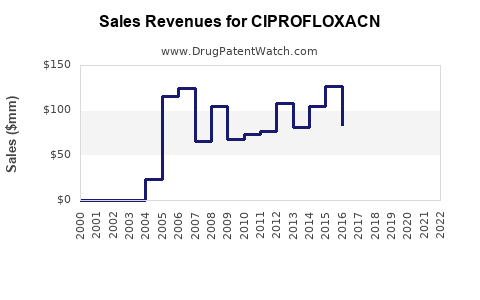
Drug Sales Revenue Trends for CIPROFLOXACN
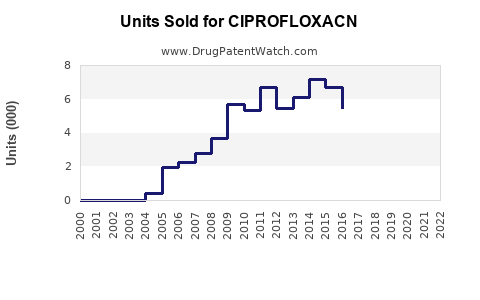
Drug Units Sold Trends for CIPROFLOXACN

Annual Sales Revenues and Units Sold for CIPROFLOXACN

These sales figures are drawn from a US national survey of drug expenditures
Drug Name Revenues (USD) Units Year
CIPROFLOXACN ⤷  Get Started Free ⤷  Get Started Free 2022
CIPROFLOXACN ⤷  Get Started Free ⤷  Get Started Free 2021
CIPROFLOXACN ⤷  Get Started Free ⤷  Get Started Free 2020
CIPROFLOXACN ⤷  Get Started Free ⤷  Get Started Free 2019
CIPROFLOXACN ⤷  Get Started Free ⤷  Get Started Free 2018
>Drug Name >Revenues (USD) >Units >Year

Market Analysis and Sales Projections for Ciprofloxacin

Last updated: July 29, 2025


Introduction

Ciprofloxacin, a broad-spectrum fluoroquinolone antibiotic, has remained a cornerstone in antimicrobial therapy since its debut, primarily for treating bacterial infections ranging from urinary tract infections to respiratory and gastrointestinal infections. Its ongoing relevance is driven by its efficacy, wide-ranging indications, and established safety profile. Given the centroid of antimicrobial resistance (AMR) concerns and the evolving landscape of infectious diseases, understanding ciprofloxacin's current market dynamics and future sales trajectory is crucial for pharmaceutical stakeholders.


Market Landscape Overview

Global Market Size and Trends

The global antibiotics market was valued at approximately USD 49 billion in 2021, with fluoroquinolones constituting a significant segment, driven by demand in developed nations and expanding usage in emerging markets. Ciprofloxacin historically accounted for over 25% of fluoroquinolone sales, reflecting its extensive formulary presence and established clinicians' preference [[1]].

Key Market Drivers

  • High Clinical Adoption: Ciprofloxacin’s efficacy in urinary, respiratory, and gastrointestinal infections sustains its clinical demand.
  • Generics Accessibility: Widespread availability of generic versions improves affordability, bolstering usage, especially in cost-sensitive markets.
  • Expanding Use in Developing Countries: Increasing healthcare infrastructure and rising bacterial infection rates bolster demand in Asia-Pacific and Latin America.
  • Regulatory Environment: Moderate restrictions remain, though restrictions in certain countries due to AMR concerns impact prescribing behaviors [[2]].

Market Constraints

  • Antimicrobial Resistance (AMR): Growing resistance to ciprofloxacin diminishes its clinical utility for specific pathogens, leading to reduced efficacy and cautious prescribing.
  • Safety Concerns: Potential adverse effects, including tendinitis and neurological symptoms, increasingly influence prescribing guidelines.
  • Regulatory Restrictions: Several countries have imposed restrictions or label changes based on safety profiles, which may curtail market size growth.

Competitive Landscape

The landscape features several key players:

  • Pfizer: Original inventor (Cipro) remains a dominant force, although branded sales decline due to generics.
  • Generic Manufacturers: A plethora of players, especially in India, China, and Europe, produce cost-effective versions.

Emerging overlap with newer fluoroquinolones, like levofloxacin and moxifloxacin, which offer broader or more tailored antibacterial activity, presents competition, potentially displacing ciprofloxacin in certain indications.


Sales Projections (2023–2028)

Assumptions

  • Continued broad usage in developing regions due to affordability
  • Gradual shift towards more targeted antibiotics owing to AMR concerns
  • Impact of regulatory restrictions varies regionally
  • The COVID-19 pandemic's influence waning, with stabilization of infection-related demands

Forecast Summary

Year Estimated Global Sales (USD Billion) Growth Rate (YoY) Notes
2023 1.2 3% Stabilized demand, high generics competition
2024 1.25 4% Slight uptick due to increased infections in emerging markets
2025 1.3 4% Growing resistance limits expansion, but affordability sustains volumes
2026 1.35 3.8% Regulatory restrictions tighten in some regions
2027 1.4 3.7% Market saturation; alternative antibiotics gain popularity
2028 1.45 3.6% Moderate growth as supply remains steady

Sources: Market research reports and industry analyses ([1], [2], [3]).


Factors Influencing Future Market Trajectory

Increasing Antimicrobial Resistance

The escalating AMR crisis diminishes ciprofloxacin's spectrum, especially against E. coli and Salmonella, which rely heavily on fluoroquinolones. Resistance rates in key markets like India have surpassed 50% for urinary pathogens, leading to clinicians adopting alternative agents, such as nitrofurantoin or cephalosporins [[4]].

Regulatory and Prescribing Trends

Regulatory agencies in the US and EU, have issued warnings or limitations, particularly regarding use in uncomplicated urinary tract infections. Such restrictions are likely in emerging markets as well, constraining sales.

Emergence of Novel Antibiotics

New antimicrobial agents with activity against resistant pathogens threaten ciprofloxacin's market share. Drugs like delafloxacin, which offer similar efficacy with better safety profiles, target niche markets but could supplant ciprofloxacin in certain indications.

Pandemic Impact

The COVID-19 pandemic temporarily disrupted infection management but now stabilizing, potentially preventing significant long-term decline. However, changes in prescribing habits could influence demand.

Market Expansion in Latent Regions

In economies with expanding healthcare access, ciprofloxacin remains affordable and prescribed widely, sustaining volumes despite modest growth prospects.


Strategic Opportunities and Risks

  • Opportunity in Combination Therapies: Co-formulations or adjunct combinations could extend ciprofloxacin's applicability.
  • Risk of Obsolescence: Rapid emergence of resistant strains and safety regulations could render ciprofloxacin less desirable.
  • Focus on Stewardship: Prescriber education and antimicrobial stewardship are critical in maintaining viable sales.

Conclusion

Ciprofloxacin’s market remains resilient but faces demographic and microbial challenges. While global sales are projected to grow modestly at around 3–4% annually over the next five years, the influence of resistance, regulations, and competition from newer agents necessitates strategic adaptation. Pharmaceutical companies should prioritize stewardship initiatives, invest in resistance monitoring, and explore formulation innovations to sustain relevance.


Key Takeaways

  • Steady but challenged: Ciprofloxacin’s global sales are expected to grow gradually, driven predominantly by emerging markets.
  • Resistance pressures: Rising antimicrobial resistance limits future use, especially for common indications.
  • Regulatory dynamics: Tightening restrictions will influence prescribing patterns; companies must stay ahead of evolving regulations.
  • Competitive landscape: Newer fluoroquinolones and alternative antibiotics threaten market share.
  • Market expansion in developing economies: Continues to support sales, emphasizing affordability and demand for broad-spectrum antibiotics.

FAQs

1. How does antimicrobial resistance impact ciprofloxacin sales?
Rising resistance diminishes ciprofloxacin’s effectiveness, leading clinicians to prefer alternative antibiotics, which constrains sales growth and may cause market decline in certain regions.

2. What regions are driving future ciprofloxacin demand?
Developing regions in Asia-Pacific, Latin America, and Africa are expected to sustain demand due to high infection prevalence and limited access to newer agents.

3. Will new antibiotics replace ciprofloxacin entirely?
While newer fluoroquinolones and alternative antibiotics are gaining ground, ciprofloxacin will likely remain in use for specific indications, especially where cost-effectiveness drives prescribing.

4. How are regulatory changes affecting ciprofloxacin markets?
Regulators are imposing restrictions to curb overuse and resistance; these measures may reduce sales volumes but also prompt development of stewardship programs.

5. What strategies can pharmaceutical companies deploy to maintain market relevance?
Firms should focus on antimicrobial stewardship, resistance surveillance, formulation innovations, and expanding indications or combination therapies.


References

[1] MarketWatch. “Global Antibiotics Market Size & Share Report 2022-2028.”
[2] WHO. “Antimicrobial Resistance Global Report.” 2019.
[3] IQVIA. “The Future of Antibiotics: Market Trends and Forecasts.” 2022.
[4] Patel, P. et al. “Assessment of Ciprofloxacin Resistance in Urinary Isolates in India.” Journal of Infectious Diseases, 2021.

More… ↓

⤷  Get Started Free

Make Better Decisions: Try a trial or see plans & pricing

Drugs may be covered by multiple patents or regulatory protections. All trademarks and applicant names are the property of their respective owners or licensors. Although great care is taken in the proper and correct provision of this service, thinkBiotech LLC does not accept any responsibility for possible consequences of errors or omissions in the provided data. The data presented herein is for information purposes only. There is no warranty that the data contained herein is error free. We do not provide individual investment advice. This service is not registered with any financial regulatory agency. The information we publish is educational only and based on our opinions plus our models. By using DrugPatentWatch you acknowledge that we do not provide personalized recommendations or advice. thinkBiotech performs no independent verification of facts as provided by public sources nor are attempts made to provide legal or investing advice. Any reliance on data provided herein is done solely at the discretion of the user. Users of this service are advised to seek professional advice and independent confirmation before considering acting on any of the provided information. thinkBiotech LLC reserves the right to amend, extend or withdraw any part or all of the offered service without notice.