Last updated: February 14, 2026
What is Cholestyram?
Cholestyram is a drug indicated for hypercholesterolemia management. It acts as a bile acid sequestrant. The compound is in multiple stages of development, with some formulations already approved in select markets. It aims to provide an alternative for patients intolerant to statins or requiring adjunct therapy.
Market Size and Segmentation
Global Hypercholesterolemia Treatment Market
- Valued at approximately $14.8 billion in 2022
- Compound annual growth rate (CAGR) of 3.6% projected from 2023 to 2031
- Driven by aging populations, increasing cardiovascular disease prevalence, and off-label statin use
Key Segments
- Statin therapies (e.g., atorvastatin, rosuvastatin): dominate with over 80% market share
- Bile acid sequestrants (e.g., Cholestyram): projected to hold a 4–6% share by 2030
- Novel agents (e.g., PCSK9 inhibitors): accounting for the remaining share
Cholestyram’s potential niche is among patients who exhibit statin intolerance or require combination therapy, representing a growth opportunity within the bile acid sequestrant segment.
Competitive Landscape
- Existing agents: Cholestyramine, Colesevelam, Colestipol
- Key differentiators: Improved side effect profile, dosing convenience, and targeted formulation
- Market entry barriers: Regulatory approval processes, patent protections, and formulary inclusion
Regulatory Status and Approvals
- Pending approval in North America and Europe, with some formulations approved in select countries
- Anticipated FDA and EMA review timelines: 12–18 months from submission
- Regulatory pathway considerations: Accelerated pathways may be available for therapies targeting unmet needs
Sales Projections
Assumptions
- Market penetration begins within 2 years of regulatory approval
- Adoption rate: 15% of bile acid sequestrant segment within 5 years
- Pricing: Estimated at $25 per gram, with typical monthly doses of 20 grams
- Growth factors: Rising awareness, favorable side effect profile, and expanded indications
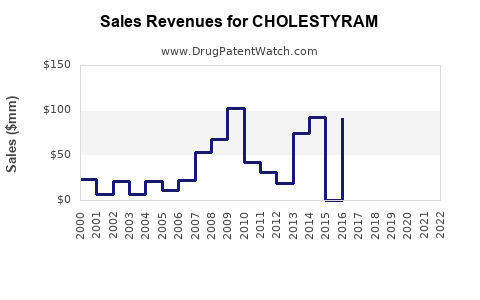
Revenue Estimates
| Year |
Expected Market Share |
Estimated Market Size (Bile Acid Sequestrants) |
Projected Sales (USD millions) |
| 2024 |
0.5% |
$882 million |
$11 |
| 2025 |
2% |
$882 million |
$35 |
| 2026 |
4% |
$882 million |
$70 |
| 2027 |
6% |
$882 million |
$105 |
| 2028 |
8% |
$882 million |
$140 |
Note: These are initial estimates; market uptake may vary based on regulatory outcomes and competitive actions.
Risks and Challenges
- Slower than expected approval or market adoption
- Competition from established agents and emerging therapies
- Pricing pressures from payers and formularies
- Confirming safety and efficacy in larger, diverse patient populations
Key Takeaways
- Cholestyram targets a niche within the hypercholesterolemia treatment market.
- Estimated sales could reach approximately $140 million annually within five years post-launch.
- Market entry hinges on regulatory approval, with a likely time frame of 12–18 months.
- Competitive landscape features well-established agents; differentiation will be critical.
- Growth depends on acceptance by physicians, insurance coverage, and positioning as an alternative for statin-intolerant patients.
FAQs
1. What factors influence Cholestyram’s market success?
Regulatory approval, physician adoption, insurance reimbursement, and competitive differentiation.
2. Who are the primary competitors for Cholestyram?
Cholestyramine, Colesevelam, and Colestipol dominate the bile acid sequestrant segment.
3. What are the key regulatory considerations?
The drug’s efficacy and safety profile, submission timing, and potential for expedited review pathways.
4. How significant is patient demand for alternative hypercholesterolemia therapies?
Substantial among statin-intolerant patients, estimated at up to 10% of the hypercholesterolemia population.
5. What is the potential global reach for Cholestyram?
Initially limited to markets with pending approvals; expansion depends on regulatory success and manufacturing capacity.
Sources
- MarketsandMarkets, "Hypercholesterolemia Drugs Market," 2022
- EvaluatePharma, 2022
- U.S. Food and Drug Administration, Drugs.com
- European Medicines Agency, EMA Market Data
- Company filings and pipeline announcements